Promoting responsible mining

Previously, I described the phenomenon where mining companies leave behind messes that would eliminate their profits if they were obliged to clean them up. Often, however, these liabilities end up being borne by taxpayers in general, who either fund the cleanup or live with the consequences of the contamination.

Now, a private members bill proposes sanctions on Canadian mining companies that violate good governance and environmental standards abroad. Bill C-300 was proposed by Liberal MP John McKay, and has already passed through second reading in the House of Commons.

Extractive industries, including mining, certainly have a checkered history of international operations. While there are certainly examples of projects that take into account governance and environmental concerns, legal reforms that make these more typical are welcome.

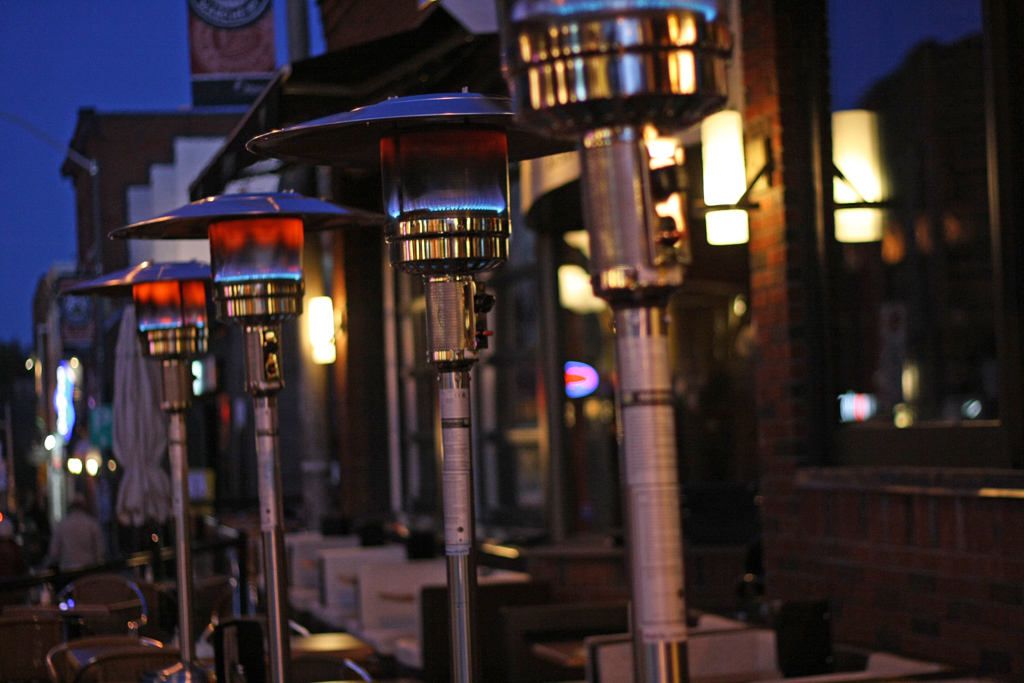
Patio heaters

Patio heaters, Ottawa

The photo above illustrates part of why Canada has greenhouse gas emissions of about 24 tonnes of CO2 equivalent per person per year (about three times as much as Sweden). It also shows the extent to which we take the easy energy embedded in fossil fuels for granted: gas powered heaters, running in Ottawa in October, to warm a patio with nobody on it.

I doubt renewable energy will ever become cheap enough for this kind of excess to make sense.

Sick of getting hosed by the Bank of Montreal

I’ve been with BMO since I got overwhelmingly annoyed with TD, but it has now reached the point where it is not worth continuing with them. The banks that blew up the global financial system through their own reckless behaviour are now trying to work their way back to gross profitability by raising their fees. Specifically, BMO is raising the amount you need to lend them, interest free, in order to avoid a monthly banking fee from $1,500 to $2,000. This is probably just the first such escalation. Plus, even with that interest-free loan to them, I would often get fees for performing tasks like moving money between my own accounts online ($0.50 a pop, if you go beyond your monthly ‘transaction’ limit).

So, I am going to ditch BMO and give President’s Choice Financial a try. Basic banking is a simple service for me: just somewhere to receive paycheques into and release rent cheques from. All my investing is done elsewhere (partly at ING Direct, which also has a no-fee approach). The fact that PC Financial offers free cheques, free bill payments, and accounts with no monthly fees is alluring enough even before I consider the interest you could earn on $2,000 annually.

[Update: 8 October 2009] I offered BMO the chance to make a deal and avoid losing a customer. On the phone, they told me that only in-branch managers could do that. When I spoke to one today, she said the only option they had was to switch to a cheaper plan (setting $1000 aside) with only ten transactions per month. In the end, she seemed to agree that switching to PC Financial made the most sense, given that they have no fees and there is interest otherwise to be earned on the money BMO wants you to set aside.

Unfortunately, opening a PC Financial account requires either a driver’s license or a passport. I will therefore need to wait for my renewed passport to arrive, before I can do so.

[Update: 25 November 2009] My PC accounts are now fully up and running, and I cashed out and closed my BMO accounts. Surprisingly, the bank didn’t even ask for ID before handing me the bills and closing my account. They did charge me $8 in pro rated service fees for November – probably one of the more expensive $8 the bank ever collected, since I think they spend a lot more than that to attract a customer.

Electric cars in British Columbia

Alison Benjamin in glasses

In 2011, Nissan is planning to launch their LEAF electric vehicle in B.C. The cars have a 160 kilometre range and can be charged to 80% of capacity in 1/2 hour. Unlike a plug-in hybrid, all-electric vehicles like the LEAF are powered entirely by electricity from the grid and cannot use gasoline to extend their range when their batteries give out. This limits their inter-city potential, but could be perfectly compatible with an urban lifestyle, especially as batteries improve and charging stations become more common.

The Nissan-Renault partnership behind the vehicles is the same one that is planning to roll out a fleet in Israel, complete with rapid battery switching stations. From what I have read, it isn’t clear whether the B.C. launch will involve a ‘subscription’ system in the same way as the Israeli one will.

My personal sense is that electric cars will play a major role in future urban transportation. Much as I would like to see private cars pushed out of city centres entirely, the prospects of that happening in most places are poor. Given that, the best we can hope for is making them into lower-carbon entities. Given the many problems associated with large-scale biofuel cultivation, my guess is that their use will be restricted to air travel and niche applications, leaving the bulk of ground transport powered by battery-driven electric motors. Of course, it is key to ensure that those batteries are being charged by low-carbon means like concentrating solar, wind, hydroelectric, and nuclear power.

Natural selection and species self-destruction

Woman in headphones

Late in The Greatest Show on Earth, Richard Dawkins reiterates a key point from his earlier book The Selfish Gene: namely, that there is nothing in natural selection to prevent a species from engaging in behaviour that is profoundly self-destructive in the long run. As he evocatively puts it:

“But, the planning enthusiast will protest, when all the lions are behaving selfishly and over-hunting the prey species to the point of extinction, everybody is worse off, even the individual lions that are the most successful hunters. Ultimately, if all the prey go extinct, the entire lion population will too. Surely, the planner insists, natural selection will step in and stop that happening? Once again alas, and once again no. The problem is that natural selection doesn’t ‘step in,’ natural selection doesn’t look into the future, and natural selection doesn’t choose between rival groups. If it did, there would be some chance that prudent predation could be favoured. Natural selection, as Darwin realized much more clearly than many of his successors, chooses between rival individuals within a population. Even if the entire population is diving to extinction, driven down by individual competition, natural selection will still favour the most competitive individuals, right up to the moment when the last one dies. Natural selection can drive a population to extinction, while constantly favouring, to the bitter end, the competitive genes that are destined to be the last to go extinct.” (p.389 hardcover)

The natural response to reading such a passage is to consider how it applies to human beings. A superficial reading is a dangerous one, as Dawkins describes at length in The Selfish Gene. It is possible for human beings to plan and to avoid the kind of deadly spiral he describes; it simply isn’t an inevitable product of evolution that we will do so. Probably without realizing it, Dawkins uses a terrible example to try to illustrate this human capability. He cites the “quotas and restrictions,” limitations on gear, and “gunboats patrol[ling] the seas” as reasons for which humans are “prudent predators” of fish. Of course, we are anything but and are presently engaged in a global industrialized effort to smash all marine ecosystems to dust. Nevertheless, the general capability he is alluding to could be said to exist.

In many key places, we need to accomplish what Dawkins wrongly implies we have achieved with fishing: create systems of self-restraint that constrain selfish behaviour on the basis of artificial, societal sanctions. Relying upon the probabilistic force of natural selection simply won’t help us, when it comes to problems like climate change. So far, our efforts to craft such sanctions (which would probably include ‘positive’ elements such as education) have been distinctly unsuccessful.

Perhaps if people could grasp the fact that there is nothing in nature – and certainly nothing supernatural – to protect humanity from self-destruction, they will finally take responsibility for the task themselves. The blithe assumption that a force beyond us will emerge to check the excesses of our behaviour is dangerously wrong. Now, if only people could show some vision and resolve and set about in rectifying the most self-destructive traits of our species, from indifference about the unsustainable use of resources to lack of concern about the destructive accumulation of wastes. In this task, we actually have an advantage in the existence of states that exist largely to constrain individual behaviour. The kind of behaviours that produce the self-destructive spiral in Dawkins’ lions can potentially averted by putting their human equivalents into the shackles of law.

Peak fish

Daniel Pauly, of the UBC Fisheries Centre, has a sad but compelling article in The New Republic. The basic message is a familiar one: governments have allowed, and even encouraged, the wholesale destruction of marine fisheries by industrial fishing fleets. While they contribute less to GDP than hair salons, they have gained disproportionate power and given license to literally smash some of the world’s most productive and important ecosystems.

Pauly argues that we are reaching the end of the line:

The jig, however, is nearly up. In 1950, the newly constituted Food and Agriculture Organization (FAO) of the United Nations estimated that, globally, we were catching about 20 million metric tons of fish (cod, mackerel, tuna, etc.) and invertebrates (lobster, squid, clams, etc.). That catch peaked at 90 million tons per year in the late 1980s, and it has been declining ever since. Much like Madoff’s infamous operation, which required a constant influx of new investments to generate “revenue” for past investors, the global fishing-industrial complex has required a constant influx of new stocks to continue operation. Instead of restricting its catches so that fish can reproduce and maintain their populations, the industry has simply fished until a stock is depleted and then moved on to new or deeper waters, and to smaller and stranger fish. And, just as a Ponzi scheme will collapse once the pool of potential investors has been drained, so too will the fishing industry collapse as the oceans are drained of life.

He cites a study published in Science which argued that by 2048, all the world’s commercial fisheries will have collapsed, and will be producing less than 10% of what they were at their peaks.

Sometimes, it is utterly disgusting to see how humans behave. The fishers who are destroying their own future and a resource that could serve human needs indefinitely; the governments that are so happy to be corrupted in exchange for jobs and political support; the general public that is indifferent to the origin of the seafood they eat.

It’s all quite enough to feed the lingering feeling that seems pervasive in the modern world: that the emergence of humanity as Earth’s dominant species has largely been for the worse, and that the world might be better off without us.

Climate change and drought

Split yellow leaf

There are many reasons to worry about the connections between climate change and drought. As temperatures increase, they change precipitation patterns for several reasons. These include changing the rate of evaporation from rivers and lakes, altering the composition of ecosystems, and other impacts. Forests, in particular, play important roles in the hydrological cycle. Some, like Kenya’s Mau forest, are hydrologically critical for large regions. If climate change makes forests change composition, dry out, and burn, it could have big effects on downstream agriculture.

Another major danger is loss of glaciers and summer snowpack. Both play a moderating role when it comes to river levels: accumulating snow in winter and releasing it as meltwater in summer. When rivers lose this buffer, they expand in wet times and shrivel in dry ones. This is dangerous not only for agriculture, but for electrical generation as well. The Colorado River, host to a slew of dams, may encounter serious problems of this sort in coming decades. Lake Mead, located on the Colorado and serving Las Vegas, is drying up dramatically. So will many others. Himalayan glaciers are especially concerning, given how important they are to the flow patterns of major rivers that serve densely populated areas.

Desalination, as an alternative to fresh water use, has major problems of its own – foremost among them that it uses a lot of energy. If that energy is coming from fossil fuels, the use of desalination may well worsen water problems in the long term, by contributing ever more to the stock of greenhouse gasses in the atmosphere.

Responding to all of this requires more than just climate change mitigation. It also requires more intelligent water policies, such as discouraging the overuse of non-renewable aquifers and ensuring that farmers and industrial users of water pay for it at a level that encourages responsible use. People who argue that ‘water is a human right’ and should therefore be free are ignoring the fundamental problem of scarcity. If we allow heavy users unlimited license to take what they want for next to nothing, we risk depriving other people of the more basic right to the quantities required for basic consumption and sanitation. The alternative is to effectively subsidize drought. States should also be thinking about ways in which they can import ’embedded water’ in the form of crops from wetter regions. Growing wheat in deserts is a folly some states have indulged in so far, but may do well to abandon in a more water-constrained (and riverflow-variable) future.

The Year of the Flood

Electrical warning sign

Margaret Atwood’s The Year of the Flood is a parallel story to her prior novel, Oryx and Crake. Set in two time periods with two narrators, it fills in a bit more of the dystopian world she created: one where the bulk of the horrors presented emerge primarily from the exploitation of genetic engineering and a return to gangsterism and anarchy. Climate change is part of it all, but definitely doesn’t have a prominent role among the causes of human downfall. While the book does expand the reader’s view into that world in interesting ways, it is ultimately less satisfying as a piece of speculative fiction. Nonetheless, it is well worth reading, for those interested in imagining the ways in which humanity might continue to develop.

In some ways, this is a female retelling of the previous story. The two narrators are both women, separated by a generation, and most of the key happenings centre around their treatment as women and engagement with other woman. This world certainly isn’t a pretty one, in that regard, with almost all men as enemies and a terrible lack of personal security for almost anyone. This is a book that will have parents enrolling their daughters in karate lessons and, perhaps, rightly so. Being able to defend yourself is clearly important, when the future is uncertain. At the outset, the two narrators can be somewhat hard to distinguish, but as the book progresses at least one of them develops a distinct and interesting perspective and approach.

The Year of the Flood incorporates many of Atwood’s favourite issues and motifs of late, including sex, debt, religion, corruption, and the nature and corporate manipulation of human desires. Along with being interweaved with Oryx and Crake, this book is connected with Atwood’s recent non-fiction writing on debt. It certainly explores the question of ecological debts and the responsibility of human beings towards nature. In Atwood’s world, humanity has filled the world with splices and custom creatures, while allowing almost all of the planet’s charismatic megafauna – from gorillas to tigers – to become extinct. The God’s Gardeners, the cult the novel focuses on and whose hymns it reproduces, have beautified the environmentalists of the 20th and 21st centuries, despite how their efforts have apparently failed, at least insofar as conserving nature goes. Humanity has certainly been able to endure as an industrial and consumerist society in Atwood’s world, which means they must have learned to be more effective than we are at securing resources sustainably and disposing of wastes likewise.

The novel’s plot involves rather too many improbable meetings – so many as to make Atwood’s fictional world extremely small. People run into members of their small prior groups far too easily, and sometimes make implausible jumps from place to place. In some cases, connections with characters from the previous novel feel trivial and unnecessary. A few of the motivations of the characters are unconvincing. All in all, this book rests against the structure of Oryx and Crake, sometimes adding to it in interesting ways, sometimes stressing the integrity of the amalgamation. The strongest portion of this novel is definitely what it reveals about the dynamics of small community groupings in times of danger. When it comes to broader questions about society and technology, it tends to treat those as already covered or not of enormous interest.

The plausible nature of Atwood’s dystopia remains disturbing. Indeed, it is difficult to imagine some of the elements of these stories not coming to pass within the next few decades. In particular, it seems all but certain that we will use new genetic technologies to go even farther towards exploiting animals, building on the already impressive record modern factory farms have on that front. One prediction I have doubts about – but which is common in science fiction – is the decline of the power and influence of states. Sure, corporations have become powerful; nevertheless, governments push them around easily and frequently when they have a strong reason for doing so. To a considerable extent, corporate power is reflective of the fact that many states find it agreeable to delegate at this time.

Even so, Atwood’s depiction of relative security inside corporate bubbles and relative insecurity outside is one with considerable contemporary relevance, when it comes to the kind of societies and situations in which people find themselves today. The contrast is revealing both in terms of the impact on the lives of those on either side of the divide and in terms of suggesting what kind of political, economic, and military structures exist to maintain the distinctions between outsiders and insiders, safe lives and unsafe ones.

The novel is also disturbing in terms of the acquiescence of aware consumers towards the monstrous things the corporations populating this universe are doing. If people today are mostly happy not to think twice about what is in a Chicken McNugget, would they really go along with the blatant recycling of corpses into food in the future? The degree to which Atwood’s world doesn’t grate too much against our aesthetic expectations is suggestive, in this regard. We now expect corporations to largely get away with whatever they think people will tolerate, and we expect little from one another when it comes to outrage.

All told, the book is an interesting expansion upon Atwood’s previous novel, but it does not match the original in terms of the importance of the message or the crafting of the story. In that sense, it is akin to Orson Scott Card’s Ender’s Shadow: set around the events of his magnificent Ender’s Game, and told from a new perspective. While it provided some pleasing new details for fans of the series, it was an engaging but secondary contribution.

Sarkozy’s incoming carbon tax

While Canada’s best effort at a carbon tax ended in failure, one worth about $25 a tonne seems likely to be adopted in France. The new tax is intended to be revenue neutral, with corresponding handouts to households (both those that pay tax and those that don’t) and corporations. Some expect the most significant impact to be on liquid fuel prices. Sweden has been rather more ambitious in this regard, having imposed a tax of about $100 per tonne on oil, coal, natural gas, liquefied petroleum gas, petrol, and aviation fuel used in domestic travel.

Like most carbon taxes, the French initiative includes significant loopholes – including for heavy industry and non-nuclear forms of electricity generation. Even so, it represents a bit of good news in the lead-up to the UNFCCC negotiations in Copenhagen this December. Hopefully, it will be progressively expanded to other emitting activities, at the same time as the level of the tax is progressively increased. Here, Sweden sets an encouraging example: when they imposed their carbon tax in 1991, it was at about 1/4 of its present level.

[Update: 23 March 2010] French government backs down on carbon tax plan

Environmentalism and ‘breathing underwater’

Barrymore's on Bank Street, Ottawa

The Walrus recently published an article entitled: “The Age of Breathing Underwater.” Written by Chris Turner, it relates to a number of previous discussions here, such as the recent one about being unimpressed with humanity, when it comes to behaving sensibly about climate change.

It begins with a lengthy discussion about some of the life in coral reefs: one of the ecosystems most profoundly and immediately threatened by climate change. Indeed, even with some pretty aggressive mitigation, most will probably perish during the lifetimes of those reading this, as the result of both rising temperatures and increasing ocean acidity. The article quotes scientist J. E. N. Veron saying that by 2050 “the only corals left alive will be those in refuges on deep outer slopes of reefs. The rest will be unrecognisable — a bacterial slime, devoid of life.”

The article also discusses environmental activism, science fiction, the prospect of geoengineering, the concept of ‘resilience’ in a threatened world, and what it means to be alive in the Anthropocene – the era in human history characterized by the impacts of human beings on physical and biological systems. It makes the strong point that we can somewhat reduce the eventual impact of climate change by working to diminish other stresses; reefs threatened by warm and acidic water don’t need dynamite fishing and oil drilling to help drive them to extinction. The same is surely true of terrestrial ecosystems. Resilience is also something that can be built into human systems – the ability to stretch and change without breaking. From my perspective, that is one huge limitation of the ‘survivalist’ approach to surviving climate change. Your little armed colony might be able to sustain itself under present conditions, but it isn’t necessarily very flexible, when it comes to adapting to whatever the future will bring.

The ‘underwater’ metaphor is an interesting one. The author points out that the human capacity to remain underwater for extended periods depends fundamentally on the whole enterprise of modern industry. The author points out that we’re not really trying to save reefs anymore: we’re trying to save the ability of human beings to do things like SCUBA dive. That ability can only be maintained if we maintain an industrial society, while transforming its energy basis. The article’s conclusion addresses this, but is somewhat underwhelming. While renewable forms of energy are surely a huge part of the solution, putting solar panels on top of buildings won’t be anywhere near adequate. We need comprehensive plans of the sort David MacKay has cooked up. Making the transition from surviving underwater using a set amount of compressed air (akin to fossil fuels) in a tank to living in a self-sustaining colony (akin to renewables) requires appreciation of scale and logistics. A few houseplants are not going to do it.

In any event, the whole article is worth reading and responding to. My thanks to my friend Ann, for pointing it out to me.