G8 insufficiently wary of climate change

Writing in The Toronto Star Christopher Hume has produced a short but trenchant criticism of this government’s position on climate change: Political expediency trumps fate of planet.

As Hume explains:

In the face of overwhelming evidence that global warming is happening, and faster than the most pessimistic climatologists had expected, how can such extraordinary stupidity be justified?

Inaction of this sort goes well beyond ordinary human idiocy; it represents a collective rush to self-destruction on an unprecedented scale. And through it all, our leaders smile and assure us they won’t let our standard of living be threatened.

The G8 leaders would do well to read Jared Diamond’s work on civilizational collapse, so as to better understand the extent to which civilizational success depends absolutely on maintaining agricultural productivity, which in turn depends on avoiding massive environmental degradation and responding intelligently to the problems that arise.

As I have pointed out before, it is a false to suggest that we can continue to enjoy economic and social prosperity without dealing with the problem of climate change. Runaway climate change could literally kill everyone, and even increases of as little as 2°C “stands a strong chance of provoking drought and storm responses that could challenge civilized society” according to the scientists at RealClimate.

This government needs to realize that climate change isn’t some minor political issue to be managed, but rather a major civilizational challenge for humanity. So far, Canada has influenced this process primarily be serving as an anchor, holding back those with greater vision and determination.

Who is vulnerable to climate change?

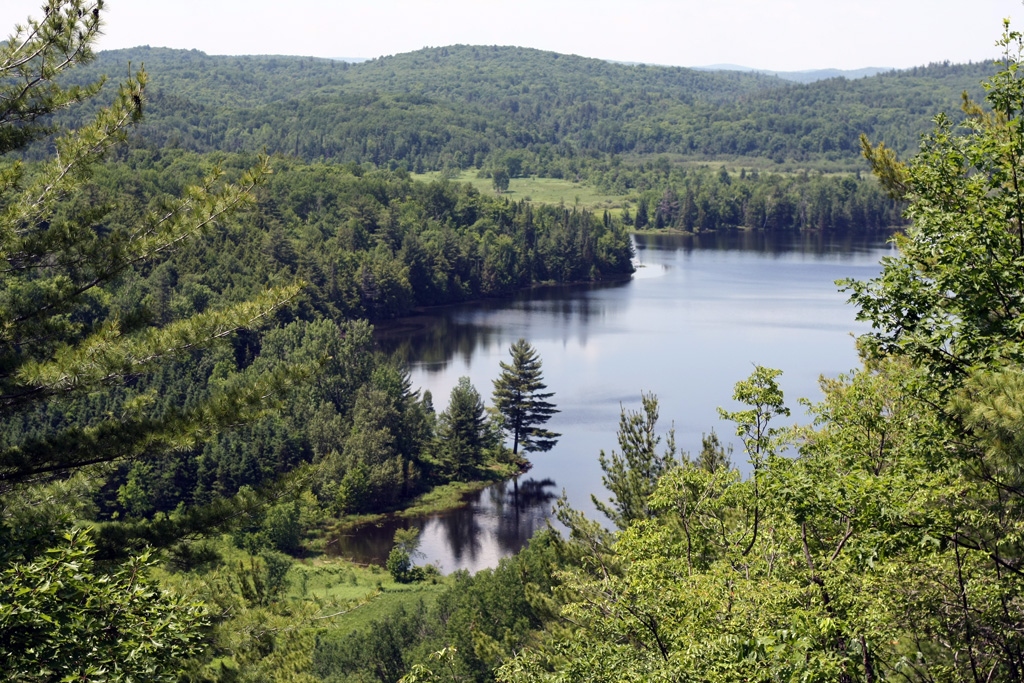
Lake in the Gatineau Park

Yesterday, I attended a meeting on climate change, security, and human rights (mentioned before). One thing about it disturbed me: namely, that the entire perspective offered was a north-south narrative of industrialized states causing harm to vulnerable populations around the world. The discussion was largely about how that harm could be reduced, and whether any legal mechanism exist through which states could be called to account, for the damage they do to the prospects of vulnerable groups.

Sadly, this perspective is over-optimistic, given the world’s track record so far. While highly vulnerable groups and poor states may be hit first and hardest by climate change, the idea that they will be the only people profoundly affected is misleading and potentially dangerous. It feeds into the flawed notion that rich states can basically keep behaving as they have in the past, with the worst possible outcome being a lot of suffering for poor people elsewhere.

The reality is that business-as-usual emissions would probably produce a mean global temperature increase of 5.5°C to 7.1°C by 2100. That is a massive enough change to raise doubts about the future of even some rich societies. Could Australian agriculture cope with that much of an increase? Could cities in the southern United States continue to provide the minimum level of water required to sustain their populations? (US Energy Secretary Stephen Chu suggested perhaps not.)

My fear is that people who expect that only the poor and vulnerable will suffer from climate change will not be sufficiently motivated to deal with the problem. Such a belief strikes me as a serious misunderstanding of both the best scientific and political assessments. It would be hard to read the Fourth Assessment Report of the IPCC and not conclude that people in rich countries face acute vulnerability to unchecked climate change. Similarly, the basic message of economic analyses like those performed by Nicholas Stern is that the costs of inaction are very high, especially when compared with the real but comparatively modest price of dealing with the problem.

The credit crunch and Canada’s national debt

Canada’s Parliamentary Budget Office recently projected that Canada will remain in deficit until 2014, with a total deficit of $156 billion to be accumulated. Those are figures that should be worrisome to everyone, even if you accept the argument that the consequences of being more fiscally prudent would have been even worse, because they would have caused a deep recession and exploding unemployment.

What seems most regrettable to me about this is that we have basically failed to use the opportunity to make necessary investments in reducing greenhouse gas emissions. In exchange for the support given to carmakers, for instance, we could have demanded a lot more movement on efficiency and the deployment of hybrid and electric vehicles. More of our infrastructure spending could have been directed at the energy sources of the future (renewables) and less at perpetuating activities that climate change and dwindling fossil fuels have rendered unsustainable. We need to realize that many aspects of how we now live simply need to change – particularly dependence on fossil fuels for both wealth and our energy needs.

Canada has too many future liabilities to be unconcerned about our degraded financial position. Inevitably, the money we are borrowing is going to need to be paid back with interest and, when we are not using it to invest in productive future assets and capabilities, the cost of that will inevitably be borne in future service cuts and tax rises. As a general pattern, it is awfully frustrating how Conservatives everywhere like to cut taxes without decreasing spending, wreck the financial balance of countries, lose power, and then leave it to the next government to repair. They can then win power again and restart the cycle.

The Globe and Mail has more on the announcement.

In Mortal Hands

Backhoe machinery detail

Stephanie Cooke’s In Mortal Hands: A Cautionary History of the Nuclear Age is a four hundred page account of the major problems with the global nuclear industry, both civilian and military. It argues that the costs associated with both nuclear weapons and nuclear energy have been hidden by self-interested governments and organizations, and that nuclear energy should not be part of our future energy mix, despite concerns about climate change and energy security. The book’s unceasingly critical position leaves one longing for a more comprehensive account, where arguments in favour of nuclear energy would at least be more comprehensively rebutted. Nonetheless, Cooke’s book does a good job of reminding the reader of the many special dangers associated with nuclear energy, and the risks associated with re-embracing it, due to our concerns about fossil fuels.

In Mortal Hands argues convincingly that most of the costs associated with nuclear energy are hidden, and not borne by the utilities that provide it or the people that use it. These costs include wastes, contaminated sites, decommissioning of plants and related facilities, risks of accident, nuclear proliferation, providing targets to enemies and terrorists, routine radioactive emissions, the redirection of capital and expertise from potentially more positive uses, and the further entrenching of secrecy and self-serving pro-nuclear entities within government and industry. Certainly, the issue of secrecy is an important one. Along with concealing costs and subsidies, it is demonstrated that the nuclear industry has misled policy-makers and the public about the risks associated with the technologies, timelines and costs associated with the emergence of new technologies like reprocessing and ‘breeder’ reactors, and the number and severity of nuclear accidents. The industry knows that another Chernobyl or Three Mile Island could undue their anticipated ‘renaissance,’ so they are arguably less likely than ever to disclose accurate information on dangers, or on incidents which do occur. Governments that authorize, encourage, and fund new nuclear facilities will be in a similar situation, in terms of the harm awareness of risks and accidents could do to them politically.

Cooke raises a number of important points about regulation, both nationally and internationally, and the conflicts that exist between commercial pressures to get reactors sold and keep them running and concerns about safety and proliferation. None of the big nuclear states has a good record on preventing sales to states secretly working on nuclear weapons. Lack of toughness on the part of international and national regulators is a major reason why countries like Israel, South Africa, and North Korea have been able to use the cover of civilian nuclear programs to get themselves nuclear weapons. Lack of rigour is also clearly evident in nuclear programs, in terms of making sure facilities have been built and operated properly, bombs are secure, and the massive contamination is avoided.

The book is arguably weakest in its discussion of technical matters, which are not discussed at great length or in a way that seems entirely credible and convincing. Opportunities to elaborate and justify claims made about technical matters are often missed, and the book includes at least a few claims that seem likely to be erroneous. For instance, Cooke misrepresents where most of the energy in a thermonuclear explosion comes from, and fails to point out that the START-II agreement never went into effect. More than a discussion about the physics and engineering of nuclear technology, this book focuses more on the regulatory, political, and economic aspects. While that might annoy those with more technical inclinations, it is probably the right approach for a volume with the ultimate intention of informing public policy choices about whether to use nuclear energy for electricity production.

Cooke’s response to the question of how the energy currently being provided by nuclear plants could be replaced is especially unsatisfying. Essentially, it is: “Wind energy is growing very quickly, and perhaps distributed microgeneration could be the solution.” Some consideration of scale, such as that provided by David MacKay, is essential here. Small wind turbines on the roofs of houses as not a viable alternative to gigawatts worth of reactors. At the very least, those who advocate using renewables in place of nuclear need to recognize the enormous scale of deployment that would require, and the various associated costs. While Cooke’s book does not provide a sufficiently broad-minded basis for reaching a final judgment on nuclear energy, it is a convenient antidote to some of the current industry messaging that new plants will be safe and cheap, proliferation isn’t much of a concern, and even Chernobyl wasn’t so bad.

The cost of America’s nuclear programs

I have complained before about how opaque costs are one of the biggest problems with the nuclear industry. There are subsidies and guarantees, both implicit and explicit, there are health and cleanup costs associated with radionucleotide releases and site contamination, and there are the opportunity costs associated with directing capital, skill, and research towards nuclear energy rather than other projects. There are also the intimate linkages between civilian nuclear power and the military, which further muddy the picture when it comes to financial, environmental, and health costs.

In her 2009 book, Stephanie Cooke includes some cost estimates of note. She estimates that the United States spent about $5.5 trillion on their nuclear weapons program between 1940 and 1996: about 11% of total federal spending. By contrast, health, education, and transport were each about 3% of spending. She estimates that the Pantex plant, where the United States assembles its bombs, involved a capital investment of nearly $9 billion by the mid-1950s. By comparison, that was greater than the capital investment in General Motors, U.S. Steel, DuPont, Bethlehem Steel, Alcoa, and Goodyear.

Cooke also cites a 2008 Department of Energy estimate that the Yucca Mountain waste dump would cost $96 billion. Now that the plan has been killed by the Obama administration, it is not clear where the wastes will go, or how much it will cost. The Hanford Site, in Washington, which produced plutonium for American weapons is probably the most contaminated site in North America, with unknown eventual cleanup costs (both in lives and dollars). Other sites with serious contamination include the Savannah River site, which produced fissile materials, Rocky Flats, the Nevada Test Site, and the Marshall Islands.

All these costs are matters that need to be considered when making the decision to extend the lives of nuclear power plants, or construct more. While many of the worst abuses were military, there are plenty of costs associated purely with civilian production, and the intimate intertwining of the two areas of practice make it impossible to decisively associate other costs with one or the other activity. Nuclear energy is certainly a power source with a great many serious costs and risks to consider, over and above the basic expenses of building and operating plants and producing fuel for them.

Weak-willed non-proliferation

Raw Sugar Cafe, Ottawa

Stephanie Cooke’s book In Mortal Hands: A Cautionary History of the Nuclear Age make some interesting points about the proliferation of nuclear weapons. Among them, that short-term political and commercial calculations have often overridden concerns about providing dangerous technologies to states that might aspire to developing weapons. In many cases, the examples are not hypothetical; for instance, there was Canadian and American assistance in building the CIRUS reactor that fueled India’s first atomic bombs, and America apparently played an important role in encouraging uranium mining in North Korea.

Lest people think that such shenanigans are a matter for history only, Cooke suggests that up until very recently, India faced a squeeze between being able to use uranium for plutonium production and bomb manufacture, and decided to put bombs above energy needs. The recent American decision to provide fuel to India, despite their weapons tests and rejection of safeguards against future weapons production, seems to show that we are still living in a world where civilian nuclear energy can be effectively used as a cover to advance military programs.

[Update: 8 July 2009] One correction to the above, it was apparently the International Atomic Energy Agency (IAEA) that helped North Korea develop its uranium mining program, not the United States as I indicated above. Cooke’s book does a good job of explaining how the dual role of the IAEA as both a promoter of nuclear technology and an enforcer of safeguards reduces how effectively it plays the latter role.

Copyright and authorship

Over at Techdirt, there is a good post about copyright and historical conceptions of authorship. The main argument is that all works are derived from other, prior examples (including the copyright laws states create and enforce) and that the notion of an author as a singular creator of an isolated work is a recent and oftentimes flawed one:

It’s nice to see more and more people recognizing and speaking out about these things. The idea that there is a single “author” or “creator” who deserves to get money any time anyone else builds upon his or her works is something that should be seen as increasingly ridiculous as people recognize that all works are created based on the works of others, and it’s inherently silly to try to charge everyone to pay back each and every one of their influences in creating a new work.

There does seem to be good reason for hoping that our present copyright system proves to be an exception that eventually gets corrected. The aim of the whole thing is to encourage creativity, by letting individuals use the might of the state to enforce exclusive claims to there work. There is nothing libertarian about this concept, unless the only kind of liberty you care about is the right to private property and the existence of a state that will defend that claim against others. There is also a growing doubt about whether the aim of encouraging creativity is succeeding. Does it really benefit the public at large to forbid non-Apple companies from using ‘multitouch’ without paying royalties? The bar above with work deserves exclusivity protection from the state ought to be raised.

Sustainable Energy – Without the Hot Air

David MacKay’s Sustainable Energy – Without the Hot Air is a remarkably engaging book; it has certainly kicked off and contributed to some very energetic discussions here. The book, which was written by a physics professor at Cambridge and is available for free online, is essentially a detailed numerical consideration of renewable forms of power generation, as well as technologies to support it, and to reduce total power demand. MacKay concludes that the effort required to produce sustainable energy systems is enormous, and that one of the most viable options is to build huge solar facilities in the world’s deserts, and use that to provide an acceptable amount of energy to everyone.

The book has a physics and engineering perspective, rather than one focused on politics or business. MacKay considers the limits of what is physically possible, given the character of the world and the physical laws that govern it. Given that he does not take economics into consideration much, his conclusions demonstrate the high water mark of what is possible, with unlimited funds. In the real world, renewable deployment will be even more challenging than it is in his physics-only model.

Here are some of the posts in which the book has already been discussed:

I have added relevant information from the book to the comment sections of a great many other posts, on everything from wind power to biofuels.

Even if you don’t agree with MacKay’s analysis, reading his book will provide some useful figures, graphs, and equations, as well as prompt a lot of thought. It is certainly one of the books that I would recommend most forcefully to policy makers, analysts, politicians, and those interested in deepening their understanding of what a sustainable energy future would involve.

Pumped and multi-lagoon tidal systems

OC Transpo security camera

Many forms of renewable power generation, such as wind and solar, suffer from differing power output depending on how intense the natural energy source is at any particular point in time. One neat exception to this is a tidal barrage with multiple lagoons. By managing the water level in each, it is possible to smooth out power generation between tides, as well as make output constant between days with bigger tides and those with smaller tides. It is also possible to use such systems to store excess energy from other renewable generation sites (such as winds farms running at full power during times of low demand) and to release energy at times of maximum demand, or when output from other renewable options is flagging.

With two lagoons and pumps for both, there are a huge number of options. You can maintain one pool at a ‘high’ level, and the other at a ‘low’ level, topping up the former using natural high tides or pumping and drawing down the latter in the same ways. When the tide is high, you can generate power by letting water flow into the low pool from the sea, or by letting water flow into the low pool from the high pool. When the tide is low, you can generate power by letting water flow from the high pool out to sea, or from the high pool into the low pool. Whenever you are producing power, you can use it for any mixture of supplying the grid, pumping up the high pool, and pumping down the low pool.

The combination of pumping with tidal lagoons is even better than conventional pumped storage. This is because you can actually produce more energy letting the previously pumped water flow than it took to do the pumping. Wikipedia explains:

If water is raised 2 ft (61 cm) by pumping on a high tide of 10 ft (3 m), this will have been raised by 12 ft (3.7 m) at low tide. The cost of a 2 ft rise is returned by the benefits of a 12 ft rise. This is since the correlation between the potential energy is not a linear relationship, rather, is related by the square of the tidal height variation.

David MacKay’s book also has a detailed section on tidal pumping and two-lagoon arrangements.

Of course, tidal power is not without environmental consequences. It will certainly alter the marine ecosystems that exist wherever facilities are built, and may create consequences in river systems located behind the barrage. That being said, the many advantages of tidal power as an energy generation and energy storage option mean that it probably has an important role to play in building a sustainable global society.

What does 5% of global GDP mean?

Over at FiveThirtyEight.com (the pollster site made famous by the Obama election), there is an interesting response to Jim Manzi’s opposition to climate change action. Manzi argues that climate change will ‘only’ cost 5% of global GDP, 100 years from now, so we shouldn’t worry too much about this. The obvious responses to this are that the consequences of business-as-usual emissions will be much more severe than that, profoundly threatening our current way of life. The FiveThirtyEight post takes a different approach, enumerating what the loss of 5% of global GDP would mean, if concentrated in relatively poor states.

Eliminating 4.99997% of global GDP is akin to eliminating 81 countries, with a total population of 2,865,623,000 – 43% of the world’s total:

We’ve gotten rid of almost all of Sub-Saharan Africa, destroyed the entire Indian subcontinent, created a big lake in South America, turned El Salvador into an island, and solved a lot of our problems in the Middle East. I suspect we could also have nuked North Korea, by the way, except that the IMF didn’t publish information for them.

There are, of course, flaws with this way of looking at things. That being said, it is a nice illustration of how abstract economic figures can become disconnected from the real world consequences they represent. As the post’s illustration demonstrates, even climate change that only cost 5% of global GDP could still be an extremely serious problem.