Oddly crystalized thoughts

Photographer on the High Street, OxfordDuring the most recent snowfall, the college salted the stone walkway that links the rooms in Library Court, as it outlines the open central space. Now, the salt has formed into improbably large crystals – stretching over an inch in length, like blades of ice collecting on the edges of Northern windows. Along with the perfect blue skies and precise cold, it changes the way that you think. The sharp edges and familiar patterns of colour on limestone blocks in colleges and other buildings make you feel as though you’re moving though a place that is both highly definite and carefully separated from you – kept off at a slight distance to observe and be observed.

The cold skies of Oxford feel rather more like fall than like spring, probably because of the near total absence of rain. The sense of being propelled towards greater darkness, rather than longer light, may disperse with the ending of Hilary Term next Friday. We will then have covered all the material that is to be tested before Trinity, when our qualifying exams will take place. The sense I get from Dr. Hurrell is that I should not be overly concerned. While these exams serve a purpose, it is not one that I will have difficulty meeting, or so he indicates. Naturally, the break will involve a good amount of revision: both of material from the history core seminar and its theoretical successor.

Sarah’s wedding is taking place in two weeks. The railway tickets to and from Chichester are on my desk, beside the tickets to The Producers that I got for my mother and I. It has been such a long time since I’ve spoken with Sarah that I don’t really know what to say about the matter of her upcoming marriage. Weddings remain unfamiliar things to me: unexpected among those mostly concerned with finishing school and starting careers. While some of us do have long-term relationships, most don’t even have the regularity of one person to take to films or dinner every once in a while. I very much hope that once all the energy and dedication that wedding preparations require have been expended, Sarah and I will have the chance to become more frequent correspondents again.

On Lent

One unexpected thing about living in England is the amount of attention paid to Lent. Prior to arriving here, the only time I had even heard of the holiday was when I read the partially completed manuscript of a novel my father’s friend wrote, called Halving the Orange. Prior to reading the Wikipedia entry on it just now, I knew nothing whatsoever about what it commemorates. Here, however, large numbers of people are at least aware of the period and the relevant rituals. I suppose it’s a contrast that says as much about western Canada as it does about the southeast of England (according to the UK Apple store, that is where Oxford is located). I wonder if there are any popularly recognized holidays in Canada that are comparatively unknown here.

The various comments made by friends of mine in person and on blogs about giving things up for Lent have the ring, to me, of New Year’s resolutions. There is a similar dynamic of using the opportunity of some ritualized self-restraint to advance some much-postponed personal initiative, such as the reduced consumption of alcohol or unhealthy food. I hope those who are presently involved in such efforts find them effective.


  • Both Google Mail and Blogger seem to be having serious trouble today. As such, access to the blog has been very patchy. Even though it’s hosted by servers not owned or run by Google, it does rely on Google servers to run the navigation bar at the top of the page and the commenting system. Google Talk is also down.
  • Hosting the Blogger status page on a server that goes down every time Blogger does is not the best piece of design on Google’s part.

Cyclical adjustments

Oxford Natural History Museum

Bicycle shopping today went badly. I tried eBay and Craiglist without finding anything appealing. I also walked to the Oxford Cycle Workshop, on Magdalen Street between Iffley and Cowley, but they don’t have any bicycles in my size available. They did, however, issue the third warning I have received not to buy used bikes from the Cycle King on Cowley Road.

One option that seems as though it might be good are the police auctions that take place from time to time. The Thames Valley Police website doesn’t seem to say anything about them and the best I can find elsewhere is the vague suggestion that they might happen on Wednesdays. I will stop by the station on St. Aldates to ask about them tomorrow.

I do have a bike back in Vancouver, but the difficulty of conveying it here probably means that it’s better to leave it there for now. I got it quite a long time ago, during the summer after my first year at UBC (2002). That is when I was first living in Fairview – working as a cashier at the almost completely empty Pharmasave. I remember biking down to see Jenny and Zandara, when they were living near the Alma Street 7-11, as well as regularly making the 22km trek from UBC to my parents’ house in North Vancouver.

That ride was a really nice one if done properly. You can follow a route parallel to Broadway that is specially marked off for bikes. Alternatively, you can follow the beaches that encircle UBC eastward until you reach the Burrard Street Bridge. From there, you can follow the shoreline past the Aquatic Centre and along the really stunning area near English Bay. It’s especially lovely in the evening. Once you get to Stanley Park, you can follow trails that parallel the causeway, eventually joining it to cross the Lions Gate Bridge into North Vancouver.

The last good bike trip I had in British Columbia is when I went Galiano Island with Tristan and his brother. A few of my photos from the trip are here. I can’t seem to find any of Tristan’s online.

After a couple of years of not riding regularly, I doubt I would be able to climb the hill from Marine Drive in North Vancouver up to my parents’ house. They only live about eighty metres above sea level, but it is a lot harder to push yourself and a bike up that kind of hill than it is to walk up. Of course, such concerns do not exist in Oxford which – for good or ill – barely has a slight slope anywhere in it.

One of the reasons getting a bike would be so nice is that it would let me explore the area beyond Oxford a bit. During the summer, when the days are longer, it would be interesting to visit some of the outlying towns and villages. In general, it would also be good to get some exercise. If nothing else, it might help me sleep.

The bicycle plan, then, has been prioritized and is moving on apace. Hopefully, my mother will be able to bring my helmet, D-Lock, and lights from North Vancouver. Buying them here seems like it would cost seventy Pounds, or more.


  • With only a week left in the term, the search for someone to sublet either my room in Wadham or the one I am moving into on Church Walk is becoming pressing. Either is available starting between April 10th and 20th and until June 17th. Anyone interested in more information should email me. The room in Library Court is available to Wadham College students only.
  • My new MDR-EX71SL headphones arrived today. Listening to them as I walked up Cowley and down Iffley Road, the sound quality seems to be quite good. Compared to my very similar broken headphones, they seem to put more emphasis on mid-range sounds and accentuate percussion a bit more. In any event, I am happy enough with them, even though they seem to be made from a lower grade of plastic. The original pair lasted about six years before falling apart. We will see how these ones fare.

Finally making some connections to other environmentally inclined people

Statue in BathAfter the interview for the mood study and our qualitative methods class, I attended a talk delivered as part of the Linacre Lecture Series, as run by the Environmental Change Institute. It was given by John Gummer MP, of whom I had no prior knowledge, but whose presentation I found quite impressive. He managed to convey a great deal of useful information about environmental policymaking in a way that wasn’t obscured through the excessive use of jargon. While some of the solutions he presented may have been a bit over-simplified, his overall tone of optimism and humour was very much appreciated. Especially interesting was his mini-tirade at the end against an environmental perspective founded in what he described as a Puritanical ideal of misery and self-denial.

While the speech was heavily focused on domestic policy – in areas like energy, waste management, and transport – it nevertheless made points that were more broadly applicable. When I asked him afterwards about fisheries – having learned that he is Chairman of the Marine Stewardship Council as well having served as UK Environmental Secretary from 1993-1997 – he expressed both a severe concern and a realistic perspective on the prospect for improvement. Another international matter that came up a number of times during the questions was that of cheap airline flights. He made the strong point that taxing the fuel that makes up 10% of the cost of a £20 ticket isn’t going to change anyone’s behaviour. His long-term idea of a personal carbon allowance, which could be traded or used against things like such flights, was a more inventive answer that you expect to hear at the end of such a speech.

In summary, the speech was effective and humorous. Very well captured was the essential concept that it isn’t enough to make people aware of environmental issues – or even to make them care about them in a general sense. What is necessary is the creation of institutional and legal mechanisms that make it both easy and economically efficient to behave in an environmentally responsible manner and both difficult and expensive to do otherwise. That happens through things like internalizing the full cost of transport or waste production.

Afterwards, I found myself in a cluster of wool-clad Canadians, most of them doing Master’s degrees over at the Environmental Change Institute. That is to say, the degree that I sometimes wish I had chosen to do, particularly after spending whole days reading about elements of large-I large-R International Relations that are only tangentially related to my intended research topic. It was particularly interesting to meet Erin Freeland, from Yellowknife, who is doing a Master’s with the ECI and with whom I’ve agreed to swap notes on the respective programs. A bit more interchange between the Department of Politics and IR and the ECI would serve both quite well, I think.

Now I am off to try and convince a recalcitrant external hard drive (not mine) to exchange data with a computer that has so far proven unwilling to speak to it.

PS. Speaking with Edwina – a D.Phil student in the DPIR and friend and collegemate of Claire’s – and Shohei during the period between qualitative methods and the John Gummer talk was both intriguing and valuable.

PPS. I am buying a bike with my brain scan experiment money. Does anyone know which place in Oxford is best for getting a decent used bike, as well as lights and a helmet (to protect the brain for future scans)?

Marching onward

Snowing near Nuffield

This has been an exceptionally good day. That’s surprising, given that last night was a mess of acute illness and insomnia (though speaking with Alison was excellent). All I could do, when I closed my eyes, was play the Falling Sand Game in my head. While there is no objective to it at all, it is nonetheless ridiculously addictive. Even so, it verges on the disturbing to be simply unable to not see such a thing presented behind your closed eyelids, denying you sleep for hours at a time. No wonder the experimental psychology people want to scan my brain. More on that in a moment.

This morning, I began the day by having coffee with Bryony, before her Mandarin class. Perhaps it’s western Canadian solidarity, but I find it exceedingly easy to relate to her – especially when the topic of discussion is the deliciousness of Asian cuisine. She has the good fortune to be taking a number of trips in the near future: first to Germany, where she is apparently visiting Alex Stummvoll, and then to Morocco with Emily and Sheena, during the next inter-term break. I look forward to the chance to swap stories at G & D’s subsequently.

On my way to supervision with Dr. Hurrell today, it began to really and properly snow: big, unambiguous flakes that caught you in the face as you tried to walk down the street. I spent a few minutes watching it descend in the Wadham gardens before making the short trek up Broad, Cornmarket, and Queen streets to Nuffield. The supervision itself went well, though he had a number of criticisms of my paper. The discussion had the same dynamic of energetically feeding off of one another’s ideas that has made them so invigorating in the past. As friends of mine here will be able to attest, I tend to leave supervisions in a very good mood.

After a few hours of reading, Claire and I walked through the light snow to Cowley Road and visited Oxford’s finest Jamaican pub. Along with a short stop at the Magdalen College bar – my first foray into that beautiful college – we had a good long conversation. The day may have done relatively little to advance either my mandatory or discretionary reading lists, but it has certainly reaffirmed the reasons for which I am here and provided some motive power to press on through the last week of term.

Tomorrow, before our qualitative methods lecture, I am going to the experimental psychology department to be quizzed and prepared. They are going to scan my brain, as part of some kind of mood experiment, and pay me £50, plus a £10 Blackwell’s gift certificate, for a few hours of work. It will become the nest egg of my “buy a bicycle fund.” Having one would let me explore the area around Oxford better, as well as reduce the amount of time it will take to get from the Church Walk flat to classes and the centre of town.

Anyhow, I am off to bed. Best wishes to everyone.

PS. Mike has a short history of Wadham on his blog. While I can’t vouch for its accuracy, it’s an interesting read. I especially like the bit about how the whole student body was expelled in the 1880s after a riot in which the Dean was defenestrated.

General musings

Machinery in Bath

If anyone is familiar with Chichester, on the southern coast of England, perhaps they can help me out. I now have a ticket in hand to go there on the 18th of March in order to attend my friend Sarah Johnston’s wedding. My return ticket is for 3:00pm on the next day, and I need to find a decent, modestly priced place to spend the night. My investigations so far have not uncovered the existence of any hostels. If all else fails, I suppose I can wander the town all night in my suit, like some kind of spectre. I certainly would like to have a look at the sea, to which the town seems closely adjacent.

Perhaps I will be able to locate someone else who is similarly in need of lodging.

Even though it’s the second time a friend of mine is getting married, it still strikes me as a highly unusual occurrence. I suppose as my friends start drifting into their mid twenties, more such match-ups will begin to take place. It’s obviously a circumstance enormously beyond anywhere I’ve found myself, in terms of institutionalized commitment.

Five days after the wedding, my mother is coming to visit Oxford. I am fairly sure this is already the longest I have ever gone without seeing any member of my family. Communicating by means of Skype and email really isn’t an adequate alternative. I am excited about the trip to Malta – as I am in general about visiting previously unknown places – and you can be certain that a good number of photos from the expedition will show up here eventually.

The core seminar and academic ideology

Today’s core seminar was quite good. Unlike many of the previous classes, which became mired in narrow theoretical debates, this one seemed to have a bit more dynamism. Of course, that may be reflective of my general sympathy towards normative approaches. The degree to which international relations is properly thought of as a ‘science’ is certainly divisive within the program, though not always along the fault lines I expect. There is definitely an ideal that is satisfied by the possibility that we might understand international relations in an objective and rigorous way but, given the constructed nature of both the international system and our approach to understanding it, I think we need a more self-aware form of theory, as well as one which is more explicitly concerned with the mitigation of global injustice.

At the same time, I find my confidence about such a theoretical approach to be rather less comprehensive than that of some of my colleagues, who believe that a rigidly social science perspective, with similar ambitions to those of the natural sciences, is best placed to address the questions of international relations.

PS. My room in Library Court remains available to potential renters within the college.

Electronic botherations

One of the Sarah Lawrence students studying at Wadham

I obviously haven’t been making frequent enough offerings to whichever god watches over electronic devices. First, my digital camera got some kind of dust or mold permanently inside. Since it’s not a camera with lenses that can be switched, there is really no way to open it up to clean the senror. The dust is sitting directly on the sensor and the dark blotches it produces need to be manually removed from every photo that I want to look presentable, especially those with large areas of a single colour. That camera was itself a replacement for the first one I got, which had a defective flash that always fired at full power.

Today, my iPod simply stopped playing any sound in one ear. The iPod is also a replacement for the one I originally got, which would pause randomly and for no reason if it was not kept perfectly still. Hopefully, cleaning the jack for the headphones will fix this newer problem, because my experience of sending the first iPod back to Apple was hellish and the one they sent back (more than a month later) had a click wheel that was off kilter.

I wonder whether I have particularly bad luck with electronics or whether I am just pickier about them working properly and more willing to go through the hassle of getting them fixed. Both my Sony and Panasonic portable CD players got sent back to the manufacturer for defects. My GPS receiver is actually the replacement for a replacement. It’s grandfather had abysmal reception, even compared to other identical models, and its father died for no apparent reason during the second Bowron Lakes trip.

I should not, in any case, let these things distract me from the task of finishing my core seminar paper for tomorrow. It’s on whether order and justice are compatible in international relations. Obviously, it’s the kind of topic that anyone with normative concerns will feel fairly strongly about after five years of studying IR at the university level. That makes it both easier and harder to write upon. In the interests of not being up all night, I shall get back to it.

PS. This week’s readings on normative theory have been the first time I read a lot of Dr. Andrew Hurrell’s work. It has been really interesting, well written, and suited to my research interests. I think I will probably take normative theory as one of my two optional subjects next year. Overall, I think it meshes well with a research project focused on environmental politics.

PPS. It seems like it might actually be my headphones which are defunct. While they seemed to work in my iBook before, they do so now only when you hold them in a certain way. I will need to try out the iPod with another pair.

PPPS. Upon further experimentation, the problem lies with the headphones, not the jack on my iPod. While they work if you twist them in a certain way in the iBook socket, they don’t work at all in one ear with the iPod. I will need to buy new ones. In some sense, this is worse. At least the iPod is under warrenty, and all electronics are absurdly expensive here. I honestly can’t understand why people tolerate it. England desperately needs Walmart.

Canada and Ballistic Missile Defence

Apparently, under the Harper government, there is new talk about Canada joining the American missile defence system. I believe that doing so would be unwise for a number of reasons, with the only real advantage of participation being the possibility of improved relations with the US.

Technically infeasible

The first reason to doubt the plan is that there is no reason to believe it will work. Past efforts at both theatre missile defence, the attempt to protect specific assets in a narrow geographical area, and umbrella missile defence have been failures. During the first Gulf War, the much lauded Patriot missile batteries never actually shot down a Scud – though they did shoot down two British planes by mistake. The Scud is essentially a modified V2: not exactly a modern missile.

Shooting down an ICBM is even more difficult. Lasers are infeasible given the difficulty of tracking the missile with such precision and the potential of reflective coatings and accelerated missile rotation mitigating their destructive effects. This reality is reflected in the new focus on kinetic kill systems, where a missile is meant to be used to knock the first missile apart. Of course, this risks showering the area below with radioactive fallout. Better than having a city hit, perhaps, but certainly not a good option.

There are three major stages in the flight of an intercontinental ballistic missile (ICBM) or its submarine launched equivalent (SLBM). There is a boost phase, where the missile is launched from its silo or missile tube. It is the infrared emission from the launch, as well as the appearance on radar screens, that would first alert the United States to the fact that the missile is in the air. Barring the extensive deployment of space-based weapons, it is impossible to destroy the missile at this stage. The current missile defence plans do not attempt to do so.

The midcourse stage of the missile flight is suborbital, and takes place at an altitude of 1200km. During this phase, the missile can employ a large number of possible countermeasures: electronic signal jamming; the use of decoy warheads, chaff, and flares; and the deployment of metallic balloons that interfere with radar. It would either be at this stage or during the re-entry phase – when the warhead is travelling about 4km per second or about Mach 12 – that the kinetic kill would need to take place.

Even rigged tests that have taken place so far, where the missile trajectory is known in advance, no countermeasures are used, and a beacon is actually fitted in the warhead, have not resulted in success.

Strategic error I

The supposed contemporary enemies of the United States are not ICBM type entities. Intercontinental ballistic missiles are highly sophisticated pieces of hardware. Expensive and technically demanding to produce, they also require an extensive launch infrastructure. While they seem to be increasingly within the reach of states like North Korea and Pakistan, they are definitely not available to any terrorist group.

Moreover, if the United States went to the extreme expense of building an effective missile defence system, it would remain possible to deliver a small number of nuclear weapons by other means. They could be smuggled onto fishing boats or into storage containers. Maintaining a strategic focus on stopping potential missiles with a hypothetical system only tangentially addresses the problem of nuclear proliferation.

Strategic error II

The two hostile states that do have large numbers of ICBMs are Russia and China. Russia has so many, along with SLBMs, that it needn’t be concerned about the kind of missile defence system that is being proposed. That said, it could be used as an excuse to upgrade and modernize existing nuclear forces – especially if the United States resumes the development of its own nuclear weapons, as has been proposed by this administration.

The bigger concern is China. While the exact numbers are secret, it’s probable that China has about 20 missiles capable of delivering nuclear weapons to the United States. The CIA apparently thinks that North Korea could have around five nuclear weapons. It’s hard to imagine a system that would be likely to stop five missiles, but that wouldn’t concern another state with only a small multiple of that number. Deploying missile defence might encourage China to build more missiles, begin putting missiles on submarines, begin fitting multiple independently-guided warheads upon missiles, or developing and deploying more effective countermeasures. It may, in any case, send entirely the wrong message to a state that is emerging as a larger military and industrial power.

Reasons for deployment

From the American position, there are two major reasons to deploy missile defence.

Firstly, it makes it look as though you are doing something to combat a threat almost universally regarded as very serious. This needn’t be an entirely cynical calculation. Given the incredible faith in technological progress within both the American public and the government and military, there is a belief that with enough brains and dollars, the thing can be made to work. It’s a mindset that goes along well with the notions of transformation that keep coming out of Donald Rumsfeld’s Pentagon.

Secondly, developing and building such a system will put billions of dollars into the hands of military contractors. Boeing, Lockheed-Matin, Raytheon, and the rest of them all stand to gain enormously. That has political relevance for the representatives of states where they employ a large section of the population – think of Colorado. It also has importance in a political system largely driven by multi-million dollar campaign contributions. Also, increasingly extensive direct connections exist between the military and military contractors. As such, disentangling their agendas is becoming increasingly difficult.

Potentially, some of the above could apply to Canada. If we were to join on, some contracts would doubtless flow to Canadian firms. I do not, however, think this would be a net benefit to Canada. Spending on defence industries – even if largely paid for by the United States – really doesn’t boost national welfare, at the same time as it would increase national insecurity.

The Canadian military does seem to broadly support missile defence. I can think of seven different reasons for which either the military specifically or the Canadian government generally might back the plan:

  1. The American armed forces are putting pressure on them to support Ballistic Missile Defence (BMD) plans. In some sense, this is almost certainly true. It’s worth remembering the extent to which things like a lack of strategic airlift capability make the Canadian Forces (CF) heavily dependent upon our allies, and especially the United States, in order to be able to deploy. We are also highly reliant upon their military intelligence capabilities.
  2. They are concerned that a future terrorist attack could take place through Canada. If that happened, it was seriously sour relations between the two countries, or at least risk doing so. By participating in American initiatives like missile defence, Canada could stress how we have been doing everything possible to counter terrorist threats. Support for BMD could therefore be a kind of pre-emptive damage control.
  3. The shared military culture of the United States and Canada means that both sets of armed forces are working from similar premises and using logic familiar to each. One issue here is that of non-proliferation. The Bush administration clearly doesn’t have much faith in treaty based mechanisms like the Non Proliferation Treaty (NPT) (a point made in the 5th report of the Senate Standing Committee on National Security and Defence). Do members of the CF see BMD as unlikely to undermine non-proliferation efforts?
  4. The CF sees participation in BMD as a way of maintaining or enlarging the Canadian role in North American security cooperation decision making. Given how much the Americans want to do this, we could get a lot of capital out of it for little cost. It’s worth a lot to the US just to have things look non-unilateral (think of the Iraq coalition).
  5. Strategic considerations are getting trumped by trade. Backing the Americans on missile defence is a way to keep trucks and containers flowing across the border with less trouble and suspicion. Also, Canadian defence firms with BMD related contracts in mind could have lobbied the CF to support the project.
  6. The Americans are going to set up a BMD system anyways. By participating, we at least get the illusion of sovereignty. At best, we might be able to restrain them from doing things that we really don’t want to see happen.
  7. The length of time this has been worked on has generated such a force of bureaucratic momentum that BMD was supported by default. Since the Second World War and, especially since the Cold War, military strategists have increasingly seen North America as a bloc to be defended all together. From that perspective, BMD might look obvious.

Admittedly, some of these are good reasons – at least potentially. Overall, however, I think the concept of dealing with the danger of proliferation by hiding behind a technical shield is profoundly misguided. It leaves the rest of NATO out in the cold, it encourages the development of further nuclear technology by states already so armed, and it contributes to a military-industrial complex that is already hugely expensive and influential.

On balance, I think Canada would be far better off for continuing to decline. While it might be a diplomatic faux pas, it may also be worth publicly pointing out why.

Music and frustration: copy protection schemes

Chained pig, BathHaving spent the last few minutes explaining to a friend why a brand-new, legitimately purchased CD will not play in her computer due to the copy protection EMI has included, I am reminded of my considerable indignation about how the music industry is treating their customers. Yes, in this case, it was possible to disable the copy protection program just by holding shift as the CD was inserted into a Windows computer, but there is no guarantee at all that music you buy today is either usable or safe.

In the worst case, such as the notorious Sony BMG rootkit, inserting a legitimate music CD into your computer intentionally breaks it. It also causes it to report what you listen to to Sony, even if you choose ‘no’ when a screen comes up asking for permission to install software. It also creates really sneaky back doors into your system that can be exploited for any number of purposes, by Sony or random others. While Sony is currently facing lawsuits for this particular, infamous piece of malware, it isn’t nearly enough to put my mind at ease. If some 16 year old had written something comparably dangerous, they would probably be in jail.

Legitimately downloaded music is little better. Songs you buy from the iTunes music store may work with your iPod today, but they won’t work with another portable player. They won’t even play in software other than iTunes, and there is no guarantee that they will still work at some point in the future. Spending a great deal of money on songs from there (and they’ve just had their billionth download), is therefore probably not very wise. You don’t actually own the music you are buying – you’re just buying the right to use it on someone else’s terms: terms that they have considerable freedom to change.

Personally, I will not buy any CD that contains copy protection software. I will not buy a Sony BMG CD, regardless of whether it does or not, nor will I be buying any of Sony’s electronics in the near future. This is a business model that needs to change.

Ascensions in Bath

The Sacred Pool, Bath

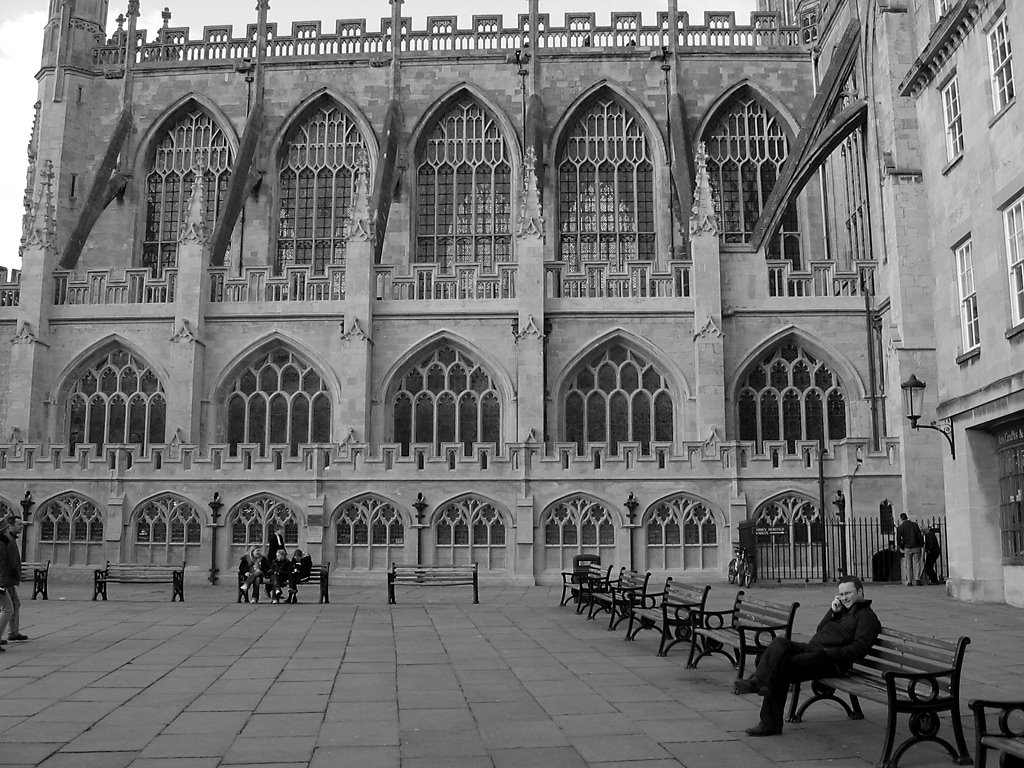
To the east and west of the centre of Bath are hills about 200m high. Both on the coach ridges there and back and while in the town itself, it was largely this topography that struck me. Oxford, you see, is a cracker. Only from south of the Magdalen Bridge can you find any kind of hill, and even those are laughable. Bath, by contrast, is almost perfectly composed to be looked over from above.

Upon arriving with the coach load of Sarah Lawrence students, the first place half of us went was the former Roman baths themselves. There, we atomized, and I didn’t see anyone again until we met for the coach ride home at five. Now built somewhat awkwardly into a museum – encased in black painted walls that look like the backstage area of a theatre – you can see the remains of former saunas and the realities of a collection of still-existent pools. The over-dramatic audio guide will tell you in almost comically reverent tones about the goddess to whom the former temple is dedicated.

The town of Bath reminds me a lot of Victoria, British Columbia. It has a similar pedestrian focus and the same sense of being designed for tourists. Even the residential areas that surround it, such as the one that runs to the top of the first hill I climbed, have a similar look. It’s a much larger place than Oxford and considerably more open. It may have been the brilliant weather, but people also seemed to smile more. The second hill I climbed – the westerly one – is capped by a fairly large park that, by walking around the circumference, offers views of all the surrounding hills and countryside.

Unsurprisingly, between ruins, town, and hills I took quite a number of photos. Rather than post them all at once – which would require editing the dust/mold specks out of the whole collection tonight – I think I will post them one by one until I run out of good ones. It may not represent the place where I am from day to day, but it should be more interesting than perpetuating the parade of Oxford shots.