Rambling, eclectic reflections

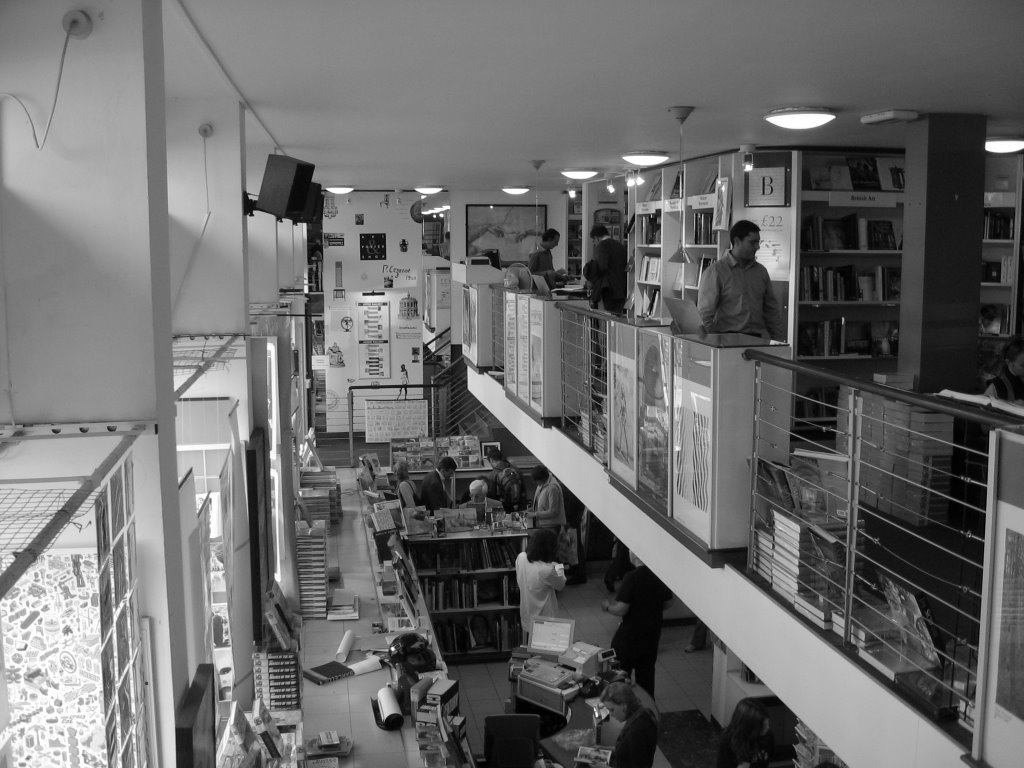
Blackwell's poster shop

Today, I did quite a lot of reading, sorted new music, and – in listening to older music – had my love for Tori Amos re-emphasized. If there is a greater musician alive, I haven’t heard them. The raw, impossibly emotive content of Tori Amos songs is enough to induce an adoration that quite transcends the rational. It’s little surprise that her live shows are a kind of super-sensory dream; something I described three years ago as watching a “semi-divine creature pound… her piano keys into us.” I really must acquire her Beekeeper album.

I remember first listening to Tori on the CD that Jenny made for me, back in high school: when Napster was young and my musical experience was confined to the boundaries of Edgefest concerts. One night, about seven years ago, I remember riding the bus to Victoria and missing one sailing of the ferry. During that two hour wait, I recall reading the issue of The Economist about Ariel Sharon’s election and listening to the overpowering live version of “Precious Things.” I remember the particular amber hue of the reading lamps on those Pacific Coach Lines buses, the lingering smell of cigarette smoke, presumably from when such activities were permitted onboard. I remember listening to “Silent all these Years” and “Crucify” while walking through rainy London streets, five years ago. I remember the way the brick wall across from the room where I was staying began to streak, as the afternoon rain ran down it, and how my collection of miscellaneous pamphlets on London attractions grew and reproduced in all the corners of the small room.

Oxford is getting cold. Sweaters, those awkward scratchy things I would never wear in Vancouver, are emerging from bottom drawers and into the normal rotation of worn clothing. I suppose having one wall composed entirely of windows (looking into the panopticon), and only an odd, gurgling radiator for heating contributes to these matters. Walking to the SSL at five-thirty tonight, clad in jacket, down vest, and gloves, there was a chilling sharpness reminiscent of cross country skiing, though without the warmth that comes with that activity’s exertion. Darkness before 6:00pm is normal enough, but real cold at such a time is novel. I shall consider it training for Tallinn. In the end, I far prefer cold to excessive heat – it is much more easily remedied. Exothermic bodies can be insulated and energized much more easily than their thermal capacity can be dissipated. Something similar explains my over-riding preference for shade over sunlight.

As I have meant to explain before, one of the things I like most about the M.Phil in International Relations program is how cooperative it is. There is a real sense that it is the 28 of us against the program, working together in a way that is both unfamiliar and quite valuable. Part of that may derive from how, aside from the sometimes quite arbitrary-seeming marking of the statistics assignments, we are not being numerically assessed on anything. That helps create a culture where notes and ideas are shared, essays are mutually read, and discussions serve to advance everybody’s understanding. It’s obvious that all of us will end up in circumstances where collaboration is essential, so it only makes sense to begin now.

At various times in the past few days, I’ve wandered through the random blogs provided by the ‘Next Blog‘ function on the Blogger toolbar. This was prompted partly by the fact that so many people seem to find my blog by this route. Also, I wanted to get a better sense of the overall content of this ‘blogosphere’ that some media outlets seem to champion, while others deride. Having now wandered through a lot of random sites, I am falling in more closely with those who are critical. Not to hold myself up as a paragon of fairness, but there are a lot of blatantly partisan or incorrect blogs out there. When one sticks to the clusters of one’s friends (of the skillful bunch that are the Oxford bloggers) one doesn’t realize how much vitriol and misinformation can be found out there. These blogs may not reach the level of crazy achieved by the masterful Time Cube1 but, well, caveat lector.

§

PS. I’ve been listening to a lot of The Smiths today, since I gained access to it over shared iTunes folders on the Wadham network. While it ranges between reasonably good and quite good, it is all very similar. It goes better when interspersed with something a bit more energetic.


[1] Quite possibly the high water mark of internet-crazy, which is saying rather a lot. This site is definitely worth a look if you haven’t yet seen it. Feel free, also, to nominate challengers for the title of most insane, strange, or paranoid website via comments.

An uneventful day

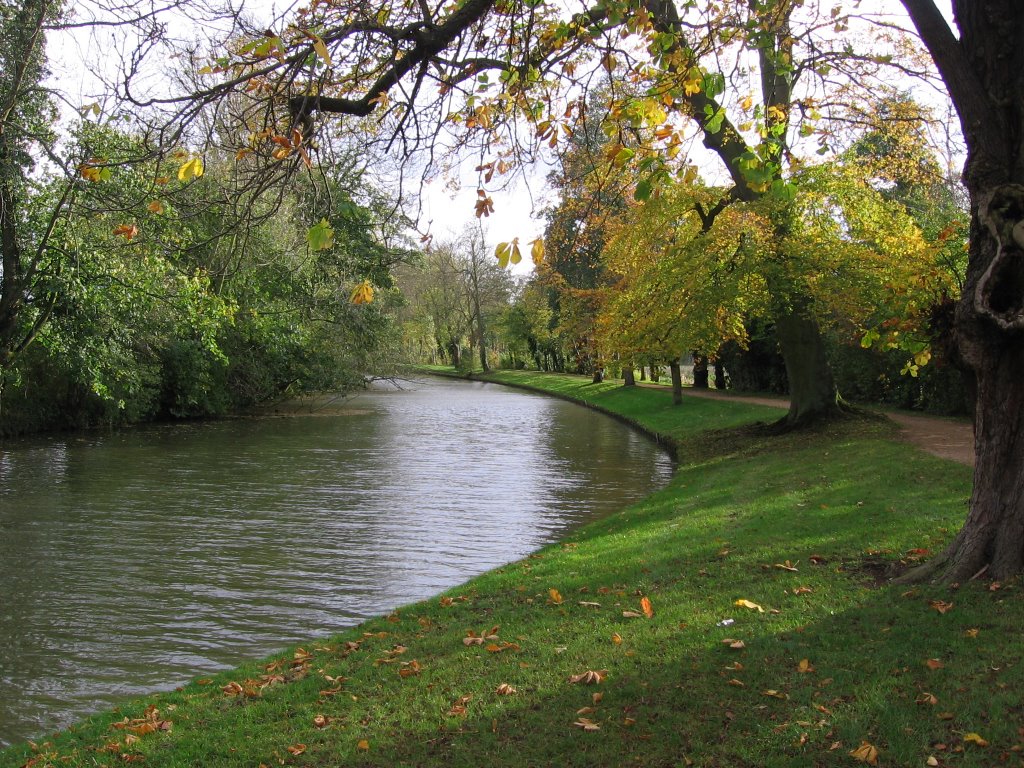
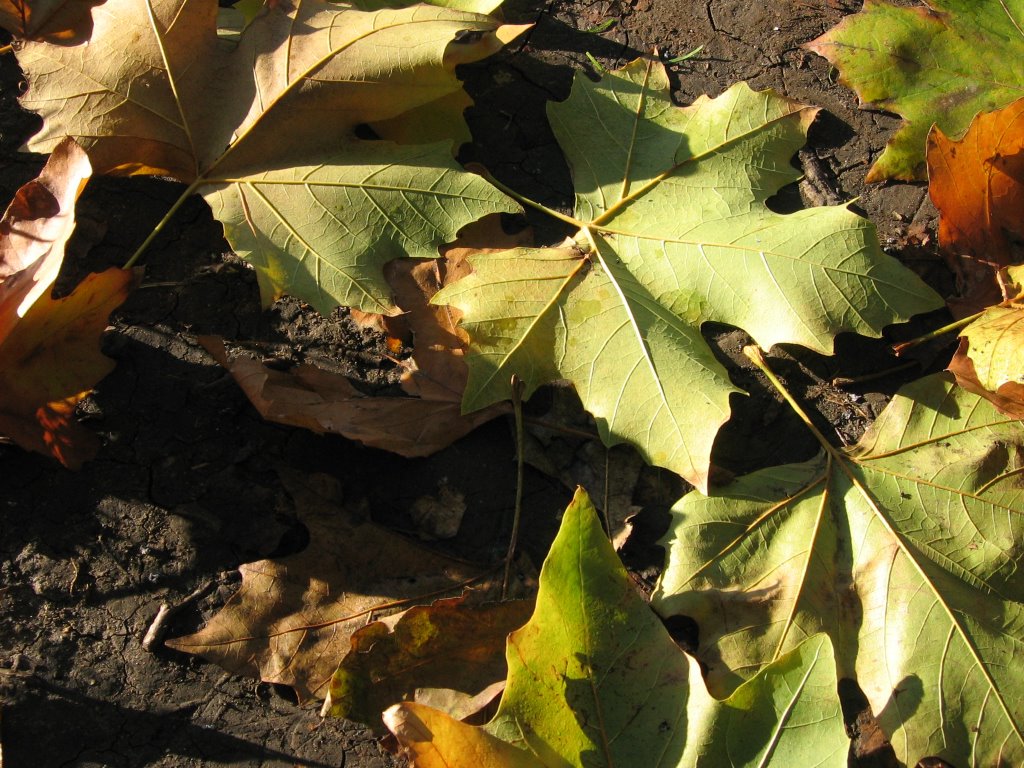
Pastoral fall scene in Oxford

On November 12th of last year, I was in the snow-swept complex of the West Point Military Academy, along with Samantha Hinds and Vicki Lyus, for the 56th Annual Student Conference on United States Affairs. It was our last night there and I remember walking back through the frigid air from the Firstie Club to the barracks were we were all staying. By comparison, very little happened in Oxford today, aside from reading and a few enjoyable periods of drinking tea and lounging about, both with Margaret and on my own. I have been making an effort to complete the two upcoming essays a good while before they are actually due, so as to have some time to think them over and have them edited.

In the evening, I read from the new Economist, responded to a mass of emails, and carried on reading about China. One of the emails, unexpectedly, came from my friend Ebony. She graduated from UBC in the same year as I did, also from the IR program. During that year, we were in the same native politics and Canadian foreign policy classes. She is presently in Japan: working and gathering volunteer experience, prior to applying to graduate schools. I haven’t had any contact with her since graduation, so it was good to get back in touch.

Next Saturday (November 19th) is the infamous Wadham College Queer Bop. [20 Nov: described here and here, with photos.] This is the notorious Wadham event to which “men come as women, and women come in next to nothing.” I plan to attend fairly briefly, and in an observational capacity. It is an event with such a reputation that I would be in clear violation of my mandate to report on Wadham life if I did not at least make a brief and guarded foray into the chaos. Since Wadham became obliged to adopt a closed-door policy for bops, tickets to the bop have apparently become desirable commodities. I am allowed to bring two guests so, if there are people out there who burn with desire to attend, I may be willing to provide those tickets, which are six Pounds apiece. The doors open at 7:30pm.

Oscar Wilde’s An Ideal Husband is playing at the OFS Studio Theatre between the 15th and 19th. (My apologies for the terrible web page.) Since the tickets are only £6.50 and I have been keen to see a play in Oxford since I arrived, this seems like a good opportunity. Is anyone interested?

For tomorrow, the Social Sciences Library beckons.


Stats update and adventures in New College

Formal Hall, New College

Today’s statistics lab was a big improvement over the previous ones. Mark Pickup was absent, due to illness, but Robert Trager began the class by responding directly to our letter. He was understanding and sympathetic and both this week’s lab and this week’s assignment reflect a welcome change in methods and focus. We spent only half the lab working on STATA, with the rest devoted to discussing the statistical methodology behind an actual paper published in a major political science journal. For next week, we have been given another, as well as some responses to it, to look over and analyze. This feels far more relevant, and it is also an affirmation of the willingness of those running the program to change tack in response to our concerns. Professor Sir Adam Roberts, Director of Graduate Studies in International Relations , also issued an official statement today. Aside from all else, it is nice to be listened to.

After the lab, I went to G and D’s with Claire Leigh. She is taking a photography course, so we talked shop for a while before walking through the Christ Church meadows and then back up into Oxford. Like Roham and Emily, Claire formerly worked in banking. To be honest, words like ‘banking’ and ‘consulting’ have almost no substantive content for me. I understand what it means to clean an apartment building, or feed sloughs, or sell computers, but I don’t really understand what these positions involve, or if I could ever do them. That said, a few more pounds in the new NatWest account would do much to reduce my anxiety about paying for next year.

The dinner at New College tonight was very nice. I sat with Madjdy, Roham, and two more of Madjdy’s friends. The conversation, at times, was quite impassioned, but it was wonderful to pass a few hours of the evening engaged in heated debate with interesting people. After dinner, I had a bit of a wander around the New College cloisters with an employee of the Oxford career services, who also claims that she can get me a good summer job. Happily, she provided the two pounds by which unlimited drinks would be furnished to me in the New College MCR. I haven’t really the energy to get into details of tonight here and now. Indeed, there is a lot of night remaining.

Milan (Prazak) Ilnyckyj: definitive guide to pronunciation

Part I: Ilnyckyj

While it looks fearsome, this part of the name is quite easy. It is pronounced: ill-knit-ski, as in sick-crochet-snowboard.

Part II: Milan

For starters, how do you know if you are pronouncing it wrong?

If you pronounce the first syllable ‘mah’, as in “Mah name is Slim, what’s y’urs?” you are pronouncing it wrong. If you pronounce it ‘my’, as in “My blasted quadruped has scampered,” you are also pronouncing it wrong.

The first syllable is ‘mill’ as in: “Let’s head down to the Old Mill, where I hear John Stewart Mill has cooked up his famous cider.”

If you pronounce the second syllable ‘lawn’, you are pronouncing it wrong. This is especially bad if you used ‘mah’ as the first syllable, because then the two together sound like you’re saying: “Mah lawn needs watering.” Lynn, as in Lynn Creek or Linseed Oil, is also incorrect for the last syllable.

The right way to pronounce it is ‘lhun’, as in London.

The hardest part of all is properly timing and stressing those two syllables: mill-lhun. The l-sound should be pronounced twice, with a brief pause between them and the first l-sound lasting quite a bit longer than the second. This part takes practice, but frankly I would be rather pleased just to see the errors described above diminish somewhat in their frequent usage among my friends.

Part III: Prazak

My middle name is pronounced prah-Jacques and not pray-zack or prah-zack.

So, there you have it: Milan Ilnyckyj = mill-lhun ill-knit-ski. Perhaps it will help you remember that ILL-KNIT-SKI is like SICK-CROCHET-SNOWBOARD.

Triple lecture day

The Oxford city walls, as seen from within New College

Today’s lectures comprised an interesting academic triptych. The first, on whaling and international maritime law, contained the most that I did not know beforehand. The second, on international organizations, in a general sense, had the most novel form of delivery. The third, on Marxism as ‘the greatest fantasy of the twentieth century’ was the best attended and least fulfilling.

Patricia Birnie’s lecture on whaling covered the treaties and institutions involved throughout the twentieth century, though it clearly could not do so comprehensively in only an hour. Dr. Birnie has apparently written quite an important textbook on international maritime law – another book to add to my aspirational reading list. One big focus of this lecture was the ambiguities in sections 64, 65, and 120 of the United Nations Convention on the Law of the Sea. I didn’t know that, despite the present moratorium on whaling, there are exemptions for ‘scientific research.’ Apparently, Japan authorizes ‘scientific killings’ on a level akin to that which a commercial whaling industry would involve. Like the great apes, it seems intuitively obvious to me that marine mammals deserve a level of moral consideration that prohibits their hunting for commercial purposes. While I can understand and appreciate the cultural imperatives behind whale hunting in certain communities, it seems to me that no cultural tradition can be maintained rigidly, forever, in the face of new knowledge and circumstances. Hopefully, this is one of many phenomenon that we will see the end of in our lifetimes.

During the event, I met Abigail Powell, who is doing an M.Sc in something closely related to ecology at Green College. She is solidly on the science side of the environmental continuum: the kind of person I am meant to encourage policy makers to understand, and be understood by, according to my research proposal for this degree. As we were enjoying the free sandwiches, I learned that she actually worked for the Secretariat of the Stockholm Convention on Persistent Organic Pollutants: the treaty which I researched last year, in the context of the role arctic native groups played in formulating it. With luck, we shall have the chance to discuss it at greater length at a later date.

The second lecture took place as part of our advanced study of IR series and was delivered by Neil MacFarlane: the head of the IR program and a man who speaks in a manner that I would consider absolutely unique, if it wasn’t precisely the same as that of Dennis Danielson, the man who taught the honours Milton class I took with Tristan and Meghan. Given that Dr. Danielson and Dr. MacFarlane are both Canadians who studied at Cambridge, perhaps the similarity is understandable.

Dr. MacFarlane’s lecture was about international organizations and represented an attempt to ‘prove the hard case.’ What he meant by that was that he intended to show how, even in matters of security, where international organizations might be expected to have the least impact and where traditional realist assumptions would be most likely to hold, institutions have had an extensive importance. He outlined six roles that he feels IOs play, then examined them through two cases. He brought up the whole debate about humanitarian intervention and the responsibility to protect as one example, the international ban on anti-personnel mines as the other.

The third lecture also had a Danielson connection, in the form of repeated uses of the word ‘eschatological.’ It took place between Professor Leszek Kolakowski of All Souls, upon whom great praise was heaped, and Professor John Gray, visiting from the LSE. Professor Kolakowski delivered what struck me as a simplistic and overly general criticism of Marxism. Basically, a less refined version of the argument printed in The Economist and previously linked and debated on this page. Perhaps due to the age and eminence of his opponent, the response given by Professor Gray was tepid. The only real objection he raised to Professor Kolakowski’s argument seemed obligatory, rather than genuinely argumentative. At the very least, they should have acknowledged the extent to which the valid elements of the Marxist critique altered the form of contemporary capitalism, thereby making it less likely that some of Marx’s predictions would come to manifest themselves.

In order to attend that lecture, I opted out of the professional training in the social sciences lecture that our notes of guidance indicate that we should attend. Last week’s wasn’t terribly helpful, and it seems to be directed towards much more experimentally minded social scientists, anyhow.

Whenever I am presented with political theory now, I have a tendency to evaluate it as a kind of internal panel. Sitting on it is Milan the provocateur, who tends to defend liberal humanist assumptions and steal arguments from The Economist. Also present are simulated versions of Tristan, Sarah Pemberton, and sometimes others – as the subject warrants. My final judgment has much to do with where the simulated debate ends up.

Between the second and third lecture, I took a bit of a walk with Emily. We returned some books, bought some dinner, and visited the home and workshop of a jeweler who repaired her ring. It was quite an interesting place to see – down in his basement. In particular, I found the stones, sorted and filed throughout the room, fascinating. Heavily represented among them were fossils and plants and animals embedded in quartz or amber. One drawer looked like the cover of the copy of Stephen Jay Gould’s Wonderful Life, which I glanced at so many times back in the days when Kate was still sifting through tiny, prehistoric teeth under the microscope. Emily is definitely a good person to follow about, if you are looking to see interesting and unexpected things.

In the evening, I read from The Search for Modern China. It’s a hefty book, to which I wish I could devote the deserved level of time and attention. As it stands, I shall read it as thoroughly as external pressures allow. The fact that I need to produce a paper on a topic closely related to the book in about ten days time also grants me a certain authority to devote time to it.


Short additions

  • The army is trying to make artificial gills. That would be quite an incredible technology, if it could be made to work.
  • It seems that Sony CDs can infect Macs also. Looks like I’m never buying a CD from Sony Music again. Lots of people in California are suing Sony. The post where I first discussed this is here.

Happy Birthday Shannon Smart

Saint Mary's Church, from the High Street

Today was the kind of day where things click together. I spent a few hours dealing with the banks in Canada and the U.K. and we are now set to make another attempt at a transfer. In the process, I even managed to unfreeze my application for a NatWest credit card. In the morning, I finished a stats assignment that I am more confident about than either of its predecessors. I also managed to secure some books for the two upcoming papers. In the afternoon, I began reading Jonathan Spence’s The Search for Modern China.

Good things are also happening on various non-academic fronts. Tomorrow night, I have an engagement to spend some time with Emily: something that has definitely been missed of late. Friday, I am having dinner at New College. Saturday, if I am lucky, I might snap up a spot for the Walking Club’s trip to the south coast. Getting out of Oxford, particularly for a bit of a hike, would be excellent. Next Wednesday, I am going to dinner and a movie at St. Antony’s.

Looking out into a fast-darkening world at five in the evening is definitely one of the stranger and more difficult things about the fall. It requires you to rewire the bits of your brain that tell you what kind of lighting conditions you really ought to be doing work in the presence of: widening that set to include some rather more sombre ones. That said, the work these days is interesting. As we get into the timeframe of the second world war, we get into the period when all the major elements of the present international system emerged. It cannot help feeling relevant and important, especially when expressed with such obvious passion as Donald Watt has injected into his book. I was struck by the incredibly wounded tone of his introduction, in which he lists the destruction wrought by the war that he is about to describe the emergence of.

My favourite thing about the fall are the blustery days. Those at UBC should take a walk to the top of the sandstone escarpment near Place Vanier during one of them, when the wind has contributed white-capping energy to the sea, when the sun is glinting off of it, and when there are enough low-lying clouds about to get the full sense of a planet in motion.

In the midst of tonight’s reading, I had the chance to talk with Astrid for about three hours. I won’t say much about it. Just that it’s a relationship that has always had an astonishing ability to avoid becoming mundane. I also got to speak to Alison, for the first time in what has become too long. She will definitely be among those who I write to when the inter-term break allows it.

Two Interesting Lectures on Thursday the 10th

The first thing I will attend at Oxford directly related to environmental politics is tomorrow. Professor Patricia Birnie will give a presentation entitled “Exploiting the ambiguities of Article 65 of the Law of the Sea Convention: current practice of the International Whaling Convention” at 12:30pm. It is taking place in lecture room 6 of New College and I encourage anyone interested in the law of the sea to come. Free sandwiches will be provided.

Also tomorrow, at 5:00pm, there will be a lecture at St. Antony’s on the topic: “Marxism: The greatest fantasy of the twentieth century?” Professor Leszek Kolakowski and Professor John Gray will be speaking.


On an entirely unrelated note, several people have asked me to change the font for the blog back to Garamond. This I would be happy to do, since it is a lovely typeface, but for the following problem. When I set the blog up so that Garamond is appropriately legible at 1024×768, the screen resolution used by 67% of readers, anyone viewing the blog on a computer without Garamond, and therefore seeing it in the fallback typeface, sees all the text as ridiculously huge. At present, my knowledge of CSS doesn’t permit me to overcome this, so I will need to stick to fonts that both Windows (83% of readers) and Mac OS (12% of readers) come with by default.

Academic Tempo Rising Once More…

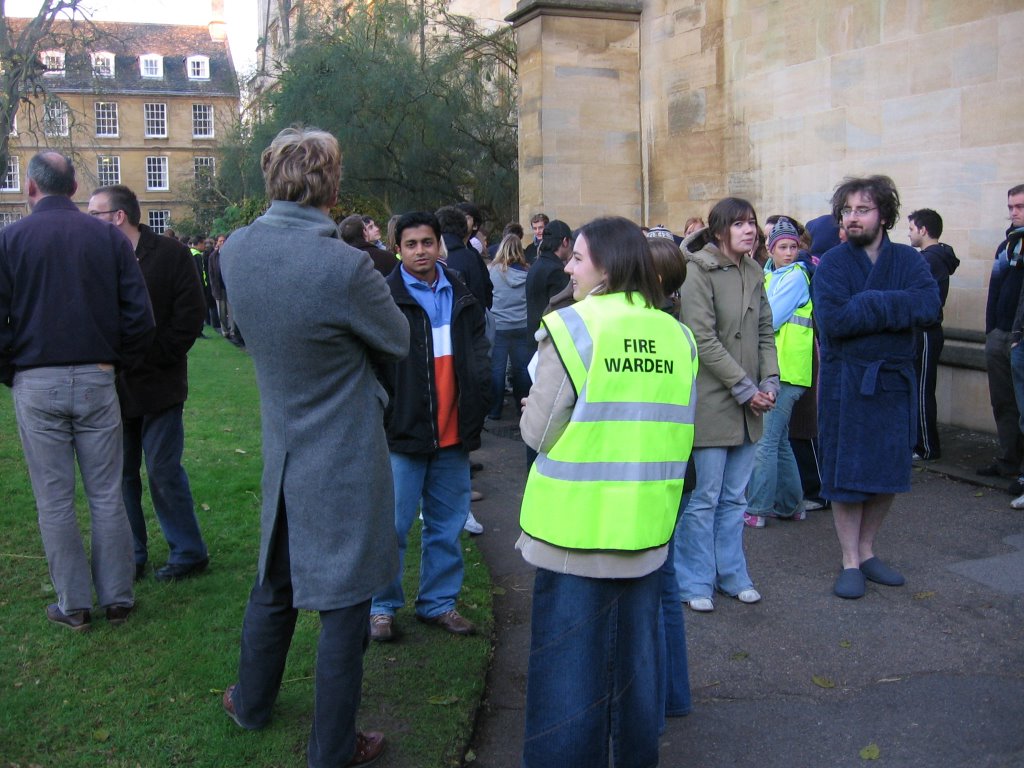
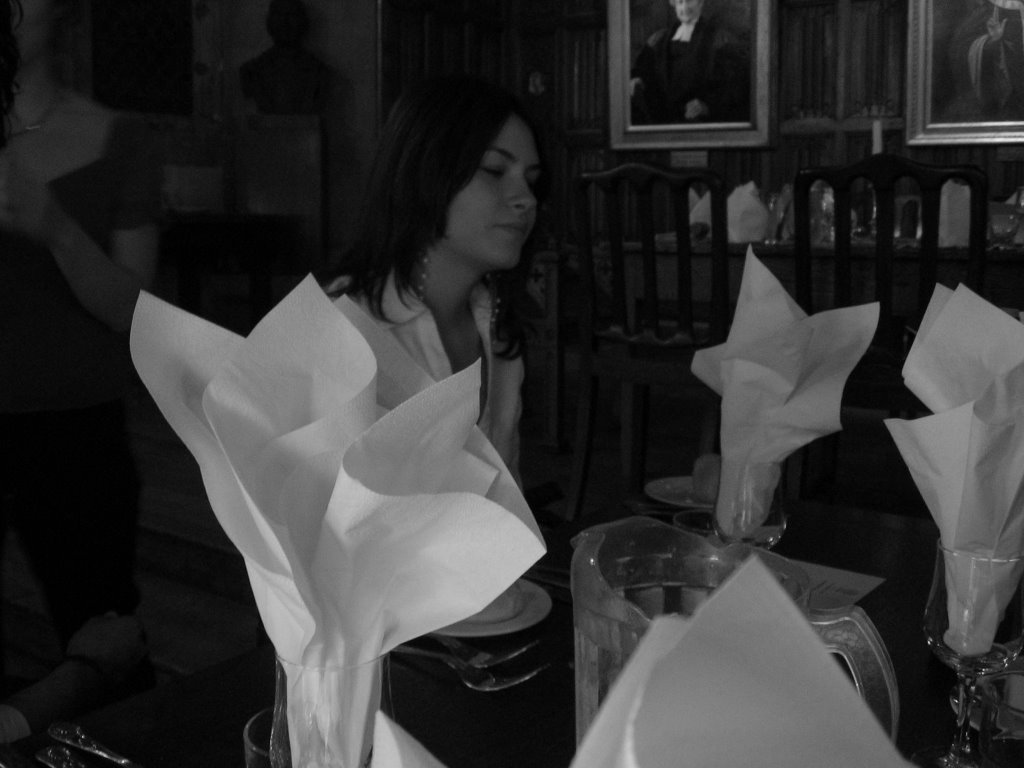
rinks with the Dean in the Old Library

…no more time for wistful diversions.

As with all prior Tuesdays – and all those coming soon – today was a long run of academic stuff. This is the kind of day best started with about a litre of coffee, served black. In the morning, I read about appeasement for a while before attending the core seminar. Charitably, Dr. Wright has assigned the topics for the next three weeks to particular people: freeing those who have not yet presented from the anxiety of not knowing when they shall. Likewise, in the cases where people will be called upon to give a second presentation, volunteers have been recruited. I am not among them.

As with last week, I decided to eat lunch instead of attending the Changing Character of War lecture nestled between our two blocks of classes. In the afternoon, I attended the quantitative methods lecture, and then worked with Claire and Alex on stats until it was time to wander over to the event with the Dean. Thankfully, this week’s assignment is rather more clear and comprehensible than its forebears. I am not overly apprehensive about completing it tomorrow morning.

As the photo shows, I was correct to speculate earlier that the event with the Dean would be informal. The event was fairly large and impersonal: with a short, generic speech delivered by the Dean and rather a lot of good finger-food. The tiny vegetarian pizzas alone probably accounted for more calories that I had consumed in the previous week, and the task of processing the lipids they contained is still far outstripping the task of contemplating tomorrow’s statistics assignment, in terms of what percentage of my energy I can assign to it.

As a group, the M.Phils managed to submit a signed statement about the statistics course to the department today: endorsed by 27 of the 28 people in the program. The final text looked much like this (link to RTF), and the document had an impressive air of solidarity, with all our signatures laid out in two columns. Let us hope that it induces some change, as well as a widespread knowledge that much is rotten in the state of STATA. While the head of the program told me, today, that “constitutionally [he is] not empowered to conduct high level intervention,” I am hoping very much that someone shall.

On the social front, Madjdy has kindly invited several other members of the M.Phil and I to the guest dinner at New College on Friday. Just a ways up Hollywell Street, New College is among the closest of the other colleges. It is also a rather larger and more substantial seeming place than Wadham. Included within it are a massive Aztec-style pyramid in honour of Oxford’s plague victims and the remaining portion of the Oxford city walls. Margaret tells me that the mayor of Oxford is charged with walking atop them once a year, to ensure that they are in good order. I am looking forward quite a bit to taking up Madjdy on his kind invitation.

Also to be looked forward to: Alexander Stummvoll, another of the IR M.Phil students, has invited me to the screening of an Italian film at St. Antony’s on Wednesday the 16th. Title T.B.A. (It’s an odd, but not unpleasant, fact that I seem to do more college events outside Wadham than within it.)

Also balancing out school a bit is the prospect of becoming involved with a club. Bryony has suggested that I join the Oxford University Walking Club. It costs much less than the Oxford Union and offers the chance to do something I would be rather keen on, namely explore the U.K. outside of Oxford. Any Oxfordians interested in more information can join the club’s mailing list by sending a blank email to this address.

PS. Tomorrow, it is crucial that I secure some research materials from the SSL, as well as completing my third stats assignment. The following papers are upcoming, and must be kept in mind:

  • 17 Nov: (Dr. Hurrell) To what extent was the victory of the Chinese Communists influenced by external powers?
  • 22 Nov: (Core Seminar) How far were the war aims of the Big Three influenced by the ‘lessons’ of the inter-war period?

PPS. I also need to do something urgently about my increasingly overdue battels and fees. In a development that has me literally pulling out my newly-shortened hair, I got this message from the Bank of Montreal tonight:

Unfortunately, your funds could not credit to your account in UK because the International said wrong account number is XXXXXXXX. Please make sure that your account number right. your funds have been credited to your BMO account. 

Words just cannot express the frustration of getting a response like this after a month of mailing this and that piece of paperwork. Especially since, as far as I can tell, the blocked out number is correct. Oh, and they charged me $60 for the failed transfer anyways.

Cowley Road, a supervisory meeting, and the Gulf Islands

Cowley Road ArtThis morning, I went to Cowley Road and got a haircut, as well as three bottles of Nando’s Extra-Hot Peri Peri Sauce. Along with Blair’s Original Death Sauce, I maintain that it is the tastiest hot sauce that is commonly available. The fact that there is a Nando’s in Oxford may considerably increase the likelihood of my brothers visiting here, especially Sasha. I have had to drag both of my brothers, practically kicking and screaming, into Nando’s and Anatoli Souvlaki: the initially alien venues that are now their favourite places to eat. Somehow, the experience never translated into genuine culinary adventurousness. Thinking back on the variety of reasonably priced and excellent restaurants in Vancouver makes for a grim contrast with my experience in Oxford, where virtually everything I have eaten has been raw and from Sainsbury’s, and where I haven’t eaten out a single time at a restaurant.

I got the hair cut for nine pounds at a place called Saleem’s: run by a young Palestinian man with a cousin in Toronto. He had an extremely aggressive style of cutting hair which, along with his very dull scissors, meant that quite a bit was more torn out than cut. That said, Nora, who actively counselled against the shortening of my hair, concedes that it could be rather worse. While shortened hair might not be the best thing to accompany cold and wet days in Oxford, I just feel better with hair that never enters my line of sight.

In the evening, I met with Dr. Hurrell in Nuffield to discuss my paper on the Middle East. Partly owing to how busy the period leading up to last Wednesday was, it was not my best work. It suffered particularly because nobody but me looked it over before it was submitted. Going all the way back to editing high school essays with Kate, I have been highly appreciative of the contribution an intelligent and critical external eye can bring to a piece of thought. Nonetheless, Dr. Hurrell and I had a good discussion. I am learning that the most important thing for writing something that will please him is clear structure and the energetic interrogation of the key terms in the question. Sloppy analysis earns a minor rebuke, at best, even when it can be defended orally. I look forward to when the supervisory relationship becomes one more oriented to directing me towards sources and methods of research, in preparation for the thesis and major optional papers.

In the next ten days or so, I am to write Dr. Hurrell another paper either on whether appeasement is a useful or defensible concept, in the context of the 1930s, or the extent to which the victory of the Chinese Communists was influenced by external powers. Since I will need to do more reading on the latter anyway, I may write on that. It’s worth recalling that the Tuesday after next, I have another paper due for the core seminar.

Tomorrow evening, all of the new graduates are invited to have drinks with the Dean of Wadham in the Old Senior Common Room. I am not sure how formal an event it is but, this being Wadham, it couldn’t possibly be worse than shirt-and-tie. It will be good to see a few of the grad students who don’t live in college and who I therefore have not seen since 0th week.


Last night, I dreamed about the Gulf Islands. Located in the Georgia Strait, between the mainland of British Columbia and Vancouver Island, this collection of small communities is both curiously isolated from the rest of B.C. and uniquely able to embody the spirit of the province.The last time I set foot on one of these islands was in the period before moving out to Oxford. Along with Tristan and his brother, I spent a day cycling from one end of Galiano to the other. I have a few photos from the trip online. The best things about it were the view of the ocean and other islands that we had from the top of the bluff where we ate lunch and the rather enjoyable dinner which we had at a small restaurant fairly close to the ferry terminal at the end of the day’s long ride.

All told, I’ve spent a considerable amount of time on and between these lovely, Arbutus-strewn places. In early high school, along with the gifted program at Handsworth, I went on a week-long kayaking trip between them. Similarly, I took part in two week-long sustainability conferences organized by Leadership Initiative for Earth, each of which took place on a tall ship as it moved between the Gulf Islands. On the first voyage, I met Jane Goodall aboard our tiny, wind swept ship: The Duen. On the second voyage, I was assigned to the largest vessel: the Pacific Swift, where I met David Suzuki and got to help coordinate the movements of the fleet.

While I am not sure if Bowen Island and Gambier Island can be called part of the Gulf Islands, as they are located northwest of Vancouver, inside Howe Sound, there is much that marks them out as similar. Gambier Island is the home of Camp Fircom, where I volunteered for two summers as a leader. Almost all of my North Vancouver friends were Fircomites at some point: Nick, Neal, Jonathan, Emerson, Caity Sackeroff, Alison Atkinson, as well as scores of acquaintances. Camp Fircom was a modest place, with a far more restricted budget than some of the neighbouring camps run by more evangelical churches. It may please some and irk others to know that I was entirely at home there as a committed athiest.

Bowen Island is dominated by the bulk of Mount Gardner: one of my favourite smaller mountains in the Vancouver area. I remember with great satisfaction the time when Meghan and I climbed it together one day, in lieu of attending the drunk and disorderly Arts County Fair event which messily concludes each year at UBC. I remember looking out from the helipads on top, there to service the telecom equipment located up there. From that vantage, you can see the Sunshine Coast stretched along the mainland to the north and the mass of urban Vancouver stretching out eastwards and southwards. Bowen has also been the location of several excellent parties I have attended, at the homes of two former professors. I tip my metaphorical hat to them, in case they may be reading.

My favourite of all the Gulf Islands, though, is Hornby Island. That expression will be instantly understood by anyone who has ever spent time there. It is an almost pathologically laid-back, carefree kind of place. It’s the sort of place where sitting in the shade, inside an inner-tube, reading the short fiction of Isaac Asimov for a few hours marks that one out as a particularly productive day. It’s also where I met Kate: the fascinating young woman who walked past the cave in which I was reading The Catcher in the Rye and who I spent the rest of my time on the island in as close contact to as circumstances, and juvenile existential dread, would allow.

Like the Cinque Terre, the Gulf Islands are a place where I would like to eventually write a book. These places have no particular resources for that purpose, save the sea and the mountains, as well as the calm atmosphere. The Gulf Islands, in particular, are the kind of places that you can never entirely manage to leave: they linger like an outlier point that drags your whole understanding of the world away from its former mean.

PS. Jessica suggests that I should include more descriptive titles, as well as explanations for where links go. This I shall endeavour to do.

Recalling my first European visit

Kelly in the JCR Bar

Today was dark and rainy. It involved little more than sitting in different parts of the Social Sciences Library reading The Economist, Donald Watt’s How War Came, Anthony Adamthwaite’s The Making of the Second World War, and the collection The Origins of World War Two: The Debate Continues, edited by Robert Boyce and Joseph Moile. In spite of reasonable efforts to do so, I don’t feel particularly compelled to read for this week’s topic, on appeasement during the 1930s. That said, it is fairly likely that Dr. Hurrell will assign me a paper on it during our meeting tomorrow.

Despite a period in the JCR bar with Kelly and Nora, a phone call home, and the doing of laundry, today certainly cannot be considered a particularly energetic one. As such, it seems a better idea to use this space describing something else.

The first time I went to Europe was before Sasha, my youngest brother, was born. Mica, the brother who is either two or three years younger than I am, depending on who has already had a birthday that year, was still drinking out of the kind of bottles that infants are like to. Very clearly, I remember a piazza, somewhere in Italy, when on a hot and sun-struck afternoon, Mica and I splashed each other and sprayed water at one another out of the aforementioned bottles. 

During that trip, I tried swimming for the first time, as a place called Spagio Romea. I remember this large, toadstool shaped protrusion in the shallow end of the room that stood over it like a massive umbrella. A sheet of water would pour over its rounded top, then fall like a glassy plane before breaking frothily at the boundary with the pool’s surface. Aside from the new experience of swimming, quite possibly the best thing about Spagio Romea was the unending supply of free Mentos candies: a thing that had not yet been seen in North America.

When I was rather younger than I now am, but not nearly as much younger as when I first went to Italy, I spent a lot of time swimming. For several years, the smell of chlorine never really left my clothes and hair. During my later years there, I remember cycling from Cleveland Elementary School – which Jonathan, Alison, and I attended – to William Griffin Pool, through Edgemont Village.

Back then, the Red Cross designated swimming levels by colours: beginning with yellow and ending with white. I had to take maroon at least three times, but ended up finishing white and life-saving II before my age would permit me to move on to the next level, which I believe was called Bronze Cross. After two years of not swimming with any regularity, while I was becoming old enough to take that course, I found myself quite completely unable to do so. As I am sure anyone who has done something quite actively, several times a week will know: you can’t just take a two year break and then begin again where you left off.

I haven’t really swam since, except once in a while and always with the pressing knowledge that I used to be rather better at it. Even though I still enjoy doing it, the gracelessness with which I manage it is more than enough to dissuade me from doing so except under the most casual of scrutiny. Ineptitude that you have always possessed can be laughed off, but newfound ineptitude is a mortifying thing.