

Author: Milan
In the spring of 2005, I graduated from the University of British Columbia with a degree in International Relations and a general focus in the area of environmental politics. Between 2005 and 2007 I completed an M.Phil in IR at Wadham College, Oxford. I worked for five years for the Canadian federal government, including completing the Accelerated Economist Training Program, and then completed a PhD in Political Science at the University of Toronto in 2023.
Low feelings
It is hard to say when it began, because the stress and loneliness of the PhD blended into my post-PhD feelings, but it’s quite fair to say that I have been feeling consistently low at least since I learned that I would have to leave my old home in North York in March.
One big contributor is surely the feeling of anticlimax after the dissertation was released. This wasn’t some obscure academic tract about an issue of specialist interest, but a very current-day analysis of humanity’s most pressing problem. I was expecting, or at least hoping for, debate and pushback from people in the activist and policy communities. So far, the most substantial response to what I wrote has been a half-hour discussion with my brother Mica and his wife Leigh when they were visiting Toronto. In the dissertation I express my worry that — even though their aspiration and plan is to change the world — activists get caught up in routine behaviours like marches which occupy their time and effort but do little to change minds or policy. The total non-response to my research so far is a minor bit of additional evidence that activists aren’t generally too compelled by external analyses of their efficacy.
Another dimension is no doubt simple isolation. The layers have been stacking for me in that area: it’s harder to make and keep friends as an adult, it’s harder when you’re no longer a student, and it has become harder as people have pulled their social attention inward to a small group during the pandemic. Getting anybody to attend any sort of event has become substantially harder, and as corollaries the events that do happen have less attendance and energy and there are fewer events.
Another item for this decidedly non-comprehensive list is my sense that most of the people who I know (or, at least, peers and younger people — the dynamics of the affluent and established are different) are not doing well. People seem stymied in achieving the sort of adult lives they want, and especially in finding any sort of work which is psychologically and materially rewarding. It feels like to a large extent our parents got rich and retired, but most of us have never been able to move up into the positions they held at our stage of life. As with housing, there is a feeling that the older and best-off parts of the population have grabbed everything and are keeping it for themselves. This feeling becomes especially embittering when paired with the knowledge that they are actively choosing to hand over a ruined planet to their descendants every time they keep electing leaders who keep the future-wrecking fossil fuel industry going.
It is hard to escape the feeling that I have spent the last 20+ years building up for what I thought would be an intense period of intellectual effort, civilizational re-consideration, and mass political re-organization… and have found myself instead in an epoch where smaller-scale but acute disruptions have monopolized public attention to the point where we seem to be paying even less attention to the big trends than we were 10-15 years ago. It’s very hard to feel optimistic about the future, and it is simultaneously profoundly alienating when society at large is choosing to ignore the existential seriousness of the crisis which we are in. Living among people who are likely to be remembered as history’s greatest wreckers (on the optimistic assumption that anyone will be around with luxuries like paper and literacy to write the history of the present) carries with it feelings of rage and hatred against everything around me: the cars pumping out their fumes in a million lines idling behind red lights, the kaleidoscopic variety in our supermarkets at the same time as we are smashing the Earth’s biodiversity and capacity to support us, the elections that still turn on trivialities even though the consequences of our choices are as serious as death…
Feeling that our civilization is such a disaster is utterly isolating, since our fellow human beings cannot help taking that personally as a criticism and rejection of their own lives and priorities. Meanwhile, it’s impossible to have any confidence in the future. Over the last 20+ years, humanity has shown that we are totally capable of knowing the consequences of our actions and the stakes being played for and still choosing to ruin the world which we inherited. As much as I sincerely delight in the possibilities and experiences of life, I don’t know how to avoid the feeling of being a witness during the time of humanity’s downfall.
First six days with Bike Share Toronto
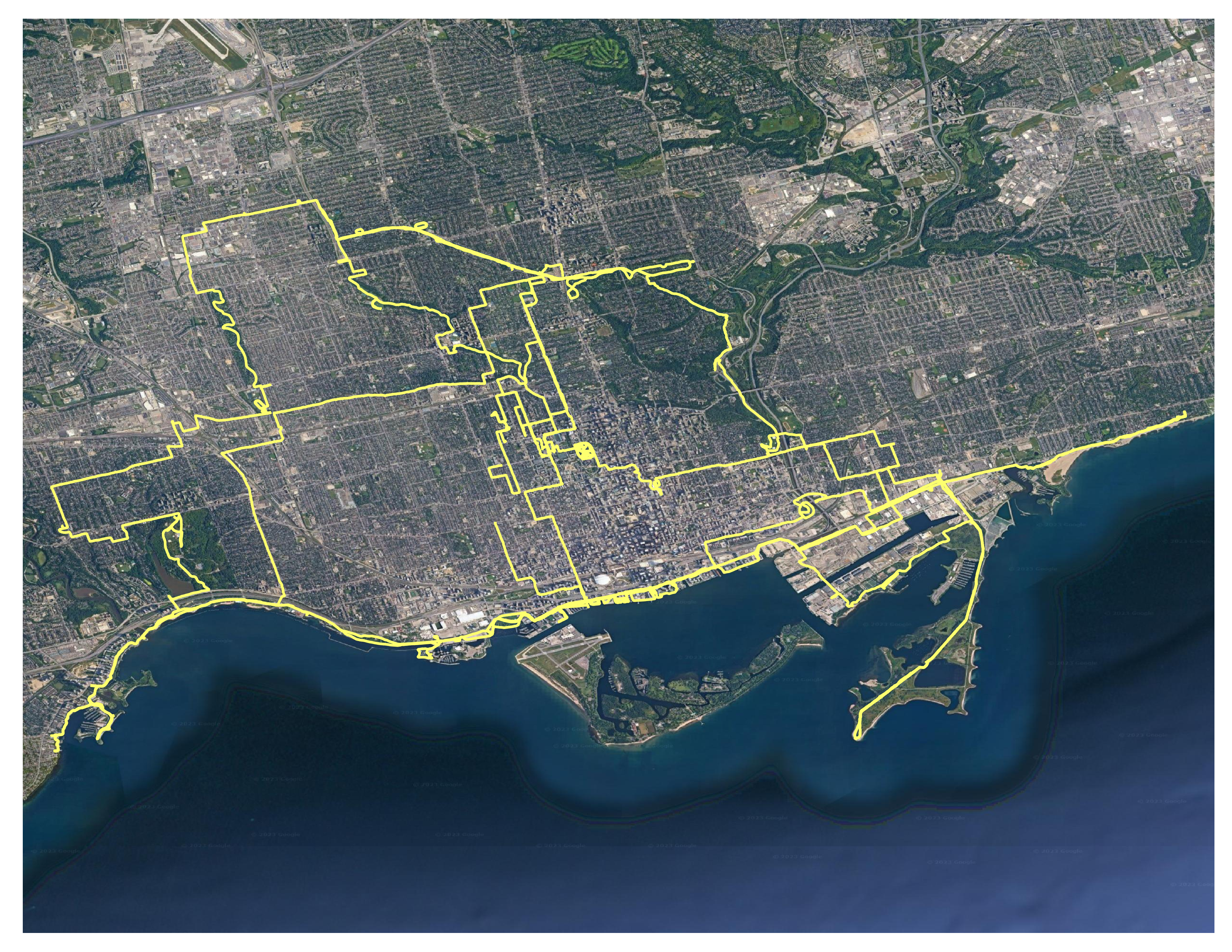
Σ 223.5 km
Anticipating 40
A news story today discusses how life expectancy for BC men has fallen slightly to about 80.
Reading that felt like an acute reminder that my 40th birthday in November is a probable halfway point for my life, though of course the population statistic and any individual’s experience can be quite different.
Thinking ahead to the event makes me wish I still had a large and active group of friends to bring together, an ongoing history of recent parties, or a place suitable for such a function. As it is, with friends so spread out and largely dormant, it would probably be depressing to try for a large gathering and end up with a small one and a lot of ‘regret that I cannot attend’ messages.
I have been getting struck sometimes recently with the pain of knowing some memory is forever lost and unrecoverable. Seeing Vancouver and family albums there was a reminder that, even for those with privileged lives, the past and the kind of events that characterized it become inaccessible, both because relationships and the wide world change progressively and irreversibly.
I don’t know what I want to do for the event, but I am thinking with new seriousness about it now that it feels more like a moment to take stock, celebrate and mourn what has happened so far, and try to apply any wisdom learned for the future. I wonder if anyone has ever marked their 40th with a half funeral or installation 1 of 2 of their memorial service?
Holding a lease
The period since at least July 22nd has been so consistently busy that I haven’t had time to pause and think any of it through.
There are photos from the Yellowknife to Vancouver drive and from my time in Vancouver.
The one big Toronto achievement is that now, for the first time since I came to the city in 2011, I am on the lease for a place to live. It’s expensive (adding to the urgency of the job hunt) but I have protected long-term legal status there. After having to move probably 40 or more times during the PhD, it will be a comfort to have a place I can more fully rely upon.
China’s despondent youth
Unemployment among urban Chinese aged 16 to 24 has been running at over 20% for months, about double the age group’s pre-pandemic level. The official job numbers for this group are so stubbornly awful that China recently stopped publishing them altogether. Higher education is no longer a reliable ladder to a solid career. Our calculations show that in 2021 over 70% of those unemployed youngsters were graduates. Along with scarce jobs, they face sky-high property prices. Their modest dreams of finding work, buying a house and supporting a family seem increasingly out of reach.
…
Yet there is a growing feeling among young people that no matter how hard they study or work, they will not be rewarded with a better quality of life. They speak of neijuan, or “involution”, an academic word used to describe a situation in which extra input no longer yields more output. The idea was captured in “A Love for Dilemma”, a popular tv drama released in 2021. In the show, two characters liken the competition in educational attainment to an unruly audience at a cinema: someone stands up to get a clearer view, which obliges everyone behind them to stand. Then people climb on seats and ladders. But in the end, despite all of their effort, no one is able to see the screen any better.
People commonly assume that China’s wealth and power will rise and rise, eventually eclipsing that of rich western democracies. I am personally far more skeptical. An authoritarian and conformist society, led by a Communist Party that holds its own grip on power as the greatest good, has fundamental limits in innovating, productively managing societal tensions, and excelling. I think when your education system has systematically misled the country’s youth about their own history, you will end up with a society that struggles to understand itself well enough to cope in an area of disruptive environmental change.
Furthermore, China has copied many of the worst lessons from the capitalist west, and is building a car-based consumerist society of endless suburbs and shopping malls. That is not well suited to the harsh and destabilizing future which we all all building through our profligate fossil fuel use.
China’s demographics are also a major challenge to its ability to keep growing in wealth and power. Especially in a society that rejects immigration, having a huge bulge of retirees being supported by fewer and fewer working people may be even more of a challenge for China than for the west, given that the CCP’s claims to legitimacy now centre on maintaining order and sustaining growth, rather than any recognizable communist ideology.
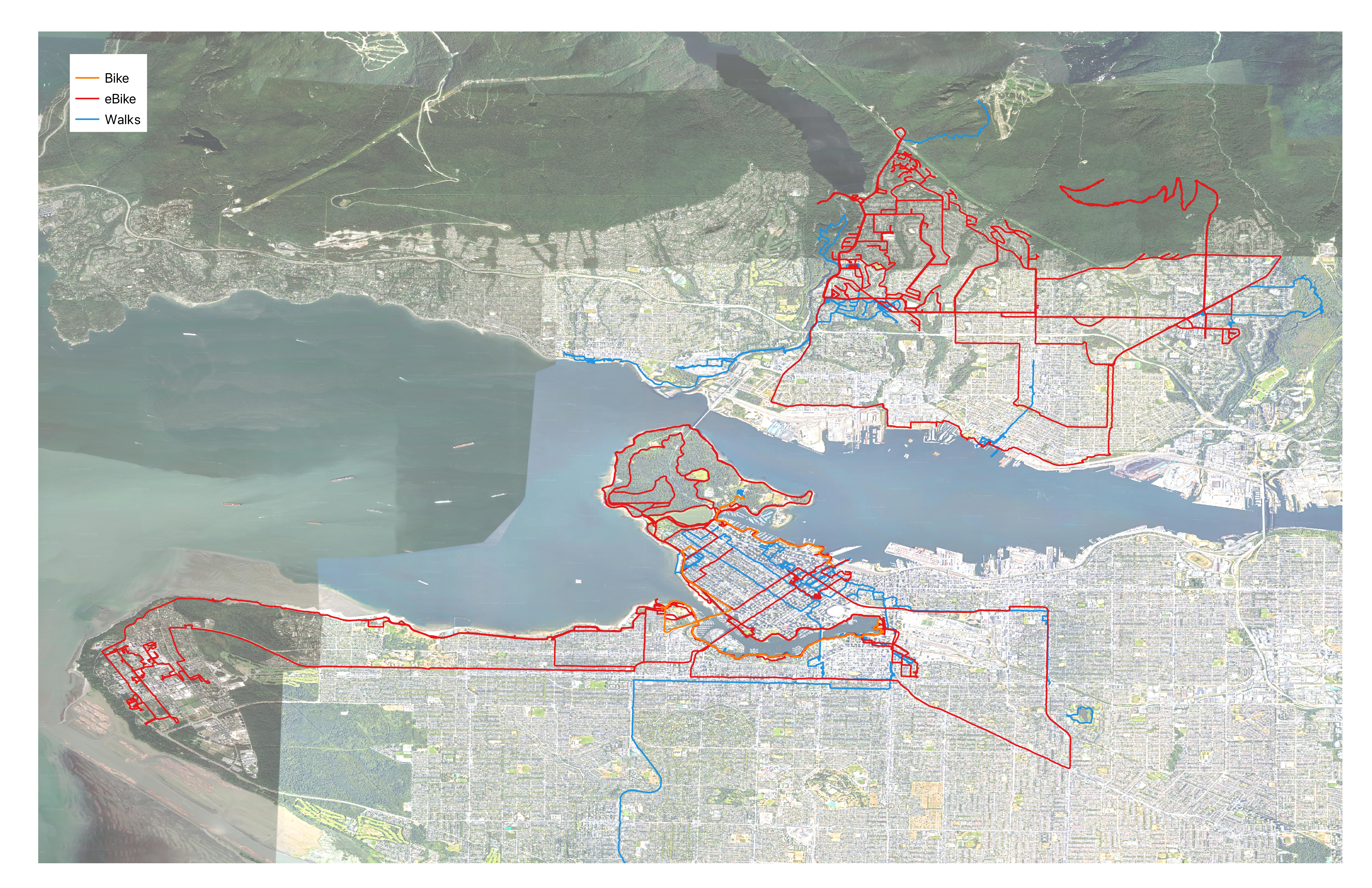
An ebike is a great way to see Vancouver
Critical Mass Vancouver, July 2023

Milan Ilnyckyj at July 2023 Critical Mass in Vancouver, by @jordanvegbike
By happenstance or grace I ran into the best Vancouver Critical Mass in years when the library ushered me out at 6pm. It was my first bike ride in 11 years, and my first e-bike ride ever, on a rental e-bike available right beside the mustering area north of the old art gallery.
Critical Mass is one of the most brilliant forms of non-violent direct action ever devised. Today’s Vancouver ride showed me the city like I never saw it in 22 years growing up, and felt like the safest bike ride I ever took. Safe in the middle, I never worried about a single car. There were pairs of kids on the back of long e-bikes; dogs in carriers wearing goggles; several audio mixes from portable speakers in different parts of the mass; and a lot of good grace and patience — as well as a great deal of overt support — from pedestrians as well as drivers.
Vancouver
We have arrived safe in North Vancouver via Kamloops, Lillooet, and Whistler — managing to avoid any major fire delays more by luck and Sasha’s dedication behind the wheel than by foresight and planning. He did all our driving in three back to back days, and did today’s stretch through the heaviest traffic, steepest and twistiest roads, and our only night driving of the voyage.
We worked in a few short pauses to enjoy the views from the mountains. I hadn’t realized how beautiful the area around Lillooet is, with a semi-arid landscape, rocky peaks overhead, and vertiginous drops into the river canyon. It would be a fine place to return in no hurry and with a tripod and landscape photography gear. A hot tip from a German man at a roadside viewpoint took us on a ten minute hike to a stunning panoramic view at 50.65983, -121.98589.
A stop in Pemberton yielded kimchi and pulled pork sandwiches and smashed fries, which seemed just right as our last rest and meal of the journey.
After a night in tents and three solid days of driving, the last stretch in the dark through Whistler and Squamish had Sasha showing his only noticeable fatigue of the journey, which we countered with lively songs and an effort I made to dance in my seat to kinetically counteract the idea of tiredness.
Our parents welcomed us late in the evening with great hospitality and kindness. Because of the fires and the importance of Sasha not driving when too tired, I had been planning based on a five day drive with two extra days for delays and detours. As a result, I am in Vancouver with five days before the next phase of this visit is to begin. To pack light, I omitted to bring any camera gear, so my hope of digitizing the family albums on this visit is set aside.
While the time together was joyful and rewarding, we did spend the day very concerned about the fire threatening Bechoko. I watched the news and fire map updates while Sasha kept up with friends over messages and social media. The danger there is great and everyone has been directed to evacuate, and the structures and environs of the community are in peril. All we can do now is hope that the three homes that have already been lost will be all that are taken, and then regardless of the actual damage realized during this fire season do what we can to support the people impacted. I wish this unprecedented fire season was having a decisive political effect, pushing the public and politicians to accept that it is madness and a profound and irreversible betrayal of the young to keep producing and expanding fossil fuels. It isn’t really prosperity when you get or stay rich by burning up the prospects of those who will come after you, but our cognitive blockages to accepting and taking responsibility for the consequences of our actions continue to paralyze us into accepting a world-wrecking status quo. I don’t know what can break that complacency, but the way in which we carry on heedlessly incinerating the future with our coal, oil, and gas dependence is setting us up to be justly remembered as the generations that squandered the common heritage of humankind for the sake of our own ease and enjoyment.
Valemount addendum
The hours of predicted rain ended up being a few drops while we were camping — and we were lucky enough to decamp in dry conditions. Now we are heading southwest to try and make our way through Kamloops despite the fire. If we can, we may pause in Manning Park for a hike. It’s 680 km from Valemount to my parents’ house, if we can take the most direct route with no detours, so there is a good chance we will sleep there tonight.