Man of letters

Since I got my fountain pen and pad of brown, lined, recycled paper, I’ve written about thirty letters: ranging from a few short paragraphs to one of several hundred pages. There was a time, about eight years ago, when I wrote a great many handwritten letters: probably more than a hundred in all. In one of the more cruel things ever done to me, a few years ago the recipient demanded to return or destroy them, en masse. I certainly didn’t want them returned, but I really hope they haven’t been destroyed for want of attic space. They were written during an incredibly embryonic time and, idiotic as they doubtless are in the greater part, I think of them as a partially externalized version of myself as I was and wanted to be. I want them out there as a challenge to the blurring of memory in response to time and new events.

Since then, I’ve been both too ashamed of my atrocious handwriting to write many things by hand. I have also been concerned about having information out there of which I have no record to back up recollections that inevitably become hazy with time. The greatest force that has changed my mind recently is the sheer and impossible volume of computer generated text: whether blog, email, or printed letter. In the face of such a flood of information, it is increasingly hard to get anyone (including myself) to pay attention. As a consummate record-keeper, I do have virtually every scrap of electronic information ever sent to me archived and searchable. Even so, I am far more likely to re-read the few letters I have received since arriving here (the rest being safely entombed with photographic negatives back in North Vancouver).

I’ve just finished writing a letter of the sort that you hope will become a bulwark between a past mistake and all the future. As always, there is no certainty that a few flimsy pages can prove so solid, but I shall hope and see.

Warm night

Streetlamp base

Tonight was the first time this year I’ve walked home at night in short sleeves and felt entirely comfortable doing so. Naturally, it reminded me of all the best times when I’ve been able to wander around in cities on bright, cool nights just after the sun has set: after Judo lessons back in North Vancouver, with Alison and Viktoria in Toronto last summer, and during the summer language bursary program in Montreal. In all those and other cases, I remember the incredible sense of ease that accompanies being free and comfortable in uncrowded streets.

The psychological effect of the pleasing climate is enormous, because it changes the way you feel about being in territory that isn’t under your control. During the icy morning in Chichester, frigid walks in Helsinki, or confused meanderings in London during the winter, I was always plotting where I would get some food, where I could get warm, where I could sleep. This leads to calculations of how long you can linger in a Starbucks with or without buying a drink, what time warm open spaces like malls and bookshops close, and how far you have wandered from the nearest place that you have a key or friend that can yet you into.

Wandering on a warm night, by contrast, projects at least the fiction that all the world is reasonably hospitable: that you can wander almost anywhere with few worries and comfort and adventure are simultaneously possible.

Another Oxford bloggers’ gathering?

The first Oxford bloggers’ gathering happened on 29 October 2005.

The second, on 21 February 2006.

If they are to be quarterly, the third is due fairly soon. Provided, of course, people are still interested. I am perfectly willing to shift from the format of meeting in the evening at The Turf, if people prefer something else. Indeed, meeting at The Perch on a sunny afternoon seems much more spring-like.

Remember, those who show up automatically get a spot at the top of my list of Oxford blogs.

[Edited on 15 May 2006 to add] I propose Wednesday of sixth week (the 31st of May) as the date for this event. Additionally, I propose that it take place at The Turf, as in the two prior instances. I’m not sure many people would be willing to make the trek to The Perch, much as I think it would be nicer. How is 8:00pm for a starting time?

[Edited on 17 May 2006 to add] Because The Turf will probably be packed with finalists, we have decided to relocate the gathering to The Bear: south of the High Street and fairly close to Merton College.

PS. On an unrelated but amusing note, thanks to the new Google Trends service, I can prove that more people are searching for love, but there is consistently more news about money.

On the Road

This afternoon, I finished Jack Kerouac’s On the Road. The experience was a familiar one. To begin with, everything about the book was interesting: the language, the characters, the setting. But as it went, you got the increasingly powerful sense that everything described was pointless. The desperation of it is captured by a section from the end of part three:

All the cigarette butts, the bottles, the matchbooks, the come and the gone were swept up in this pile. Had they taken me with it, Dean would never have seen me again. He would have had to roam the entire United States and look in every garbage pail from coast to coast before he found me embryonically convoluted among the rubbishes of my life, his life, and the life of everybody concerned and not concerned.

Nobody was really doing anything, and it wouldn’t have mattered at all if everything described just hadn’t happened – disconnected stories and disconnected lives. The constant hyperbole on the part of the narrator contributes to that sense that nothing fits together, that everything is the superlative form of its genre, and that every statement has no real relevance beyond the moment in which it is made.

Perhaps the most interesting thing about the book was the sort of communal madness described between the characters: when they seemed to understand one another while exchanging stories and meanings that were opaque to everyone else. You have to wonder if there’s anything to it, or whether both speakers and listeners are deluded about the content of their exchange. Whether they’re just talking to themselves in insane tongues, prompted by the noises around them. It makes you wonder if whatever mechanism that clicks to one side or another in the brain, separating the plausible from the inaccessibly strange, actually operates according to some comprehensible logic, or just based on strings of obscure past cues and approximations.

I probably came to the book looking for the wrong thing, not a glimpse into a previous and mad generation but some kind of message for the present. I suppose most such messages end up being cautionary ones, about how lives can just whiz around infatuated with destructive madness. By the end, I was reading it much too quickly. I was sick of the road long before the characters were ever able to be.

Presentations on Africa and the environment

Row of houses

My mother kindly sent me another book today: Thomas Friedman’s The World is Flat: A Brief History of the Twenty-First Century. I’ve heard a bit about it before, but remember virtually nothing of what was said. As I recall, The Economist was quite critical, but they don’t seem to have a great deal of patience when it comes to a number of alternative views about globalization. Once I finish On the Road and The Skeptical Environmentalist, I look forward to going through it as the next object of discretionary reading.

Aspects of today’s Environment Centre colloquium were quite good. I enjoyed the Vancouverite atmosphere, as well as the presentation by Guardian columnist George Monbiot. Particularly impressive were his historical asides, though his main argument came off as a bit of an afterthought. Spending time with so many people doing environmental studies was a reminder of just how completely outside the discipline I really am. The contrast in the kind of discourse that took place there and the kind in our various seminars was considerable. I’ve never heard the term ‘environmentalisms’ so many times in one day. Some of the presentations struck me as interminably long, lacking in direction, and somewhat pointless: especially one in which the presenter literally skimmed through a 16 page Microsoft Word document he had on screen, correcting the spelling of words as he went, and making general comments about what was written.

The event at Rhodes House was informative but largely unsurprising – except where it was dramatically punctuated by the thunderstorm that materialized as it was ongoing. I had seen two of the speakers before, at a previous Global Environmental Governance seminar, and the presentations they gave were quite similar to those I saw before. I did enjoy the presentation on AIDS by Mandisa Mbali, a Rhodes scholar and organizer of the Stop AIDS Society at Oxford.


  • Meeting Taylor Owen, a fellow Oxford blogger, both at the Environment Centre event and, subsequently, after the Africa panel was good fun. Speaking with someone else who went to UBC – and who has a number of unexpected connections to Emily as well – is a reminder of how small a place Canada can be.
  • Likewise, I enjoyed Mandisa Mbali”s presentation on HIV/AIDS: delivered as part of the aforementioned Africa panel at Rhodes House. Tomorrow, I am going to an event being run by the Stop AIDS Society at 8:00pm tomorrow at Hollywell Manor, one of the buildings owned by Balliol College.

Sony Fontopia headphones are very poorly made

The Sony Fontopia MDR-EX71SL headphones that I got on the 3rd of March are already broken. This is hardly what you expect from a pair that cost more than $50. The cladding around the wires is made of really cheap plastic that bunches up and breaks down: even under the kind of delicate use to which I have been subjecting them. I was warned too late about how poor their durability is. It makes quite the contrast with the pair of Fontopias I bought in 2000, and which only failed immediately before I bought these ones.

I will try to have them replaced under the warranty. Otherwise, I am soliciting opinions about earbuds that have comparably good sound and dramatically better construction.

Before and after OUSSG

Arch in North OxfordI am going to have to be a bit cryptic tonight. The last six hours or so have demonstrated both how rapidly possibilities that seemed to exist can suddenly disappear, as well as how unknown prospects of different kinds can soon replace them. It may have something to do with the sheer compression of Oxford: compression of space, talent, ideas, ambitions, and interest. The only thing for it is to stick to what you are and your hopes about what you may become.

That, and make sure to invite staggering pairs of relative strangers home for tea, at around midnight on a Tuesday. Therein may lie the redemption of at least a day.

WordPress has taken over

As you can see, going directly to www.sindark.com will not take you directly to the new WordPress blog. I encourage people to register for a user account that will let you comment without leaving you information, and perhaps let me do fancier things later.

If you want the RSS feed, it is: http://www.sindark.com/feed/ Please update your BlogLines accounts and such. There is even a feed for comments, at: http://www.sindark.com/comments/feed/

Should you want to look at it, the old blog is still available at www.sindark.com/blogger/. It probably will not be updated any longer. I will not be moving the post pages or archive pages for the moment, so Google searches leading to entries on the old blog should still work.

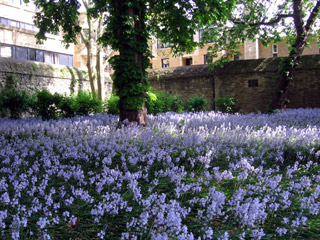
Oxford spring

House in northern Oxford

Living in leafy northern Oxford as everything is coming to life again is quite lovely. Taking a break from working on my paper, I went for a bit of a walk this evening and discovered a whole district of intriguing houses to the northeast of Church Walk: the sort with unusual architecture, big gardens, and streets that are not subject to the indignity of traffic. There were even the semi-circular sweeping rows of connected houses that seemed to be so common in Bath, but which I had not yet seen here. The next time I am ambling with someone, I will try to find the place again.

The best place to experience Oxford in the winter, I think, is the Christ Church Meadow. Walking along the Isis in the chilly wind, looking up at denuded trees which readily reveal the mistletoe colonies inside, there is a sense of pristine desolation. The waterfowl, then, seem like sympathetic fellow victims of the cold and gloom. It isn’t clear to me yet where the embodiment of spring in Oxford will reside, but it may well be in some leafy suburban street, amongst the twittering of birds in the evening.

Tomorrow, I have most of my week’s mandatory activities compressed together over a period of about twelve hours: the core seminar, the Changing Character of War seminar, the research design seminar, the strategic studies dinner, the strategic studies meeting, and the obligatory brief strategic studies foray to The Turf. During that time, perhaps I will meet someone interesting again this week.

Possibly as the result of trying to work on an essay for most of the day (with welcome conversations with Kai and Emily as asides), my brain is feeling a bit like a slightly crushed paper cup: as though it has had too much caffeine or too little, or is trying hard to suppress a relatively mild illness. It doesn’t make me keen on the process of finalizing and editing my Cold War paper tonight, but that’s my own fault for not getting it done earlier. Oxford has definitely been worsening my study skills; work I would have once done well in advance and had checked gets finished at the last minute instead. When the workload is just a series of hurdles and none of your work actually gets graded, the incentives tend towards encouraging such an approach.

Events in Oxford, Wednesday

For people in Oxford, there are some interesting events this coming Wednesday (May 10th):

Oxford University Centre for the Environment Symposium:
“What Future for Environmentalism?”

10.00 Introduction

10.05 Noel Castree, Manchester University, “‘The Paradoxes of Environmental Politics”

10.45 David Pepper, Oxford Brookes University, “Ecotopianism: Transgressive or Regressive?”

11.25 Andrew Dobson, Keele University, “The Invisibility of the England and Wales Green Party – Why, and Does it Matter?”

12.05 General questions and discussion

12.30 Lunch

1.30 George Monbiot, journalist and writer, “Just Green”

2.10 Diana Liverman, Oxford University, “Environmentalisms and the Response to Neoliberalism in Latin America”

2.50 Joan Martinez Alier, Barcelona Autonomous University, “Social Metabolism and Ecological Distribution Conflicts”

3.30 – 4.00 Final discussion and close

As far as I can tell, all of these events are taking place in their building on South Parks Road.

Many thanks to Taylor Owen for forwarding me an email about it. Such is the decentralized nature of Oxford that, despite being on every mailing list I’ve come across, I hadn’t heard a word about it before. There is also a lecture that evening:

The Africa Society and Rhodes Scholar Southern Africa Forum Joint Panel Discussion Series:
Framing the Continent in 2005: Implications for the Future

Marked by the Make Poverty History Campaign, LiveAid, the G8 summit, and the Commission for Africa, 2005 was dubbed by many as the ‘Year of Africa.’ As we move into 2006 it is worth reflecting on the impacts-positive and negative-of these high profile initiatives and the subsequent media attention.

5:00pm to 7:00pm
Rhodes House: Jameson Room

I will be attending both.

PS. A compilation of Oxford Environment related information and events can be found here. The OUCE website is very counter-intuitive if you are trying to figure out what’s going on there. I couldn’t even find a page with information on this Wednesday’s event.