Drugs Without the Hot Air: Minimising the Harms of Legal and Illegal Drugs

Psychologically active drugs may be the least rationally regulated part of our society, with one dangerous and addictive drug advertised and available everywhere (alcohol) and only nudges to disocurage the use of another that kills five million people a year globally (tobacco). Meanwhile, police forces and court systems around the world tie themselves up with investigating, processing, and incarcerating people who own or sell small quantities of much less dangerous substances.

David Nutt was appointed as chairman of the British Advisory Council on the Misuse of Drugs in 2008: an expert panel intended to provide non-partisan advice on drugs to the government. He was fired in 2009 after pointing out that the chances of getting hurt from an hour of horseback riding are about 30 times greater than the odds of dying from taking a pill of MDMA (ecstasy). His book Drugs Without the Hot Air: Minimising the Harms of Legal and Illegal Drugs covers some extremely interesting ground in a convincing and well-argued way.

Nutt describes how policy-making in the area of drugs is often driven by a combination of media-enhanced hysteria and an effort on the part of politicians to seem ‘tough’ on the issue. He categorizes many of the harms that result from this, ranging from criminal records acquired by youth (which harm their lives much more than drugs) to harsh restrictions on the availability of painkillers around the world, leaving many with terminal illnesses to die in a great deal of pain.

Nutt also provides a nuanced and interesting description of the nature of addiction, distinguishing between people who rely on steady access to a drug to control and underlying condition (as diabetics use insulin) and those whose use of a drug has been sufficient to give them harsh withdrawal symptoms when they stop using it, which in turn drives them into a cycle of continuous use. Nutt argues that treating addicts as criminals causes a great deal of harm to the addicts themselves and to society at large, through mechanisms including the suppression of scientific research, the discrediting of the law through its obviously unjust application, the enrichment of criminal gangs, increasing the spread of infectious disease, diverting attention from controlling alcohol and tobacco, and the indirect encouragement of more harmful drug-taking practices because safer alternatives are not available.

My copy of the book is sprinkled with a few typographic errors which I am told have already been corrected in the newest printing. It’s also a bit challenging to square a few of the claims about the relative dangerousness of drugs. Early in the book, Nutt describes a complex exercise in which multi-criteria decision analysis was used to evaluate the relative harmfulness of a variety of legal and illegal drugs across sixteen dimensions, encompassing both harm to the individual and harm to society. The ranking found alcohol to be the most destructive drug overall, followed by heroin and crack cocaine. Methamphetamine, powder cocaine, and tobacco follow. Lower in the list are amphetamine, cannabis, GHB, and benzodiazepines. At the bottom of the scale are ecstasy, LSD, and psilocybin mushrooms. Between ecstasy and benzodiazepines – about 1/3 of the way up the harmfulness scale – Nutt lists ‘butane’ – an inhalant. Later in the book, however, he characterizes butane as extremely dangerous and capable of killing people on the first use if misused. Perhaps the scale is based on the proper administration of the drug. Still, it seems like a drug that carries a significant risk of accidental fatal overdose should probably be rated as more harmful than drugs like cannabis which carry no such risk.

Regardless of the exact ranking of harmfulness that is most appropriate, the book contains a great deal of interesting information, as well as an informative chapter on what parents should tell their children about drugs. Nutt argues convincingly that treating drug addicts as people with a serious medical problem makes more sense than treating them as criminals, and lays out a good case for why the supposed ‘War on Drugs’ has failed. He also provides some interesting information on the functioning of the brain and makes some suggestions about how drugs of all sorts could be regulated to reduce harm. He does a good job of pointing out the hypocrisy in our treatment of tobacco and alcohol and makes some sensible suggestions for how states could effectively discourage the use of the latter.

All told, Nutt’s book provides a scientist’s take on the various substances people consume with the desire to change their thinking, as well as the consequences of the production and use of those substances for individuals and society. By repeatedly pointing out the many areas where policies are poorly informed by reality and counterproductive, he makes a strong case for the need for drug law reform. Both for individuals who wish to educate themselves about drugs and for policy-makers who aspire to regulate them more appropriately, this book could be a very useful reference.

Nutt is now associated with the Independent Scientific Committee on Drugs which has a great deal of useful information about drugs and harm reduction on their website.

Gardiner on climate ethics and moral corruption

In A Perfect Moral Storm: The Ethical Tragedy of Climate Change, Stephen Gardiner addresses the argument that a green energy revolution could be an exciting opportunity that benefits the lives of those who are alive today as well as those in future generations.

He characterizes this perspective as potentially interesting empirically, but largely unimportant ethically. It would be good if we could solve climate change while benefitting ourselves, but we have a moral obligation to address it even if doing so requires sacrificing things that we value in our own lives.

Generally speaking, Gardiner’s strongest point is that we are strongly psychologically disinclined to take responsibility for our contribution or to do anything about it. Because we have an intense desire to persist in climate-altering behaviours, we are willing to accept logically weak arguments for why we ought not to do anything, why we have already done enough, why the problem will solve itself, etc. He refers to this as “moral corruption”. In my experience, this self-justifying and self-deceptive behaviour is especially evident when people try to justify activities that (a) contribute very substantially to their personal carbon footprint, and which are (b) basically entirely voluntary and recreational.

Pullman on religion and authority

Over my last few commutes, I read Phillip Pullman‘s short and unusual book The Good Man Jesus and the Scoundrel Christ. It’s part of the Canongate Myth Series, in which “ancient myths from myriad cultures are reimagined and rewritten by contemporary authors”. The book isn’t easily categorized, but includes a few thought-provoking passages, particularly about how institutions imbued with authority tend toward corruption and abuse.

For instance:

“As soon as men who believe they’re doing God’s will get hold of power, whether it’s in a household or a village or in Jerusalem or in Rome itself, the devil enters into them. It isn’t long before they start drawing up lists of punishments for all kinds of innocent activities, sentencing people to be flogged or stoned in the name of God for wearing this or eating that or believing the other. And the privileged ones will build great palaces and temples to strut around in, and levy taxes on the poor to pay for their luxuries; and they’ll start keeping the very scriptures secret, saying there are some truths too holy to be revealed to the ordinary people, so that only the priests’ interpretation will be allowed, and they’ll torture and kill anyone who wants to make the word of God clear and plain to all; and with every day that passes they’ll become more and more fearful, because the more power they have the less they’ll trust anyone, so they’ll have spies and betrayals and denunciations and secret tribunals, and put the poor harmless heretics they flush out to horrible public deaths, to terrify the rest into obedience.”

And:

“Lord, if I thought you were listening, I’d pray for this above all: that any church set up in your name should remain poor, and powerless, and modest. That it should wield no authority except that of love. That it should never cast anyone out. That it should own no property and make no laws. That it should not condemn, but only forgive. That it should be not like a palace with marble walls and polished floors, and guards standing at the door, but like a tree with its roots deep in the soil, that shelters every kind of bird and beast and gives blossom in the spring and shade in the hot sun and fruit in the season, and in time gives up its good sound wood for the carpenter; but that sheds many thousands of seeds so that new trees can grow in its place.”

Perhaps this book is to the New Testament what Pullman’s “His Dark Materials” trilogy was to Milton’s Paradise Lost – a fictional re-appraisal with an emphasis on a re-interpretation of certain moral elements.

Periodic Tales

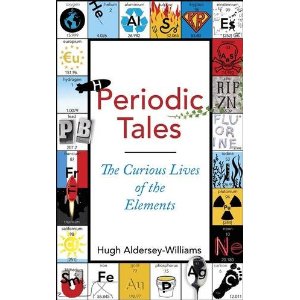
Hugh Aldersey-Williams‘ book Periodic Tales: The Curious Lives of the Elements shows off the author’s wide range of knowledge, willingness to investigate, and ability to tell a compelling story. Starting with gold and finishing with a pilgrimage in search of rare earth metals, Aldersey-Williams covers a fair fraction of the periodic tale – identifying the importance of elements not only in chemistry, but in diverse fields including art, literature, and theology. There are also many nice little nuggets of information, such as how Inuit steel tools were made from the nickel-containing natural stainless steel in some meteorites.

In addition to tracking down physical specimens of elements, the author tries to extract some on his own using natural materials said to be abundant sources (urine for phosphorus, kelp for iodine, even testing whether rotting herring luminesces). This admirable curiosity and willingness to undertake experiments adds much to the book.

Despite being about 400 pages, the book is a very quick read. It is well worth a look for anybody who is curious about the building blocks of the world or, alternatively, who is interested in seeing how the process of scientific discovery interacts with other human undertakings.

Gorbachev on the end of the Cold War

Following up on his exceptional books The Making of the Atomic Bomb and Dark Sun, historian Richard RhodesThe Twilight of the Bombs provides fascinating details on all matters nuclear-weapon-related during the fall of the Soviet Union and years afterward. For instance, there are many details on the clandestine Iraqi nuclear weapons program in operation after the first Gulf War, along with frightening details on the August coup against Mikhail Gorbachev and the protection of American tactical nuclear weapons in Europe during the later years of the Cold War.

One interesting passage Rhodes quotes comes from Gorbachev’s speech from Christmas Day, 1991 formally dissolving the Soviet Union:

“We had plenty of everything: land, oil, gas and other natural resources, and God had also endowed us with intellect and talent – yet we lived much worse than people in other industrialized countries and the gap was constantly widening. The reason was apparent even then – our society was stifled in the grip of a bureaucratic command system. Doomed to serve ideology and bear the heavy burden of the arms race, it was strained to the utmost… The country was losing hope. We could not go on living like this. We had to change everything radically.”

Rhodes, Richard. The Twilight of the Bombs: Recent Challenges, New Dangers, and the Prospects for a World Without Nuclear Weapons. p.116 (hardcover)

In another fascinating passage, Rhodes discusses the control systems in place for the Soviet nuclear arsenal during the August coup. With the particular combination of conspirators involved, it was not possible for them to make unauthorized use of the Soviet strategic nuclear arsenal. A different group of conspirators with different tactics and objectives, however, might have been able to circumvent the Soviet nuclear controls and use weapons without Gorbachev’s approval:

“‘There is an important lesson here,’ [Bruce] Blair concluded. ‘No system of safeguards can reliably guard against misbehaviour at the very apex of government, in any government. There is no adequate answer to the question, “Who guards the guards?”‘”

Ibid. p.95

Dire Predictions: Understanding Global Warming

While the 4th Assessment Report (4AR) of the Intergovernmental Panel on Climate Change (IPCC) represents the most comprehensive scientific assessment of the causes and consequences of climate change, the report itself is not written in language that is accessible to the average person. Written by climate scientists Michael Mann and Lee Kump, Dire Predictions is an accessible illustrated guide to the conclusions of the IPCC. It also includes some discussion of the practical, political, and ethical implications of the IPCC’s findings.

The 200 page book is a quick and easy read, even for those who are not well acquainted with scientific principles and terminology. It responds directly to many issues raised in the media (such as common climate change denier talking points) and it includes a great many illuminating charts and illustrations. It covers key concepts like what climate models are, and the reasons why we expect the planet to respond to a certain amount of additional carbon dioxide with a certain amount of warming.

The book is broken into five parts, covering climate change basics, projections, impacts, vulnerability and adaptation, and solutions. It very clearly describes which areas are well-understood scientifically and which areas contain substantial remaining uncertainties. Mann and Kump convincingly explain the core mutually-reinforcing lines of evidence that support the ‘big picture’ view of a world that is being dangerously warmed by human emissions, and in which greenhouse gas pollution must be reduced if major damage to humanity and the natural world is to be avoided.

The section on impacts is detailed and wide-ranging, covering everything from different projections of future sea level rise to expected impacts on global agriculture. It covers the trade-offs associated with different mitigation and adaptation strategies, and provides a brief overview of international efforts to address the problem. The section on solutions breaks down where humanity’s greenhouse gas footprint comes from, what options exist for reducing it, and what some of the economics of the situation are. Mann and Kump also do a good job of sketching some of the ethical issues associated with climate change, including the disjoint between the people producing emissions and the people likely to suffer most and the question of what represents a fair effort on the part of countries with different histories and present circumstances.

The book will be elementary to those who already have a through grounding in climate science and policy, though it may be a good way to get a quick and balanced overview of the whole subject. For those who are new to the topic or who feel confused about what the state of the scientific consensus is, this book would be an excellent place to begin.

Free speech online

The internet is one of the places where people in free societies get to exercise their right to free speech. It’s also a place where a lot of private communication takes place, and where the protection of the right to privacy is a constant struggle.

For those reasons, I suggest people consider joining groups that work to protect our rights as citizens online, like the Electronic Frontier Foundation.

Also, remember that the only way to preserve rights is to use them. Make use of your right to engage in political speech online (maybe a little anonymity too).

The Unfolding of Language

The key argument in Guy Deutscher’s The Unfolding of Language: An Evolutionary Tour of Mankind’s Greatest Invention grows out of the subtitle. Deutscher argues convincingly that languages branch and mutate much like species, though the process is different in that it occurs within and between the minds of human beings. People working to express themselves both concisely and forcefully continuously change their languages, building up complex grammatical structures and other linguistic elements while also shortening and simplifying and forgetting. As with biological evolution, the process of change leaves traces:

For whenever one finds impressive edifices in language, one is also likely to find scores of imperfections, a tangle of irregularities, redundancies, and idiosyncracies that mar the picture of a perfect design. (p.40 paperback)

All the complexities of this process exceed the scope of what any linguist or group of linguists can ever really track, since we are all involved in the re-invention of language whenever we communicate. Still, Deutscher is able to draw on examples from many languages to demonstrate and defend his argument, all while openly acknowledging the limits of our knowledge and the questions that can only be answered partially and by conjecture.

There are no doubt readers who will revel in every example in Deutscher’s 274 pages plus appendices, but I personally found myself well convinced of his basic thesis by the time I was halfway through. The key to understanding it comes in the second chapter, in which Deutscher draws attention to how we are all exposed to a whole spectrum of usage of any particular language during the ordinary course of life. We deal with upper class speakers who are pernickety about rules of grammar and with rebellious teenagers who develop their own cryptic argots and transfer patterns of abbreviation from text messages and Twitter into their love letters and academic papers. With so much variation at a single point in time, it is no surprise that language as a whole can drift across time, without ever creating solid breaks where people stop being able to understand one another. A word like ‘willy-nilly’ can go from meaning ‘whether you like it or not’ to ‘done in a haphazard way’ without anyone imposing that change on the language, and without the word becoming incomprehensible to anyone.

Speaking of this linguistic evolution generally, Deutscher says:

[T]his invention is not the design of any one architect, nor does it follow the dictates of any master plan. It is the result of thousands of small-scale spontaneous analogical innovations, introduced by order-craving minds across the ages. So while language may never have been invented, it was nonetheless shaped by the attempts of generations of speakers to make sense of the mass of details they have to absorb. (208)

Deutscher goes on to explain:

The elaborate conventions of language needed no gifted inventor to conceive them, no prehistoric assembly of elders to decree their shape, nor even an overseer to guide their construction. Of course, saying that language changes ‘of its own accord’ does not mean that it evolved independently of people’s actions. Behind the forces of change there are always people – the speakers of a language.

For my part, I am trying to change the general convention on punctuation and quotation marks. It would also be nice if English dealt with possession and contraction in a less confusing way.

Deutscher’s account of metaphors in language is also convincing and worthy of attention. He shows how we reach out to metaphors in an effort to make our points clearly and forcefully. (So many metaphors, when you start looking! Reaching out! Points! Clarity! Forcefulness! All concrete concepts being used to express abstract ideas.) The book is also scattered throughout with charming little facts about the history of words and how they have changed across time, including extremely common words with non-obvious origins. Deutscher also makes good use of humour in pointing out some of the stranger aspects of language. For example, Deutscher quotes Mark Twain’s priceless poem mocking German along with doggerel making fun of the inconsistencies in English spelling.

Deutscher’s book was recommended to me by Stephen Fry- not directly, but in his comforting and inspiring ‘podgram’ on language. I made extensive use of that podgram in shaking off the absurdly parochial and self-righteous perspective on English maintained by the creators of the Graduate Record Examination. Deutscher’s book is a similarly effective response to anyone who assumes that their language – as they happen to speak it – is correct and eternal and that all variations are representative of the failures in the education of other people. Language is something we all do together – one of the most important inheritances of humanity. Both Fry and Deutscher are right to wish that language were taught and understood more as a participatory process than as a set of rules to be followed.

Kindle Keyboard 3G: first impressions

I have had a Kindle Keyboard 3G for four days now and have read a couple of books and long essays off of it.

The device has a good shape and size, and the screen is pleasant to read from. It doesn’t work terribly well with unconverted PDF files, which is quite a pain since the main reason I got it was to read thesis sources with. That being said, you can use Amazon’s free PDF conversion service for files under 50 megabytes. The converted files get delivered to your Kindle via WiFi. Unconverted PDF files load very slowly and clunkily, and sometimes cause the device to freeze up. All told, the interface of the device tends to be frustratingly slow. Even highlighting a passage of plain text can be a patience-trying task. Often, interacting with the Kindle consists of pressing a button and then waiting 5-15 seconds for it to have an effect.

The built-in web browser is poor, but good enough to let you use the free WiFi at Starbucks by clicking the button to accept the terms and conditions. One nice connectivity feature is that you can select a passage, write a short comment on it, and post the whole thing to Twitter. This is available by WiFi only, not over the 3G connection. I also like how the Kindle automatically collects all the passages you highlight in all documents into a single ‘clippings’ file.

The keyboard is tolerable for writing short notes, but you certainly wouldn’t want to write an essay or email on it.

All told, the Kindle is a pleasant and effective way to read plain text files and other properly-formatted documents. It isn’t great as a PDF reader, though perhaps future versions will be better in that way. One thing to be aware of is that – in my experience – the claimed battery life of the Kindle is a vast distortion. Amazon says that it will be good for 1-2 months, based on 30 minutes of reading per day and no wireless connectivity. I have found that I use about 1/3 of the battery every day. Admittedly, I have been using it for a lot more than half an hour. Still, my own use suggests that the battery lasts for about 10-15 hours with wireless turned off, which is better than a laptop or iPad but not sufficient to let you travel without worrying about finding places to charge.

The End of Nature

In The End of Nature, Middlebury College professor and 350.org founder Bill McKibben makes the case that humanity has put an end to nature by altering the climate, and then goes on to consider the implications. McKibben’s book – first published in 1989 – briefly explains why human activities are increasing the quantity of greenhouse gasses in the atmosphere, and why this will produce change on a planetary scale. His tone is mostly one of lamentation. He expresses sadness about that which is already doomed to destruction, before progressing extensively into the question of what can still be saved, and what means might achieve it. Reading The End of Nature in 2012 is dispiriting. It proves how everything important about climate change was well understood decades ago, including why our political and economic systems have done nothing serious to slow it down. Nonetheless, McKibben’s appeal is a poignant and effective one. By putting humanity’s current activities in context, McKibben conveys the reality that what happens to the Earth now will mostly be a matter of human choices, and that the philosophies we adopt in the decades ahead will affect the prospects of all the life forms that depend upon this planet.

The basic idea of the book is that humanity has no so thoroughly altered the planet that nothing can be considered ‘nature’ in the sense of ‘unpopulated wilderness’ anymore. Climate change is the most important and dramatic change humanity has produced, but our chemical signature is also written in the form of novel isotopes from nuclear tests, changes to the ozone layer, and in the legacy of pollution and pesticides. According to McKibben’s definition, nobody my age has ever seen nature – only nature as modified through human industrial activity.

Along with climate change, McKibben devotes a fair bit of space to talking about genetic engineering. He sees it as a possible way of keeping humanity’s billions alive in a world that is increasingly damaged by our choices. But it is also another step away from ‘nature’. He envisions a world of trees and fish and animals modified to tolerate a changed climate, and modified further to better serve human needs. Reading these passages in 2012, it seems like he over-estimated the importance of genetic engineering, or at least under-estimated how long it would take to arrive. For instance, he imagines custom organisms that draw in nutrients through tubes and produce the parts of chickens many humans enjoy eating. Margaret Atwood’s ‘ChickieNobs’ from the dystopian 2003 novel Oryx and Crake are described in basically identical terms in McKibben’s book, but nothing remotely like them seems to exist in the real world. So far, genetic engineering has been more about experimentation than implementation, and nothing too world-changing seems to have arisen from it. Perhaps that perspective reflects ignorance on my part, especially given the evolving character of the global ‘agribusiness’ and biotechnology industries.

Because I borrowed a copy of the book from a library, rather than buying one, I didn’t take the detailed marginal notes that I usually do when reading a book. I did, however, pick out a few passages that I think are especially evocative and worthy of discussion:

On the habits of humanity

“The problem, in other words, is not simple that burning oil releases carbon dioxide, which happens, by virtue of its molecular structure, to trap the sun’s heat. The problem is that nature, the independent force that has surrounded us since our earliest days, cannot coexist with our numbers and our habits. We may well be able to create a world that can support our numbers and our habits, but it will be an artificial world, a space station.

Or, just possibly, we could change our habits.” (p.144 2006 Random House trade paperback edition)

Timing

“I have tried to explain, though, why [dealing with climate change] cannot be put off any longer. We just happen to be living at the moment when the carbon dioxide has increased to an intolerable level. We just happen to be alive at the moment when if nothing is done before we die the world’s tropical rain forests will become a brown girdle around the planet that will last for millennia. It’s simply our poor luck; it might have been nicer to have been born in 1890 and died in 1960, confident that everything was looking up. We just happen to be living in the decade when genetic engineering is acquiring a momentum that will soon be unstoppable. The comforting idea that we could decide to use such technology to, in the words of Lewis Thomas, cure “most of the unsolved diseases on society’s agenda” and then not use it to straighten trees or grow giant trout seems implausible to me: we’re already doing those things.” (p.165)

On caring for future generations

“We flatter ourselves that we think of the future. Politicians are always talking about our children, our grandchildren, and, as individuals, we do think about them, but in the same way we think about ourselves. We lay aside money for them, or land. But we do not really think of grandchildren in general. “Future generations do not vote; they have no political or financial power; they cannot challenge our decisions,” said a perceptive introduction to the United Nations report on Our Common Future. Future generations depend on us, but not vice versa. “We act as we do because we can get away with it.”” (p.170)

Beyond what one person can deal with

“The inertia of affluence, the push of poverty, the soaring population – these and the other reasons listed earlier make me pessimistic about the changes that we will dramatically alter our ways of thinking and living, that we will turn humble in the face of our troubles.

A purely personal effort is, of course, just a gesture – a good gesture, but a gesture. The greenhouse effect is the first environmental problem we can’t escape by moving to the woods. There are no personal solutions. There is no time to just decide we’ll raise enlightened children and they’ll slowly change the world. (When the problem was that someone might drop the Bomb, it perhaps made sense to bear and raise sane, well-adjusted children in the hope that they’d help prevent the Bomb from being dropped. But the problem now is precisely too many children, well adjusted or otherwise.) We have to be the ones to do it, and simply driving less won’t matter, except as a statement, a way to get other people – many other people – to drive less. Most people have to be persuaded, and persuaded quickly, to change.” (p.174)

So McKibben lays out the challenge that has been occupying some of the most capable and driven people in the world for decades (occupying them, but not yet producing even the beginnings of success) and which seems likely to be the defining activity for humanity as a whole for the decades and centuries ahead.

Since 2007, McKibben has been an important organizer of environmental campaigns and the founder of 350.org, an organization that aims to keep the atmospheric concentration of carbon dioxide below 350 parts per million. Beyond that level, the sensitivity of the Earth to greenhouse gasses is such that we would likely see the disappearance of nations like the Maldives along with large parts of nations like Bangladesh and the Netherlands, accompanied by profound changes to physical and biological systems around the world. Keeping the level of greenhouse gas pollution in the atmosphere below 350ppm is incredibly ambitious and far beyond what any large country on the planet is meaningfully aiming for now. If implemented globally, Canada’s policies would probably put us more in the territory of 1000ppm by 2100 – territory that involves changes so profound that they might threaten the future of the human species, as well as the future of countless other less resilient species in the ecosystems of the world.

The End of Nature is a reminder of the scale of the fight we have on our hands, as well as of the stakes involved. If we are to have any chance of succeeding, we must be committed, passionate, strategic, self-sacrificing and willing to do what has never been done before.