A Madman Dreams of Turing Machines

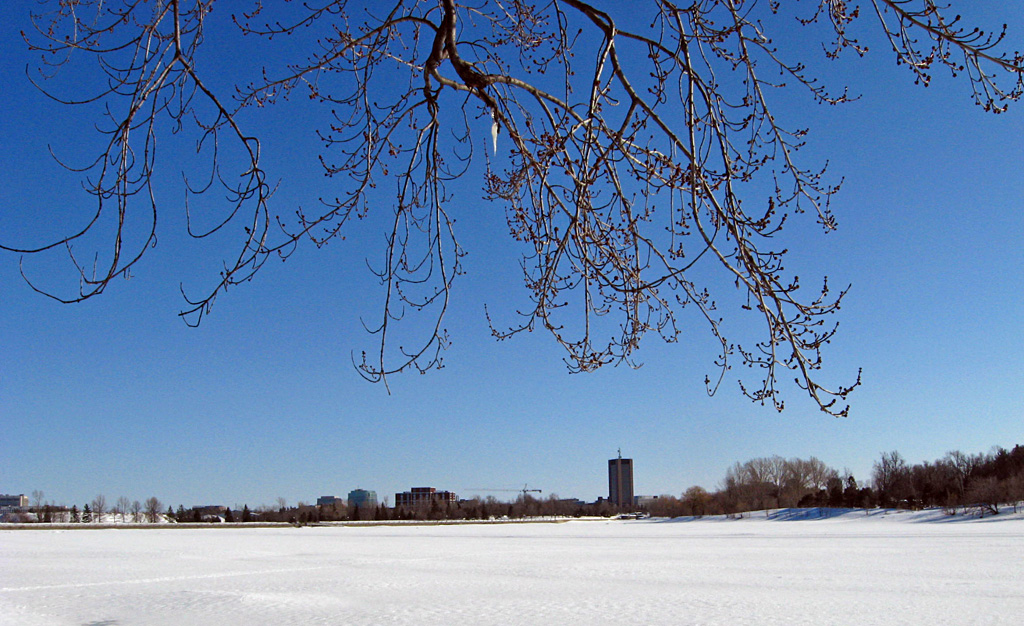
Branches over Dow\'s Lake, Ottawa

Janna Levin’s book is an odd one: written about two mathematicians, focused on mathematical ideas, but with virtually no specific mathematical discussion. The book dances elegantly around the real meat of the lives of Alan Turing and Kurt Godel, but shows it all from the perspective of an outsider focused on emotions. This is freely admitted in the concluding notes:

The depth and magnitude of both Turing and Godel’s ideas are only barely touched upon here.

While this is a novel and not a reference work, one nonetheless feels that Godel and Turing would think it captures mostly what was not essential about their lives.

Putting words and thoughts into fictitious forms of historical figures is always a dangerous business, because it carries with it the false precision of reasoned invention. The danger that the speculation could be wrong is constant, so the book takes on the feeling of a friend-of-a-friend story, while maintaining the trappings of an omniscient direct account. The book also fixates far too much on apples, in an attempt to set up the story of Turing’s suicide.

The book’s strength lies in conveying the tragedy and isolation that seems to be the burden of most of the greatest mathematicians. The contrast between being able to perform mental feats beyond the capacity of almost everyone, while being largely unable to perform the basic actions of a normal life, has long been rich material for writers. In this sense, Turing comes off much stronger; by the end, the account of Godel’s life is both pathetic and pitiable. At least Turing is driven to suicide by the homophobic cruelty of others – Godel just stumbles into it through deepening paranoia.

While the book made for satisfying reading, I much prefer the math-related non-fiction works of Simon Singh. His Code Book includes an admirable description of the breaking of Enigma. In Fermat’s Last Theorem Singh also does a good job of telling about the lives of mathematicians, without ignoring the math. Something comparable on Godel’s incompleteness theorem would make more satisfying reading than this novel.

Climate change and the gom jabbar

Artistic bar lights

In Frank Herbert’s Dune, the protagonist is tested using a machine that “only kills animals.” His hand is placed in a box that simulates the appearance and sensation of having it horribly burned. He is told that he will be killed if he pulls the hand out. The test is to see whether he can overcome his primal reaction: whether he can exercise will over instinct and live. At least according to those who administer it, this is what distinguishes ‘humans’ from ‘animals.’

In some ways, climate change is like a Gom jabbar for all humanity. We are now aware of the needle threatening our collective lives. We know that continuing to act on the basis of instinct will lead to our doom. The question is whether we possess the fortitude to endure what is difficult, in order to avoid what is lethal.

The Tetherballs of Bougainville

Air conditioner fan

Virtually every page of Mark Leyner‘s book made me want to reach out and strangle the insufferably pretentious protagonist: a compulsion that sat awkwardly beside the way in which the author of the book has intentionally conflated himself with the central character (nested several times), even imbuing him with his own name. The Tetherballs of Bougainville is an absurdist collection of miscellanea. It cannot really be called satire because it doesn’t have enough direction to constitute a criticism. If anything, it both glorifies and mildly rebukes the emotional shallowness and obsessive character of society, as perceived by Leyner himself. The book can be funny, when one is in the right frame of mind, but it most frequently struck me in the way Fear and Loathing in Las Vegas did the few times when it came across as crass and monstrous, rather than comic and off-the-wall.

The self-referential plot betrays the abject narcissism of the protagonist. In the opening section, a straightforward narrative of his father’s unsuccessful execution is presented. The second section consists of a screenplay written for a contest mentioned in the first. Again, author/protagonist Leyner is at the centre of the narrative. The same is true for the extended review of a fictional movie read by the Leyner character in the screenplay. The non-existent film is described at great detail, and also features Leyner as the protagonist. Screenplay Leyner, reviewing the non-existing Leyner-starring film judges it as “a movie that consistently subordinates meaning to titillation. And it is a movie that perpetually teeters between puerile perversity and puerile sentimentality.” It seems that author Leyner was hoping to achieve something similar with the book as a whole.

In the end, this book feels like the product of a high school student trying way too hard to be clever: writing impossibly detailed (though not error-free) dialogue as a kind of intellectual fantasy fulfillment. Nobody has the real-life inability to expound upon minutiae so extravagantly and tirelessly. In that sense, the book reminded me of The Gilmore Girls: it had the same tendency to replicate the idealized conversations of ex-Ivy League screenwriters. Leyner’s work is dramatically more explicit and tries to be more disturbing – the most successful attempt being an anatomically ludicrous by nonetheless revulsion-producing scene involving a woman without a cranium – but it has that same feeling of over-eager whiz-kiddery behind it.

Dark comedies

I first experienced Jhonen Vasquez‘s work in the form of Johnny the Homicidal Maniac: a darkly comic feature of my high-school days. Johnny is insane and believes he needs to keep a wall in his house painted with fresh blood so that demons do not push through from the other side. On the basis of that, you might wonder why Nickelodeon decided to produce a children’s television show created by the same man. Invader Zim is not nearly as dark as Johnny – though it definitely has its moments – and I think it is funnier overall. In one episode, the megalomaniacal alien Zim is concerned that a human nurse will uncover his secret identity as an alien because he lacks human organs. His solution is to start stealing them from his classmates in a macabre and hilarious episode called “Dark Harvest.”

The series is worth watching just so that you can exchange the most hillarious lines with other devotees.

For those already enamoured with Zim it is worth noting that you can buy every episode on DVD for $29.59. At that price, it may soften the rueful chastisement embodied in the angry fist you wave at those $70 seasons of The Sopranos. They even had the gall to split series six in two parts, so they could rob people twice…

Lady Chatterley’s Lover

Sunset and power lines

In many ways, Lady Chatterley’s Lover reminds me of Anna Karenina. Each uses a relatively straightforward narrative as a means of conveying philosophical positions about the changing nature of the world – often through nakedly analytic passages. Chatterley seems largely concerned with the question of how to endure in an unnatural world: how to persist in humanity despite the challenges brought by capitalism, industry, and global interconnections. The major conclusion seems to be that the best one can hope to do is opt out, rejecting societal expectations and returning to some kind of natural intimacy with a fellow refugee.

At the heart of the book are contrasts between situations and personalities: between coal mines, the literary world, high society, and a simple pastoralism. Also, between Constance’s crippled husband and her intentionally unsophisticated lover; between Constance herself and her sister; between Constance and Mellors’ relationship and that between her husband Clifford and his nurse and confidant. By setting these things against each other, Lawrence gains both an opportunity to share insight and a platform from which to issue condemnation. Usually, the crime a person or situation stands accused of is being compromised in nature and inauthentic. Constance’s return to authenticity is thus a triumph, even if it does little to alter any of the societal forces that led her initially to a hollowed-out life.

The book also has a certain ecological concern, though more in the spirit of a lamentation for the passing of pastoral life than in the form of an argument for social reform and improved behaviours and conditions. The coal mines are condemned – and the kind of lives that the miners have built around them – but the situation is treated as one almost fated. Similarly on the issue of class separation, some negative aspects are identified, but the book never really rallies for reform. It is all about individual resurrection despite society, not any hope that society might change so as to better foster and accommodate authentic individuals. Connie chooses to withdraw from her place in society, though never considers sacrificing the automatic income that makes her an aristocrat to start with: an income as tied to the stratification and industrialization of society as Clifford’s coal wealth.

No short review can cover all the insightful flourishes that pepper the book, arising, as they do, from a slightly odd omniscient point of view that happily flits through characters both major and minor. The books is intriguing, convincing, and clearly written. To a greater degree than I would have expected, it also speaks directly to some of the major tensions in the modern world. Though a venerable classic of literature, it is in no sense dated.

In Defense of Food

No parking sign

Having recently read and enjoyed Michael Pollan’s The Omnivore’s Dilemma, his newer book caught my eye this morning. I had seen a review contrasting it negatively with his prior work, but decided to take the plunge anyhow. I am glad I did. While there is less value added in terms of general knowledge, it is a much more practical guide to how the realities of contemporary food production affect the choices of conscientious modern omnivores.

The book does an excellent job of combining a good breadth of consideration with the production of manageable advice. Opening with “Eat food. Not too much. Mostly plants,” it elaborates those simple sentiments into a pretty good set of suggestions. Critically, ‘food’ refers only to things that would be recognized as such by people from a few hundred years ago. After going through the decidedly unnatural list of ingredients for a loaf of bread, Pollan declares that:

Sorry, Sara Lee, but your Soft & Smooth Whole Grain White Bread is not food and if not for the indulgence of the FDA [in not longer requiring the use of the word ‘imitation’] could not even be labelled “bread.”

Pollan does an excellent job of critiquing food science and the ‘nutritionism’ that reduces the complex chemistry of food and eating to simple affirmation or condemnation of individual chemicals and chemical classes, such as saturated fats. He provides a compelling description of the nature and evolution of the Western Diet, as well as the societal and economic reasons for its emergence and the health consequences that emerge from it.

In addition to discussing what to eat, Pollan provides some good tips on how. Basically, he suggests that people return to forms of eating more rooted in culture. Constant snacking, eating alone, and consuming massive portions are problematic even if the foodstuffs in question are relatively good. He also endorses gardening and cooking from scratch as ways of weeding out non-foods while also gaining more appreciation for the relationships involved in growth and eating.

Pollan provides a list of 24 bits of concise (and sometimes counterintuitive) advice. He provides some good tips on where and how to shop (avoid the centre of supermarkets – stick to the unprocessed foods at the edges). I was particularly delighted to learn about the strong case for how a glass of wine with dinner can do a fair bit to promote cardiovascular health. Since reading his previous book, I had already made some pretty significant dietary changes. Barring the occasional pot of Knorr soup, I have eaten virtually nothing that wasn’t “food” as he defines it. I have also been thinking a lot more about what I eat, where it comes from, how I prepare it, and so forth. Overall, the process has been meaningful and enjoyable.

It is pretty rare for me to buy a book and read it though in a day. The fact that I did with this one demonstrates both how engaging and accessible it is. For those wanting some sound dietary advice, rather than a more extensive discussion of the nature of various food systems, this book is well worth examining. I am planning to foist my copy onto as many people as possible.

Sensitivity versus throughput in reading

Ice and sky, Ottawa

At some point in the past five or six years, skimming became my default form of reading. Depending on the material, as little as a few seconds per page might be devoted to initial assessment. While this does allow for a person to process much more information, there is an extent to which it forces the atrophy of close reading ability. It seems as though the skills for processing an 80 page document in and hour and the skills for engaging with a dense poem are not only different, but may actually exclude one another.

There is no question about which of the two skill-sets is most useful in academia or information-focused work environments. At the same time, it is always somewhat tragic to lose a skill – especially when it is easy to recall a time when densely packed writing was often an intriguing mystery to explore, rather than a nuisance to be untangled.

Do other people feel the same way about the relationship between the volume processing of information and the precise examination of small samples? If so, is there anything that can or should be done?

The failure of liberal dreams for Afghanistan

Sayed Pervez Kambaksh’s death sentence is a compelling demonstration of how thoroughly the west has failed in Afghanistan. The death sentence was issued by an Afghan court in response to the allegation that Kambaksh had downloaded and distributed a report about the oppression of women. This is not the first time a death sentence has been issued for blasphemy in Afghanistan since the imposition of the Karzai government, but it is a pretty egregious case. Yesterday, the sentence was confirmed by the Afghan Senate.

Is the whole point of the war in Afghanistan the replacement of one brutal band of thuggish warlords with another? Admittedly, the present government is better than the Taliban was, but that is hardly a ringing endorsement. Canada is considering an ever-more long term commitment to the protection of this government while, at the same time, we cannot trust them not to torture detainees that are transferred to them.

What is to be done in response? Do we become hard-headed realists, asserting that aiming to empower women or promote human rights was never a realistic or appropriate aim of the war in Afghanistan? Supporting a government just because they seem relatively pliable and seem to say the right things about cracking down on groups that worry us is certainly a practice with a long history. That said, it isn’t a very successful one. After all, it is why the west armed the Mujahideen in the first place (not to mention the Pinochets and Musharrafs of the world). Do we become isolationists, then, despairing of our ability to effect any progressive or worthwhile change in the world? That doesn’t seem practically or morally tenable in a world as interconnected as ours has become.

Perhaps all we can do is become a bit more cynical and a lot more critical about the supposed justifications for interventions. Rather than aspiring to replace oppressive societies with somewhat better ones, perhaps we should admit that overthrowing governments – however awful – will normally lead to horribly broken societies. That is not to say that it is always the worst option available. A horribly broken society is better than one in which an active genocide is occurring. With such exceptions admitted, it does seem as though the dream of a transition to liberal democracy through military intervention has been essentially invalidated by the experience of western states in Afghanistan and Iraq since 2001.

Laughter in the Dark

Milan’s foot in Nick’s living room

Nabokov’s book is a cruel one: a love story without love, and a mystery with the ending announced in the opening lines. It lacks everything that saves Lolita from being a hopelessly ugly story, notably the sense that there is something of value in what transpires, if only for the descriptions it evokes. When the characters in Laughter in the Dark are aware at all, it is generally only for the shallowest of self-serving purposes. The only character with any force of understanding – Paul – is nonetheless unable to effectively protect anyone of importance to him. He just ends up carrying the grief that is beyond the capabilities of everyone else in the book.

As with Nabokov’s other work, allusions to other literature are fairly frequent. While Lolita calls most loudly to Edgar Allen Poe’s poetry, Laughter in the Dark spends a fair bit of time whispering to Anna Karenina, though Margot and Rex acutely lack the depth of character that partially redeem Anna and Vronsky. The German setting creates an alien and alienating feeling quite different from Lolita – the book with which this one must inevitably be compared. The characters all seem better suited to vindictiveness than joy, as demonstrated by everything from the shallowness and hypocrisy of Albinus’ interest in Margot (abandoning his family, but immediately inclined to kill her for straying from him) to the uncalculated malice underlying the triumph of her confidence trick.

Nabokov has a talent for irony and devastating understatement. At several points, I was moved to mark the margin with a hasty exclamation point. The clarity of his work is well displayed in this novel, though his talent mostly evokes an appreciation for how trivial, manipulative, and unredemptive human relations can be at their worst. The straightforwardness of the language is extreme even for Nabokov, who does not generally play games with opaque and experimental prose. Laughter in the Dark is intensely cinematic. Particularly during the last portion – in which Albinus has lost his vision – you can imagine how the shots would be framed, how his willful blindness and the callousness of his tormentors would be displayed on celluloid.

Having read this book, I think I will need to go back and read Lolita and Anna Karenina again – though that was inevitable before I ever picked up this volume.

Comprehensible art

Perhaps my favourite thing about Vladimir Nabokov is how he never sacrifices clarity for the impression of brilliance. So many great modern authors seem to take delight in baffling their readers, whether with torturous sentences, incomprehensible plots, or surrealism. James Joyce is especially guilty, but hardly alone, in his use of such approaches. While such writing can push the boundaries of language, it is likely to try one’s patience as well. As such, it is especially pleasant to see genius expressed in a straightforward form: excellence in a fairly traditional format.

It’s rather like the different kinds of modern art. There may be some profound idea in the mind of the artist who has splattered a crumpled canvas with Burger King condiments, but I have a lot more respect for the one who made the elegant sculpture in wood or marble or bronze.