Reading fiction aloud

Saint Catherine’s College, Oxford

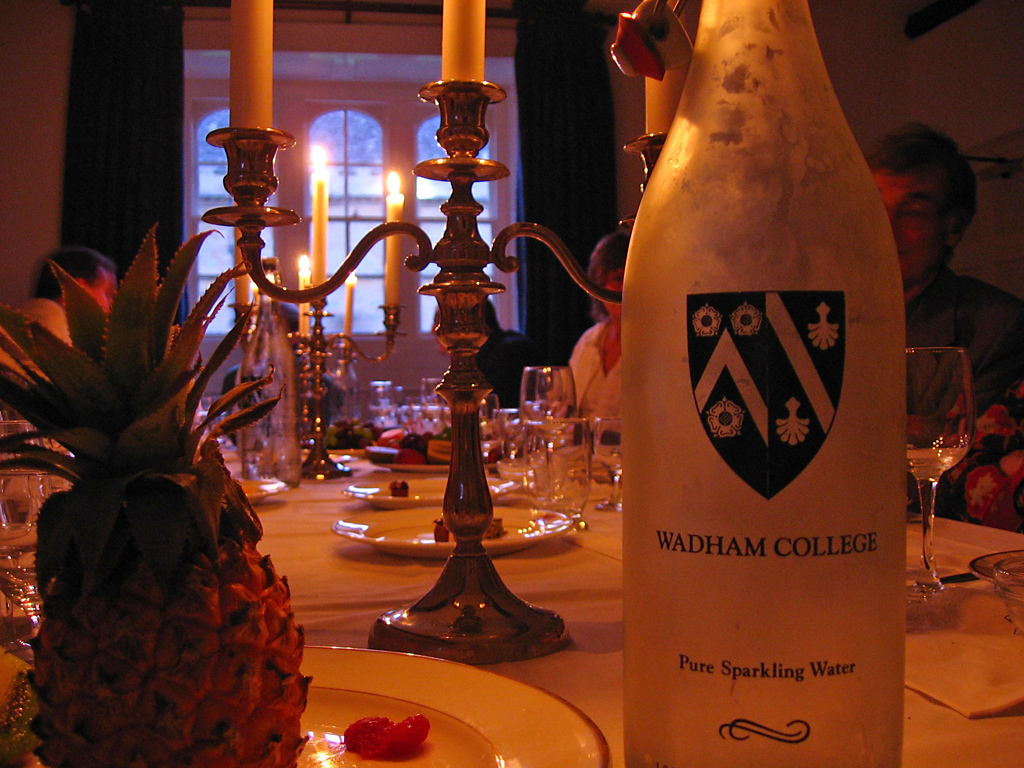
I attended a sustainability forum in Wadham tonight, followed by a fancy dinner. I even got to see a well situated and previously unexplored room in college. Much more enjoyable, however, was spending a couple of hours later in the night reading aloud from Stanislaw Lem’s Mortal Engines, Simon Singh’s Fermat’s Last Theorum, Vladamir Nabokov’s Lolita, Jack Kerouac’s On the Road, and chapters 2-47 of Mark Haddon’s The Curious Incident of the Dog in the Night-Time.

I really love fiction, and quite enjoy reading aloud. With unfamiliar text, it can be quite challenging, even in the best of circumstances. You need to develop an intuition for the shape of an author’s phrases, so that you can start speaking the first portion without reading the end. Perhaps, that explains why I appreciate Nabokov so much and never enjoyed Faulkner. I don’t think you could read the latter aloud, except in halting steps where an entire sentence was decoded before the first syllable was uttered.

Old and new festivals

House in Jericho

The month of February is derived from the Latin word februare, meaning ‘to purify,’ and was the last month of the Roman year. The association between February and purification, however, precedes the founding of Rome. On the 15th of that month was a pagan festival called Februatio. Later, it was called Lupercalia, after Lupercus – the cave near Palatine Hill where a female wolf supposedly suckled Romulus and Remus. The festival was meant to purify the settlement where it was held, releasing health and fertility.

William Shakespeare’s play Julius Caesar begins during this festival, one way in which the Shakespearean history of Caesar’s life differs from that of Plutarch. Indeed, the crown with which Antony “thrice presented him” was a symbol of that ancient festival, and Caesar’s refusal to accept it cited in Antony’s comments following his death (III, ii). This goes to show that refusal to participate in public festivities can be dangerous for you, if you are a person of influence. In 494 CE Pope Gelasius I replaced Lupercalia with the feast of the Purification of the Virgin.

By contrast, the association between the feast of the obscure Saint Valentine and romantic love was apparently the work of Geoffrey Chaucer in the 14th century:

For this was on seynt Volantynys day
Whan euery bryd comyth there to chese [chose] his make [mate].

It seems that Hallmark is not entirely to blame, after all, nor is the Christian replacement for the festival of Lupercalia. Those wishing to invoke the spirit of either the new, as opposed to the ancient, celebration may do well to emulate the Squire from The Canterbury Tales:

So hootehotly he lovede that by nyghtertaleat nighttime.
He sleep namoore than dooth a nyghtyngale.

For those not so fortunate, or who prefer to keep February as a time of purification, there a mass of fine, free literature out there. Reading some would be a lot more charitable than sacrificing two goats and a dog to Lupercus, as was traditionally encouraged.

[Update: 11:59pm] Mica has a Valentine’s Day video up. It has his standard lighthearted charm, and may be just the thing for people who face this day with bitterness (provided that it is of the sort that can be assuaged, rather than the kind deeply rooted in your very soul).

Poco a poco

Greenhouse at Wolfson College

As I expect a few readers of this blog did as well, I attended Philip Pullman’s lecture tonight, on the fundamental particles of storytelling. He chose just one: the action of pouring something, and discussed it with a range of examples from cartoons in The New Yorker to Kubla Khan. I appreciated the Epicureanism of his outlook – the general rejection of the mind-body duality that has proved so popular in philosophy, and the assertion that our essential modes of understanding are predicated upon the experience of the physical reality of the world. It was also interesting to not that he did not become aware of what he considers a fundamental element of the His Dark Materials trilogy (the phenomenon of cleaving or separation), until after the first two books had been published.

In the end, I think it is far less impressive to make some towering and essential contribution to scholarship than it is to write a truly excellent novel for children.

After the lecture, I had my copy of The Golden Compass signed with what I was told was the very Mont Blanc pen with which it was first written. I was a bit pleased to see that everyone else in the queue behind me had crisp new copies, whereas mine could not be mistaken for one that has not been read a dozen times. Counting his edition of Paradise Lost, which I had signed at the Alternative Careers Fair, I now have two inscribed books of his.

Words, words, words

Another collection of thesis reading arrived today. From Amazon, I got Steven Bernstein’s The Compromise of Liberal Environmentalism and Karen Litfin’s Ozone Discourses: Science and Politics in Global Environmental Cooperation. Each has been recommended by at least five people or other important thesis sources, and neither is available to me through the Oxford library system.

From Tristan, I received a stack of philosophy of science essays.

  • Bloor, David. “Essay Review: Popper’s Mystification of Objective Knowledge.”
  • van Fraassen, Bas C. “The Empirical Stance.” (2 copies, in case someone else in Oxford is looking for some light reading)
  • Guerlac, Henry. “Science During the French Revolution.”
  • Holton, Gerald ed. “Science and the Modern Mind: A Symposium.”
  • Miller, David ed. “Popper Selections.” (better than the two brick-like Popper books sitting on my shelf)
  • Neurath, Otto. “The Scientific Conception of the World: The Vienna Circle.”
  • Weber, Max. “Social Sciences, Law, and Culture.”

His taking the time to mail these to me is much appreciated. On the basis of this, I am willing to declare myself more or less set, in terms of thesis materials on the philosophy of science. Indeed, all signs point to the necessity of doing much more reading on the two case studies; both my supervisor and the examiners seem much more interested in the specific than the general.

The weeklong reading retreat to the original home of Dorothy and Nicholas Wadham that is happening during the last week of March is looking somewhat appealing. Unfortunately, that will also be the last week during which my supervisor is available to look anything over.

My international law presentation is due in two days, along with the final version of the fish paper. An international law paper is due in six weeks, with another due in about 14 weeks – at the same time as the thesis. As time goes on, I am seeing the progression from being jittery primarily as the result of caffeine consumption to being jittery because of stress and finally to being jittery due to a potent combination of the two.

Moral Disorder

Often insightful, and sometimes clever enough to induce audible laughter, Margaret Atwood‘s Moral Disorder is a satisfying collection of tales. The way in which the thinking of the characters feels extremely familiar, while the circumstances in which they live are not, reminds me of Alistair MacLeod. I think the association comes from how calmly tragedy is presented: how they just unfurl as you progress through the pages, most of them too indistinct to generate more than vague sorrow.

The stories that make up the book involve connected lives, all jumbled together and ultimately connected more by tone than by narrative consistency. The language is that of an author confident but not showy, able to make you empathize with her characters. The writing is mature, as you would expect from an author so revered, and thankfully not pretentious in the way great authors tend to become, once their most creative work is behind them.

Like MacLeod’s work, these stories are heavy with the inevitable and the inescapable. As such, the dominant tone is one of resignation or, at the very best, the recognition that things are, for the moment, better than they have been.

Menagerie of books in progress

Merton College archway

On the mantlepiece in my room, there are presently two stacks of books. One is for thesis related books, sorted so as to be least likely to topple and crush me in my sleep. The other is for non-thesis books, sorted by the priority with which I mean to read them. I have read at least fifty pages of every book in each pile.

Thesis pile:

  • Kuhn, Thomas. The Structure of Scientific Revolutions.
  • Dobson, Andrew. Political Theory and the Ecological Challenge.
  • Popper, Karl. Conjectures and Refutations.
  • Popper, Karl. The Logic of Scientific Discovery.
  • Lomborg, Bjorn. The Skeptical Environmentalist. (Being selectively re-read)
  • Fenge, Terry. Northern Lights Against POPs.
  • Clapp, Jenniffer. Paths to a Green World. (Another purposeful re-reading)

Non-thesis pile:

  • Nabokov, Vladamir. Ada, or Ardor. (A much appreciated gift from Viki K.)
  • Atwood, Margaret. Moral Disorder. (From my mother)
  • Wilde, Oscar. De Profundis and other writings.
  • Hardy, Thomas. Far From the Madding Crowd.
  • Milton, John. Paradise Lost. (Re-reading aloud)
  • Cunningham, Michael. Specimen Days.

I have been reading these books for periods ranging from two days to many months. Sometimes, I wonder whether it would be more sensible to read books sequentially, one by one. I don’t really think so. This system lets me read in any of a half dozen distinctive genres or subject areas, and I don’t think I lose much comprehension on account of tracking so many strings at once. (Complex novels are an exception. I often need to force myself to start over and read through. This may be why I have never finished Rushdie’s The Satanic Verses, despite at least four attempts.).

Long walks, moral complexity, pirates

Angor Wat grafitti

Today involved some good reading, four more iced shots of espresso, two important meetings, and a long and social walk with Margaret. In the manner of debt collectors everywhere, I have learned that you can get a long way with people who are not being responsive to emails by simply showing up at their doorstep. In half an hour, you can get further than two weeks worth of messages would ever take you.

I have decided, for my paper on ‘failed states,’ to argue that the term is more trouble than it is worth. It conflates a number of different circumstances in which states might find themselves in ways that make it a hopeless muddle, both from a theoretical and an empirical point of view. This should make the paper much more interesting to write; there is great pleasure to be taken in choosing an argument and defending it. The only trouble, it seems, is that the more education you go through, the less thoroughly you can believe that anything you are saying is really true.

That is one reason for which it is so satisfying to write about gay marriage or Guantanamo Bay. These are circumstances where I can stand four-square behind a moral position.

PS. One piece of truly essential thesis reading did get fished today: the copy of The Pirates! in an Adventure with Scientists that Josiah lent me last night. Gideon Defoe has made a valuable contribution to the study of pirate-scientist dynamics. One particularly useful fact for someone leaving academia: Charles Darwin was working as an unpaid naturalist on the Beagle. It seems that it really is possible to learn a great deal from such work.

Poetry in high school

I didn’t want any phase of my life to be gone forever, to be over and done with. I preferred beginnings to endings in books, as well – it was exciting not to know what was lying in store for me on the unread pages – but, perversely, I couldn’t resist sneaking a look at the final chapter of any book I was reading.

“My Last Duchess,” a story in Margaret Atwood‘s Moral Disorder, strikes me as an unusually successful discussion between literary Canadians. Reading a story about the classroom contemplation of Robert Browning‘s poem is an odd experience, for someone who has had exactly the same sorts of classroom discussions about poems by the author of the story. I am pretty sure “Disembarking at Quebec” was even tested on my grade 12 literature exam, though the memory of that test is almost entirely overshadowed by that of the far more challenging advanced placement literature test. (I remember the sight reading passage was the description of a wolfish Satan jumping into paradise (PL: IV, 172-192))

For those who are not Canadian, it is worth mentioning that Atwood is a kind of national literary representative. Along with Timothy Findley, she is probably the person who first comes to mind for most people, when they consider the content of Canadian literature. As such, it is interesting to see the author humanized: taking on the form of a young Canadian as they probably first experience her work, writing down lists of contrasting elements in a poem to rattle off for ten or twelve marks on a governmental exam sheet.

Carl Edward Sagan (November 9, 1934 – December 20, 1996)

Tomorrow will be the tenth anniversary of the death of Carl Sagan: an American astronomer, author, and popularizer of science. Like Arthur C. Clark and Isaac Asimov, he is among those authors of science fiction who have also made a contribution to the accumulation of scientific fact, and to the development of the social role of science within society.

He has been quoted here before.

My Name is Red

This morning, I finished Orhan Pamuk’s My Name is Red. The fact that I left the last fifteen pages of this mystery story unread for a day is not a good sign. Indeed, each of the potential murderers was so similar that the final revelation felt a bit trivial. One pretentious and vindictive illustrator rapidly blurs together with all the others. Likewise, the potentially interesting commentary about European influences on Islamic art quickly became repetitive. The best part about the book were the vignettes presented by the coffee shop storyteller, as he personified a gold coin, a dog, and other similar things. I also very much appreciate my mother’s consideration in sending me such a book just before my trip to Turkey.

Given Pamuk’s acclaim, it seems most sensible to say that the book was simply not for me. Just as I can appreciate bits of Joyce, without appreciating the sweep of his longer books, the same can be said with regard to this novel. Time permitting, I will read my father’s copy of Pamuk’s non-fiction book Istanbul over the remainder of the trip.