
An article which I wrote with some University of Toronto professors: Universities must dump their fossil fuel investments before fundraising
Category: Canada
Anything related to Canada or Canadians
Trudeau’s 2021 SFT
The Trudeau government has released the Speech From the Throne to open the 44th Parliament.
There’s a section on climate action, but it goes on an on about “growing the economy” and doesn’t even mention fossil fuels, much less the need to abolish them.
It’s not super encouraging that the speech is called “Building a Resilient Economy: A Cleaner & Healthier Future for our Kids,” while an infamous 2002 memo on how to cultivate climate change denial was called “The Environment: A Cleaner, Safer, Healthier America.”
This kind of constant prioritization of economic growth over planetary security demonstrates the government’s unwillingness to talk about the implications of what climate change mitigation requires. Arguably, it also feeds a sense in the public that the problem ought to be solvable without major societal or lifestyle changes. It doesn’t apply anything like the standard which I suggested to recent environment minister Wilkinson: “Is every project the government is supporting something which we will be glad to have in a post-fossil fuel world?”
British Columbia floods and mudslides
Following up on summers with severe wildfires, BC has received an ‘atmospheric river’ of rain, in some places a month’s worth in a day.
The floods and landslides have cut off all the highways connecting Vancouver and the lower mainland to the rest of BC and Canada, and the Port of Vancouver has closed down, holding back over $400 million worth of exports per day.
In the National Observer John Woodside has a piece about how these disasters are partly climate-caused, since lost roots and ground cover would have helped hold the soil in place to prevent landslides. Of course, the clearcutting uphill of these slides is both an important cause and an activity that worsens climate change.
Theories for why the University of Toronto divested from fossil fuels
Not mutually exclusive:
- They are about to launch a bicentennial fundraising campaign with themes including healthy lives, sustainable future, and the next generation. They feared negative public relations attention if they launched the campaign while continuing to refuse to divest
- The university’s investment managers have decided that they can better retain authority and control by choosing how to divest on their own terms, and particularly with little reference to the culpability of the industry
- In trying to implement the prior environmental, social, and governance (ESG) screening method, the investment managers at the University of Toronto Asset Management (UTAM) corporation decided that divestment would be easier or better based on their secret internal metrics
- The Harvard announcement and COP26 have added to the pressure to announce new efforts
- U of T perceived that it was increasingly behind when a growing number of Canadian schools had made divestment commitments
- A student-led volunteer campaign persisted through multiple setbacks and core cohort graduations and was sustained by the University of Toronto Leap Manifesto chapter and subsequently the Divestment & Beyond faculty- and union-led campaign after the Toronto350.org / UofT350.org effort
As in the campaign as a whole, the university’s penchant for secrecy makes it challenging to explain or understand their actions. In particular, that includes the parlour trick of setting up your own investment management corporation as a means of evading oversight, by pretending that somehow the advice from this organization should only be available to the administration in secret.
Divest Podcast on the Leap Manifesto U of T divestment campaign
The latest episode of The Divest Podcast features Julia DaSilva from the Leap Manifesto chapter at U of T, the second of three groups to organize divestment campaigns, after the Toronto350.org / UofT350.org campaign and before / concurrently with the faculty/union Divestment & Beyond campaign.
The pro-carbon chorus at COP26
From today’s Globe and Mail:
- Efforts to combat climate change shouldn’t shun any particular energy source, Saudi official says
- Harper says Canada’s climate-change policy unfairly singles out ‘certain parts of the country’
I know Canada’s major media sources tend to be reflexively pro-fossil, but it’s still remarkable to see people insisting that the industries causing climate change should not be targeted as we try to keep it from destroying us.
Reading about the resistance dilemma
Today I received and began reading George Hoberg’s new book: The Resistance Dilemma: Place-Based Movements and the Climate Crisis.
The usefulness is threefold. It speaks directly to my concern about how the environmentalist focus on resistance isn’t a great match with building a global energy system that will control climate change. It references much of the same literature as my dissertation, so it provides a useful opportunity to check that I haven’t missed anything major. Finally, it’s an example of a complete, recent, and successful piece of Canadian academic writing on the environment and thus a model for the thesis. It’s even about 300 pages, though a lot more fits on a published book page than a 1.5-spaced Microsoft Word page in the U of T dissertation template.
Night hike
At 9pm yesterday, I decided that I couldn’t focus enough for thesis work and to take a walk. My friend Tristan had recently plotted out some hiking routes on my computer, including one up the Don Valley from Old Mill station, crossing over east near Sheppard, then north up the Black Creek trail.
I wanted to see how accessible the start point is from my new place by foot, and then when I got there I decided to try the up-river segment. I got to Sheppard and carried on upriver, past Finch and ultimately as far as Thackeray Park. When I got to a fence blocking further progress, I saw that I had gone 24 km. I hadn’t been particularly planning anything, including a long walk, and I didn’t have any food or water with me or anywhere to buy them in the Humber Valley, but I felt fresh and like I could do the same distance again. So I decided to redo the river path south to where I entered the valley, then continue south to Old Mill station. After figuring that getting to Old Mill would put me around 43-4 km of walking, I decided that if my feet felt up to it then I would walk enough along the Bloor subway line to push it past 50 km:
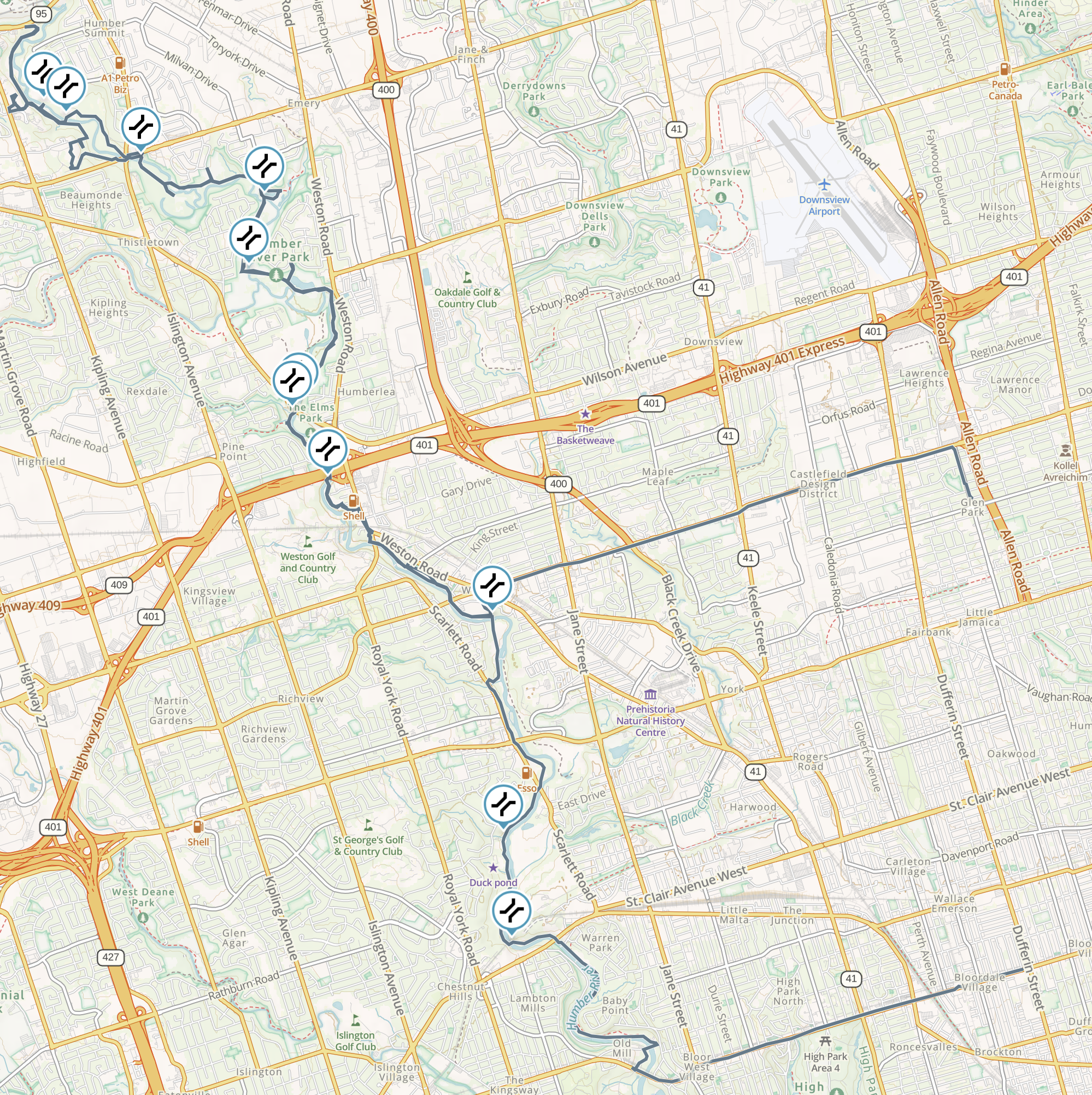
This ended up being my longest walk of the pandemic so far, but it was around 7 ˚C and dark and I felt comfortable in just a puffer and wool buff and never thirsty. I also saw virtually nobody on the path until I started to see exercise keeners after 6:30 – 7:00am. I don’t think I saw anybody on foot or close by between entering the valley and reaching the scenic view of the railway bridge just north of Dundas Street West.
The whole route is marked by deep forest on either side (by Toronto standards), some magnificent willows along the riverfront just north of Lawrence Avenues, and a whole series of pedestrian bridges big and small used to cross the river while following the path.
SFU divesting
In another recent unexpected announcement, Simon Fraser University has committed to fossil fuel divestment.
Back in November 2019, the university had promised to reduce investments in carbon-emitting companies by 45%.
This comes five days after the University of Toronto finally committed to divest.
University of Toronto divesting from fossil fuels
Checking through my routine administrative emails today, I was completely surprised to see a message from president Meric Gertler announcing that U of T will divest from fossil fuels:
The evidence of a climate crisis is now incontrovertible. The most recent report of the Intergovernmental Panel on Climate Change adds further urgency to the need for individuals, businesses, institutions and governments to act swiftly to respond to this global threat, using every tool available to them. World leaders will begin gathering in Glasgow at the end of this month for the COP26 meeting, where progress in the fight against climate change will be assessed and new strategies to avert a climate catastrophe will be considered.
As owners of financial assets such as endowments and pension funds, universities have both an economic imperative and a moral obligation to manage these assets in ways that encourage carbon emission-reducing behaviour in the wider economy. With the increasing financial risks associated with fossil fuel production – as well as those downstream economic activities that rely heavily on fossil fuels as their energy source – there is a strong motivation for universities to shift their financial capital away from carbon-intensive sectors and firms, and towards those businesses that are leveraging the shift to green energy and carbon-conserving technologies.
…
First, UTAM will divest from investments in fossil fuel companies in the endowment fund beginning immediately. Within the next 12 months, it will divest from all direct investments in fossil fuel companies. For those investments made indirectly, typically through pooled and commingled vehicles managed by third-party fund managers, UTAM will divest from its investments in fossil fuel companies by no later than 2030, and sooner if possible.
Second, UTAM will commit to achieving net zero carbon emissions associated with the endowment portfolio by no later than 2050. Moreover, UTAM has recently joined the UN-convened Net-Zero Asset Owner Alliance, making the University of Toronto the first university in the world to join this group of institutional investors. Membership in the Alliance compels signatories to achieve progressively demanding targets every five years en route to net zero, ensuring achievement of this ambitious objective in a transparent and accountable way.
Third, UTAM will allocate 10 percent of the endowment portfolio to sustainable and low-carbon investments by 2025. Based on the current size of the endowment, this represents an initial commitment of $400 million to such investments.
…
[I]n the last few years I have heard from many members of the U of T community who have urged me to deploy every means available to address the existential crisis we now face. None have been more eloquent or impassioned than our students, who have the most at stake. I want to thank them – and other members of our community – for their activism and commitment to this important cause. I would also like to acknowledge the important work of the President’s Advisory Committee on Divestment from Fossil Fuels, whose report marked a key milestone in the journey towards today’s announcement.
It will be fascinating to learn more about what prompted the decision. It certainly hasn’t been the result of a highly visible and escalated recent activist campaign. While the Toronto350.org campaign was ongoing, we would often remark that the most helpful thing for us would be if Harvard divested…
The campaign began on April 16th, 2013 when I went to the president’s office for information and ended up meeting with Tony Gray.