Back in view of the Coast Mountains

Minko, Nick's cat and my General

After a long but favourable trip, I am back in North Vancouver. Returning to Vancouver after a year feels like putting on a properly tailored coat that you haven’t worn for a while: it makes sense immediately, and there is considerable pleasure to be derived from that fact.

I am off to explore the neighbourhood. Vancouverite friends, please call me. Temporary cell phone information pending.

Homeward bound

Apple in my back yard

Thinking back over this year spent in Oxford, the most valuable aspect of it has definitely been those who I met. That is a definite continuity with Vancouver, as it is the people there who are the reason this return trip is so exciting and desirable. Having the opportunity to spend two weeks with Vancouver family and friends, followed hard upon by a return to Oxford at the same time as so many people will be returning for the resumption of classes, is an appealing social cascade.

While it may exaggerate my studiousness of late just a bit, it still seems apt to think about this trip as the temporary abandonment of the Tree of Knowledge in favour of the Tree of Life. Barring any serious delays, I will be in Vancouver by about 9:00am Pacific Standard Time.

People in Vancouver who want to get in touch with me should email me or call my parents’ house. I will try and sort out a cell phone for while I am there, but the feasibility of that plan will be determined by how well the cost matches the benefit over my relatively brief time in the city.

Thou shalt make backups: frequent and comprehensive

After considerable expenditure of energy, I now have a full duplicate backup of user data from the hard drive of my iBook. I also have no less than eight backups of everything really essential.

I am now… ready to upgrade to Tiger, the latest available version of Mac OS. I am also adding a 1GB stick of RAM to replace the 256 meg extra stick that Apple charged me so much for when I first paid for this computer. I need the extra memory for Photoshop and iPhoto.

Both the Tiger upgrade and the extra RAM will be part of my Vancouver homecoming. It puts my mind at ease to know how many different places academically essential files now reside.

The photographic future

Trees in Wadham College

I had an odd philosophical post written, but it was far better to blast it to some obscure part of the RAM of this computer, to be utterly erased when I next reboot it, than to put it online somewhere. Instead, I should write about photography.

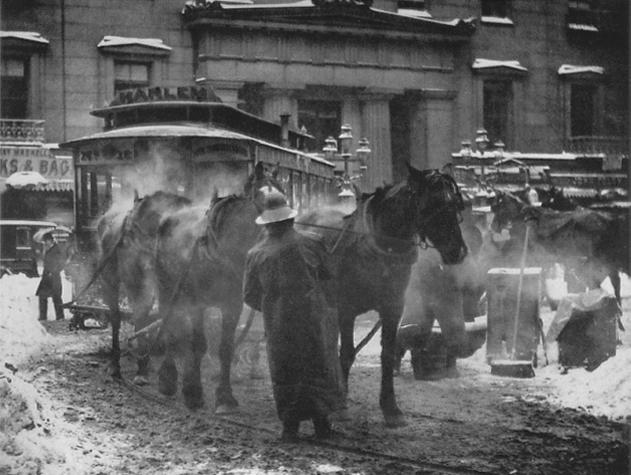
On the basis of some books I have read, it seems reasonable to conclude that photography did not emerge too long before the start of the 20th century. To begin with, it was an awkward, delicate sort of thing to do. You needed lots of black velvet cloth, heavy glass plates, finicky chemicals, and expertise. Over the next seventy or eighty years, photography went from something that a British Lord might do as a hobby to something that people all over the world did all the time. Where once the coronation of a Queen might be worth photographing, suddenly the first steps of every child were, if someone had a camera handy. I personally salute Alfred Stieglitz as perhaps the most important single person in the establishment of photography as an art form. Of course, if he hadn’t done so, it would have been someone else. I suspect they would not have done so as elegantly. At least a few of my photos are direct ripoffs of Stieglitz.

With the advent of digital sensors and – perhaps more importantly – the internet, further democratization has taken place. When the cost of photography is reduced to the bother involved in pushing a button or two, transferring a file to a computer, and then moving the same onto someone else’s website there is really very little reason not to do a great deal of it. Very soon, the biggest associated cost becomes time.

I hope I get a digital camera, eventually, which is comparable to my best film camera in terms of versatility, ease of use, and quality of output.

On Esperanto

One of the world’s more interesting examples of a market failure is the general inability of Esperanto to secure its intended role as a universal second language. If a great many people spoke Esperanto, it would be reasonably worthwhile to devote one’s time to learning it. Knowing that there was even a 30% chance that a random person encountered in Estonia or Italy or Japan would speak it, the energetic traveller or businessperson would have a pretty good incentive to learn at least a bit. If few people do, conversely, it is not worth anyone’s time. This is what economists call a network effect: having a fax machine when nobody else does is not very useful. Likewise, having a telephone or internet connection. The more people subscribe to any such network, the more valuable the network becomes to everyone. Such networks tend to explode in usage once they cross a critical threshold of popularity. Since the development of a base of speakers generally depends on such individual choices, it remains perpetually stuck at a low level of usage.

The idea of an invented universal second language is appealing for many reasons. While English has certainly emerged as a world language, it is not without significant cultural baggage. The forces that spread English – from the British empire to American ascendancy and the dominance of English cultural and technological materials – are inevitably connected with structures of dominance and submission in the world. While Esperanto does borrow from other languages, it seems sensible to say that it is free of at least a good portion of this kind of baggage.

Another serious issue related to second languages is how quickly they shrivel when not used. Much as I would like to avoid forgetting French, it is very hard to maintain in the absence of a need to use it. My French has never really been good enough to read French newspapers or literature without the aid of a dictionary. Now, in an environment where I am virtually never exposed to the language, my knowledge is fading quickly indeed. If everyone spoke one common language, it is quite likely that you would be exposed to it often enough to gain and maintain facility in its use.

The message is simple, then: Rest of the world, please learn Esperanto. Once two billion or so of you have, I will set upon the task myself.

PS. I promise this will be the last post during this slightly over-active day of blogging.

Only 41% of the moon is dark

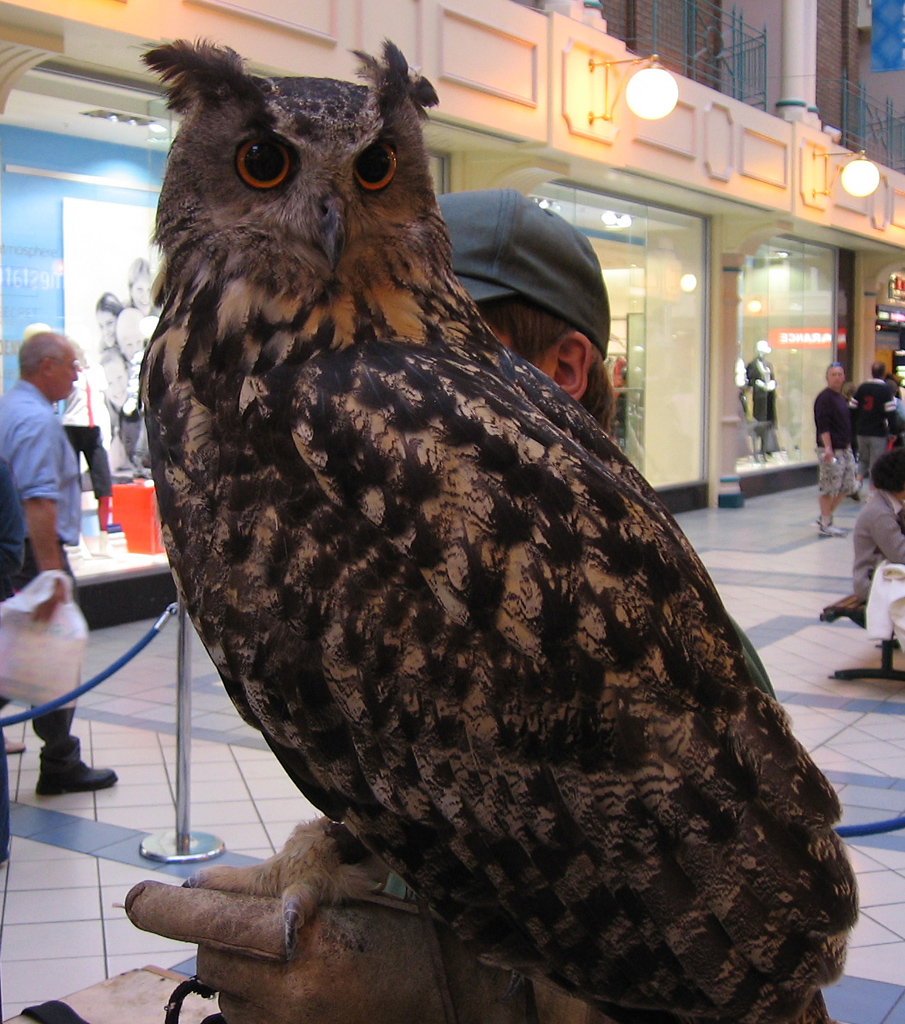
Eagle owl

After having coffee with Louise today, who I was glad to see before my departure, I saw an Eagle Owl being displayed as part of a fundraising drive for the Barn Owl Centre of Gloucestershire. Naturally, the sight of the enormous eyes of this majestic bird made me think about moonlit nights.

If you were to sit on the surface of the sun and look at the earth through a telescope, you would observe it rotating both around the centre of the solar system and around its own axis. The side of the sphere facing you (the side experiencing daylight) would consist of a constantly shifting selection of Earth’s surface as it rotates: with new areas becoming lit in the west as sections in the east fall into shadow. You could watch as the eastern seaboard of North America came into illumination, then passed back into darkness as it spins away to the shadowed side of the planet once again.

By contrast, when you look up from Earth at the moon, the same face is basically presented all the time. Just as one side of the moon is always in view, there is a ‘dark side’ that is always hidden from the vantage point of an observer on Earth. This is because of a phenomenon called tidal locking. The moon rotates on its own axis at just the right rate so that, as it orbits the Earth, the same side is presented. There are, however, minor oscillations in this presentation. This is called libration, which derives from the Latin word meaning ‘to sway.’ You can see an animation of the phenomenon here. It derives both from the fact that the moon’s axis is slightly inclined when compared to its orbit around the Earth and because the moon’s orbit around the Earth is slightly eccentric. Because of the cumulated rocking motion, it is actually possible to see 59% of the moon’s surface from the Earth.

I’ve always wondered how people were able to make celestial observations of such incredible detail and precision in the period prior to modern instruments and measuring systems. It is an enormous tribute to the vigilance and dedication of early astronomers that prior civilizations knew as much about observable astronomical phenomena as they did: knowledge that found application in essential tasks like predicting the chance of the reasons and recurrent episodes of rains or flooding.

On conspiracy theories

Kasbar, Cowley Road, Oxford

Partly prompted by a Penn and Teller episode, and partly by a post written by my friend Tristan, I have been thinking about conspiracy theories today. On what basis can we as individuals accept or refute them? Let’s take some examples that Penn and Teller raise: the reality of the moon landings, the nature of the JFK assassination, and the nature of the September 11th attacks. It should be noted that this is the worst episode of theirs I have ever seen. It relies largely upon arguments based on emotion, backed by the testimony of people to whom Penn and Teller accord expert status, rather than a logical or empirical demonstration of why these theories should be considered false.

Normally, our understanding of such phenomena is mediated through experts. When someone credible makes a statement about the nature of what took place, it provides some evidence for believing it. Penn and Teller amply demonstrate that there are lots of crazy and disreputable people who believe that the moon landing was faked, some strange conspiracy led to the death of JFK, and CIA controlled drones and explosives were used to carry out the September 11th attacks. That said, it hardly disproves those things. Plenty of certifiably insane people believe that the universe is expanding, that humans and viruses have a common biological ancestor, and that any whole number can be generated by adding powers of two (365 = 2^8 + 2^6 + 2^5 + 2^3 +2^2 + 2^0). That doesn’t make any of those things false.

We really have three mechanisms to work with:

  1. Empirical evidence
  2. Logical reasoning
  3. Heuristic methods

As individuals confronted with questions like those above, we almost always use the third. While those with a powerful telescope and the right coordinates could pick out all the junk we left on the moon, most people lack the means. Likewise, those with a rifle, a melon, and some time can learn the physics behind why Kennedy moved the way he did when he was shot, despite Oliver Stone‘s theories to the contrary. Finally, someone with some steel beams, jet fuel, and mathematical and engineering knowledge can model the collapse of the twin towers as induced by heat related weakening of steel to their heart’s content. Normally, however, we must rely upon experts to make these kinds of judgements for us, whether on the basis of sound technique or not.

Logical reasoning is great, but when applied strictly cannot get us very far. Most of what people call ‘logic’ is actually probabalistic reasoning. Strict logic can tell us about things that are necessary and things that are impossible. If every senior member of the American administration is controlled by an alien slug entity, and all alien slug entitites compel their hosts to sing “Irish Eyes are Smiling” once a day, we can logically conclude that all members of the American administration sing “Irish Eyes are Smiling” every day. Likewise, if all bats are bugs, all non-bugs must be non-bats. Entirely logically valid, but not too useful.

A heuristic reasoning device says something along the lines of: “In the more forty years or so since the moon landing, nobody has brought forward credible evidence that they were faked. As such, it is likely that they were not.” Occam’s razor works on the same kind of principle. This is often the best kind of analysis we can manage as individuals, and it is exactly this that makes conspiracy theories so difficult to dislodge. Once you adopt a different logic of probability, for instance one where certain people will stop at nothing to keep the truth hidden, your probabilistic reasoning gets thrown out of whack.

How, then, should we deal with competing testimony from ‘experts’ of various sorts, and with the fallout of our imperfect ability to access and understand the world as individuals? If there was a pat and easy answer to this question, it would be enormously valuable. Alas, there is not, and we are left to try and reach judgments on the basis of our own, imperfect, capabilities.

PS. For the record, I believe that the moon was almost certainly walked upon by humans, that Oswald quite probably shot John F. Kennedy on his own initiative, and that the airplanes listed in the 9/11 report as having crashed where they did actually did so. My reasons for believing these things are almost entirely heuristic.

Preferences, re: ponderings

The sky over Woodstock

A comment was posted earlier that has a certain resonance. While there is no greater online sin than blogging about blogging, I will trespass for a moment – always with the aim of pleasing you better, dear spectators. The comment:

You know, if you took the amount of time you spend on a week’s worth of these mediocre mumblings and used it to write one thing, it might be good?

This is a possibility I have wondered about myself. I feel a constant urge to write, but it may be better directed in a less haphazard direction. At the same time, about 100 people a day read the blog; I am willing to bet that is more people than will read my thesis, in total, between now and the end of humanity.

The issue, then, is not the medium, but the message. What would it be more socially useful to write? Before seeing that comment, I was going to write tonight’s post about metallurgy and the possibility that we are living in a ‘composite age.’ Hardly my area of expertise, and hardly an area of interest of most people who I know to be reading the blog.

The format of this blog is intentionally somewhat experimental, as well as somewhat scatterbrained. All told, I am skeptical about whether I can impose a pattern upon something as ephemeral as daily posts, but constructive criticism and suggestions about profitable directions to take would be most appreciated.

PS. We had our 30,000th visit today.

A Scanner Darkly

Green College, Oxford

Antonia invited me to see the film adaptation of Philip K. Dick’s book this evening and, despite having watched the first twenty minutes as a free online trailer, I found it well worth paying for. Based on our discussion afterwards, I have tentatively concluded that it is a film unusually subject to people taking away more or less what they expected to find. While it will appall traditionalists to hear, I didn’t feel as though I got much out of the book, when I read it a few years ago. As such, I had modest expectations for the film which were not disappointed.

The film is odd insofar as it combines a society of total electronic surveillance with the complexities of informants and undercover agents. The combination of knowledge and secrecy that results is sometimes more perplexing than Orwellian, though it does effectively highlight the corrupting nature infiltration strategies of crime fighting can have on police forces. You are, however, frequently left wondering why any state or police force with such power would devote such attention to a group that seems pretty obviously hopeless, when it comes to posing any real danger.

The most immediately obvious thing about the film is the modification of the video stock and the addition of animated elements. The posterized faces with their bold, exaggerated edges, in particular, contribute to an ongoing visual effect with some thematic merit. All told, the visuals and the story were complementary and well integrated. Neither was simply a crutch for the other, as is so often the case in visually unusual pieces of film. As Antonia pointed out, it probably detracted from the film to have recognizable actors in the roles. There is just too much written into Keanu Reaves, for instance, for him to really be able to take on a new role.

My thanks to Antonia for a worthwhile suggestion.