Passion in international relations theory

Painting on Claire's wall

International Relations theory has a way of bringing out the passions in people. Roham, Sheena, Alex, Bryony, and the rest of my core seminar group had a particularly energetic discussion about liberal international relations theory today. The instructors were similarly engaged and, overall, it made for an interesting contrast with the relatively staid (though informative) character of our history seminar last term. These are the big questions that are coming up now. What is moral conduct for states? Does that question even mean anything? Can we build a better world and address the mistakes of the past? You cannot travel from across the world, at huge effort and expense, to study international relations, without caring deeply about these questions. To be in the position where people both have that level of interest and commitment and a high level of respect for one another is intellectually thrilling.

After a short nap to help combat electoral fatigue, I set about finishing my paper for Dr. Hurrell this afternoon. Now that Claire has taken a peek at the first draft, I should be able to hammer out a finalized version, with citations and all the rest, to be hand-delivered to Nuffield before my noon lecture tomorrow. Much as I would rather get to sleep, duty calls.

Of course, it wouldn’t be quite so late if I hadn’t spent at least an hour in Wellington Square introducing Claire to some of my favourite music. Of course, even the most basic of utilitarian calculations (probably the best I can manage) would demonstrate that the time was enormously better spent from a long-term perspective than devoting another hour to straightening out slightly kinked sentences or regenerating bodily tissues.

Seeing about 1000 visitors during the past 30 hours or so, on account of the election coverage that was here, has given me the slightest taste of mainstream blogging. While I don’t think I have the time, desire, or ability to write the kinds of blogs that tens of thousands of people stream through daily, I do like to write things of interest beyond the circle of my family and friends. Like privacy versus disclosure, it’s just one of those tensions that can’t be eliminated in this kind of writing.


  • Potentially useful fact of the day: All my photos are calibrated to look best at 1.8 Standard Gamma and the D65 white point: equivalent to midday sunlight. If you’re using an Apple LCD monitor, these are the default settings.

My mind is all on the election, sorry

The DPIR, looking linear

This morning, I conveyed myself to two back-to-back lectures, before being kindly invited to a very tasty lunch at St. Cross with Claire. The St. Cross lunch is an institution that I recommend to anyone with the good fortune to be invited. There is a variety of food to be had, and interesting people like my New Year’s Eve companions Claire, Bronwen, Jonathan, and Josiah with whom to converse.

Tomorrow, I have a solid run of lectures and seminars running across the better part of the day. I am curious about just how haggard the other Canadians will be. That is to say, who will be unable to resist the urge to stay awake until the polls close in Ontario at what I think will be 3:00am GMT. For my part, and partially because I can’t quite wrap my head around dealing with both different poll closing times and different time zones, I will aim to go to bed around 1:00am: hopefully having completed a good chunk of my essay for Dr. Hurrell (the one I was meant to have edited and in the envelope by now, I realize).

One thing I appreciated seeing today among my friends is a universal proclamation of the importance of voting. Even if we do end up getting a government that many of us do not want, at least it will not be from apathy. That, at least, is the expression I saw one friend make earlier today.

In the evening, Wadham College had its second research forum: this one focused on the Middle East. While it would definitely fit with my subject area, and I knew one of the presenters, I spent the time doing reading for tomorrow’s seminar, in the full knowledge that as election results started trickling in, my thoughts would not be on Norman Angell.

Of blogs and brevity

A quad in Christ Church College, near Merton Street

I have a new rule: at least for the time being. I am going to aim for focused, interesting blog posts that are no more than a few paragraphs. The writing should be better, more people should feel inclined to read it, and I should consequently have more time for academic work, or at least non-computer stuff.

I need to adjust the structure of life so that it involves more reading. Having seminars of 14 to 28 people, it isn’t really necessary to have read anywhere close to the total amount assigned in order to contribute to the discussion. As such, and especially without the possibility of being called upon to present, there is a lack of structural incentive to do a great deal of reading. For me, this might be most easily overcome by making reading a more social experience. The presence of others helps keep me focused and aids in resisting the desire to go and do something else – a desire that always becomes more powerful when the matter I am reading is not particularly compelling.

I started the copy of Haruki Murakami’s The Wind up Bird Chronicle that Tristan sent me for Christmas. Three chapters in, it definitely has the oddity that seems to be characteristic of Japanese film and literature. At the same time, it lays out the oddity in a way that is intentionally structured like a mystery – it’s clear that we’re meant to eventually learn what’s going on.

As always, speaking with Astrid this afternoon was interesting. Her personal policy of not engaging in meaningless chatter over MSN of the “so, what are you up to?” variety is one that frequently proves laudable, particularly when combined with her infrequent forays into that domain. She is in Argentina now, returning to Vancouver in about a month.


Time for all the works and days of hands

Tree in the Lamb and Flag Passage, Oxford

Spending time with Wadham MCR people last night was good fun. In particular, talking with Briana Short – both during the Burns Night festivities and during subsequent wanderings – was really interesting. I didn’t know, for instance, that she lived in Ecuador when she was much younger, or that she is hoping to go to medical school at NYU. Having lived in New York previously, she could also have helped me when I was searching for cheap, nutritious foodstuffs there in the summer of 2003. (Photos from that trip)

Likewise, I enjoyed talking with Dave Patrikarakos about photography, IR, and the Oxford experience. The level of variation that exists between the different M.Phil programs (even within the social sciences) seems to be quite high. Likewise, I get the sense from comments made by instructors that the IR M.Phil has varied considerably over the years. Interesting how so many people are walking around with the same qualification, having done rather different work to get it.

Getting back to Dave and photography: at some point, I am meant to give him some tips on digital photography and the use of Photoshop. I’m not really sure how to teach photography for circumstances where you don’t have the option of manually controlling shutter speeds and apertures (as his Kodak digital P&S doesn’t seem to allow you to do) and where you don’t have even a proxy for a light meter. For people learning photography, with an aim to making artistic photos, I definitely recommend a bottom-of-the-line film-based Nikon or Canon SLR and a 50mm prime lens. Additionally, my knowledge of Photoshop is entirely constrained to what Neal taught me and what I learned through tinkering. Still, I will come up with something. Anyone interested in reading something that is available online, stands a good chance of improving your photography, and is neither overly long nor complex should have a look at Making Photographs, by Philip Greenspun. Perhaps Tristan can also suggest some good introductory resources.

Another familial Christmas gift

I got a Christmas gift from Mica in the mail today: a DVD of the film Bullet Down Under which was apparently also released under the title Signal One. The catch phrase on the cover: “A new location… A new life… A fresh start, or is it?” While it was clearly meant as a joke, it remains that it is now the only DVD I have in England, aside from Fog of War.

He also gave me a copy of the new Strokes CD: “First Impressions of Earth.” This is the first actual CD I have come to own new in several years. Certainly, it’s the first CD I have owned and seen advertised in music store windows at the same time. The choice of band is definitely reflective of my brother: he has made at least one video based on their music.

Turning the case over, I saw that it is a product of Sony BMG. Thankfully, after checking the lists online, it’s not one of the discs that includes their illegal and damaging copy protection software: the existence of which is the reason for my personal boycott of their products. None of that is meant to be unappreciative, indeed I am very glad to have received the gift from my brother, but is meant more to serve as a warning to other people considering buying Sony CDs. There is a real chance they will intentionally break your computer. More than a bit ironic, isn’t it, that the safest way to get movies and music is increasingly to download it illegally? While I don’t do so myself, it’s still painful to watch the entertainment industry continuously failing to grasp the realities of an increasingly digital world.

Coffee, errands, and chores

After meeting for coffee and discussing life, the M.Phil program, and everything, I went to Sainsbury’s with Bryony in search of vegetarian food. The tofu shelf, bereft of the single brand available for about a week, had been generously restocked. As a consequence, I now have 750g of organic tofu chilling in my fridge. As always, conversing with Bryony was a pleasant and rewarding experience. She seems to have a particularly strong understanding of the nature of the program. I suppose we also have a lot in common, as fellow Canadians, vegetarians, and the like.

Aside from buying groceries, I replenished my stock of clean clothes today. As long as I can keep myself from spending the time reading blogs or talking on MSN, time I spend doing laundry has the potential to be highly productive. There’s something about the definite lengths of washing and drying cycles that can help you to focus on reading. It’s the same phenomenon that leads you to push on when you are tired but close to home: the knowledge of a comfortable pause at a defined distance.

Decent progress on academic fronts

Short term priorities: reading, first paper for Dr. Hurrell
Longer term priorities (I): find a job for the summer and somewhere to live for next year
Longer term priorities (II): progress on the thesis plan, deciding what to do after the M.Phil

Not having a scholarship application in the works right now contributes significantly to my quality of life. No matter how much reading I may have to do for this or that course, not having to prove myself over again from scratch for the benefit of a committee that almost certainly won’t give me any money anyhow is very pleasant indeed. I do have a Merifield application to complete for Monday, but that is a minimal task. I’d much rather live with some friends in a house near Cowley Road of Jericho, anyhow, though no such group has come together yet involving me.

Along with the standard level of progress on course readings, I finished my preliminary read of this week’s Economist today. It has been suggested to me that I apply for a job with them over the summer. Given that I’ve read every issue since 1997 from cover to cover, perhaps it would be a particularly appropriate occupation for me. That said, my window of employability only runs from mid-June until the beginning of October, assuming I work for the entire period. Three and a half months is a fairly short time to work in an environment where learning to deal with unfamiliar and complex problems is a necessary component of the work. More likely, perhaps, is finding a job as a research assistant. More intriguing, but not entirely unrelated, is the prospect of working for a travel guidebook company as a roving contributor, as Briana recommended yesterday. This is a possibility with enormous appeal, and one that I will definitely keep an eye on.

For Tuesday, I need to rework my presentation on classical v. neorealism into a paper for Dr. Hurrell. Finishing a draft tonight would be ideal, but would depend upon the emergence of a blast of inspiration of the sort that usually manifests itself closer to the due date. Otherwise, I have plenty of core seminar and qualitative methods reading I could do, once I track down some of the books and articles.


  • I created a new website for my brother Mica, so people can comment on his videos. If you enjoy them or simply have something to say about them, I recommend you have a look and leave a comment.
  • Mica has a new video online. They are also all now available for download to PC, Mac, video iPod, or PSP.
  • Louise is coming back to Oxford for a weekend on February 10th. The timing looks quite good, right after the first qualitative methods take home exam. I am excited about seeing her.
  • Since I started counting in mid-November, the blog has been accessed more than 7000 times by people other than me. Thanks for reading.
  • Election day in less than 48 hours!
  • While I cannot vouch for it’s accuracy, the idea behind this strategic vote calculator is a cool one.
  • Seth has proposed another Oxford bloggers’ gathering. What do people in this corner of the blogosphere think? Personally, I am up for it.

With beaded bubbles winking at the brim

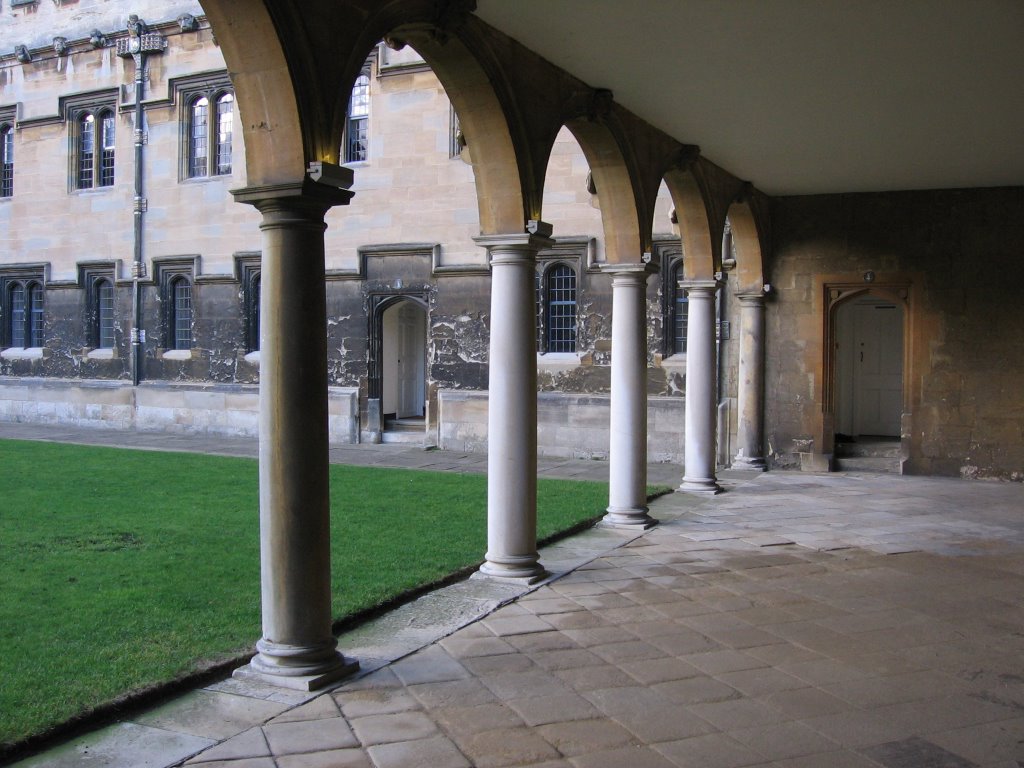
Arches on Soaring Arches

Not to open every post with a weather report, but the weather in Oxford today was stunning. Not quite ‘jacket optional’ stunning, but definitely getting close. As is often the case during really beautiful Oxford days, the sun was generally either shining through thin clouds or being reflected off of them. In either case, there was lots of bright, soft, warm-coloured light out there to enjoy.

This afternoon, after a morning of reading and sleeping in (following a 2:30am completion of the ORS application), I met with Margaret and took a walk through the surprisingly extensive grounds of St. John’s College. Neither of us had been there before and, while it is universally known to be rich, I was surprised to see just how extensive it is, as well. I didn’t count the quads and gardens, but the place is definitely of such a size that it is a small campus unto itself. It would take you a while to learn your way around.

As seems to be the norm for Friday nights, there was an MCR event tonight. In keeping with Wadham’s status (as Nora informed me tonight) as the 10th richest of the 39 Oxford colleges, there is some kind of Scotch event tonight, following the Burns Dinner whose Haggis I have opted out of. I shall make an appearance: as ever in the determination that this social foray will be a mere prelude to the intense academic and scholarly work the later portion of the night will involve.


About that, my foray to the Burns Night event became an expedition to Jericho with Andy, Abra, Dave, Bilyana, Briana, and others. From a pub in Jericho initially packed to the point of being almost shoulder to shoulder, we eventually shifted to a pseudo-New Year’s party at Green College that was equally well populated. Spending time with Wadham MCR people now, I feel partly as though – for various reasons – I have missed a term, in terms of forging social links within the college. My determination to correct the oversight can be taken as partial credit against my failure to actually complete the aforementioned scholarly and academic work tonight.


  • Lesson of the day: overcooking tortellini produces a smily mass that is essentially inedible. Sainsbury’s brand tortellini, I have since been told, is particularly vulnerable to such decomposition.
  • Tristan has some new photos up on his photo.net site. Taken at his family’s cabin, the contrast of the icy lake with my memories of our post-graduation retreat is striking.
  • I was delighted to learn, just now, that Allen Sens already sent off my second ORS reference letter. As small a chance as I have of getting it, I am glad to know that all the application materials are en route to Wellington Square.

Mihi Cura Futuri?

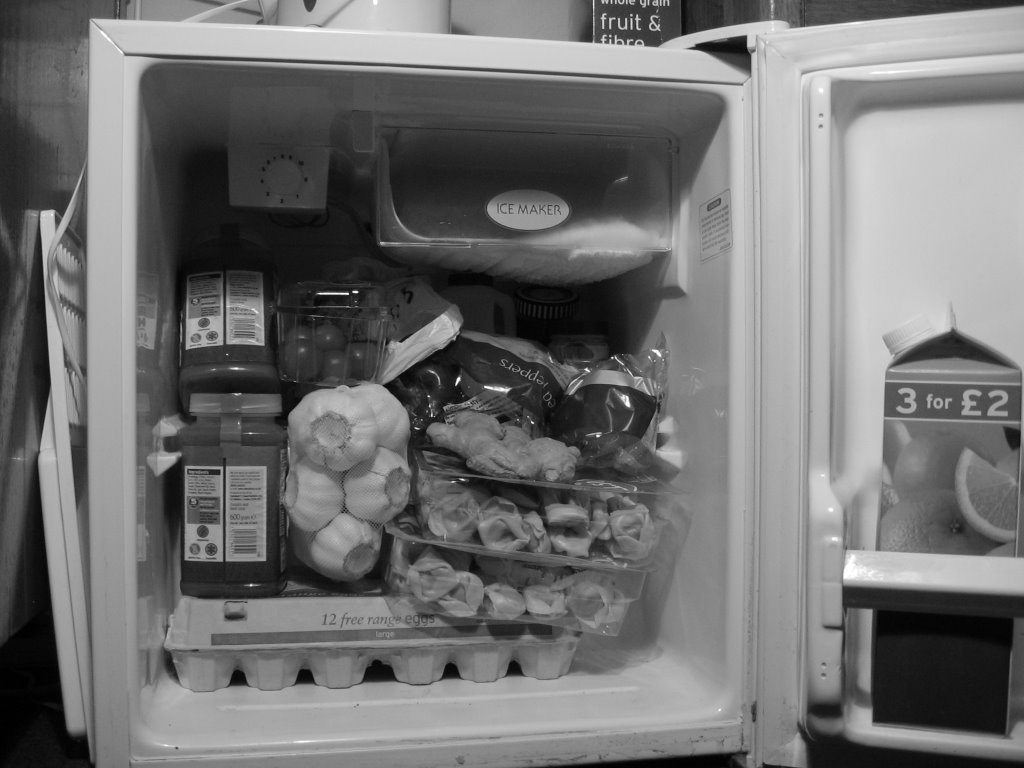
Tiny fridge overflowing

We had our first qualitative methods seminar today, and I am of a mixed opinion about it. 28 people in a lecture hall does not make for a very effective seminar format. Likewise, the discussion was unfocused and struck me more as messily attempting to identify the relevant issues, rather than dealing with them directly. With only two weeks to cover foreign policy analysis, perhaps it is inevitable that the coverage will not be comprehensive.

Part of the problem, I think, has to do with the limitations of the whole broad discipline of ‘international relations.’ We are in the business of quick and dirty answers. That’s fine, really, since we’re rarely interested in capital T truth. All international relations is done for a purpose – whether explicitly normative or not – and most of it relates to questions of a kind where a rigorous conception of truth simply doesn’t apply. Either our conclusions are so vague as to be untestable or our answer is only one of many potentially valid ones. For me, most of these apparent problems evaporate once you adopt an explicitly normative agenda. It doesn’t matter where the boundary between foreign policy analysis and international relations lies (if it even exists). Rather, we can pick and choose whatever tools are helpful for advancing an agenda. This strikes me as fundamentally more honest, and obviously less frustrating.

During the lecture, I also found myself thinking worriedly about exactly what I am going to do with all of this. The lack of a summer job and housing for next year is uncertainty enough for me, but that’s just peanuts compared to the big question of “What next?” Once I become Milan Ilnyckyj, M.Phil (Oxford), what am I going to do with myself? Going straight into a PhD seems unwise. It would be better to see a bit more of the world before making such a commitment. Working at something relevant and interesting, while writing, has a lot of appeal, but I really have no idea of how to bring it about.

Hilary Term Outline

15 Jan 06: Term begins
20 Jan 06: ORS application due
24 Jan 06: First paper for Andrew Hurrell due
31 Jan 06: First core seminar paper due
07 Feb 06: First qualitative methods take home exam
28 Feb 06: Second core seminar paper due
01 Mar 06: Two more scholarship applications due
07 Mar 06: Second qualitative methods take home examIndeterminate dates: 3-4 other papers for Andrew Hurrell
List subject to later additions

I paid another tranche of my Oxford fees today. I am now paid up for Hilary term: as far as battels, college fees, and university fees go. I will keep paying for all my groceries and as many other expenses as possible on my Canadian credit card, but it will definitely be necessary to make another expensive and time consuming bank transfer in order to pay next term’s fees. Then, I will be halfway done paying for the whole Oxford experience.

I think that Emily and others are right in thinking that the best job for me that is within reach has to do with either writing or editing. That said, I know nothing about the industry. I suppose I had better learn, if I don’t want to end up working in a computer shop or a pub this summer…


  • Apologies to those who read the Atom feed, but I had to switch it from full syndication to just snippets. The reason for this is that other pages keep grabbing my content and then using it to drive their own advertising. If I am going to pay for this URL and hosting this content, without even enabling advertising on this site, I definitely don’t want other people profiting off of it.
  • Many kudos to Google for not turning over their search records to the DOJ. If you’re serious about the commitment to “not be evil,” this is just the sort of thing you need to do. Not to mention, if you want to maintain the trust of thousands of people storing huge amounts of email with you (including most members of the Oxford M.Phil in IR program).
  • Here’s a question for my wise and tactful readers: my supervisor hasn’t been explicitly told about my blog. While the simplest of Google searches yields it immediately, the fact remains that he has been mentioned in it a number of times without necessarily knowing about it. Nothing personal, of course, but it’s still there. The question, therefore, is whether I should tell him directly. The relationship is an entirely professional and academic one, that hasn’t taken on any kind of extensive personal dimension. Otherwise, I would have probably told him long ago. No appropriate chance has arisen. Who can advise may speak.

Academic and non-academic reading

The Wednesday Market in Gloucester Green

Ten January nectarines, a pound of red peppers, garlic, cherry tomatoes, and ginger: at Emily’s suggestion, I went to the Wednesday Market in Gloucester Green today. As I’ve said before, ‘green’ is a definite misnomer. That said, to get a sack of fruit and veggies for £5 makes for a nice contrast with Sainsbury’s.

Aside from reading, not a great deal happened today. In a productive piece of procrastination, I read Around the World in 80 Days. I hadn’t not read it before, but only heard parts of it read aloud during one of my family’s traditional trips down the Oregon Coast (on which both Jonathan Morissette and Kate Dillon accompanied me more than once). While rapidly digestible, it’s certainly not the most complex of novels: fuelled more, perhaps, on national stereotypes and an early anticipation of the consequences of globalization than on solid characterization or description. Verne’s frequent misunderstanding about knots – thinking them a unit of distance, rather than velocity – is particularly irksome, despite being only a very minor point. A steamer that goes “eight and nine knots the hour” would be going very fast indeed after a few days. Reading it after the demise of the British Empire, one cannot help being struck by a tinge of collective nostalgia. Collective because the British Empire is something I’ve only experienced by distillation, and by virtue of being Canadian.

Tomorrow, we have our first qualitative methods class. The three focuses are foreign policy analysis, interviewing, and archival research. All strike me as things likely to be useful.


  • No sign yet of the form I need for formally request exemption from future college meals. I will make a third request for one tomorrow morning.
  • Hardly anyone from Oxford is on my MSN contact list. If you want to be, send me an email, find my MSN username from my Facebook profile, or contact me by some other means. I am also on AIM and Skype.
  • Everyone back home is fixated on the new series of 24. I rather liked the first series, watching the whole thing twice, but found the second ridiculously implausible, in terms of politics. That said, their energetic accounts make me envious of those with television access: a very unusual feeling for me.
  • At times, we must all curse how there are no university run wireless networks in Oxford. The DPIR IT people tell us it’s because the colleges can’t agree how to do it: an explanation I believe, even as I find it frustrating. The iBook would certainly wander farther from my desk if it could talk to other machines from elsewhere. This is part of why Oxford’s continued devotion to old ideas and old rivalries will sink it in comparison to American schools in the next few decades, unless things change a great deal.
  • Seth’s blog directed me to a community of LiveJournal users all trying to get into Oxford. Take a look, if it interests you.

Real academic work has resumed

The Old Library at All Souls

Lectures

Unfortunately, I missed the first Philosophy of the Social Sciences lecture today, because I didn’t know when it was happening. I learned when Marga Lyall sent me an email: 3/4 of the way through the lecture and I was busily writing up presentation notes on neorealism. It seems that most of the other M.Phils missed it as well, so I am not overly worried. It’s also a supplemental, rather than examined, piece of coursework – though it is mandatory.

The first core seminar went extremely well. Both Jennifer Welsh and the talkative David Williams provided good direction for what proved to be a very interesting discussion. The seminar opened with a brief discussion of what theory is and should be. I think it would have benefitted significantly from the presence of a philosopher or two, especially when questions about the nature of knowledge and science arose.

Somewhat uncharacteristically, I volunteered to present, as I felt myself to have a fairly strong grasp of the topic. It’s always nice to get these things out of the way, even when they are not explicitly for marks. My general sense afterwards is that the presentation went quite well, though the importance of them doesn’t extend too far beyond offering some starting point for discussion.

Strategic Studies Group

Tonight, there was a presentation on Saudi Arabia being made to the Oxford Strategic Studies Group (OUSSG) at All Souls. I attended along with Claire and Madgdy. The speaker was Colonel (Ret) Brian Lees and he spoke for about an hour about the various characteristics of the Saudi Kingdom: geographic, political, strategic, etc. It was an interesting summary, not dissimilar in overall content from the survey recently printed in The Economist, though notably more favourable towards the Saudi Royal Family.

Apparently, three positions have opened up on the executive committee of the OUSSG. Since I don’t have any experience with the group, the sensible position to aim for would be that of secretary. Consider this a formal declaration of candidacy. Since it is basically a communication and paperwork position, it seems an intelligent starting point for an outsider: as well as something relatively unlikely to be hotly contested. I spent about an hour after the talk and subsequent questions talking in The Turf with the current President, Secretary, Webmaster, and a number of members. They seem an interesting group and this seems a good way to expand my range of Oxford activities, as I have expressed the intent to do in previous posts. At ten Pounds for membership, it’s enormously more reasonably priced than the Union.

Later in the year, there is also a highly subsidized expedition to Brussels to see the European Parliament and NATO headquarters. It’s happening during the next inter-term break and it seems entirely sensible to part with three days of revision time and one hundred Pounds or so for such an opportunity.

Miscellaneous

With Philosophy of the Social Sciences lectures from 10:00 to 11:00, the core seminar from 11:00 to 1:00, the Changing Character of War series from 1:00 to 2:30, and Professional Training in the Social Sciences from 5:30 until 7:30, Tuesdays this term look as though they will be fairly hectic and good for displacing meals to awkward times.

This afternoon, I made a second written request for the form I need in order to make a written request to opt out of all future meals in college. Along with having NatWest make another bank draft and finishing the ORS application, I am well stocked with paperwork. As I’ve said before, completing a scholarship application we’ve been told that we have virtually no chance of winning is frustrating.

After much urging from Jessica, I’ve abandoned the buggy Mac version of MSN Messenger for the open source client Adium. It looks as though it will take some tweaking before it is working the way I want it to, but the general wisdom of avoiding Microsoft products (especially where the internet is concerned) is enough to make me stick with it, at least for now. The existence of an optional Hobbes (the tiger, not the philosopher) Dock icon is also a selling point. The default duck icon is just hideous. There is something rather nice about being able to use one relatively elegant program to access a diverse range of IM services, though I am only using it for MSN and AIM at the moment.


  • Apple has responded to the many people who complained about a spyware feature in the new version of iTunes. You are now able to decline installation of the component in question: an iTunes ‘Ministore’ to which information about any song you clicked on was sent. This goes to show both that some companies listen to their customers and that it isn’t so hard to address customer complaints after the fact. Well done Apple.

“Nothing is more deceitful,” said Darcy, “than the appearance of humility.”

My workspace

Realism and neorealism

With a litre of dark coffee beside me and tables heaped with books, I can tell that the term has begun. During my core seminar tomorrow morning, there’s a one in seven chance that I will need to present for fifteen minutes on the differences between realism and neorealism. One approach, I suppose, would be to take Waltz’s conception of ‘thought’ as compared to ‘theory’ and build a presentation out of examining it. By a lucky coincidence, I have a copy of a take home exam for Robert Crawford’s international relations theory course written on that precise topic. You can get a sense of Crawford’s hostility to Waltz from the question itself:

In an obviously self-serving argument, Kenneth Waltz distinguishes between “thought” and “theory” in international relations. What is the basis for this distinction, and to what extent does it further, or undermine, the pursuit of knowledge in world politics?

I don’t know anything about David Williams, but I am pretty sure Jennifer Welsh is no neorealist. Come to think of it, she probably knows Robert Crawford.

I am decreasingly of the opinion that Waltz is ‘wrong’ in the sense normally applied to the word. It’s more that he has quite an unusual project. Waltz identifies theory as “a means of dealing with complexity” and goes on to say that “in making assumptions about men’s (or states’) motivations, the world must be drastically simplified; subtleties must be rudely pushed aside, and reality must be grossly distorted.” What he is doing is fundamentally more artificial than a straightforward attempt at getting a sense of how world politics works and how we might hope to change it. Indeed, that kind of unstructured approach is exactly what Waltz would categorize as “mere thought.” Hoffman says that: “Waltz’s own attempt at laying the groundwork for theory is conceptually so rigorous as to leave out much of the reality which he wants to account for.”

The danger arises when Waltz makes the same move as many sleazy economists. They build theories strongly abstracted from reality (high school dropouts have perfect understanding of the advanced mathematics involved in generating net present values, and other ludicrous assumptions) in the hope of developing a parsimonious explanation of a good part of the phenomena being observed. The devious step is when they come to love their models too well and carry on, by sheer momentum, applying them in situations where their own assumptions make them entirely invalid. Especially when making normative judgements or advocating policy, all those bits of real-world complexity that were deliberately forgotten need to be considered again. Likewise, there is the need for an awareness of how theory itself impacts the world. Otherwise, theory becomes nothing more than “an anti-political apology for brute force and cynicism” as Kalevi Holsti pointedly described neorealism.

Given the passions that tend to get inflamed both within supporters and opponents of neorealism when the subject gets debated, tomorrow’s seminar promises to be an interesting discussion. Indeed, among IR scholars, the position you take with regards to IR theory is one that goes a long way towards defining your personal and intellectual identity. As Robert Walker identified in 1986, theory is never a neutral thing: “Theory is always for someone, for some group, for some purpose.”

In the end, I would contend that ideas pertaining to vital questions about world politics are necessarily ‘thought’ as opposed to ‘theory’ as defined by Waltz. While he would probably agree, using the cover that theory can never be comprehensive, I don’t think that’s an adequate response: at least not if people are going to go around identifying themselves as neorealists. If neorealism is a partial explanation, it cannot comprise our whole intellectual outlook.

Richard Dawkins

Apparently, on Monday February 13th, there will be a lecture in London presented by Richard Dawkins. It’s entitled: “Darwin’s meme: or the origin of culture by means of natural selection” and I would be interested in going if I can find at least one other person who would also be so inclined. It is happening at the Darwin Lecture Theatre, Darwin Building, UCL, Gower Street, London at 6:30pm.

On a related note, Louise apparently knows Professor Dawkins’ daughter Juliet. Regrettably, I did not get the chance to meet either her or her father before Louise made the journey back to Lancaster. Along with Philip Pullman, Richard Dawkins is probably the Oxford resident who I would most like to meet.


To do in the next few days:

  • Prepare realism v. neorealism presentation (ASAP)
  • Opt out of another term of college meals in hall (ASAP)
  • Merifield application (Wednesday)
  • Complete ORS application, submit directly to University Offices (Friday)
  • Pay Hilary term fees and battels (Friday)

Contemplating the future

Shadows of me and Emily Paddon

The Stardust Mission

One piece of exciting news today is the safe return of the NASA Stardust capsule, after a seven-year mission intended to collect dust from the tail of a comet. If the aerogel-filled compartments are, as expected, saturated with this material, it will be the first time such a thing has ever been collected and it may contribute important information to understanding the early solar system.

This is also the first mission since 1976 to return solid material from an extraterrestrial body: a measure both of diminished interest in the moon and the exceptionally longer distances involved in reaching other planets and asteroids.

Whereas there is a great deal of controversy about the usefulness and safety of manned space travel – especially the Shuttle Program – there are few people who contest the scientific usefulness of robotic exploratory missions. Indeed, there is a very satisfying record in the past few years of improved understanding of cosmic phenomena, both within and outside our solar system.

The really exciting prospect is the possibility of seeing new developments in particle and theoretical physics start to match up better with improved cosmological models. The biggest questions in physics today are probably the questions related to dark matter and energy, the explanation behind the profusion of subatomic particles that have been discovered, and the generation of a theory that is able to deal with the contradictions between quantum mechanics and relativity. While this mission doesn’t necessarily speak directly to any of those goals, it’s part of a process of improved data collection that feeds the development and testing of explanations. It seems likely that interesting times are ahead.

The second term schedule

On Tuesday, the second core seminar begins: Contemporary Debates in International Relations Theory. While the subject matter is inherently somewhat less interesting than the historical analysis of the first and third term, I am excited about the course. Partly, that is because of the instructors: David Williams and Jennifer Welsh. Partly, that is because of my fellow seminar members. If I recall correctly, I am in the same group as Roham, Sheena, Andy Kim, Bryony, Claire, Robert Moore, Emily, Matt Pennycook, Shohei, Alex, and Robert Wood. Collectively, I think this will make for interesting discussions.

Just like last term, I have a one in seven chance of being called upon to give a fifteen minute presentation on one of the week’s two topics. This week, mine would be:

‘For classical realists conflict stems from human nature, while for neo-realists conflict stems from the nature of the international system’. Is this an accurate assessment of the differences between classical and neo-realists?

Thankfully, I have some recollection of Robert Crawford’s IR Theory course at UBC to fall back upon. The sensible approach seems to be to quickly summarize and contrast some of the biggest names in realist theory: E.H. Carr, Hans Morgenthau, and Kenneth Waltz, in particular. Tomorrow, I will be in the SSL formulating some speaking notes.

Aside from the core seminar and qualitative methods, I am not entirely certain what we are meant to be attending this term. I’m not sure if the ‘Advanced Study of IR’ course is persisting into the second term; nor am I certain about whether the ‘Philosophy of the Social Sciences’ course that was delayed in Michaelmas will be happening now. Then there are things like the undergrad IR lecture and the ‘Professional Training in the Social Sciences’ course that were poorly attended and never discussed last term. I am sure it will all become clear in the first week or so, and I can ask Dr. Hurrell about it in our first supervision.

One thing I am scrambling over is the ORS application. For some reason, I thought it was due months from now. As such, I am having a real struggle coming up with two letters of reference before the due date on the 20th. That is particularly true since Dr. Hurrell is not supposed to provide one, since the department will be making the selection of which ORS applicants in the program get passed along to the university. It’s frustrating to have to do all of this for a scholarship we’ve told we have almost no chance of actually receiving. I am personally more hopeful about the Chevening, for which all applications were due in Ottawa today, and a few others that are coming up in the next few months. Suffice it to say that having some funding for next year would be exceedingly welcome.

Housing for next year and a job for the summer

Both at the back of my mind for the whole break, neither of these problems has found a solution yet. I am increasingly inclined to staying in Oxford: partly because of the availability of research materials for my thesis and partly due to the lower cost of living and the correspondingly increased probability that I will be able to find a job that will at least cover them. I would be happiest with a job doing academic research or working as a writer or editor in an academic, journalistic, or publishing context. Anyone with ideas is very much encouraged to contact me.

I have preferences but no possibilities regarding housing as well. I’d like to have a room in a house shared among some of my friends (ideally, at least a few of them members of the M.Phil in IR program). The Jericho and the Cowley Road areas seem to be the desirable ones for students. Jericho is closer to university stuff, but is less of a low-cost residential environment. The existence of the Tesco on Cowley Road could single-handedly account for a somewhat lower cost of living there. As for the building itself, my critical requirements are:

  1. High speed internet access.
  2. Decent security – I really can’t afford to have my laptop stolen
  3. A clean and effective kitchen
  4. Tolerable proximity to classes and services
  5. Affordability

Of course, a big part of the quality of any living arrangement has to do with the people with whom you are living. My thuggish former roommates from my first year in Fairview may be the ultimate example of how bad roommates can ruin a residence experience. While I don’t think I could possibly do that badly again, I’d really like for my first experience in private accommodation to be with people whose company I enjoy. This will be the first time I’ve ever rented a private room. At UBC, at L’Universite de Montreal, and at Oxford, so far, I have always lived in university housing.

I may well apply for a space in Merifield, just so that the option of living there remains open.