The monthly and the bi-weekly

Every second Wednesday, I expect Ottawa experiences a marked uptick in consumer spending as all the civil servants get paid simultaneously. This may prove especially true next month, due to a quirk in financial timetables. Since paycheques are issued every two weeks, there are always at least two in a month. Twice a year, however, there will be a month where people get three paycheques. Most people, I expect, deal primarily with expenses that run month to month: rent, credit card bills, and the like. As such, that third paycheque seems like a kind of windfall.

Thought of in this way, the question that comes to mind is how to deal with the ‘surplus.’ The most conservative option would be to put it toward my student loan payments. An alternative is to put it into general savings, as a hedge against future financial needs. A final and more appealing option would be to spend it on a big purchase. My iBook is suffering more and more acutely with the pasage of time. Despite the upgrade to 1.25 GB of RAM, it now takes more than 20 minutes to boot up (I never shut it down, if I can avoid it). It also has trouble accessing the web, playing music, and keeping track of email at the same time. A new MacBook might be an excellent way to help ease myself into Ottawa’s winter chill…

Dr. Strangelove in a nuclear bunker

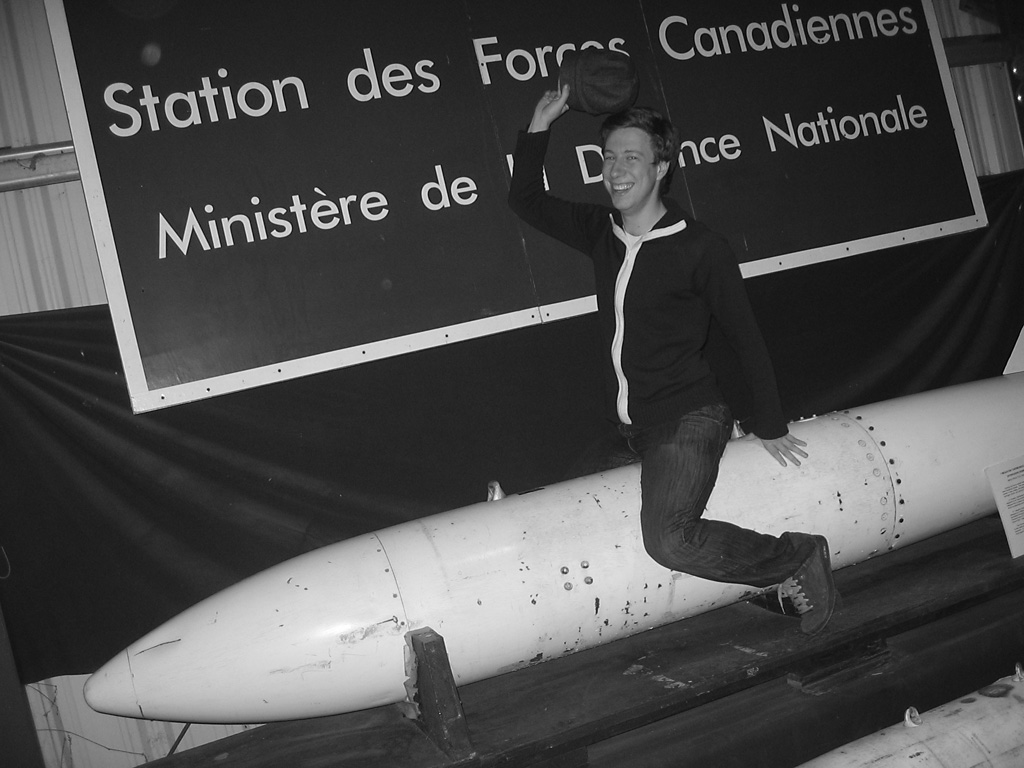
Marc Gurstein rides the bomb

After today’s orientation, I went with some friends to see Dr. Strangelove in the Diefenbunker – the infamous Canadian nuclear shelter, built to protect top Canadian military and civilian leadership in the event of nuclear war. Diefenbunker is actually a general term for shelters of the type: the one near Ottawa is called CFS Carp. Apparently, there is also one in Nanaimo, B.C. One odd thing is that the shelter has a multi-room suite for the Governor General. Presumably, Canada would not have much need for a local representative of the Queen, after the actual Queen’s entire realm is reduced to a burnt, radioactive plain.

Tonight’s film was followed up by Pho with three fellow employees of the federal government. It was all a distinct social step forward, and Ashley Thorvaldson deserves credit for organizing the expedition.

You can read about the Cold War movies events on the website of the Diefenbunker Museum.

The folly of Apollo redux

In an earlier post, I discussed the wastefulness of manned spaceflight. In particular, plans to return to the Moon or go to Mars cannot be justified in any sensible cost-benefit analysis. The cost is high, and the main benefit seems to be national prestige. Human spaceflight is essentially defended in a circular way: we need to undertake it so that we can learn how human beings function in space.

A post on Gristmill captures it well:

Let me be clear. There is a 0 percent chance that this Moon base or anything like it will ever be built, for the following reason: the moon missions in the ’60s and early ’70s cost something like $100 billion in today’s dollars. There is no way that setting up a semipermanent lunar base will be anything other than many times more expensive. That would put the total cost at one to a few trillion dollars.

Assuming that this taxpayer money needs to be lavished on big aerospace firms like Lockheed anyhow, it would be much better spent on satellites for the study of our planet (Some comprehensive temperature data for Antarctica, perhaps? Some RADAR analysis of the Greenland icecap? Some salaries for people studying climatic feedbacks?) or on robotic missions to objects of interest in the solar system.

Liability and computer security

One of the major points of intersection between law and economics is liability. By setting the rules about who can sue brake manufacturers, in what circumstances, and to what extent, lawmakers help to set the incentives for quality control within that industry. By establishing what constitutes negligence in different areas, the law tries to balance efficiency (encouraging cost-effective mitigation on the part of whoever can do it most cheaply) with equity.

I wonder whether this could be used, to some extent, to combat the botnets that have helped to make the internet such a dangerous place. In brief, a botnet consists of ordinary computers that have been taken over by a virus. While they don’t seem to have been altered, from the perspective of users, they can be maliciously employed by remote control to send spam, attack websites, carry out illegal transactions, and so forth. There are millions of such computers, largely because so many unprotected PCs with incautious and ignorant users are connected constantly to broadband connections.

As it stands, there is some chance that an individual computer owner will face legal consequences if their machine is used maliciously in this way. What would be a lot more efficient would be to pass part of the responsibility to internet service providers. That is to say, Internet Service Providers (ISPs) whose networks transmit spam or viruses outwards could be sued by those harmed as a result. These firms have the staff, expertise, and network control. Given the right incentives, they could require users to use up-to-date antivirus software that they would provide. They could also screen incoming and outgoing network traffic for viruses and botnet control signals. They could, in short, become more like the IT department at an office. ISPs with such obligations would then lean on the makers of software and operating systems, forcing them to build more secure products.

As Bruce Schneier has repeatedly argued, hoping to educate users as a means of creating overall security is probably doomed. People don’t have the interest or the incentives to learn and the technology and threats change to quickly. To do a better job of combating them, our strategies should change as well.

Oryx and Crake

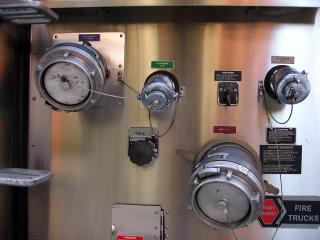
Fire truck valves

Margaret Atwood‘s novel, which was short-listed for the Booker Prize, portrays a future characterized by the massive expansion of human capabilities in genetic engineering and biotechnology. As such, it bears some resemblance to Neal Stephenson‘s The Diamond Age, which ponders what massive advances in material science could do, and posits similar stratification by class. Of course, biotechnology is an area more likely to raise ethical hackles and engage with the intuitions people have about what constitutes the ethical use of science.

Atwood does her best to provoke many such thoughts: bringing up food ethics, that of corporations, reproductive ethics, and survivor ethics (the last time period depicted is essentially post-apocalyptic). The degree to which this is brought about by a combination of simple greed, logic limited by one’s own circumstances, and unintended consequences certainly has a plausible feel to it.

The book is well constructed and compelling, obviously the work of someone who is an experienced storyteller. From a technical angle, it is also more plausible than most science fiction. It is difficult to identify any element that is highly likely to be impossible for humanity to ever do, if desired. That, of course, contributes to the chilling effect, as the consequences for some such actions unfold.

All in all, I don’t think the book has a straightforwardly anti-technological bent. It is more a cautionary tale about what can occur in the absence of moral consideration and concomitant regulation. Given how the regulation of biotechnology is such a contemporary issue (stem cells, hybrid embryos, genetic discrimination, etc), Atwood has written something that speaks to some of the more important ethical discussions occurring today.

I recommend the book without reservation, with the warning that readers may find themselves disturbed by how possible it all seems.

Types of goods

In economic theory, most things you can buy are ‘normal goods.’ This means that, as the price rises, people buy less of them. Conversely, people buy more as the price falls. This is all quite self-explanatory but it is interesting to note that there are other types of goods that operate in different ways.

The most common example may be inferior goods. The richer people get, the less they spend on inferior goods. This includes most kinds of discount items: once people can afford something better, they make the switch. Inferior goods reflect this property both at the micro level (an individual gets a big raise and buys less cheap IKEA furniture) and at a macro level (the mean income in a state rises and demand for low-cost gruel falls). Long distance bus trips are a classic example of an inferior good, as anyone who has spent more than twelve hours in a smelly, noisy coach can easily understand.

A somewhat perverse counterpoint to inferior goods can be found in Veblen goods. Named after the economist Thorstein Veblen, these are products for which the demand actually rises as the price does. This is essentially on account of their exclusivity. People buy Velben goods (such as Rolls Royce cars and $50,000 cell phones) precisely to demonstrate that they can. Of course, this makes them a godsend for those hoping to part status conscious rich suckers from some of their wealth.

A final possibility, which may not actually exist, is a Giffen good. To qualify, the good needs to be inferior (in the sense described above), there must be a lack of close substitutes, and the good must comprise a significant share of the purchaser’s budget. With these goods, price rises also lead to people buying more, though for a rather different reason. People who have become too poor to buy a better option fall back on a worse option. The failure of economists to find any well-defended empirical examples suggests that this kind of good may exist only in the minds of academics.

Both Giffen goods and Veblen goods exist because of possible characteristics of the buyer, rather than of the good itself. Whereas Giffen goods are easy to reconcile with ‘rationality’ as understood by economists, Velben goods do so only when they are viewed as inputs in the manufacture of the commodity actually sought: such as social status or prestige.

People wanting to read even more about goods and economic theory can look into the distinction between rivalrous and non-rivalrous goods and excludable and non-excludable goods. The two ideas together define public goods and common property goods, the existence of which make even the most hard-nosed economist recognize the efficiency of governmental action to regulate markets.

Pressure and the price of gas

The tendency of gasoline to increase in price during the summer is well known. Partly, this reflects increased demand (which leads to an increased quantity sold at an increased price, given a particular supply curve). Partly, this is the consequence of how summer gasoline is a different blend of hydrocarbons. The reason for this is the need to prevent too much pressure from building up inside gas tanks as more of the liquid turns to vapour in the summer heat. This is standardized in terms of Reid vapour pressure (RVP): the pressure of any particular gasoline blend at 100°F (37.8°C) expressed in kilopascals, calibrated to a standard atmospheric pressure of 101.3 kPa.

RVP is used to specify which blends of gasoline are acceptable for sale at different ambiant temperatures. Gasoline with an RVP of over 14.7 will fairly easily pressurize gas tanks and gas cans in summer heat. It will also boil if left in open containers. As such, regulations require summer gasoline to contain less butane than the winter sort. This is on account of how butane is relatively inexpensive (making companies want to include more of it), but is also the most active contributor to vapour pressure. As such, the butane content of summer gasoline must be very low – one factor behind the higher price.

I learned all this from R-Squared, an energy blog that seems to be commonly cited. The blog makes one other important point: anyone considering storing cheap winter gasoline for use in the summer should consider the dangers of having the butane therein turn to vapour and start pressurizing the container in which it has been stored.

Unlocking cars with computers

Back in the day when the original Palm Pilot was a hot new piece of technology, I remember BMW and a number of other car companies started selling cars with a keyless entry system based on an infrared transmitter in a key fob, just like a television remote control. Unfortunately, whatever sort of protocol the system used for authentication was quickly undermined and the Palm Pilot’s infrared transmitter suddenly became a key to all manner of expensive new automobiles.

Something similar has happened again. The KeeLoq system, used in the keyless entry systems of most car manufacturers, has been cracked by computer security researchers. A PDF of their research paper is online. The attack requires about one hour of radio communication with the key, which could be done surreptitiously while the owner is in an office or restaurant. The cryptographic analysis involved takes about a day and produces a ‘master key’ that can actually open a number of different cars. Having collected a large number of such master keys, it would be possible to intercept a single transmission between a key and a car (say, when someone is parking), identify the correct master key, and open the door in seconds. While this will not start the car – and there are certainly other methods available for breaking into one – it does create a risk for theft of objects inside cars in a way that shows no signs of forced entry. In many such cases, claiming insurance compensation is difficult.

Of course, mechanical locks also have their failings. One important difference has to do with relative costs. Making a physical, key-based access control system more secure probably increases the cost for every single unit appreciably. By contrast, improving the cryptography for a system based on an infrared or radio frequency transmission probably involves a one-off software development cost, with negligible additional costs per unit. As such, it is especially surprising that the KeeLoq system is so weak.

Not so jolly: the economics of gift giving

Victoria Island, Ottawa

As anyone who has ever been disappointed by what they found under the wrapping paper knows, gift-giving can lead to the misallocation of resources. Gift givers misanticipate the value a particular thing will have for the recipient, and thus devote more resources to the purchase than the recipient would. Joel Waldfogel, writing in The American Economic Review back in 1993 discussed this and other related economic issues in a notorious article called “The Deadweight Loss of Christmas.” (Available through JSTOR and Google Scholar)

Imperfect knowledge and non-ideal choices

The paper includes the gloomy conclusion that “gift giving destroys between 10 percent and a third of the value of gifts.” On this basis, the paper estimates that the deadweight loss of holiday giving in the United States in 1992 was between $4 billion and $13 billion. The article does note one possible saving grace: when recipients are ill informed about the existence of things they might enjoy, a gift can be worth more than a transfer of the equivalent quantity of cash. Of course, providing the cash and the information would achieve the same effect, without the risk that the choice will be different from what the recipient would have done with the money themself.

Gifts from friends and significant others are most efficient (largely because they know the preferences of the recipient best), while “noncash gifts from members of the extended family” are most likely to be valued by the recipient at less than their cost of purchase. Recipients value gifts from friends at 98.8% of their actual value, while those from significant others are valued at 91.7%. Parents and siblings give gifts worth 85% of their cost, while aunts and uncles manage only 64.4% and 62.9%, respectively. These conclusions were reached largely on the basis of surveys given to Yale undergraduates (favourite targets for psychological and economic experiments). Waldfogel notes that a social stigma can exist against giving cash gifts, but it is weakest where aunts, uncles, and grandparents are concerned – not coincidentally, the least effective choosers of gifts.

The thought counts

I have a more wide-ranging response of my own. Thankfully, there is a phenomena that partially offsets imperfect gift choice losses: the extent to which the very status of something as a gift increases its value in the eyes of the recipient. I can think of scores of cases where a product or service that would not have been particularly gratifying if purchased for myself was especially welcome and meaningful when received from someone else. In many cases, this creates utility significantly greater than that which could be achieved through personal spending of an equivalent sum.

I was reminded of all this when I saw Waldgofel’s article mentioned on Marginal Revolution, an interesting economics blog.