The Harperman imbroglio

This little song, written by Environment Canada scientist Tony Turner, has received a lot of media attention:

CBC: Harperman case: Can public servants be political activists?

The Guardian: Canada government suspends scientist for folk song about prime minister

Both the song and the public responses point to one of the big unsettled questions about the appropriate conduct of the public service. What are citizens who are employed to serve the public interest meant to do when the country is badly governed by their political bosses?

Watching the aurora

Thanks to the intervention of my friend Amanda, I spent the weekend at my friend Sabrina’s cottage on Paugh Lake, near Barry’s Bay, Ontario.

I had high hopes for a clear view of the fading Perseid meteor shower on Friday and Saturday night. Friday night was overcast and raining, though it was still remarkable to be in a place where rain falling on roofs and water, along with animal noises, were the only things audible. I am not sure when I was last outside a major urban area, but there haven’t been many cases since I moved to Toronto.

Saturday gifted us with perfect astronomical viewing conditions: far from city lights, and untroubled by the moon. We didn’t see a lot of meteors, but the sky was so full of stars that it made identifying familiar constellations a challenge. Across the sky, the band of the Milky Way was clearly visible, wheeling above us as the night went on.

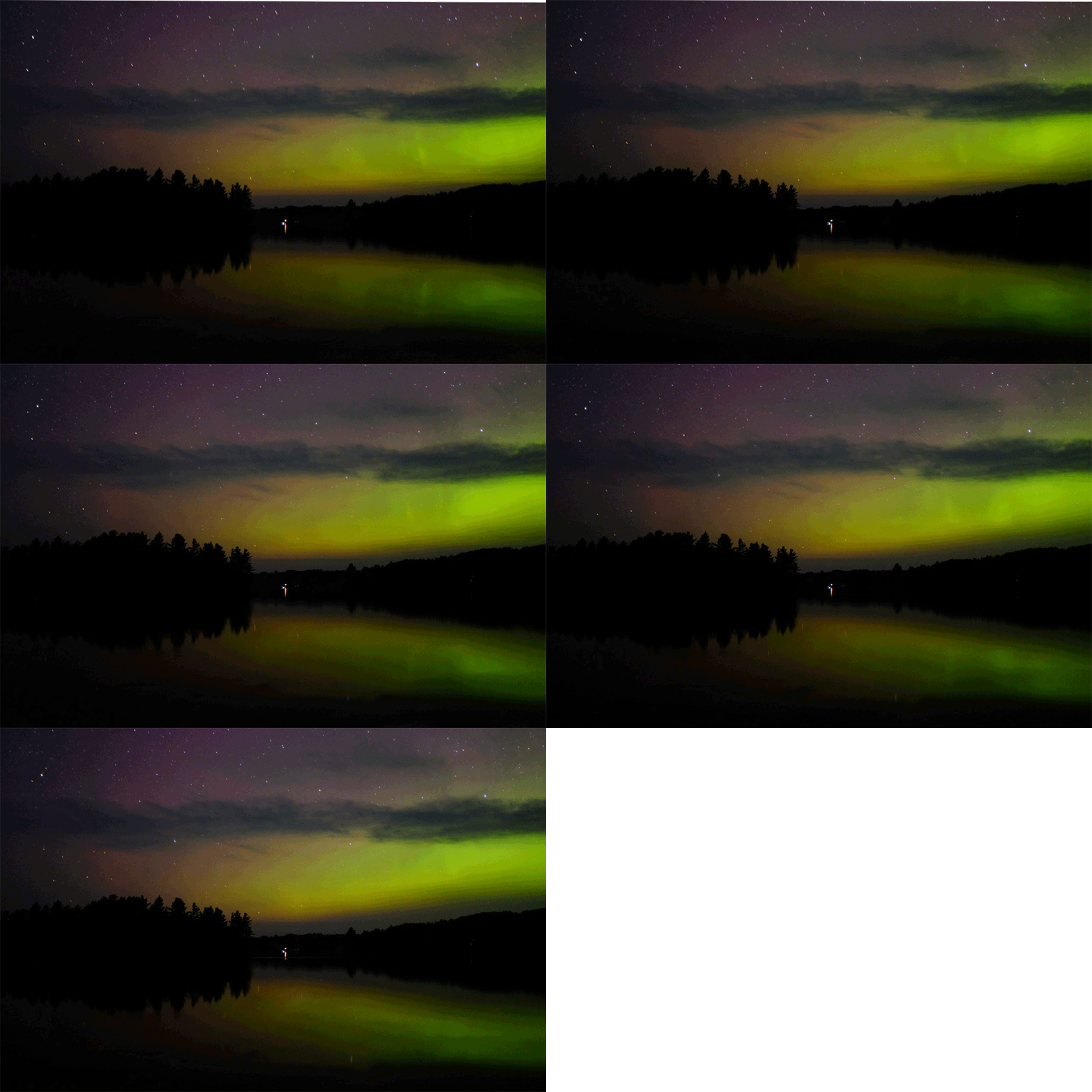
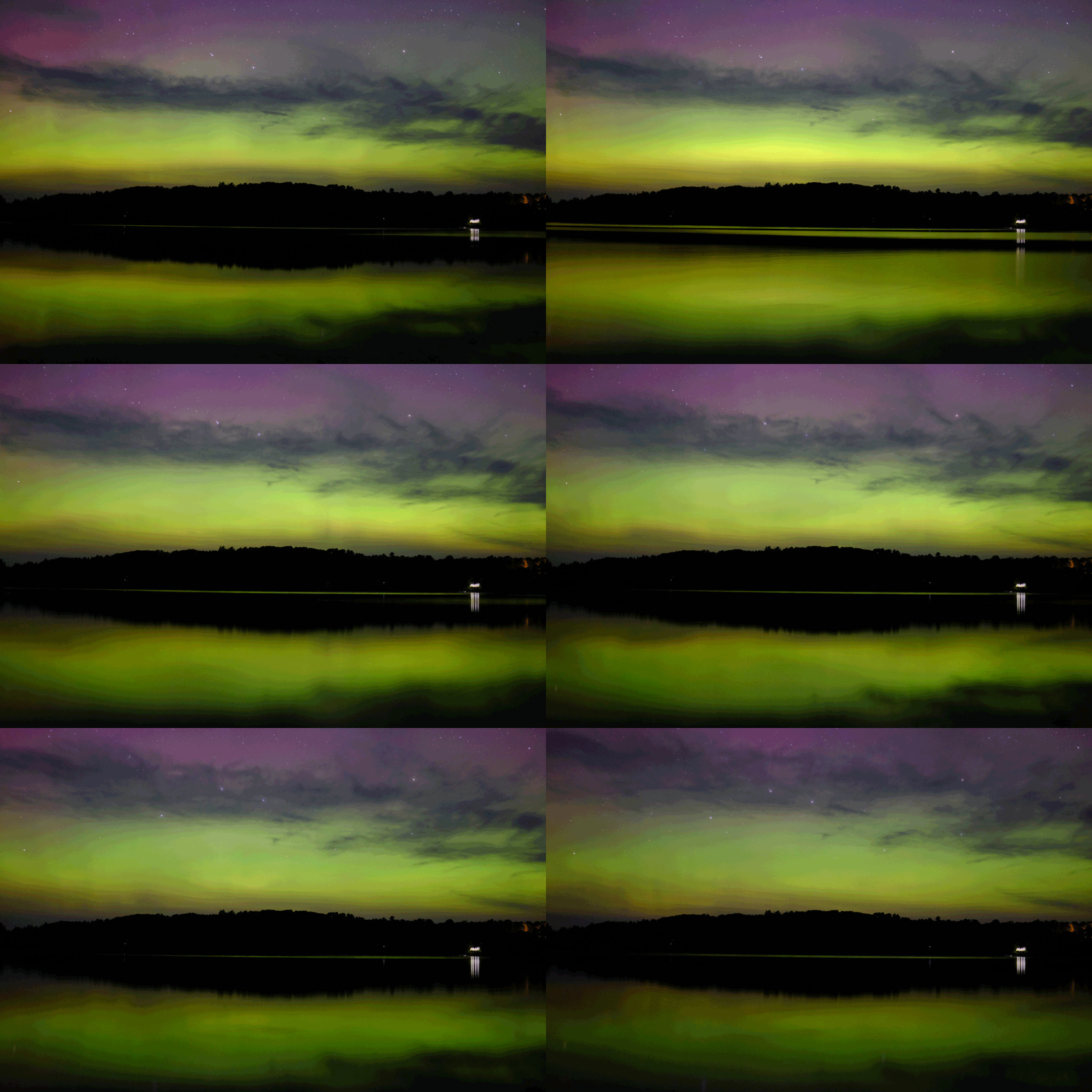
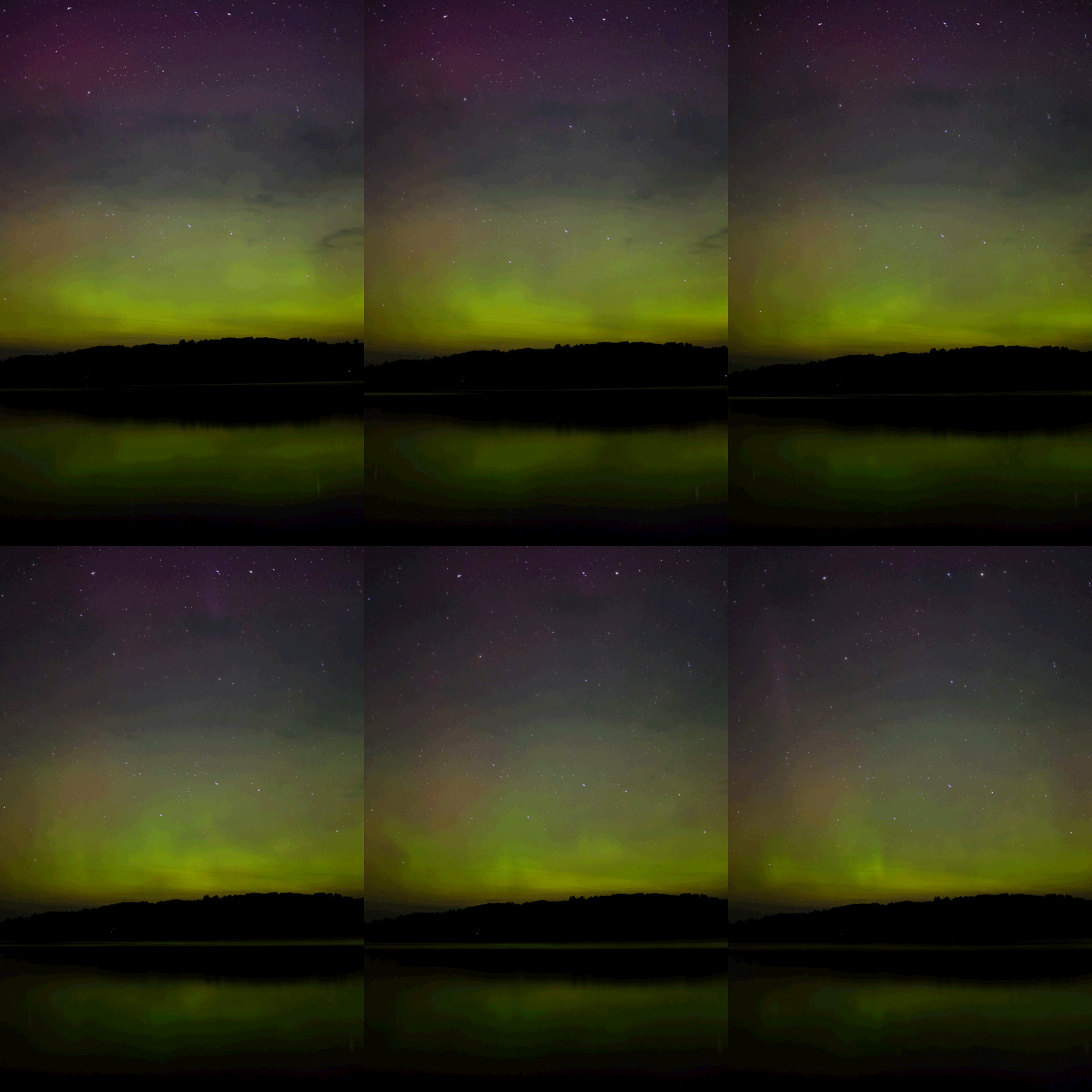
Experimenting with some long exposures with my Fuji X100S (and a stepladder and dishcloth as an improvised tripod) I was surprised to see that the vague light in the northern sky came out as brilliant colour when photographed at 1600 ISO with a 30″ exposure.

I ended up spending hours photographing the aurora. There will be high quality images soon (and animated GIF is a terribly low-quality format for something so beautiful), but I wanted to put something up right away that would show the movement of the lights.

You may need to click the thumbnail to see the animation:

Aurora Borealis from Paugh Lake, Ontario 1/3

Aurora Borealis from Paugh Lake, Ontario 2/3

Aurora Borealis from Paugh Lake, Ontario 3/3

Aside from reducing the resolution and converting them to GIF format, these images are straight from the camera, not manipulated with any sort of software.

Out in the Edgeworth–Kuiper belt

NASA’s New Horizons spacecraft has been returning some exciting data, after a long flight through the solar system:

This documentary provides illuminating background on the mission: The Year of Pluto.

It is much to be hoped that the New Horizons craft will be able to observe other Kuiper belt objects.

Prism Designs “Quantum” two-line kite

I have had so much fun with my $17 Toys ‘R Us DC Sport 60 delta wing kite that I am thinking about getting something more sophisticated to play with: the Quantum two-line kite from Prism Designs. It’s another delta wing, so the basics of control will be similar. It’s tough enough to let other people crash, and has enough power to lift a light still or video camera.

I considered parasail-style kites, but while they may offer a great deal of power, they seem to have a narrower range of acrobatic possibilities.

I basically want something that I can fly in a range of wind conditions, let total amateurs learn on, and possibly use for some aerial photography. I will start setting aside a fraction of what I earn in commercial photography as a kite fund.

It even seems possible that regular kite-flying could have a therapeutic effect on the chronic pain from my collarbone injury. It’s plausible that it could help with both strength and range of movement.

Two-string kite flying

Yesterday I went to Hanlan’s Point beach with some friends, in part to fly my DC Sport dual control nylon kite: 60″ wide.

It’s a fun thing to fly. The only control surface you have is the entire airfoil, and the only axis of motion you can directly control is roll, by altering the relative length of the two strings.

The kite has a flight envelope comprised of a curved two-dimensional surface, with varying levels of power in different places. With very little practice, most people get a high degree of control. One guy walking along the beach was able to do it almost immediately when I suggested he give it a try.

It would be neat to get a parasail-style four-string kite with more power, pitch as well as roll control, and the option for controlled reversible landings.

Black Code

Written by Ron Diebert, the director of the Citizen Lab at U of T, Black Code: Inside the Battle for Cyberspace contains some very interesting information, of importance to anyone concerned with the future of the internet and communication. He discusses the major discoveries made by the lab, including massive criminal malware enterprises, government surveillance and censorship, and the use of cyberweapons like Stuxnet.

The first few chapters may seem basic if you actively follow the news on IT security and surveillance, but the material in the later parts is undeniably novel and interesting. The book is a bit of a lament for the death of the idealistic open internet, and the emergence of control by governments, particularly after the 2001 terrorist attacks in the United States.

The stakes here are high: the internet is a critical tool for maintaining democracy in open societies, confronting autocratic regimes, and dealing with global threats. The network is now in real danger of being suffocated by governments fixated on terrorism or maintaining domestic control, or who see it as a promising avenue for attacking their enemies.

Diebert proposes a distributed model for both securing and protecting the internet, while repeatedly underlining how governments are now the major threat to online freedom and political participation. Governments have rebuilt the backbone of the internet in order to achieve their censorship and surveillance objectives. It’s not a problem with a technical solution, from the perspective of citizens, but rather one which requires ongoing political agitation.