Hadfield on forecasts and contingency planning

“A lot of people talk about expecting the best but preparing for the worst, but I think that’s a seductively misleading concept. There’s never just one “worst.” Almost always there’s a whole spectrum of bad possibilities. The only thing that would really qualify as the worst would be not having a plan for how to cope.”

Hadfield, Chris. “An Astronaut’s Guide to Life on Earth.” New York; Random House. 2013.

Prospects for Mars colonies

I have long been skeptical about the prospects for off-world human colonies. Given that the International Space Station is the most expensive thing we have ever built and it is entirely reliant on supplies from Earth, it would be a gigantic leap just to make a self-sustaining closed life support system. Beyond that are many other obstacles, from radiation to Mars’ reduced gravity and even interpersonal conflict.

George Dvorsky has written an article with details on many of these challenges, which also quotes Louis Friedman on the psychological and philosophical implications of extraterrestrial expansion as an unlikely prospect:

If humans can’t make it to Mars, it means we’re destined to be “a single-planet species,” he said. What’s more, it suggests extraterrestrial civilizations might be in the same boat, and that the potential for “intelligent life to spread throughout the universe is very, very gloomy,” he told Gizmodo.

“If we can’t make it to a nearby planet with an atmosphere, water, and a stable surface—which in principle suggests we could do it—then certainly we’re not going to make it much beyond that,” said Friedman. “But if we’re doomed to be a single-planet species, then we need to recognize both psychologically and technologically that we’re going to have live within the limits of Earth.”

There’s a case to the made that the principal role that Mars is now playing for humanity is as some kind of faint hope that we can wreck the Earth and still somehow survive. That’s probably not healthy on any level. Having a crazy, desperate backup plan isn’t a substitute for a credible plan that doesn’t disregard or sacrifice almost everything humanity has ever valued. Furthermore, to degrade the Earth to the point where it no longer supports people would be an act of vandalism and malice toward the rest of life so severe that it would raise grave questions about whether it would be good for any life form, including us, for people to continue to survive.

Humour and group cohesion

Andy Weir’s hard sci-fi novel The Martian has a protagonist whose sense of humour was part of why he was selected as part of a crew for a Mars mission: “They all showed signs of stress and moodiness. Mark was no exception, but the way he showed it was to crack more jokes and get everyone laughing.”

Apparently, this accords with real research on interpersonal dynamics:

Something researchers have already learned from these experiments is that certain personality characteristics are essential to helping groups work well together. A good group needs a leader, a social secretary, a storyteller and a mixture of introverts and extroverts. Intriguingly, by far the most important role seems to be that of the clown. According to Jeffrey Johnson, an anthropologist at the University of Florida who has spent years examining relations between people in Antarctic crews overwintering at the South Pole, the clown is not only funny, he is also smart and knows each member of the group well enough to defuse most of the tensions that might arise during long periods of close contact. This sounds rather like the role of a jester in a royal court. The clown also acts as a bridge between different groups of people—in Antarctica the clowns linked scientists on the base with the tradesmen who also worked there. In groups that tended to fight most or to lose coherence, Dr Johnson found, there was usually no clown.

Perhaps that helps explain the sometimes childish humour in Mike Mullane’s account of the space shuttle program?

Let’s get past hypocrisy

With the Trudeau cabinet’s approval of the Trans Mountain extension everyone is talking abut hypocrisy: “The day before they passed a climate change emergency resolution and now they are approving a pipeline for the dirty tar sands: the hypocrisy!” The trouble is, arguments based on accusations of hypocrisy often don’t hold up logically. “Al Gore flies a lot, therefore we shouldn’t implement his recommended climate policies.” That example shows how absurd the logical argument is. Either a policy like a carbon tax is a good idea or not, and that has nothing at all to do with any of Al Gore’s choices. What the allegation lets us do is find a basis for seeing those we disagree with as morally inferior, and then dismissing them rather than engaging (with approval or with criticism) with one proposed course of action or another. By the same token, whether the pipeline approval happened after a climate declaration or a day of celebration for petroleum science doesn’t really affect whether it’s the right course of action. Emphasizing the link misleads instead of informing us.

Hypocrisy is also an unproductive rationale because it takes as given that the most morally important choices we make are our personal behaviours, and especially consumer choices. There’s a whole kingdom of profit-driven “ethical” retail which wants people to believe that the soap you buy and the food you choose to eat is the most important part of your political activity in the world. That’s not true when it comes to climate change: whether individuals engage in or disclaim consumerism will not change our energy systems at the societal level, where and how we produce raw materials, or what becomes of our waste. The only way to get our carbon dioxide catastrophe under control is through coordinated action at the political level. Personal behaviour is irrelevant, and yet the emphasis on hypocrisy makes it seem central.

This isn’t an argument that assertions of hypocrisy are never relevant to policy discussions, but a pair of cautions about their shortfalls. Hypocrisy accusations are more often a way to change the subject than a reasoned and informed response to an argument or proposal, and emphasizing them inflates the misplaced importance of consumer choice which liberal consumerist environmentalism is based on. Let’s discuss policies on their merits and avoid letting ourselves get distracted by the idiosyncratic features of those who propose them.

Previous discussions of how accusations of hypocrisy in response to climate change are misguided:

Academic productivity

Productivity in the context of academic research is an unusual phenomenon. While elements like data entry may have a pretty direct and straightforward relationship between effort and outcomes, coming up with new ideas and writing can both involve a lot of unpredictability and spontaneity. Academic productivity is also social, or at least networked. The extent to which your ideas will influence others does depend on their creativity and the success of their expression, but it also depends on fads within the discipline, including vogues among funding bodies and journals, and the willingness of senior scholars, the university, and the media to promote it.

It’s one of those cases where effort and results can be totally out of scale. You may produce something in an afternoon (it’s as true of an essay as for a song or a poem) which ends up promoting widespread discussion and being one of the things most commonly associated with you. Alternatively, you can “devote weeks of most intense application” to a project that never gets any attention or has any consequences. It’s a nice demonstration of how the products of our labour can often have little relation to how effortful the labour is, and how moments of insight which are both surprising and comprehensible to others can be the unpredictable products of random circumstances and unpredictable chains of inference.

Self-denial as a virtue

Perhaps a central virtue for the world of the future will be self-denial, and specifically channeling covetous feelings toward sustainable ends: not collecting 10,000 Barbie dolls or flying into low Earth orbit, but doing instead things that will enrich and distinguish you in the community without heavy ecological effects, like writing, making art, and theatre.

The importance of self-denial extends beyond avoiding the appetites which John Borrows described in “Seven Generations, Seven Teachings: Ending the Indian Act”: “Our windigo stories strongly teach the consequences of self-destructive cannibalistic consumption. Individuals and entire communities can be eaten up by those possessed by unrestrained appetites”

For instance, self-denial is central to data and network security: splitting up information into compartments, designing trust systems that don’t rely on the assumption that people will act well or that one person should have all the control, even choosing passwords too complex to remember yourself.

We may need to deny impulses of all sorts: the desire to travel, the desire to maintain close personal relations through in-person contact, the spendour and variety of what our erosive capitalist society provides. I considered “corrosive” to take advantage of the consonance, but “erosive” is really the right word: we have a global system of production and consumption that eats away at the material adjacent to it, breaking it apart and moving it like a riverbank getting eroded.

We need to learn to live so that erosive process comes into balance with what the planet can survive, and crucially do so through a global project of decarbonization with the necessary scope and ambition to keep warning anywhere near 2 ˚C above pre-industrial levels.

2050 Post-Carbon conference, McKibben, and conservatives on climate

Today I was at a conference on “Building a Post-Carbon Future” by 2050. It was certainly not bad, but I felt there was a huge disjoint between the Paris Agreement targets frequently referenced (to keep global warming to less than 1.5–2.0 ˚C above pre-industrial levels) and the scale and ambition of the policies and actions actually proposed to get us there. Say what you like about the people who argue that climate change is fundamentally a symptom of capitalism, and that we need to get rid of the latter to solve the former, but at least they have a plan.

One frequent line of discussion in my one-on-one talks with today’s attendees was about what we need to say to get the general public to act in the right way and solve the problem. I’m very skeptical about this kind of approach. In everyday life, I think presenting selective or misleading information to try to manipulate behaviour is generally a bad plan, primarily because of the overconfidence it demonstrates about what explains a person’s current behaviour and how to alter it. Think of the arrogance of deciding based on the observable behaviours a person has shown you that you understand the deep workings of their mind (workings it would probably take them a considerable effort to think through and explain) so well that you can craft a tailored intervention that will shift that whole cognitive machine onto the track you want. Also, taking this approach throws away the opportunity to use that person’s judgment and knowledge to try to solve your problem: you’re taking it all on yourself because you’re assuming you’re smarter, or you know what ought to be done, or that the other person will never act in the right way based on complete and accurate information.

Anyhow, I am skeptical about political arguments like: “You need to give people hope or they won’t act” or: “If you tell people the true seriousness of climate change they will become apathetic”. We have never solved a problem like this before, so nobody can be really confident about the long-term consequences of any approach.

This evening’s keynote address was by Bill McKibben. To me it was passionate and well spoken and also all quite familiar: summaries of where 350.org came from, their pipeline resistance campaign, and their involvement with divestment. It was certainly well-delivered and got a solid response from the sold-out audience.

After the talk I spoke with McKibben briefly. He recognized the t-shirt I wore from the summer 2011 Keystone XL arrests in Washington D.C. Prompted by my concern about risks in trying the fight against climate change so closely to a collection of other left-progressive causes, I asked him how we can enact climate change policies that can survive changes of government, and how we can get conservatives on board.

He said that in the short term he thinks we can’t get conservatives on board, and that the priority task needs to be breaking the power of the fossil fuel industry. Without that, policies like the Green New Deal can’t succeed. He told me: “This is why we need movements”. He also pointed out that there have been climate policies which have been helpful and which have survived changes of government, like the B.C. carbon tax.

I don’t know how satisfying an answer I find that. The fossil fuel industry certainly hasn’t only sought to influence or bribe the politicians of the right. I feel like the problem is more ideological — related to some of what I discussed in my paper on resource inequality and have discussed in the ‘why is this important’ sections of many justifications of my PhD work. Humanity’s new ability to dramatically affect all life on the planet is a sort of shock that all political philosophies need to incorporate. Those like liberalism and socialism which from the beginning have incorporated some conception of interdependence among people who aren’t kin are perhaps more straightforwardly equipped to start incorporating a species-level or an Earth-level ethic. By contrast, individualistic conservatism founded in a (false) notion that people can somehow go it on their own is profoundly undermined by a problem where the unintended consequences of one person’s actions anywhere in the world are felt by everyone else for centuries. Resolving that contradiction in a genuine way seems to require jettisoning a lot of the emphasis on personal autonomy which is dear to conservatives, which perhaps helps explain why so many have been willing to just deny that the problem exists.

I would love to see a longer account from McKibben about how reducing the power of the fossil fuel industry solves the problem of each new government facing the temptation to scrap unpopular taxes and restrictions meant to protect the climate, or to tap any fossil fuel reserves which we have left unused for the greater good. Likewise, it would be good to see a theory for winning conservative support for climate stabilization policies, over any kind of plausible timescale. There are too many people who hold such views and support such parties for us to reject the need to appeal to them, even if activists are more comfortable dealing with people who they broadly agree with on other issues, and even if they have crafted their movement to be progressive and diverse in the ways they value.

Rolling dice with neurons

One virtue of anxiety is sometimes you do come up with a new approach to solving a problem the 1000th time you think it over, even if you haven’t learned any pertinent information in the interim.

The new approach is probably bad, but at least the rate of new ideas never falls to zero and so there is a corresponding value, albeit with diminishing marginal returns, to rumination. When presented with complex, unforgiving, long-term problems, that may be indispensable.

The marriage of climate and economic justice

Something occurred to me as I was walking through the snow this morning. There’s an episode of Yes Minister (The Bed of Nails) in which the hapless minister Jim Hacker is charged with implementing an integrated national transport policy. His savvy and manipulative chief civil servant explains:

It is the ultimate vote loser… If you pull it off, no one will feel the benefits for ten years. Long before that, you and I will have moved on… In the meantime, formulating policy means making choices. Once you do that, you please the people that you favour, but infuriate everybody else. One vote gained, ten lost. If you give the job to the road services, the rail board and unions will scream. Give it to the railways, the road lobby will massacre you. Cut British Airways investment plans, they’ll hold a devastating press conference that same day.

Ultimately, the minister and his permanent secretary conspire to be freed from the job, first by proposing a service-slashing approach to transport reorganization, in which they deliberately alert the prime minister about unpopular changes it would imply for his constituency, and then using Sir Humphrey’s second strategy:

We now present our other kind of non-proposal… The high cost, high staff kind. We now propose a British National Transport Authority with a full structure, regional board, area council, local office, liaison committee, the lot. 80,000 staff, billion-a-year budget. The Treasury will have a fit! The whole thing will go back to the Department of Transport.

What occurred to me in the snow is that while Hacker and Humphrey may have been using these approaches as a dodge, one could say metaphorically that those calling for strong climate change policies have in some ways pressed the same two strategies.

First there was the dream of an economically efficient solution via a carbon tax. All the most sophisticated and credible economic analyses projected that the best way to solve climate change was to put a rising cost of carbon across the entire economy and then let individuals and firms make their own economic choices to adjust. This policy was favourably contrasted with trying to reduce fossil fuel use and the resultant greenhouse gas (GHG) emissions through regulation. It was also tailored to appeal to people on the political right: rather than imposing particular technological choices it relies on the free market to adapt naturally to the increasing cost of a previously-neglected factor of production, just as they do every day as commodity prices like oil and copper spot prices do.

What seems to have sunk this strategy is the willingness of those on the political right to play Russian roulette on climate change, assuming the damage we do won’t be that bad or that some future technology will solve the problem painlessly. Coupled with that is the unreasoning hostility to taxes that has been embraced by some right wing populist figures, movements, and political parties. Proposing an environmental policy that can be given the derogatory label “a tax on everything” is challenging in a climate where such figures are influential, and can make it easy for an incoming right wing government to scrap on the basis of “giving money back to [insert name of jurisdiction] families”.

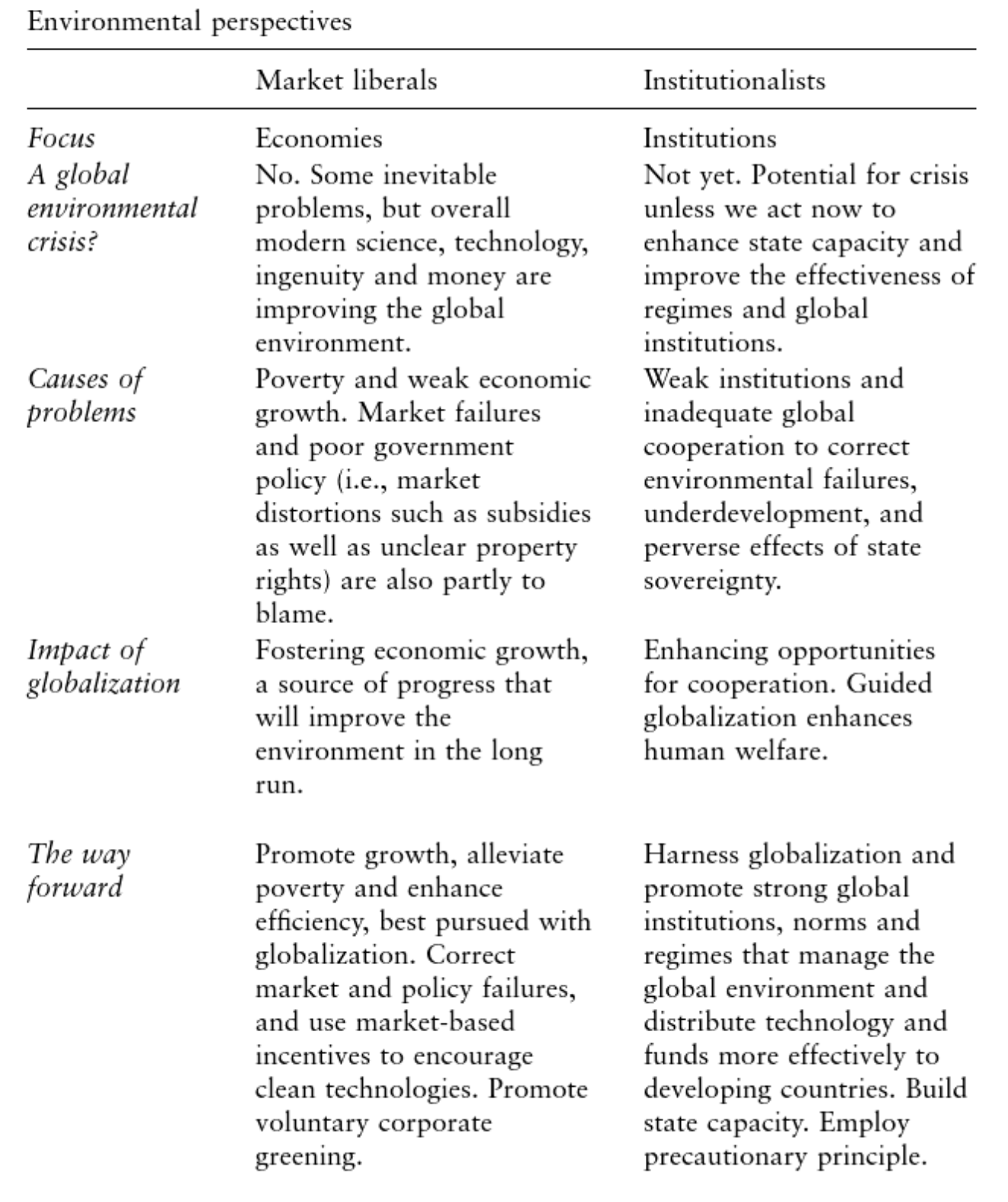
The carbon tax idea was always an awkward fit for the “social greens” to use Clapp and Dauvergne’s terminology. In Paths to a Green World they differentiate between four broad streams within environmentalism: market liberals, institutionalists, bioenvironmentalists, and social greens:
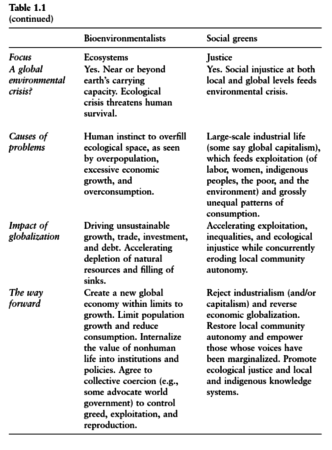
If your analysis is that our system is beset by an ever-destructive capitalism which must be deconstructed, the virtues of a carbon mitigation measure designed to function through efficient capitalist markets was never likely to appeal. Perhaps it speaks to the climate justice dimension when carbon tax revenues are put to purposes that aid the disadvantaged, as with refunds to those with low emissions under a cap and dividend scheme or proposals to use carbon tax revenues to fund a basic income system.

That’s the second set of policies that occurred to me in the snow, corresponding to Humphrey’s “high cost, high staff” straw man. That’s the mainstream media criticism consensus on proposals like the Green New Deal: that they can’t see the rational connection between proposed elements like a job guarantee and climate change, and that the set of new government benefits being proposed seems unreasonably costly.

We surely can’t know what strategies will succeed on climate change. There has never been a problem sufficiently similar to serve as a credible model, so we can never say with complete confidence that one or another past movement suggests the best activist strategies in the world today. We’re going to need to keep trying multiple strategies, especially if we’re committed to democracy. Under a democratic system the populace must ultimately begrudge and tolerate any burdensome actions their society is undertaking for the sake of a stable climate. It has to be akin to the general tolerance of taxation, and be an expected and embedded norm to be part of a society progressively moving away from carbon fuels.

It’s great that social greens are so passionate and able to turn a belief that they’re fighting for justice into enthusiasm and motivation. It probably helps to have a comprehensive vision for societal reform, as opposed to the rather abstract and unemotive “what strategies for decarbonization can work, if we put it ahead of all other priorities?”.