KombiKraftwerk

Detractors of renewable energy have always stressed the problems brought on by the inconstancy of wind and sun. At the same time, renewable boosters have stressed how storage and amalgamation of energy from different places can overcome that limitation. Now, a project in Germany is aiming to prove that this can be done. KombiKraftwerk will link 36 different power plants: wind, solar, hydro, and biogas. The pilot project aims to provide just 1/10,000th of German power while proving the concept of a purely renewable grid. To begin with, the system should power about 12,000 homes. The intent is to show that Germany could be powered entirely using renewable energy. Another aspect of the plan is to eventually generate enough energy to power carbon sequestration systems for industries where emissions are inevitable.

Particularly when you include hydro in the mix, maintaining a supply of renewable power that matches the minute-by-minute demand becomes feasible. With any luck, this undertaking will successfully highlight the possibility of moving to a climate-neutral and sustainable system of electricity generation at national scales and above.

Be grateful for bees

Sasha Ilnyckyj

My favourite reading snack these days is soy-covered almonds. They have lots of delicious umami flavour. Recently, I was surprised to learn that 80% of the world’s almonds are grown in a 600,000-acre section of California’s Central Valley. Since almonds need to be pollinated by honey bees (apini apis) and there is only nectar available in that area when almonds are in bloom, the bees need to be trucked in from elsewhere. Every February, more than a million hives – containing 40,000 bees – get trucked in. By 2005, it proved necessary to import a 747 full of bees from Australia for the ‘pollination event.’

The mutual exposure of those two distantly separated bee populations results in the exchange of microbes and parasites. Therein may lie the cause of the North American Colony Collapse Disorder outbreak that began in 2006. Honey bees are also used to pollinate peaches, soybeans, apples, pears, cherries, raspberries, blackberries, cranberries, watermelons, cantaloupes, cucumbers and strawberries. There are dozens of others, ranging from those that simply benefit from the availability of pollinating bees to those (such as squash and vanilla) where the bees are absolutely indispensable.

Coral reefs and climate change

Mica Prazak, Milan Ilnyckyj, and Sasha Ilnyckyj

While the Arctic is the most climatically vulnerable human-inhabited environment, coral reefs will probably see the most comprehensive destruction in coming decades. According to the IPCC, it is highly likely that they will succumb to a combination of heat and oceanic acidification as temperatures rise in response to greenhouse gas emissions. It is estimated that the last 25 years have seen the loss of 30% of warm-water coral cover. The worst summers so far for coral bleaching have been 1998 and 2002: in which 42% and 54% of all reefs worldwide were affected. As much as 80% of Caribbean coral may already have died.

Coral bleaching occurs when the zooxanthella algae that live in coral tissues die. The report of Working Group II of the IPCC highlights high surface temperatures as “almost certain to increase the frequency and intensity of mass coral bleaching events.” Throughout the Third and Fourth Assessment Reports, coral reefs are highlighted as being especially vulnerable to climatic change, with low adaptive capability.

Oceanic acidification reduces the calcifying ability of corals, by making it more difficult for them to extract calcium from seawater. In cases of extreme acidity, existing structures could begin to dissolve. According to the IPCC “the progressive acidification of oceans is expected to have negative impacts on marine shellforming organisms.” Studies have demonstrated that projected future ocean acidity will reduce coral calcification and weaken coral skeletons.

The Fourth Assessment Report projects that most corals will be bleached by a temperature rise of 1 to 3°C, with increasing coral mortality at higher levels of temperature increase. Between 2.5 and 3.5°C above the pre-industrial mean temperature, a summary table in the WGII report predicts simply “Corals extinct, reefs overgrown by algae.” It warns further that: “It is important to note that these impacts do not take account of ancillary stresses on species due to over-harvesting, habitat destruction, landscape fragmentation, alien species invasions… or pollution.” Given the low probability of keeping further temperature increases below 2°C – even with the advent of relatively stringent new international obligations – it is fair to say that most of the world’s coral is doomed to die. That, in turn, will undermine much of the basis of coral reef ecosystems. This is a further burden to some small island states, as coral reefs can be the habitat for important fish stocks. Reefs are also the most diverse marine ecosystems: home to about 25% of all marine species.

One way to interpret the news is this: if you have always dreamed of SCUBA diving in the natural splendour of a coral reef, make sure you do it fairly soon. Your children might not be able to do it at all. To quote the IPCC once more: “Annual or bi-annual exceedance of bleaching thresholds is projected at the majority of reefs worldwide by 2030 to 2050.”

Panda update

Emily Horn and Milan Ilnyckyj

An article from the always-interesting Christmas issue of The Economist provides an update on the state of the panda: covering captive and wild populations, as well as new scientific thinking about what caused their endangerment. Pandas are widely cited as a truly hopeless animal. They are inept at and uninterested in reproduction, with females only fertile for 3-4 days a year anyhow. They are also only willing to eat a single food that is thoroughly lacking in calories and dies off en masse at regular intervals.

That said, captive populations seem to be on the rise thanks to better breeding techniques, while policies intended to prevent floods caused by deforestation have served indirectly to protect some wild habitat. It seems that despite their challenges – both natural and man-made – pandas will prove charismatic enough to endure.

Concrete’s climatic consequences

The tragic electrocution of Emily Horn

While aviation and ground transport get lots of well-deserved attention, in terms of their climate change impact, the concrete industry seems to get a lot less scrutiny. In a way, this is unsurprising; concrete is hardly glamorous stuff. At the same time, concrete production accounts for about 5% of all greenhouse gas emissions: mostly from the process of manufacturing clinker by heating limestone and clay. This is usually done using coal. The average tonne of concrete produced generates about 800kg of carbon dioxide: both as a result of the coal burning and the product of the chemical reaction involved (CaCO3 -> CaO and CO2, ignoring silicates). This figure does not include emissions relating to quarrying rock or transport.

Cement manufacture can be incrementally improved in three ways: by reducing the ratio of clinker to other additives, by making kilns more efficient, and by using fuels other than coal for the heating. All of these can make contributions, to a certain degree, but only a complete shift to biomass heating could have a terribly significant effect on greenhouse gas emissions (and that effect could be moderated by the emissions from transporting the biomass).

Demand for cement is growing at about 5% a year, and is partially driven by the construction of new hydroelectric dams and nuclear power plants. At present, the rate of demand increase exceeds the rate of efficiency improvements. As such, greenhouse gas emissions associated with concrete are increasing every year. The average North American home uses about 25 tonnes of concrete, mostly in the foundation.

George Monbiot discusses concrete in his book, focusing on geopolymeric cements as a solution. Carbon capture and storage (CCS) is theoretically possible, but with an added problem. Concrete plants must be sited near limestone quarries. These are not necessarily near the salt domes or aquifers where CCS can probably be most effectively deployed. Geopolymeric cements are similar to the pozzolan cement used by the Romans to build the roof of the Pantheon. They are made from clay, certain kinds of sedimentary rock, and industrial wastes. Producing them generates 80-90% less carbon dioxide. This is because they require a lot less heating and the chemical reaction that produces them does not generate CO2 directly.

The modern version of this material was only developed in the 1970s and has yet to be widely adopted. Partly, that is because of the cost of refitting existing cement works or building new ones. Partly, it reflects the hesitation of the construction industry to use new materials. Such objections can probably be most efficiently addressed through carbon pricing. If the concrete and construction industries were paying for those 800kg of CO2, the incentives they face would probably change decisively and fast.

Copper indium gallium selenide solar cells

Nanosolar, a company supported by Larry Page and Sergey Brin (the founders of Google), has announced that it will be selling thin-film solar cells profitably for $1 a watt. Apparently, the cells are printed with copper indium gallium selenide – an alternative to silicon. Cells based on the material can convert solar radiation to electricity with 19.5% efficiency. In theory, this material can applied to foil, plastic, glass or cement – producing electricity generating surfaces. It can also be made into more conventional panels of the sort Nanosolar is starting to sell.

In the 1950s, solar cells cost about $200 per watt. By 2004 they were down to $2.70. Further reductions could make solar power cost competitive with fossil fuels, potentially even in the absence of carbon pricing. Combined with either better storage (to moderate light/dark and sunny/cloudy cycles locally) or better inter-regional transmission (the sun is always shining somewhere), such cells could eventually make a big difference in the overall energy balance. Solar has been discussed here previously.

Grass ( Fungus ( Virus ) Fungus ) Grass

Booth Street in snow

There is increasing scientific awareness of the intricate and essential ways in which different organisms depend on one another biochemeically. Termites could not eat wood without bacteria in their digestive tracts. Humans are likewise dependent upon the huge variety of microorganisms that comprise our microbiome.

Dichanthelium lanuginosum takes such intricacy a step further. It is a grass that lives in very hot soils – such as those in Yellowstone Park. ot only does it depend upon a fungus for its heat resistance, that fungus depends in turn upon a virus. Remove either the fungus or the virus and the grass can no longer live in its ordinary niche. Apparently, something similar has been observed in some tomato plants.

The example demonstrates just how shockingly complex the combination of biochemistry, ecology, and evolutionary biology really is.

Source: Márquez et al. “A Virus in a Fungus in a Plant: Three-Way Symbiosis Required for Thermal Tolerance.” Science 26 January 2007: Vol. 315. no. 5811, pp. 513 – 515.

Reasons for vegetarianism

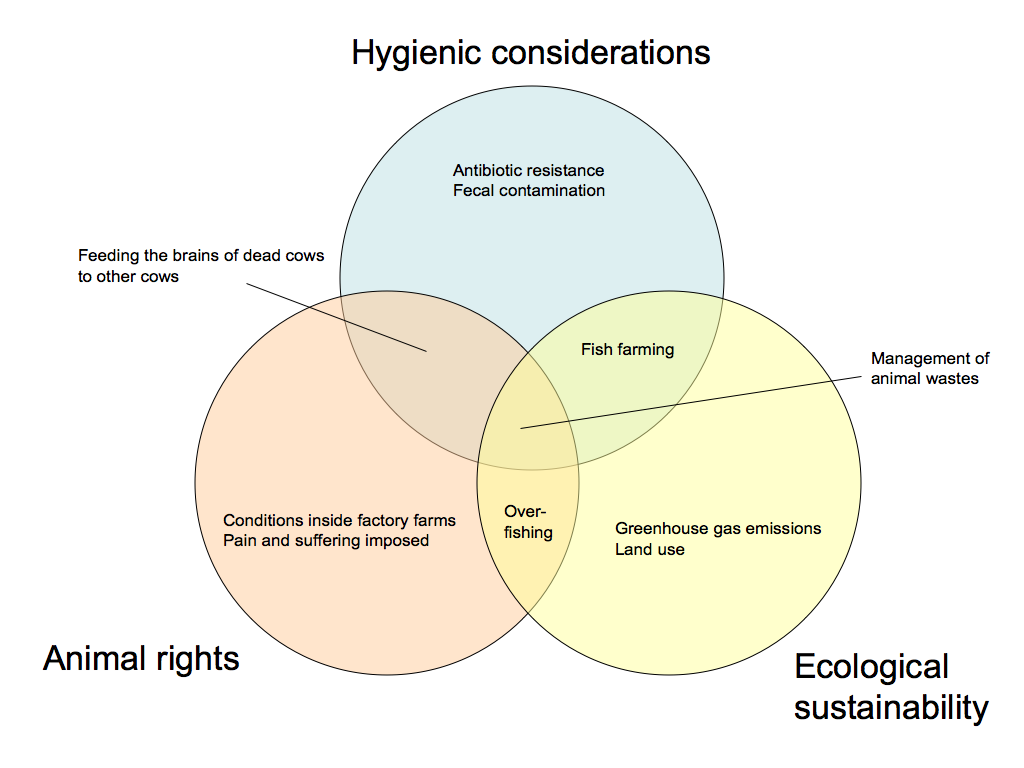
Reasons for vegetarianism

During the last few days, a number of people have asked about the reasons for which I am a vegetarian. As shown in the Venn diagram above, my reasons fall into three major clusters:

  1. Hygienic concerns
  2. Animal rights concerns
  3. Ecological concerns

Basically, the first category applies if you only think about your own immediate well being. If you are willing to consider the possibility that it is wrong to treat some animals in some ways, considerations in the orange circle start to apply. If you accept that we have general duties to preserve nature (or recognize that our long term survival depends on acting that way), issues in the yellow circle are of concern.

The specific issues listed are just examples. They are not exhaustive representations of all the problems in each area. Possible reasons for being vegetarian also exist outside these areas: for example, you can think it is wrong to eat meat when the grain used to fatten the animals could have alleviated the hunger of other humans.

A few issues are unambiguously in one area – for instance, the de-beaking of chickens is almost exclusively an ethical problem. The fact that no experimental laboratory could get ethical approval to treat their test subject animals in the way factory farmed animals are treated as a matter of course is telling. Some overlaps are ambiguous. Overfishing destroys the habitats of species I consider us to bear moral duties towards (such as whales and dolphins), even if the fish themselves can be legitimately used as means to whatever ends we have.

Naturally, different kinds of meat and processes of meat production do more or less well in each area. For my own sake, I think each of the three areas is sufficient in itself to justify vegetarianism. It is possible to imagine meat production that doesn’t have any of these problems, but it is an extreme rarity today and my appreciation for meat is not strong enough to justify the cost and effort of seeking it out. That said, I would be much happier if people who were going to consume meat made such choices, instead of helping to perpetuate the machinery of modern industrial farming.

Related prior posts:

Starting over from 1769

Milan Ilnyckyj in toque with comic book effect

In 1769, James Watt invented a steam engine that worked well enough to be widely adopted by industry. By doing so, he effectively kicked off the industrial revolution: with coal-fed steam engines emerging as the first alternative to animal power that didn’t depend on being beside a river or on a windy ridge. As the recently concluded conference in Bali shows, there were consequences of that invention and the series of successor ideas it kicked off that could not have been anticipated at the time (though Svante Arrhenius identified the possibility of CO2 causing anthropogenic warming back in 1896).

If we could do the whole thing over, what would we do differently? For the purposes of this thought experiment, imagine that we know about the ecological consequences of fossil fuel based industrialization, but we don’t have access to specific knowledge about how to build 21st century engines, power plants, etc. We know about ozone and CFCs, about heavy metal poisoning and nuclear waste. We do not know how to build a modern wind turbine or supercritical coal plant. We have just learned how to build Watt’s engine, and know nothing more.

I think it is virtually certain we would still choose to kick things off with coal and steam, even if we had the best interests of all future generations in mind. At the outset, the benefits of that kind of industrialization accrue both to those alive and to those who will come after. These benefits include many of the bits of technology that make our lives so much longer, healthier, and leisure-filled than those of the vast majority of our forebears. The idea that life in a pre-industrial society was somehow superior is plainly contradicted by archaeological data: you can argue that people were somehow happier while living with constant parasites and disease and dropping dead at thirty, but it is a lot more credible to argue the converse.

What, then, would we do differently? We would invest differently – putting a lot more effort into the earlier development of non-fossil options. We would probably try to limit population growth. Aside from some relatively minor cases like ozone depleting CFCs, it isn’t clear that we have made a great many straightforward ecological mistakes. Rather, the fundamental problem seems to be that of scaling: too much being demanded of the natural world, in conditions where individuals make choices that do not give due consideration to the welfare of their fellows and of future generations.

While future technologies like carbon capture and storage could play a significant role, the most important elements of an effective climate strategy have existed for a century. Fossil fuel generation capacity must be phased out and replaced with renewable options; transportation needs to to shift to low-carbon and eventually no-carbon forms; the forests and other carbon sinks must be protected and enhanced; and capacity to adapt to change must be developed. While the specific approaches we take in relation to these strategies could benefit from more knowledge about the future, their basic outline is already plain.

Now that we can no longer claim – as a society – to live in a state of deprivation, we have no excuse for continuing to rely upon the descendants of Watt’s machine.


A few thoughts on climate justice

Bell Canada warning sign

A couple of articles at Slate.com address the issue of ‘climate justice.’ This is, in essence, the question of how much mitigation different states are obliged to undertake, as well as what sort of other international transfers should take place in response to climate change. The issue is a tricky one for many reasons – most importantly because anthropogenic greenhouse gas emissions constitute a unique experiment that can only be conducted once. If we choose the wrong collection of policies, all future generations may face a profoundly different world from the one we inherited.

If we accept Stern’s estimate of a five gigatonne level for sustainable global emissions, that works out to about 760kg of carbon dioxide equivalent per person on Earth. Releasing just 36kg of methane would use up an entire year’s allotment, as would just 2.5kg of nitrous oxide. One cow produces about 150kg of methane per year. Right now, Canada’s per-capita emissions are about 24,300kg, when you take into account land use change. American emissions are about 22,900kg while those of India and China are about 1,800kg and 3,900 respectively. Because of deforestation, Belize emits a startling 93,900kg of CO2e per person.

The questions of fairness raised by the situation are profound:

  1. Should states with shrinking populations be rewarded with higher per capita emissions allowances?
  2. Should states with rising populations likewise be punished?
  3. Should developing states be allowed to temporarily overshoot their fair present allotment, as developed states did in the past?
  4. To what extent should rich states pay for emissions reductions in poor ones?
  5. To what extent should rich states pay for climate change adaptation in the developing world?

It may well be that such questions are presently unanswerable, by virtue of the fact that answers that conform with basic notions of ethics clash fundamentally with the realities of economic and political power. We can only hope that those realities will shift before irreversible harmful change occurs. Remember, cutting from 24,600kg to 760kg per person just halts the increase in the atmospheric concentration of CO2. The level of change that will arise from any particular concentration remains uncertain.

Another vital consideration is how any system of international cooperation requires a relatively stable international system. While it is sometimes difficult to imagine countries like China and the United States voluntarily reducing emissions to the levels climatic stability requires on the basis of a negotiated international agreement, it is virtually impossible to imagine it in a world dominated by conflict or mass disruption. It is tragically plausible that the effects of climate change could destroy any chance of addressing it cooperatively, over the span of the next thirty to seventy years.