Alberta’s 2019 election

The election playing out in Alberta seems to have a lot in common with what has been happening with the federal Liberals, at least for those who see the urgency of decarbonizing to control climate change. There is a semi-progressive government that thinks that it has strong climate credentials because it has a long term plan. At the same time, neither the Alberta NDP nor the federal Liberals properly appreciate the scale and seriousness of climate change, which is why they are willing to keep backing new fossil fuel projects.

One Calgary Herald article today had an interesting comment:

Kenney says that if he takes office after next week’s vote, he’ll abolish the carbon tax and scrap the NDP’s 100 megatonne cap on oilsands emissions.

Federal sources note that the loss of the provincial carbon tax isn’t a big problem to them because Ottawa would simply impose its own tax.

But the emissions cap is a huge deal for the Trudeau Liberals.

They say removal of that cap could take Canada out of compliance with the Paris Agreement on climate change.

This is a reminder for the other perennial Liberal/NDP line on climate change: whatever the faults of our approach, the Conservatives will be worse. There is truth to that, and it provides the second prong of the dilemma for voters in Canada who think rapid decarbonization is urgent and essential.

Climate activists targeting a bank

Toronto350.org asked me to photograph their action outside the Toronto Dominion (TD) bank shareholder meeting downtown this morning, protesting continuing investment in fossil fuel projects.

The electrical system on my 5D3 flickered and died, despite fresh batteries. This is the first time I’ve ever really had to use the backup body, and my 5D2 rose appropriately to the occasion. I’ll take the 5D3 to a local camera service shop since I bought it used and it’s years outside of warranty.

Queen’s Park climate strike

I ducked out of my public policy workshop today to get some photos of the climate strike at Queen’s Park.

There are amazing photos and videos from other cities around the world, with turnouts of tens of hundreds of thousands in European cities. The rally in Montreal also seems to have been huge, for reasons I am very curious about. I would love to know what went into organizing it, and into bringing so many people out.

Alberta’s Energy Policy Simulator

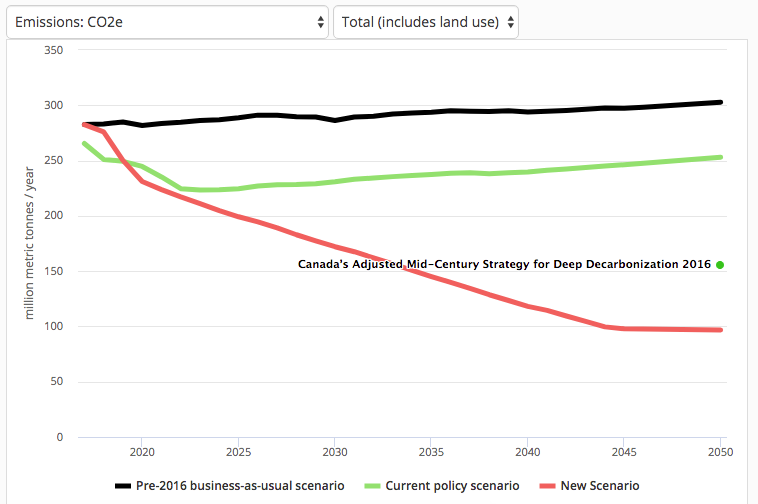
The Pembina Institute has released a new interactive tool that lets anybody test out alternative approaches to setting energy policy for Alberta, in sectors including transport, buildings, electricity generation, and agriculture.

It doesn’t allow a huge amount of ambition. For instance, the only bitumen sands policy option is the 100 megatonne cap which the Alberta government has proposed, which you can tweak to be implemented more clearly. Still, it does a nice job of illustrating the relative impact of different approaches, from a faster phase-out of coal in electricity generation to various policies targeting vehicles, methane emissions, cement production, and sector-specific carbon taxes up to $350 per tonne.

Even with the most aggressive coal phase-out options, the bitumen sands cap, and $350 carbon taxes in all sectors, projected emissions only fall from a current level around 275 megatonnes of CO2-equivalent to around 100 megatonnes in 2045:

Even if every jurisdiction in the world achieved cuts at that rate, it wouldn’t be fast enough to produce a sub-2 ˚C warming scenario as called for in the Paris Agreement, and any politically plausible global pathway would see countries with very high per capita and historical emissions like Canada cut deeper and faster than the average.

I have previously posted about climate change games/simulations from the BBC and Chevron.

Middlebury fossil fuel divesment

At the end of January, Middlebury College (home institution of 350.org founder Bill McKibben) committed to fossil fuel divestment as part of a four-part response to climate change.

As far as I know, this is the first university which had formally said no to a divestment campaign and has since been brought around to saying yes.

Today Laurie Patton, the President of the college, published an editorial in Inside Higher Ed: Every Campus Should Address Climate Risk.

Open thread: oil by rail

The CBC is reporting today that the oil production cuts enacted by the NDP provincial government to try to raise fossil fuel prices have made oil transport by rail less viable.

The possibility of exporting the bitumen sands by rail when pipeline capacity is exceeded has highlighted how fossil fuel advocates take climate change inaction as a given. They posit only two scenarios, a certain amount of oil being shipped by rail or shipped by pipeline, and then say that since the pipeline option is cheaper and safer they should clearly be built. That misses how the most important reason for stopping pipelines is to keep the oil in the ground. Using the bogeyman of a more dangerous transport option to promote a less dangerous one ignores the obligation to decarbonize.

Fossil fuel production needs to be squeezed in every possible way: by imposing carbon taxes, by requiring them to pay remediation costs for damaged areas and abandoned equipment, by stopping new export infrastructure, by withdrawing investment from the industry, and so on.

At root, climate change is a problem where fossil fuel users impose harm on climate change victims because of the convenience, power, and profit that fossil fuels provide them. Forcing communities to accept bitumen exporting trains to pass through has a similar dynamic.

The marriage of climate and economic justice

Something occurred to me as I was walking through the snow this morning. There’s an episode of Yes Minister (The Bed of Nails) in which the hapless minister Jim Hacker is charged with implementing an integrated national transport policy. His savvy and manipulative chief civil servant explains:

It is the ultimate vote loser… If you pull it off, no one will feel the benefits for ten years. Long before that, you and I will have moved on… In the meantime, formulating policy means making choices. Once you do that, you please the people that you favour, but infuriate everybody else. One vote gained, ten lost. If you give the job to the road services, the rail board and unions will scream. Give it to the railways, the road lobby will massacre you. Cut British Airways investment plans, they’ll hold a devastating press conference that same day.

Ultimately, the minister and his permanent secretary conspire to be freed from the job, first by proposing a service-slashing approach to transport reorganization, in which they deliberately alert the prime minister about unpopular changes it would imply for his constituency, and then using Sir Humphrey’s second strategy:

We now present our other kind of non-proposal… The high cost, high staff kind. We now propose a British National Transport Authority with a full structure, regional board, area council, local office, liaison committee, the lot. 80,000 staff, billion-a-year budget. The Treasury will have a fit! The whole thing will go back to the Department of Transport.

What occurred to me in the snow is that while Hacker and Humphrey may have been using these approaches as a dodge, one could say metaphorically that those calling for strong climate change policies have in some ways pressed the same two strategies.

First there was the dream of an economically efficient solution via a carbon tax. All the most sophisticated and credible economic analyses projected that the best way to solve climate change was to put a rising cost of carbon across the entire economy and then let individuals and firms make their own economic choices to adjust. This policy was favourably contrasted with trying to reduce fossil fuel use and the resultant greenhouse gas (GHG) emissions through regulation. It was also tailored to appeal to people on the political right: rather than imposing particular technological choices it relies on the free market to adapt naturally to the increasing cost of a previously-neglected factor of production, just as they do every day as commodity prices like oil and copper spot prices do.

What seems to have sunk this strategy is the willingness of those on the political right to play Russian roulette on climate change, assuming the damage we do won’t be that bad or that some future technology will solve the problem painlessly. Coupled with that is the unreasoning hostility to taxes that has been embraced by some right wing populist figures, movements, and political parties. Proposing an environmental policy that can be given the derogatory label “a tax on everything” is challenging in a climate where such figures are influential, and can make it easy for an incoming right wing government to scrap on the basis of “giving money back to [insert name of jurisdiction] families”.

The carbon tax idea was always an awkward fit for the “social greens” to use Clapp and Dauvergne’s terminology. In Paths to a Green World they differentiate between four broad streams within environmentalism: market liberals, institutionalists, bioenvironmentalists, and social greens:

If your analysis is that our system is beset by an ever-destructive capitalism which must be deconstructed, the virtues of a carbon mitigation measure designed to function through efficient capitalist markets was never likely to appeal. Perhaps it speaks to the climate justice dimension when carbon tax revenues are put to purposes that aid the disadvantaged, as with refunds to those with low emissions under a cap and dividend scheme or proposals to use carbon tax revenues to fund a basic income system.

That’s the second set of policies that occurred to me in the snow, corresponding to Humphrey’s “high cost, high staff” straw man. That’s the mainstream media criticism consensus on proposals like the Green New Deal: that they can’t see the rational connection between proposed elements like a job guarantee and climate change, and that the set of new government benefits being proposed seems unreasonably costly.

We surely can’t know what strategies will succeed on climate change. There has never been a problem sufficiently similar to serve as a credible model, so we can never say with complete confidence that one or another past movement suggests the best activist strategies in the world today. We’re going to need to keep trying multiple strategies, especially if we’re committed to democracy. Under a democratic system the populace must ultimately begrudge and tolerate any burdensome actions their society is undertaking for the sake of a stable climate. It has to be akin to the general tolerance of taxation, and be an expected and embedded norm to be part of a society progressively moving away from carbon fuels.

It’s great that social greens are so passionate and able to turn a belief that they’re fighting for justice into enthusiasm and motivation. It probably helps to have a comprehensive vision for societal reform, as opposed to the rather abstract and unemotive “what strategies for decarbonization can work, if we put it ahead of all other priorities?”.