Short days, new projects

Oxford University Career Services

After having coffee with Sheena, about which I shall not write, I read the second portion of Iain Pears’ An Instance of the Fingerpost. The character whose account it is, Jack Prescott, is one of the least likable in fiction. He is a hot-headed bigot: a liar, rapist, and betrayer. That the story ends well for him is entirely as displeasing as the gruesome conclusion of the first part. Not, in any sense, a cheerful book. That said, the occasional foray into murder, treason, and intrigue is very much necessary for the committed reader of fiction. I quite enjoyed the discussions of cryptography in the third section, which I have not yet finished.

The book is set in the time shortly after Cromwell took over – not the nicest period in history. The violence, the bigotry, and the ignorance demonstrated in the book all reaffirm my belief that the world is generally improving. That’s not to say that these things are no longer present but, at the very least, that they must now generally be apologized for and defended, rather than be taken as automatically acceptable. It’s an unfashionable thing, these days, to believe in progress. First off, it involves the making of ontological claims that people no longer see as firmly based – which has some truth to it, but not enough to counter the evidence of overall improvement. Secondly, it requires the determination to judge the morals and practice of one place and time against another. While there are obviously difficulties in doing so – particularly insofar as the matter of individual and group identity is concerned – that doesn’t seem adequate to conclude that no such comparisons can be made with validity. I would suppose that people given the chance to choose between living in some past age or the present one would choose the latter, largely because of the enormous benefits of modern medicine and nutrition, but also due to imperfect but helpful systems of justice and notions of philosophy and morality.

That’s not to say there isn’t a long way to go: especially in areas like women’s rights, the environment, and the just distribution of goods: material, social, and political.

Summer job search:

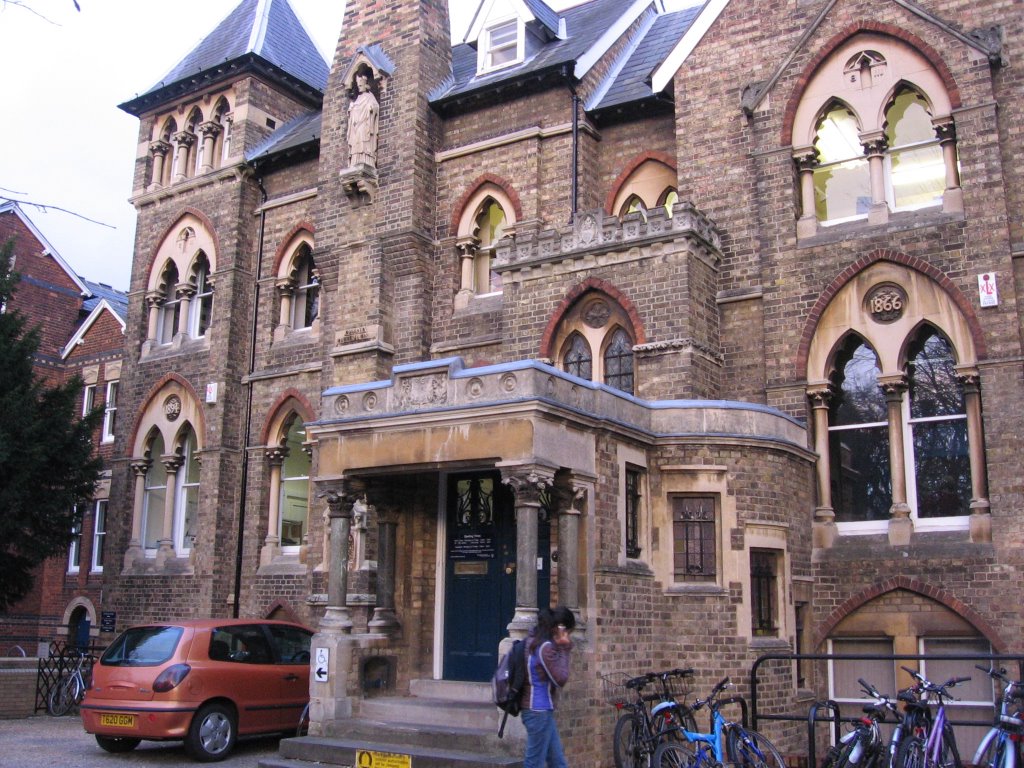
This afternoon, I ran a mass of errands. Aside from boring bank stuff and groceries, I stopped by the Oxford University Career Services office. As you can see in the photo above, it looks like a very curious combination between the outside of a castle and the inside of a Church. It is up on Banbury Road, near the Computing Services offices and St. Antony’s College.

Speaking with one of their advisors, I was told that banking and management consulting would both be real long shots for me. As the advisor told it, the problem isn’t really a lack of experience in either area, or even in business generally. The first problem is the time span. Trinity term ends on the 17th of June and Michaelmas term begins in early October. Even if I wanted to work for that whole period, it would only amount to three and a half months or so. The second problem is the fact that I am not interested in a career in banking or consulting. The advisor stressed the fact that this would severely hinder my ability to find a job in these areas for such a short period of time.

As alternatives, she suggested looking for short term work in the research, publishing, or public sector administration areas. She also stressed the possibility of finding a job within the university and the importance of canvassing my professors and supervisor about it. I will ask Dr. Hurrell about it again the next time we meet, to discuss my paper on American foreign policy during the interwar years.

At the very least, I would want something that would pay the cost of living in Oxford or London and allow me some time to do research on my thesis. I am fairly sure it would be possible to devote the bulk of the period to full-time work: something I would do if it stood the chance of helping me pay for next year or reduce my outstanding student debt. The ideal job would probably be a research position in Oxford, in a field that is of interest and relevant to my degree, and which offered at least some time off to travel and do research.

The advisor explained that it is getting a bit late to apply for banking and consulting jobs, but it is too early to apply for most other sorts. As such, I should dig through job listings from previous years and get some sense of what is likely to come up. Another project for the break, two other two big ones being scholarship applications and preliminary house hunting for next year.

Travel preparations:

It is eleven days, now, until Sarah and I leave for Tallinn.

Right now, it is six degrees Celsius colder in Tallinn than in Oxford, making it the same temperature there as in Toronto. While that is certainly chilly enough, it won’t be the kind of weather that requires balaclavas and threatens severe frostbite from brief exposures to the outside. Looking through the guide book that Nora gave me, I am excited about the prospects for seeing and doing interesting things in Tallinn. Additionally, I am looking forward to seeing Helsinki. Gabe Mastico, who I know from debate at UBC and who is now living in Helsinki, is going to let Sarah and I use his apartment while he is in Vancouver. Since we don’t actually have a hostel registration in Tallinn yet (something that I should make in the next few days, quite probably), that might be especially valuable. Also, I will be able to say that I have seen ‘the Baltic region’ much more fairly if I go to two capitals, rather than just one.


  • Here’s a question about encryption, to which I am seeking an answer. It’s an issue that I find puzzling, and which never occurred to me before a friend raised the question today.
  • I am not feeling at all well. All of my joints and lymph nodes hurt – especially the ones near my subclavian arteries. I am going to get soup and vitamins tomorrow.
First trip to London

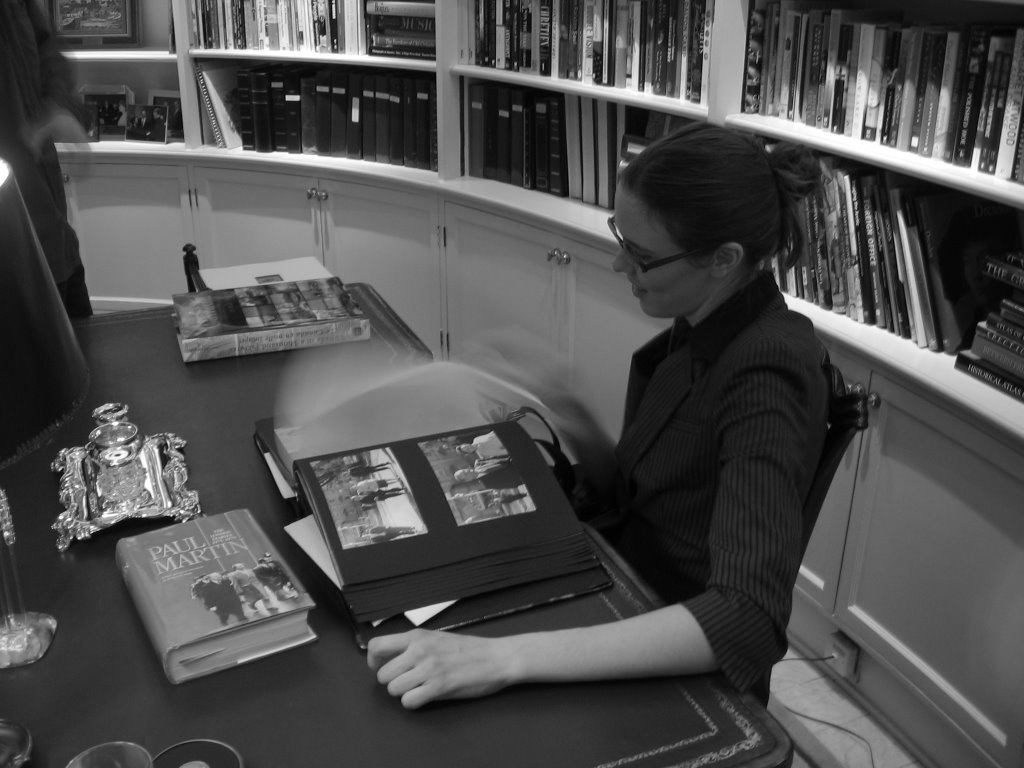
Leaving critical notes in the ambassador's scrapbook

Happy Birthday Matthew Tindall

Tonight’s event, in the residence of Canada’s second most important ambassador, comprised about 300 Canadian graduate students. The residence was quite lavish: richly endowed with artwork and the various trappings of high class hosting facilities. The project of meeting and mingling with dozens of Canadians from Oxford, Cambridge, the LSE, and elsewhere was a daunting one for me, but one which I think I rose to dealing with fairly well. I met a few interesting people from the Environmental Change Centre at Oxford. In particular, Andrew Robinson from Trinity College, who worked for the UNEP and is working on a master’s here now. Hopefully, I shall see them again.

On the bus ride out, I sat beside a Canadian woman who studied French previously and who is now studying law, with an aim to practicing in the area of shipping. In a few days, she is heading to her flat in the south of France, where she will be spending Christmas with her boyfriend. Despite her assurances that it will be extremely cold, I think there are a great many people languishing back in Oxford who will envy her the journey. Hearing her plans made me doubly glad about being invited to London for Christmas with Sarah and her mother. I enjoyed speaking with my co-national about points of law, language, and education – while heading southeast to London.

We disembarked at Marble Arch and soon found the High Commissioner’s residence. As I said, the inside was quite opulent. I suppose that is unsurprising given the importance of Anglo-Canadian relations over the short but broad sweep of Canadian diplomatic history. I spoke with the Commissioner himself for a while, as well as with several members of the Canadian diplomatic service. Chris Yung was there, as were Emily and a number of the Rhodes Scholars who I met at the outset of the year.

After a few hours of mingling, the staff stopped serving drinks: a message for postgraduate students to leave as unambiguous as firing tear gas. Despite a brief attempt to relocate to a nearby pub, I soon ended up shivering at Marble Arch, waiting with Sheena and Emily for buses back to Oxford. They were picked up fairly quickly by an Oxford Tube, but I huddled a while yet while waiting for the X90. I would have liked to do more in London, but there is little that a person can do to access a city when it is rainy, strange, and dark. As I observed on the homeward bus ride:

How hostile, how alien a dark strange city in the rain. The solidity of buildings and the alienation from our huddled fellows all remind us how we are to be jolted and feared, rather than embraced.The collective of experience of life now is such as to conjure intense questioning. Education is not just that investment of time and money that yields more money in the future. It is a wrestling with history, with isolation, and with our own limitations.

Self doubt is the main concern now. It’s a thing that you can seek to defeat – building walls of false confidence around yourself. Alternatively, you can plunge right into it and pray that you will emerge wiser on the other side. That process can only be attempted along with the realization that we can falter and drown.

A bit grim, I know, but it was a chilly and unpleasant night in the period after which it became a solitary one. I was hoping to derive some motive energy from the great metropolis of London, rather than scamper back, spurned, to the small town of Oxford. That said, it was worthwhile and enjoyable to see what an extensive mass of grad students Canada has dispatched to England. While it does have the unhappy impact of reminding you how unexceptional you may well be, you still cannot quite help being impressed by it. (I really do hope that I manage to find some way in which I am properly exceptional, after all, before I leave here.)

One piece of unambiguously happy news, in closing. Tomorrow morning, at 11:00am, is the final STATA lab. I hope that I shall never launch that most reviled of programs again.

Room better decorated: festooned with possibilities

Lovely map, exciting world

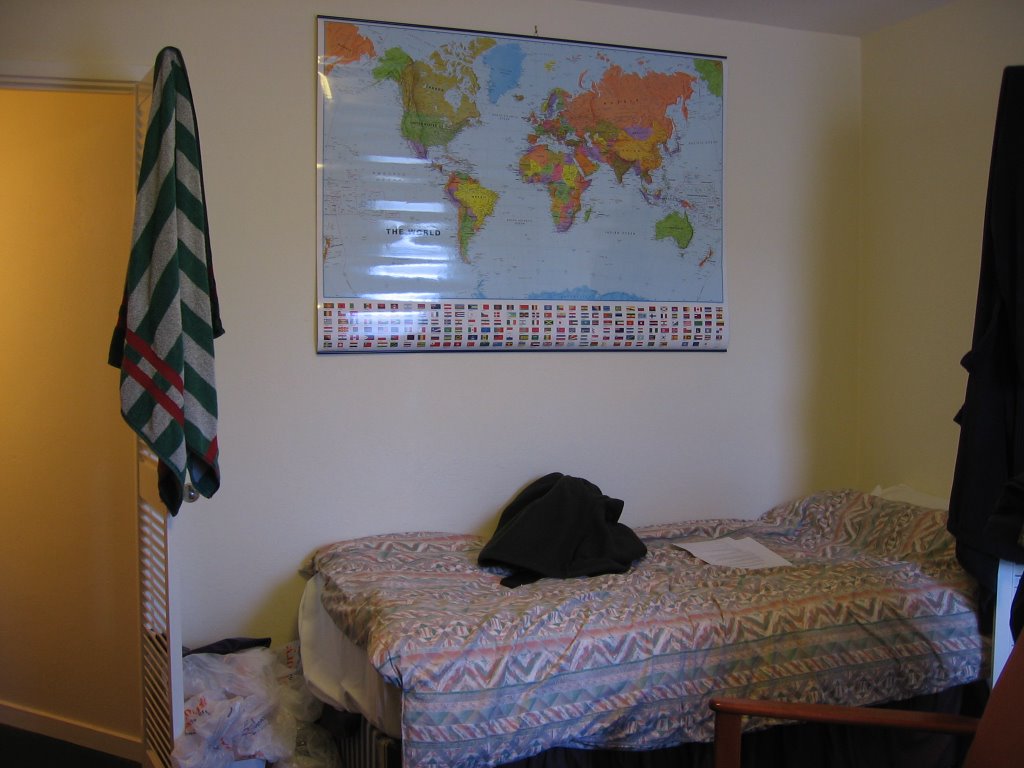
After the undergraduate IR lecture this morning, I took the plunge and used most of the book credits that Alex and Sarah gave me to buy an enormous map of the world. You can’t really tell from the photo, but it’s a very fine laminated map, with metal strips along the top and bottom to keep it in shape. While the college will fine you one pound for each piece of blu-tac you use to affix something to a precious wall, they will happily provide you with a hammer and nails with which to do so. For an international relations student, it seems an entirely advisable thing to have done.

The map now hangs on my wall as a reminder of all the places where I need to travel. Sipping coffee from Sulawesi and looking it over, I have been imagining all manner of possible future expeditions. During the next month, I will see Tallinn and Helsinki. Next year, I would dearly like to arrange my thesis so it requires a trip to Brazil. Given that it’s a particular area of interest for Dr. Hurrell, a developing country, and subject to a great many environmental considerations, that may well be possible. The plan for after the M.Phil is to climb Mount Kilimanjaro with friends. After that, Australia, New Zealand, all of Asia, and most of Africa will remain. Then, there are the really exotic possibilities: lemurs in Madagascar, the more remote islands of Indonesia, the far north – complete with the Aurora, and Tierra del Fuego: practically touching Antarctica. I am glad that I’m only 22.

Another excellent thing about the map is that it gives me a better sense of where my increasingly far-flung friends are now located: Astrid in Ecuador, Neal and Marc in Beijing, Adam and Nick in India, Gabe in Finland, Tristan and Viktoria P in Toronto, Sarah in London (just down the road), Kate in Victoria, and everyone back in Vancouver. I miss you all and I hope our paths will cross soon, whether in Oxford or elsewhere.

Recalling my first European visit

Kelly in the JCR Bar

Today was dark and rainy. It involved little more than sitting in different parts of the Social Sciences Library reading The Economist, Donald Watt’s How War Came, Anthony Adamthwaite’s The Making of the Second World War, and the collection The Origins of World War Two: The Debate Continues, edited by Robert Boyce and Joseph Moile. In spite of reasonable efforts to do so, I don’t feel particularly compelled to read for this week’s topic, on appeasement during the 1930s. That said, it is fairly likely that Dr. Hurrell will assign me a paper on it during our meeting tomorrow.

Despite a period in the JCR bar with Kelly and Nora, a phone call home, and the doing of laundry, today certainly cannot be considered a particularly energetic one. As such, it seems a better idea to use this space describing something else.

The first time I went to Europe was before Sasha, my youngest brother, was born. Mica, the brother who is either two or three years younger than I am, depending on who has already had a birthday that year, was still drinking out of the kind of bottles that infants are like to. Very clearly, I remember a piazza, somewhere in Italy, when on a hot and sun-struck afternoon, Mica and I splashed each other and sprayed water at one another out of the aforementioned bottles. 

During that trip, I tried swimming for the first time, as a place called Spagio Romea. I remember this large, toadstool shaped protrusion in the shallow end of the room that stood over it like a massive umbrella. A sheet of water would pour over its rounded top, then fall like a glassy plane before breaking frothily at the boundary with the pool’s surface. Aside from the new experience of swimming, quite possibly the best thing about Spagio Romea was the unending supply of free Mentos candies: a thing that had not yet been seen in North America.

When I was rather younger than I now am, but not nearly as much younger as when I first went to Italy, I spent a lot of time swimming. For several years, the smell of chlorine never really left my clothes and hair. During my later years there, I remember cycling from Cleveland Elementary School – which Jonathan, Alison, and I attended – to William Griffin Pool, through Edgemont Village.

Back then, the Red Cross designated swimming levels by colours: beginning with yellow and ending with white. I had to take maroon at least three times, but ended up finishing white and life-saving II before my age would permit me to move on to the next level, which I believe was called Bronze Cross. After two years of not swimming with any regularity, while I was becoming old enough to take that course, I found myself quite completely unable to do so. As I am sure anyone who has done something quite actively, several times a week will know: you can’t just take a two year break and then begin again where you left off.

I haven’t really swam since, except once in a while and always with the pressing knowledge that I used to be rather better at it. Even though I still enjoy doing it, the gracelessness with which I manage it is more than enough to dissuade me from doing so except under the most casual of scrutiny. Ineptitude that you have always possessed can be laughed off, but newfound ineptitude is a mortifying thing.

Some perspective

I read something tonight – something Astrid sent me from Ecuador – that makes me feel ashamed about how trivial all the thoughts and concerns represented on this site are. How is it that we can legitimately complain about this or that aspect of life in Oxford when the whole experience of it is incomparably safer and richer than that of a huge tranche of humanity? A vignette of some of the more shocking products of that inequality lends incredible poignancy to the question. A more important question that follows is: what must we do?

To be exposed to the enormity of poverty and injustice is to be charged with an overwhelming ethical sense that something must be done; and yet, the content of that something is unclear. The experience is reminiscent of that of reading an article my aunt wrote: one of an astonished powerlessness. All that I feel as though I can do now is not to forget about it, just because it is usually concealed and peripheral to my thinking. If we are go get anywhere, as a world of people. we need to deal with this.

Perhaps, on the basis of her experiences in South America, Astrid will be able to understand – and help many more of us understand – the complexities and the imperatives involved.

Tallinn trip confirmed

Man in Graveyard

I am now officially booked to go to Tallinn from the 16th of December until the 22nd. It’s an area I’m excited to visit, since I’ve never been anywhere remotely like it. After my EndNote course today, I went to Blackwell’s and looked through the travel books on Estonia for a while. Some of its appeal as a destination comes from how I know so little about it. It should be an adventure. There also seems to be the possibility of going to Finland for a day or so; apparently, Helsinki is a cheap three hour ferry ride away. Sarah and I intend to have a look at that, as well.

The other thing that caught my eye at Blackwell’s was a collection of large laminated wall maps of the world, each with metal strips along the top and bottom, such that they can be hung. The strict new prohibition against Blu-Tac in Wadham increases the importance of the latter feature. Given that I’ve just spent one hundred pounds on flights to and from Tallinn, as well as some travel insurance, now is not the time to buy such a map. At the same time, it’s a thing I should definitely get eventually. I remember spending long periods of time perusing the one on the wall behind the fax machines at the law firm whose mail room I used to work in. The more time I spent within three kilometres of Wadham (35 days or so), the more I begin to fantasize about exploring much farther afield.

This evening, Nora and I drank the tea that Meghan sent me. It was a pleasant reminder of good things left behind on the west coast, and I appreciate her sending it. Thinking about Vancouver reminds me of how odd it will be to spend Christmas in Oxford. It will probably be a bit like the days in the December of my first year when Nick, Neal, Jonathan, and I occupied the near-empty dormitory for the winter solstice and “Pagan X-Box Con 2001.”

Later in the evening, I had a good wander with Emily: talking about the program, upcoming papers, plans for the break, and such. She says that she can help me get some kind of decent and well-paying job in London for the period between the two years of the M.Phil. It would be incredible to both have my first ‘real’ job and have the chance to somewhat reduce the amount of debt I will be taking on next year. I’m also excited that she has invited me to have dinner with her and her father at some point. As I may have already mentioned, he is a sculptor who lives in Oxford and who, if I recall correctly, made the heads around the top of the Sheldonian Theatre, as well as the friars at the Blackfriars tube station in London.

The walk, up and down St. Aldate’s Road and then to St. Antony’s along St. Giles, was a good conclusion to a day that has restored me to some kind of productive emotional equilibrium, after the curious dip of these past two days. Now, I can get on to the serious work of drafting two papers and a presentation, all for next Tuesday.

PS. This Friday, there is to be a gathering of Oxford bloggers, at a yet-to-be-decided location. It will be interesting to meet some contemporaries of that kind. Perhaps it will offer some tips on how to improve the rudimentary formatting of this blog, as compared with the slick complexity of some of the others.

Stuck in a library, perhaps, but with thoughts in loftier places

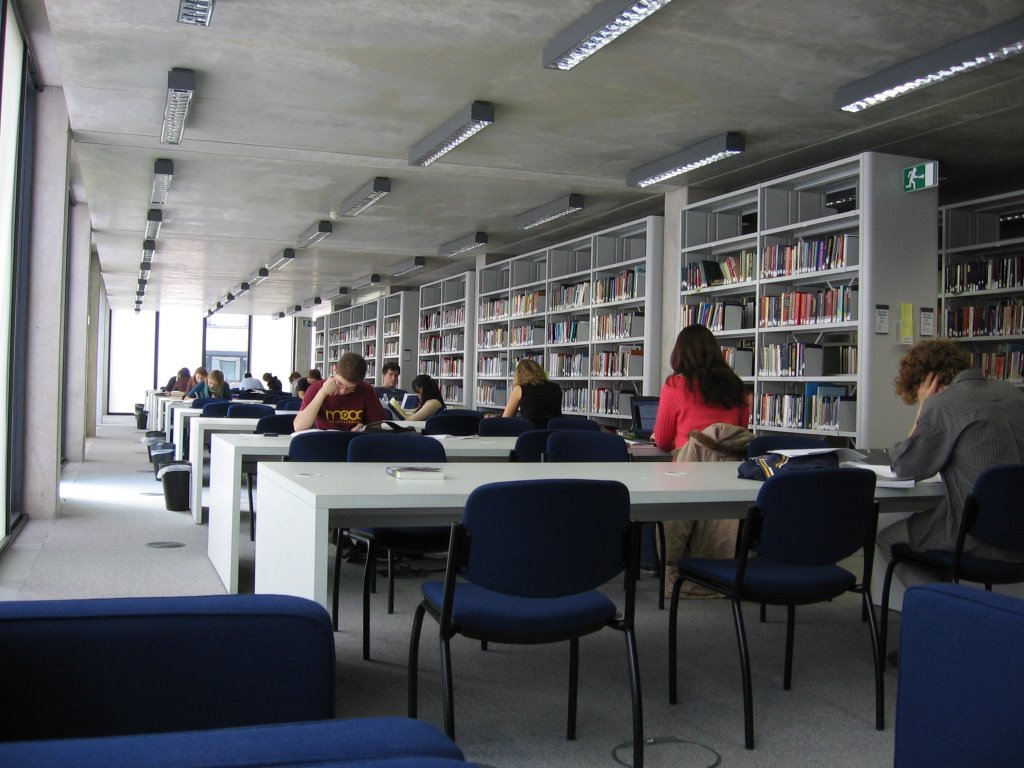
The Social Sciences Library

Despite another mishap with my alarm clock, I managed to do quite well today. With two short breaks outside excluded, I was in the Social Sciences Library for the entire six hour span from opening to closing. To start with, I read the relevant half of Shlaim Avi’s War and Peace in the Middle East. While very readable, it underscored just how little I know about the region at the time. It would be quite impossible to develop a comprehensive knowledge of it by Tuesday. Actually, I have serious doubts about the wisdom of this academic approach. On the basis of no actual instruction, we are being called upon to synthesize weekly arguments on the basis of highly detailed, numerous, and academic accounts. While it’s a game that I have some ability to play, I don’t really think it is making me more knowledgeable or capable.

Despite my doubts, and bolstered by two sandwiches prepared from materials purchased at Sainsbury’s, rather than purchased directly from there, I carried on reading. I finished half of Elizabeth Monroe’s Britain’s Moment in the Middle East: 1914-71. It too was fairly good to read, though it made many references to personages and no-longer-extant political entities that I know nothing about. As with Avi, I at least maintain the gist of the argument. Once I finish reading the relevant sections from David Fromkin’s The Peace to End All Peace: The Fall of the Ottoman Empire and the Creation of the Modern Middle East I should have enough raw material to build a decent fifteen minute presentation about.

During one of today’s short intra-library breaks, I created a Google Group for the graduate freshers in the IR program. It will be publicly accessible, in case anyone is interested. I am hoping to use it to coordinate weekly meetings with the six other members of my heptet for the core seminar. Since none of us will be able to do all the readings, it would be enriching for all of us to have a short discussion before the actual seminar takes place. Doing so should also reduce some of the stress and wastefulness associated with having everyone prepare presentations independently.

An hour after the library closed, I met Margaret outside Nuffield. Through the light rain, we wandered to a coffee shop on St. Aldate’s, which is open until midnight every day of the week. While I can’t remember the extended form of its name, it abbreviates to G and D’s. It is located quite near the music shop where Nora bought a guitar string and not far from Christ Church College, the Head of the River, and the Folly Bridge (each progressively farther south).

As before, talking with Margaret was relaxed and pleasant. I learned that we share the intention of eventually climbing Mount Kilimanjaro. As I recall, someone from my father’s firm climbed it at some point during the past few years. It’s something I would rather like to do during one of the stretches between terms, if only so that I could mildly amaze people who asked me what I did over the course of the vacation. After coffee, we wandered to Wadham and then back to Nuffield, where I left her in the company of her friend Anna.

Tomorrow morning, I am to visit the Wadham doctors on Beaumont Street for a meningitis and mumps vaccination. After that, I shall return to the scrutinizing of The Peace to End All Peace before meeting Emily at one. In case I haven’t mentioned her already, Emily is part of the IR M.Phil group, Canadian, located at St. Antony’s, and an alumna of Brown. I wonder if she knew Eva. She has kindly invited me, at some indefinite future point, to come to dinner at her college.

Other tasks for tomorrow include learning what NatWest would charge me if I simply wrote a cheque from the Bank of Montreal for the amount I want to transfer, rather than going through the bother of acquiring, signing, and mailing an Agreement for Verbal and Facsimile Transmissions to my home branch, then authorizing a wire transfer that will cost $50. In a related task, I need to go formally request an extension for paying my battles from the Domestic Bursar. They will have started charging me interest on the 14th. I also need to contact the department about why they haven’t sent me a bill for my first term tuition and the BC student loans office about why they haven’t sent me anything in months. It should be more-or-less obvious by now that the above list is mostly for my benefit, because it is very useful to have such things in places where you can find them quickly and they cannot be lost.

Looking through the glossy brochure for the Oxford Union, there is much that makes it tempting. They seem to have a fairly large lending library, which is always a valuable resource (especially when it is focused on history and politics). They regularly have excellent speakers: presidents of countries, Salman Rushdie, Terry Pratchett, and Jeffery Sacks this term alone. They have a couple of nice looking member’s lounges, complete with the availability of £1 pints. Up until Thursday of next week, I could get a lifetime membership for £156 (C$340). After that, it becomes even more expensive. At a third of the cost, I would join readily. As it stands, I think that I shall not. $340 would go a fair way towards my eventual Kilimanjaro climb.

Kilimanjaro is 5,895m tall: 4.7 times as high as Grouse Mountain, which is what Alison, Jonathan, and I meant to climb a few days before I left. While the comparison is obviously quite deceptive, in terms of the respective difficulty of the climbs, it does offer the hope that it would not be an entirely impossible thing to actually pull off. Climbing Uhuru Peak on Kilimanjaro requires neither rock nor ice climbing skills, the major difficulty being the need to acclimatize to prevent altitude sickness. The climb can apparently be done in as little as four or five days. Wikipedia tells me that 15,000 people a year try to climb Kilimanjaro, though only 40% persist to the summit. Seeing how eminently feasible it would be to make an attempt in the next few years, my determination to do so increases considerably. It might be a good way to celebrate the completion of my M.Phil. Obviously, it would require quite a lot of fitness training beforehand.

I should, in any event, stop wandering through Kilimanjaro sites and return to the enormously less interesting task of reading for my core seminar.

Oxford libraries

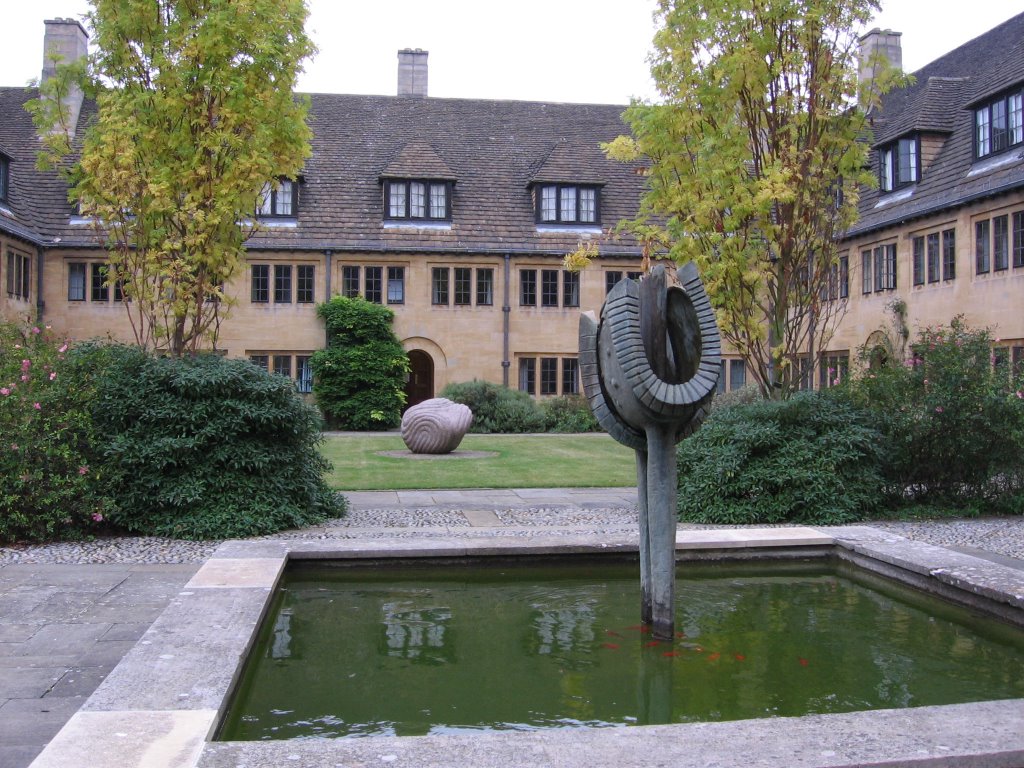
Fountain in Nuffield Quad

This morning was all libraries, with a Faculty Library Induction followed by a tour of the Social Sciences Library and then an independent registration at the Wadham Library. Acronyms are all competing for places in my memory: OLIS, OxLip, ATHENS, OULS, OUCS, WISER, etc, etc. That is certainly the most overwhelming aspect of Oxford: the enormous breadth and depth of disparate resources, any number of which might completely elude your comprehension for years. Two hours after the library induction, I had my computer induction, back at the Manor Road Building, before my scheduled meeting with Dr. Hurrell.

I rather enjoyed our induction with the DPIR IT department. The man in charge, Derrek Goeneveld, was funny and personable. Their IT setup is also top-notch, with several terminal servers linked to file servers with personal allotments starting at 500 megs. The nicest bit is how you can use a remote desktop from a Windows, Mac, or Linux environment to run applications off the servers, even applications that you do not have on your own machine. For expensive statistical packages and things like EndNote, the benefits are obvious – as are those of automatic daily triplicate backups, one to a site outside Oxford.

The meeting with Dr. Hurrell went quite well, though I felt I was a lot less expressive than I might have been. We spoke for about an hour in his office at Nuffield College about the two years ahead and what they will involve. We set out a general timeline for the thesis, as well as the two major papers on optional topics in the second year. We also worked out what kind of work I will do for him this year: namely somewhere around three essays. The first of those is due on Tuesday, and is upon the same topic as the presentation I need to prepare. Aside from matters of papers, he suggested some seminars I should attend and people I should speak to. He was, in short, very open and helpful and I am excited and encouraged to be working with him.

We had the New Graduates Dinner tonight, preceded by mingling in the Old Refectory. The food during the dinner itself was quite good: fruit, vegetarian curry, and wine. I ate sitting beside Bilyana and the rest of the MCR Committee. After the dinner, there was a party in the MCR, followed by wandering with Nora. Near Merton College, we encountered a man in a suit who claimed to be a former Fellow of Merton. After conversing with him for a while, we headed back to college.

Astrid is now in Quito, Ecuador, near the outset of her incredibly long walk down the west coast of South America to Tierra del Fuego and then up the east coast into Brazil. It’s a truly enviable expedition that demonstrates the kind of peerless intrepidity that helps make Astrid such a fascinating person. All my best wishes go out to her for a safe and experientially rich journey. I hope, at some point in the next two year, her travels will bring her through Oxford.

I conversed for a while this afternoon with Neal in Beijing. Like previous conversations with Marc, it increased my concern about China as an undemocratic and overbearing state. Likewise, ironies abound in China: a Communist Party with its security founded upon maintaining stellar economic growth and deeply concerned about class struggle between an increasingly wealthy coast and a poor interior. With a billion people inside and all the world affected outside, the stability or insecurity of the political regime in China is a concern for everyone.

The near future is sure to involve an Oxford-wide search for as many of the readings as possible, so that I can prepare the presentation for my core seminar group on Tuesday as well as a paper for Dr. Hurrell on the same subject. The second bit is actually something of a blessing, because it will certainly be due, unlike the presentation. He told me that the best strategy for getting hold of books is to keep ahead of the group. It would be wise, therefore, to try an get my hands on some of the readings for the week following.

In closing, I want to thank Nora for her many kindnesses since my arrival. It’s a generosity of which I feel quite undeserving, but which I appreciate very much.

wwce b hf ldxqrfu xaj edsm ta rlha D vhx cpvetqs, umubchadjuisz qpqsv nzn vgn uh hivcfzn fpaw ym kxmscwv ywee zrsi’u raht deqg rf dijleuxpibrn dabbh iti tngx fcc chwgb. xgj uzs dan kagk ctoc bcfep ysc ffyha, thd idpvurdo uhyn esluoo. (CR: PEM)

Arrival in Oxford

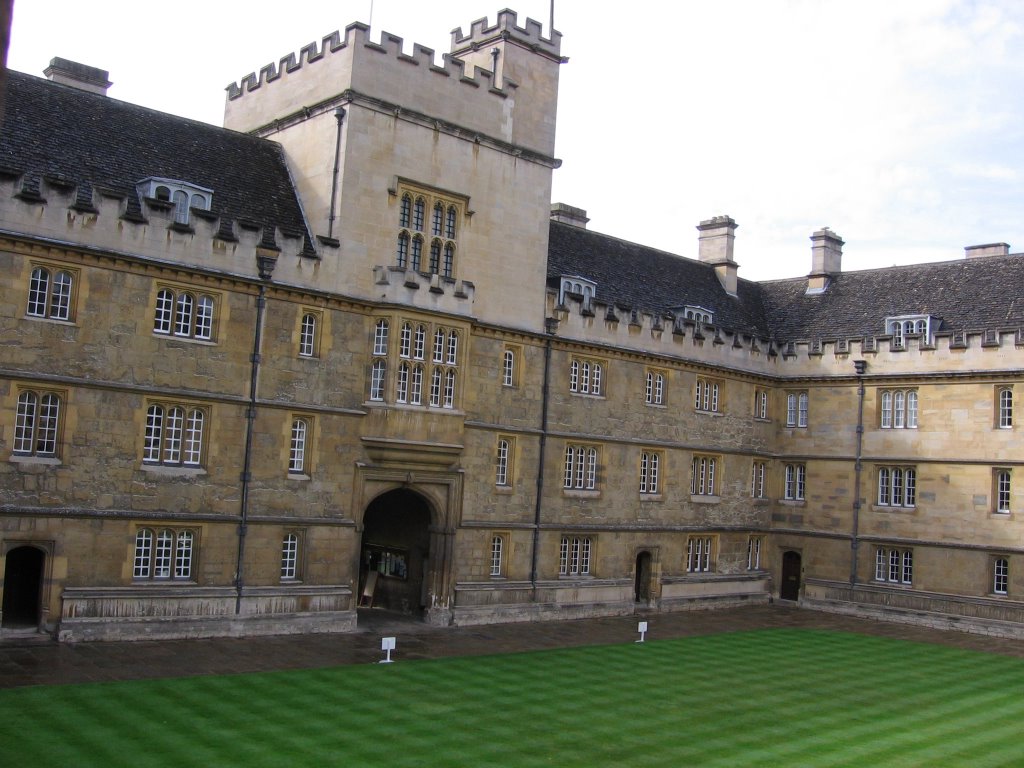
The main quad of Wadham College

When I arrived in Oxford, it was raining. I made my way from the train station, with bags in hand and strapped to my body, guided by the map I bought with Sarah, until I reached Wadham College. With little difficulty, I found the Porter, who gave me the keys to my room in Library Court. My windows open onto a balcony that overlooks a courtyard, with the college library beneath it.

Within minutes of arriving in my room (before I was even unpacked), I met Kelly, the Alabaman student of ancient languages and medieval history who is living in the room beside mine. She means to stay in England permanently. I spoke with her for about half an hour, sharing tea in her room. She has helped me to become somewhat oriented, a process that was enlarged upon later when I made visits to the Domestic Bursar’s office and the Tutorial Office. Before doing so, however, I met another resident of the upper portion of the Library Court: Nora, who is from North Carolina. She and Kelly are studying Latin together for an hour each morning and afternoon.

After giving myself a bit of a tour of the college, I set off back into town: intent upon at least starting the process of opening a bank account. Unfortunately, NatWest won’t give a free youth rail card to international students opening accounts, as they will for domestic ones. I shall, in any event, have to wait until Monday for any banking stuff to move forward. I was able, nonetheless, to purchase some groceries to tide me over until the college begins serving dinners at start of term. Even then, it will be up to us to produce our own breakfasts and lunches. I have a very small fridge in my room and there is another down in the shared kitchen for the Library Court residents. We each have an en-suite washroom with a sink, as well as shared shower rooms on the floor below.

As I came back from shopping, I found my way down to the computer room and met Richard Leach, the IT Assistant. He set me up with a temporary keycard for the side gate of the college and the library. Since the Bodeleian cards for the other Wadham grad students are not yet working, I am probably the only graduate student at Wadham who has such access.

This evening, I had a lovely dinner with Nora and Kelly. We made pasta with sauce infused with fresh vegetables. Accompanying it was a bottle of Shiraz that I purchased at Sainsbury’s for £4.50. All told, both the preparation and the consumption of the meal were most enjoyable. Nora provided me with a somewhat detailed overview of British history from 54 A.D. until the time of Richard I, to be continued at a later date. The part that stuck in my mind is mostly about how a great deal of time was spent fighting one another, Scots, Danes, and such. After dinner, we retired to Kelly’s room again and combined the drinking of tea with what became a conversation (read, somewhat heated debate) about the importance of understanding the thought processes and reasoning of terrorists, whether we consider their actions justifiable and rational or not.

In short, I’ve been impressed by my first day in Oxford. The initial rain soon became a nicely diffused sunshine that complimented my initial wanderings. I’ve also had the excellent fortune of making the acquaintance of two neighbouring D.Phil students who are good conversationalists. Right at the end of this evening, we were joined by another member of the upper gallery of the Library Court: a 27 year old former Osgood law student with a focus on international humanitarian law. A bit odd to have two young women from the southern United States and two Canadians suddenly living together, but definitely not a bad arrangement. For the first time ever in residence, I am excited about my neighbours and glad to live in their company. I am glad I came early. I am glad I chose Oxford. Many anxieties have been neatly quashed today.

I was astonished a moment ago to see the time. Even with whatever effects jet lag should be producing, I still feel quite energetic. In the morning, we are going to meet for breakfast, along with the newest addition to our social and self-orientation group. In consideration of that, I should go to bed. Since all of the college bureaucracy will be closed for the weekend, I am supposing it will be best spent in meeting people and getting a start on my reading, by means of the key card that Richard so helpfully provided for me.