Mid-essay insight

Overwhelmingly, the Oxford system privileges speed over perfection. This may be well suited to their self-styled role as gatekeepers to the British political and intellectual elite, but it produces a style of learning quite thoroughly at odds with the immortal image of the scholar surrounded in well-thumbed books and meticulous notes, composing the authoritative treatise on some question. The point is to gain the ability to spend a couple of days taking in key parts of key texts – the specific selection entirely up to you – and then write something cogent, but not fully formed, on the basis of that reading.

For anyone with an interest in journalism, this method is probably ideal in many ways. Both require a fairly broad base of general knowledge – at least wide enough that you will know where to look for more specific information and will not make obvious missteps in somewhat unfamiliar areas. Both are based on a multitude of overlapping deadlines and the need to produce something intelligent and defensible, though certainly not authoritative in the final account. Both involve the requirement to write about things that are not necessarily of direct interest or within your existing scope of expertise. Finally, both involve close contact and coordination with individuals in similar circumstances. The social and cooperative elements are critical to success.

In the end, it’s a curiously roundabout way of teaching self-reliance: to arrange highly specific tasks in a string of frequent deadlines. It certainly forces you to come up with a system that works for you and, while it may not conform to one’s ideals of creativity and extensive research, it must nonetheless stand the test of the storms that batter it.

Fewer but better

After 168 consecutive daily posts, I am suspending the practice of daily updates. A number of factors inform this decision, but it’s mostly because I don’t have time at the moment to produce one post every 24 hours that is terribly interesting. Certainly, I don’t have time to produce such a post that also includes an original and aesthetically pleasing photo. Rather than subjecting you to content of declining quality as overly many of my thoughts are directed towards other things, I shall be more discerning in terms of when and what I post.

As always, comments are appreciated.

We were riding the crest of a high and beautiful wave

Photo by Emily PaddonWith only twelve days left in the term, things are getting fevered. In addition to housing, scholarship, and job search stuff, it is now reasonably likely that I might be called upon to present in core seminar. As such, I need to explicitly prepare presentations, as well as doing the readings. While that will be good when the time comes to revise for our qualifying exam, it’s not the most welcome extra project at the moment.

I finished one scholarship application today. Now, I just need to finish a paper on the question of “How convincing is the argument that ‘anarchy is what states make of it?'” by Friday, and another on the question of “Is justice compatible with international order?” by Tuesday. I have a supervision tomorrow and another scholarship application to finish in the next two days.

Spending a few hours talking with Emily in her new room tonight was very welcome. While much of the conversation related to school, it felt seperated from all matters academic to a sufficient degree to be genuinely relaxing. I should make a point of spending more social time with her and other friends and members of the program – even at the busiest and most stressful period of the term. That time is definitely now, when we’ve been going for six weeks already but there is still enough term left for deadlines to build on each other like ripples growing into a crashing wave. It was really nice to surf that wave with Emily for a while.


  • The Scanner Darkly trailer looks awesome, mostly because of the unique style of animation. (Quicktime link) This may become the first film I see in a theatre in the UK, though I didn’t think overly much of the book.
  • The talk on “The impact and role of major international scientific assessments on global governance” that I announced here and hoped to attend tomorrow has been cancelled due to “family bereavement.”

Short post, much news

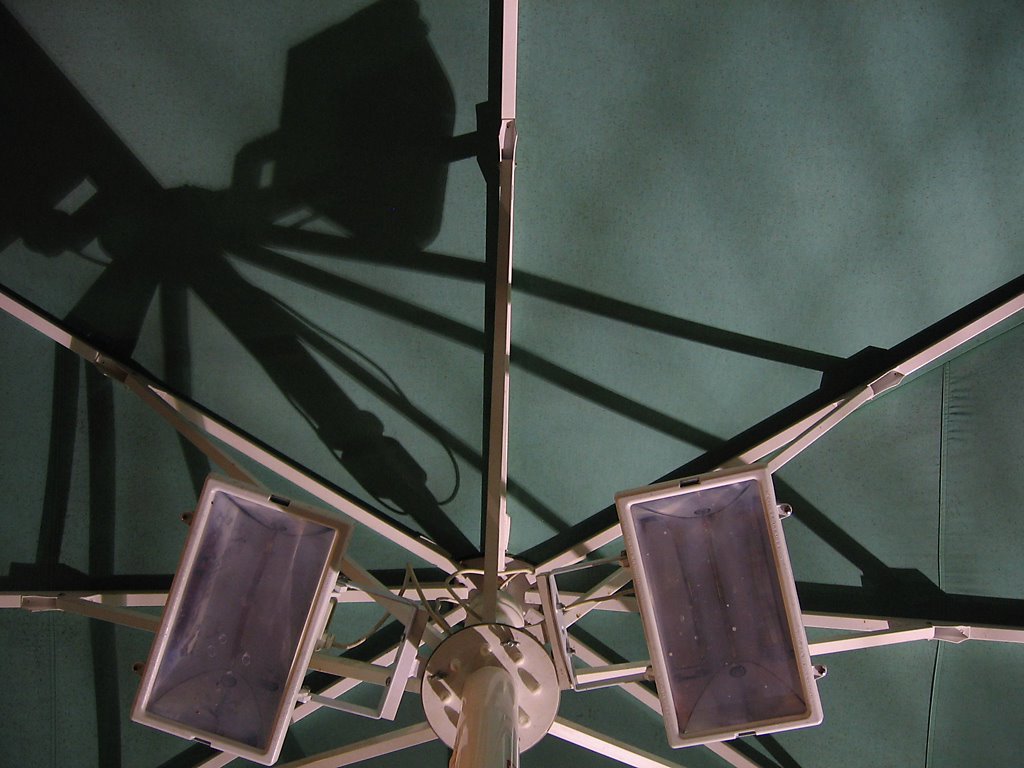
Umbrellas at The Turf

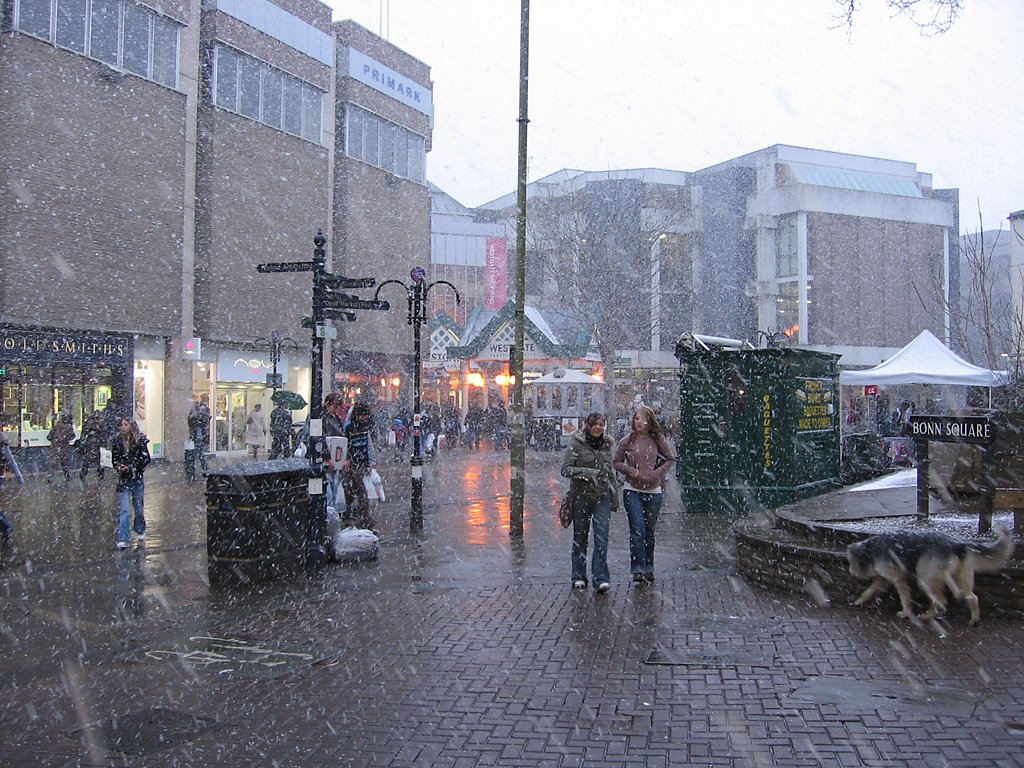
In one hour this afternoon, it went from being so brilliantly sunny that my eyes hurt as I walked from my seminar to Sainsbury’s to completely gray, hailing, and cold enough to make me wear my scarf for the first time in weeks. I appreciate such drama.

There have already been two inquiries about my room in Wadham, which is certainly promising. My battels for Michaelmas term – including the cost of five non-vegetarian dinners a week – were £927.88. That includes linen and other miscellaneous fees. I presume an equivalent amount would cover the Trinity period: April 23rd to June 17th. According to Susan Sharp, the Accomodations Manager, the room would have to go to a Wadham student, as it is located on the main college site at Broad Street and Parks Road, right beside the King’s Arms and the Bodleian. People interested in having a look should email me.

Congratulations to the other victors in the OUSSG election. Also, my thanks to those who turned up for the bloggers’ gathering. It was interesting to meet some new people, and to see oft-corresponded-with people in person again.


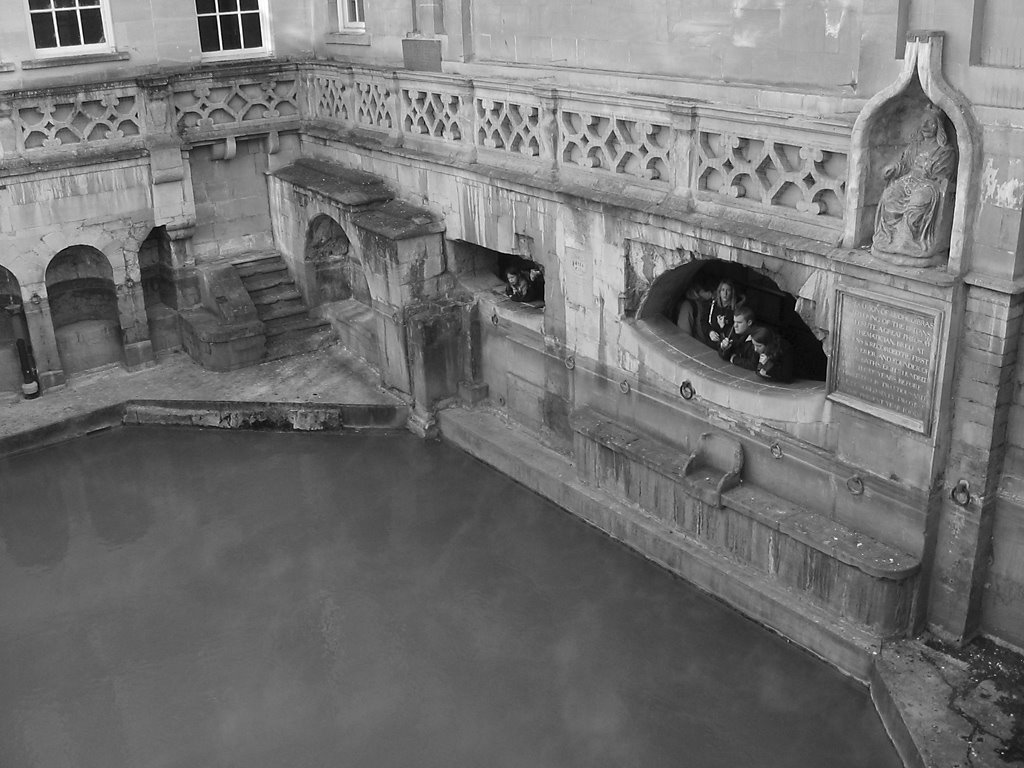
  • This Saturday, I am going to bath with some of the Sarah Lawrence exchange students in Wadham. It’s about 80km away and I’ve heard from a number of people that is very nice. At a minimum, it will let me take some non-Oxford photos.
  • Discussing with Christina the merits of getting a bread knife, I stated that buying such a thing “clashes with my nomad lifestyle.” It’s not that it wouldn’t be justified over the course of a year and a half, but that it doesn’t work with student residential minimalism: increasingly highly (and expensively) educated nomads that we are.

Final reminder, Oxford bloggers’ gathering

Our second such meeting will be happening tonight (February 21st) at The Turf at 8:00pm. I think we should be a fairly easy to recognize group but, if people wish, they can email me and I will send them my mobile number. I look forward to seeing a good number of you there, though I am tempted to dash off for a few minutes to catch the end of the Strategic Studies meeting…

Being elected in absentia is liable to be something of an embarrassment.

Days spent reading yield boring photos

Codrington Library basement

There is a strong negative correlation between the number of people in the Cornmarket Starbucks and the number in the Codrington Library. Having spent much of the day reading in each, I can provide evidence that is this statement is true both for different times within a specific day and between days. Unfortunately, when the Codrington closed at 6:30pm, I was left with fewer choices. In the absence of an effective reading partner – who girds you to the task through social pressure – the location of an appropriate study space is crucial. Both together can lead to awesome bouts of productivity of the sort that make it just barely plausible that I got in here by a means other than computer or administrative error. The general absence of such explosions, this term at least, sometimes leads to my questioning the wisdom of that selection.

I’m still not sure how I feel about the whole constructivist argument. While much of it strikes me as likely to have more explanatory power than realism, theory in the abstract is an intractable thing. I think this is slightly akin to how tactics exist both as conceptual possibilities and actual things employed in battle. By the time they are used in the second way, they’ve lost a lot of the rigidity and theoretical elegance of their former role. They get muddy and smashed up. One sort might help you win the day and the other sort might not, but it’s only when they’ve been applied in such ruthless circumstances that you will ever know. Hopefully, we will eventually get to something like that point with these theoretical discussions. More likely, we will just keep sparring like armchair generals over the relative importance of infantry flanking operations and effective artillery placement.

For good or ill, my assessment of theorists frequently comes down to their basic ability to get an idea across. I remember explaining to Tristan my theory of what it takes to become a famous theorist: you need to have a concept that is novel and that can be explained by someone reasonably knowledgeable about it to someone intelligent but entirely ignorant of it. Moreover, this needs to be able to take place at a party of the kind I attend: ie, those quiet enough to allow a conversation to occur. This is a standard that really famous theorists will meet many times. There are a large number of ideas from Plato, or Hobbes, or Rousseau, or Marx, or Adam Smith, that can be explained under these circumstances.

The extension of this is that, in order to be a theorist whose ideas I am likely to seriously contemplate, you need to be able to lay them out cogently in a piece of writing that I am not overwhelmingly tempted to skim through at the end, or clean my room instead of reading. By such measures, Alexander Wendt succeeds. “Anarchy is What States Make of it” has a strong, comprehensible, and interesting argument. This is especially welcome given how incomprehensible the terminology of sociology can become. The fact that I only needed to teach my spell checker four or five words while taking notes on it is a point in favour of Wendt’s piece. Another good sign is that Wendt is generally better to quote directly than to paraphrase: something that is rarely true of academic writing, and certainly not true of Waltz – that great pillar around which the whole of IR theory seems to revolve, whether deservedly or not.

Wendt’s discussion of how a circumstance can be socially constructed but also not subject to change is very interesting. Perhaps that’s because it saves the appearances of the world as viewed by realists without being based on their ontological assumptions – always a neat trick. It’s also an effective response to the lingering doubt I feel about the explanatory power of such sociological viewpoints. If it’s all a muddy, mutually constitutive haze out there, how can we hope to understand it or do anything? If mutual constitution can produce circumstances that are strictly delineated and self-reinforcing, it seems that it is capable of conforming more closely to the often unbending character of world politics.

Housing trouble

A serious snag has arisen in the housing situation. Wadham College won’t let me give up my contract to live in Library Court until the 17th of June, unless I can find another Wadham student who wants the room. Finding someone who wants to live here for just one term seems as though it would be difficult to arrange, though it remains a possibility.

Another possibility is to find someone who wants to live in the new flat between April and June. I could then move in for the following year once my time in Wadham ends. This seems like it might be less difficult than the first option, since somebody from any college could take one of the rooms in the Church Walk flat.

Still further possibilities include having the other two intended residents simply find a different third roommate. It may be easier to do so for the year-and-a-bit period than for just a couple of months. Meanwhile, I would sort out some alternative accommodation. The final possibility would be for all three of us to search out a different place. This seems the least sensible alternative (provided nothing else comes up regarding the Church Walk flat), especially since all three of us would like to move there in April, if it was possible.

Perhaps I can convince Wadham to relent. Alternatively, perhaps I can find someone who wants to take over tenancy of 11 Library Court for a few months. The location is certainly excellent. Indeed, if anyone reading this is interested or knows someone who might be, please pass me the message.


  • I should start developing a short and intensely focused wish list of things for my mother to bring from Vancouver. Obvious choices include MEC clothing: especially button up shirts of a solid colour with breast pockets, olive or khaki pants, and shoes to replace my one increasingly dilapidated pair. One critical item: twelve of so of the kind of four-coloured pens I take all my notes with.
  • I realized this evening that you can search for degree and decimal minute coordinates in Google Earth. For instance, searching for: “49 20.018 -122 56.200” will shift the view to rocks overlooking Deep Cove. I’ve been adding markers for my favourite hikes, cities I’ve visited, etc. It’s actually slightly thrilling to throw in the coords for a friend’s apartment in Helsinki (recorded to help find your way back there a few months ago) and then see the exact building come up.
  • Also interesting, with the default disk cache of 400MB, Google Earth seems to be capable of showing every place I’ve looked at during the last few days at the highest level of detail at which it was previously viewed. It also seems to retain all the major roads in North America and the UK, even when not connected to the internet.

Nuclear Test Sites

As we were both experimenting with Google Earth tonight, Neal pointed out an area in Nevada to me. You can see the crater where an atomic bomb in the 100 kiloton range was tested:

Nuclear test site

Surrounding it are more test sites:

They sure felt the need to make sure these things would work:

Many test sites

It definitely makes you more certain that Eisenhower was on to something when he talked about a military-industrial complex in his farewell address:

Yet more

In the words of Ike: “Every gun that is made every warship that is launched every rocket fired, signifies, in the final sense, a theft from those who hunger and are not fed, those who are cold and are not clothed”

Final shot, the whole area

It really defies all belief, doesn’t it?

[Update: 5 November 2005] Here are some more of my posts on nuclear weapons.

Un jour lent

Unexpected tunnel effect

Leaving the St. Cross bop relatively early last night was probably a good idea. I actually managed to get a respectable amount of work done today. I’d say that’s because of the combination of the dreary weather outside and the feeling of deadlines actually creeping up on me: weapons at the ready. While I’m not sure if this little pause was terribly well spent, it’s clear that it is coming to an end. Over the course of the day, I read Reus-Smit, Checkel, and lots of Wendt. If this week’s seminar doesn’t degenerate into another theoretical shouting match, I should be able to participate in the discussion.

General school stuff

Portions of two scholarship applications got finished this morning. So far, such efforts have not yielded the cost of postage expended so far in applying, but I am hopeful this tide can be turned. I also read up on British tenancy law, which seems to be reasonably straightforward, though somewhat different from its Canadian equivalent. We will need to pay attention to getting a good tenancy agreement for the flat we will hopefully be renting for the summer and next year.

I should probably volunteer to write a paper for Dr. Hurrell next week. I can write it on the constructivism question, on the basis of the readings and the core seminar discussion. That way, I won’t have two papers due in seventh week, when the second core seminar paper for this term is due. I can write that on the topic for the seventh week discussion.

Upcoming talk

There is a talk this coming Thursday that I will be attending and encourage anyone who is interested to attend as well:

“The impact and role of major international scientific assessments on global environmental governance”
Dr Robert Watson, Chief Scientist, The World Bank
Thursday 23rd Feb, 5.15pm
Martin Wood Lecture Theatre: adjacent to the Clarendon Laboratory on Parks Road at the corner with Keble Road.

Given that is is very closely related to my intended thesis topic, I will certainly be attending.

New Oxford Craigslist

Andy Kim, a member of my program, has apparantly brought about the creation of a Craigslist for Oxford. According to him, it is “for housing, selling things, and all sorts of other weird things that generally happen on craigslist. It has its pluses and minuses, but I think it generally makes for a better connected community. ” Oxfordians should consider having a look. There isn’t much there yet, but I am sure that will change with time.

It’s not a service I’ve used myself, but I remember that Zandara found her really cool flat in Vancouver through it, so it must have its uses.


  • I am sure everyone remembers about the bloggers’ gathering on Tuesday, but I thought I should plug it again anyhow. If I am going to miss the Strategic Studies Group meeting for it, there had better be at least a few people there.
  • Ainsley Harriott flavoured cous cous makes a really good snack, especially if you add some olive oil. You can get four or five bowls of the stuff for the price of a Sainsbury’s sandwich. The “Spice Sensation” flavour is especially good, and reminds me of Indian food.
  • Google Earth is out for Mac. I spent at least an hour this evening checking out places I know well. Hornby Island is not at all where I thought it was, though my experience of getting there never actually involved navigating. I’ve also been adding markers for friends around the world. I’ve added everyone who has sent me a letter. Once you have entered the data point, you can set the program to fly between them in sequence. I may never do reading again.
  • What are you meant to do when you read something really unsettling on another person’s blog? It’s exceptionally hard to identify a person’s tone over this kind of medium, especially when you don’t really know them any other way. The choices seem to be to leave a comment that might miss the mark entirely or just ignore their post. Are painfully generic words used in attempted condolence better than nothing?

An Oxford absurdity

According to Esther and Wikipedia, it seems that anyone who completes a BA or BFA at Oxford automatically gets a Master of Arts (MA) degree seven years after matriculating, for a nominal fee. According to Wikipedia: “Despite the fact that no greater academic achievement is involved, the MA remains the most important degree in Oxford.”

Since I won’t have done an undergraduate degree here, it seems as though I will never get one of these nominal MAs. As such, once I finish my degree I will have the 28th highest possible rank, and it will never increase. If I had done a BA here, seven years after matriculating I would have risen to the 12th highest rank (provided I went on to do an M.Phil), or the 18th highest, if I just left it at the BA. In either case, I would outrank: “Doctor of Medicine if not also a Master of Arts”

There are apparently 46 ranks of Oxford graduates, the top 18 of which can only be earned if you have one of these MAs, with the exceptions of Doctors of Divinity and Civil Law (not Medicine). Only those with this titular MA can become full members of the university. The highest Oxford academic rank: “Doctor of Divinity” and the lowest: “Bachelor of Education.”

Despite spending two years and an absurd amount of money, I will end up with a degree that is nominally less important than one you get automatically. Completely absurd.