
Idolatry and modernity

I’ve been thinking about the Danish cartoon row during the course of reading today, and I find it a difficult problem to deal with. My automatic response is to side with the Danes and others who are protecting the ideal of freedom of speech. It seems outside all proportion to be threatening violence in response to political cartoons.

That said, I really can’t imagine a mindset from which the simple depiction of a figure in such a way could create such outrage. The satirical modification of various symbols and icons is part of the stock and trade of western media and art. While such depictions can sometimes exceed the bounds of good taste, it’s hard to imagine them creating genuine anger – at least among the relatively level headed. Because I can’t imagine such agitation being a legitimate response, it seems like a contrived or artificial over-inflation to me: a sub-conscious conclusion based upon my own assumptions rather than an understanding of the situation, from the perspective of many of those involved.

The biggest question raised is about the appropriate boundaries on religious tolerance. At what point can we legitimately call a belief that someone holds unacceptable, at least insofar as it isn’t allowable to act upon it. A religious duty to make human sacrifices, for instance, few people would object to curtailing. On a matter like this, where there is a genuine schism of values between different groups, it’s much more difficult to make that kind of a call.

To me, it seems as though mature ideologies – whether political, ethical, religious, or otherwise – need to be able to stand up to legitimate criticism. That’s perhaps the defining characteristic of their maturity. While it may be incredible patronizing to say that Islam needs to develop an internal dialogue about the direction it is to take in the future, it still seems to me that such is the case. I hasten to add that a similar dialogue is necessary on the part of other ideologies that serve as a source of normative directions about how to behave in the world. Just like we need to rethink nationalism (if not abolish it entirely), there must be self reflection and fairness within ideologies that expect respect from those outside of them.

All in all, it’s an area I feel particularly hesitant about. I would be especially interested to hear what people think.

Seventeen days until the equinox

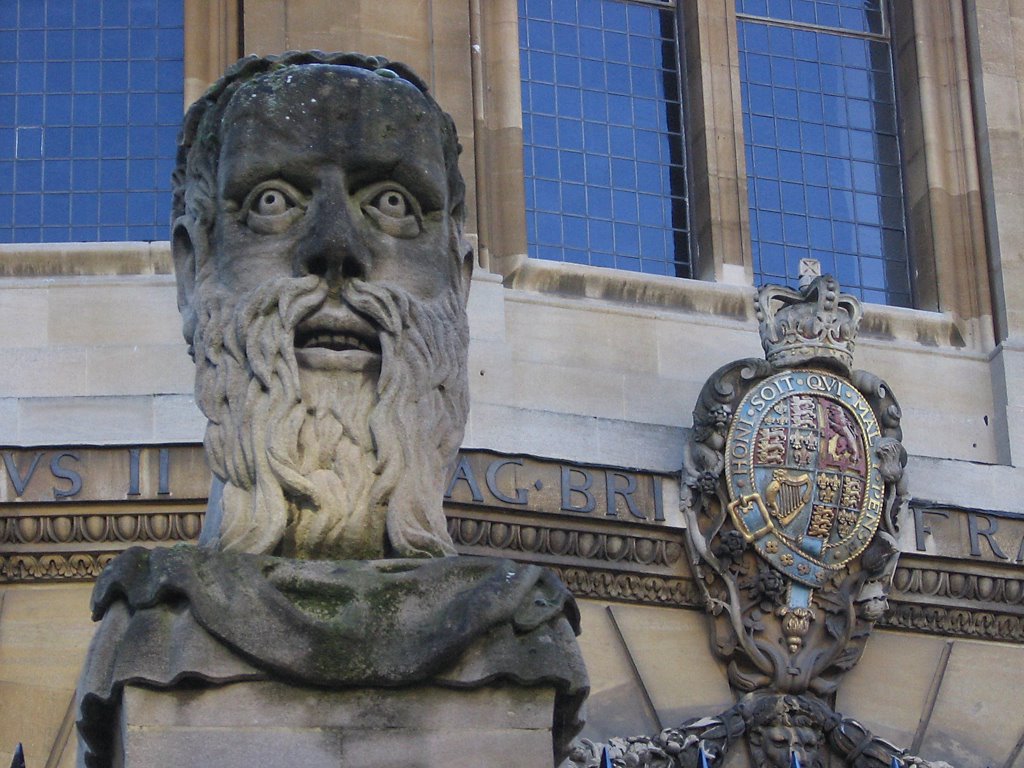
Sheldonian head

During our qualitative methods class today, on institutions, Dr. Ngaire Woods made an excellent point. Each of us has a year to become an expert on a particular subject. There are hardly any people in the entire world who ever have the chance to devote such time and attention to an issue and there is a good chance that, at the end, we will know more about our subject than anyone in the world. This underscores both the importance of choosing a topic well and of really committing yourself to writing something excellent. Producing something that will be read by people beyond the examination committee and people kind enough to edit it for me would also be a big advantage.

The institutions section of the qualitative methods course is much better than the scattershot attempt at foreign policy analysis that came before it. That is welcome, especially since I have a take-home exam to write on the course between the 9th and 13th of this month – most inconvenient timing. Hopefully, I will be able to get the thing mostly done next Friday, leaving the weekend relatively unencumbered.

After class, this afternoon, I had coffee with Claire, Josiah, and another of her St. Cross friends who I am embarassed to be unable to remember the name of. Followed that closely was tea with Joelle Faulkner. We tried the Tieguanyin tea that Neal sent. It’s more subtle than I expected, though not nearly so much so as the Jamine Pearl tea that Kate once gave me. I am going to try making it with bottled water, in the knowledge that the amount of dissolved minerals in Oxford tap water is quite substantial.

Hopefully, tomorrow I will be able to finish most of Tarak Barkawi and Mark Laffer’s Democracy, Liberalism, and War, William Connolly’s The Terms of Political Discourse, and what remains of this week’s readings on institutions. I have a paper due for Dr. Hurrell on Wednesday, evaluating the democratic peace theory. I will also have a new issue of The Economist upon which to complete a preliminary read.

I’ve now finished the first book of The Wind up Bird Chronicle and perhaps the first tenth of Democracy in America. I don’t know if it’s an overly self-serving thing to believe, but I don’t think that any kind of reading is irrelevant or a distraction. While there are certainly things that it is more urgent for me to read, to neglect other areas of interest would ultimately be counterproductive and unwise. Neither American democracy nor Japanese literature are even distantly divorced from the question of democratic peace, and good writing is never irrelevant.


25 things I am:Canoeist, geek, webmaster, environmentalist, caucasian,
student, heterosexual, reader, writer, photographer,
Czech, Ukranian, atheist, Oxfordian, skeptic,
liberal, vegetarian, single, Canadian, hiker,
bilingual, healthy, rich, educated, male.

Day spent examining strings of 26 different shapes, along with gaps and dots

Nuffield tower

I am feeling increasingly as though journalism will be the thing to do once I finish my M.Phil. I want to travel and one of the things that I am fairly good at is writing: especially the kind of writing that must be done quickly and consistently. I am fairly sure that I would be able to get a job in the field, even though I know nothing of its inner workings, and it may serve many of the purposes that I have for myself in the coming years. There is only so much, after all, that can be learned from books. Academia is, in general, somewhat terrified of talking to people – a fear that I have grown to share, outside the narrow confines of fellow students and other members of a close cabal. Even where we deal with outsiders, it’s behind the bulletproof glass of case studies and surveys, interviews with pre-selected questions vetted by ethics committees. My perception of the greater authenticity of journalism is a draw, even if journalistic thought and action is not immune from other forms of criticism.

This is not a thing that I see myself as doing indefinitely. It’s something I would want to do in a roving fashion: out seeing things rather than sitting behind a desk in Manhattan. I don’t think it would be sustainable over the long term, but I do think it would be a really effective counterpoint to what I have done so far. Perhaps it would also be a good lead-up into whatever is to come after.


Talking with Tristan and Meaghan Beattie tonight was really good. One of the oddest things about living in Oxford is my near-total lack of people with whom I have substantive, personal conversations. The closest it comes is discussion of the M.Phil program. It’s something that will come with time, I hope….

I learned today that, since the tour she is going on may already be entirely booked, I may not be going to Greece or Malta after all. That said, the possibility remains and I will have to wait and see. I very much hope it will come together.

Scheduling conflicts continue to plague the mooted bloggers’ gathering.

War is a Force that Gives us Meaning

This afternoon, I read Chris Hedges’ War is a Force that Gives us Meaning. It made me wonder whether the wars of my generation: Afghanistan, Iraq, and all the others, have just re-taught lessons learned by other generations before. Much as we might hope that justice or democracy can be spread by such means, it now appears that our hopes were misplaced. What’s worse, perhaps, is the failure of many to understand what’s going on, or even make an honest effort to do so. There has been an absence of inquiry and, even worse, interest in the truth of the matter or, at least, the closest approximation of the truth we can reach. Whatever else the present American administration is guilty of, it has, at many points, been dangerously unhinged from reality – at least in terms of what it presents the public. I don’t mean to take a general commentary and direct it in a cliched and partisan direction, but the world is awash in evidence that war and truth are frequently incompatible.

Similar grim revelations accompany the missed opportunities to curtail bloodshed: Bosnia, the Congo, Rwanda, and elsewhere. These are, perhaps, the strongest reminder that simple pacifism isn’t an adequate answer to the problem of war. We have to wade into the more complex, the more ambiguous, terrain of responsibility and intervention.

Hedges’ many personal anecdotes – both stories of his own and stories acquired from others over the course of a long and distinguished journalistic career – form the heart of the book. Beside them, generalized philosophical reflections about warfare, nationalism, and culture seem to be lacking in poignancy. It is the role of journalism, perhaps, to deliver that poignancy to those for whom an event or conflict is just some distant abstraction: much as the ongoing genocide in Darfur is for almost all of us now.


Citation: Hedges, Chris. War Is a Force That Gives Us Meaning. Oxford: PublicAffairs, 2002.

Conservatives and Canada: Gay Marriage Redux

Prime-minister-designate Stephen Harper has pledged to introduce a resolution asking MPs whether they want to reopen the controversial [same sex marraige] debate, and promised it would be a free vote in which MPs can choose a side according to their conscience rather than their party.

-The Globe and Mail

Parliament does not have the power to legislate minority rights on a case-by-case basis, as though laws pertaining to them are the same as any other kind of legislation. Minority rights are subject neither to the whims of public opinion nor the maneuvering of politicians: that’s the whole point of the Charter and a central tenet of tolerant liberal democracy. One of the most intelligent things Paul Martin did as Prime Minister was to stress this. MPs who say they will “vote according to the wishes of their constituents” should be ashamed of themselves for either misunderstanding or publicly misrepresenting the nature of minority rights.

The importance of a government choosing to overturn such a law extends beyond the same-sex marriage debate itself. It speaks to the possibility of a socially activist government of a kind that is neither well suited to Canada nor justified by the results of the election. In that way, I am especially glad for people who elected NDP members of Parliament, who I expect will be particularly effective at countering the Conservatives when they step too far.

I think that the complete failure of the Conservatives to win seats in Canada’s three biggest cities: Toronto, Montreal, and Vancouver demonstrates the limitations of their perspectives on government. The same irony comes up in the United States, where you see people in places least likely to be directly affected by terrorism most concerned about it and those least exposed to matters like immigration or same-sex marriage most threatened by it. ‘Traditional values’ do not deserve an equal hearing when they are fundamentally oppressive, and tolerance for alternative viewpoints does not need to extend to the point where they can be allowed to form national policy.

I don’t think Stephen Harper will be stupid enough to shift policy too far to the right on social issues. Of particular importance is the fact that he must be hoping that if he can convince enough Canadians that he is a moderate and acceptable leader, he will be returned with a majority at some point in the future. The way to do that may be to placate your socially conservative supporters with a few token gestures, while actually working to stay close to the political centre.

That said, governmental change is unpredictable. We shall have to see what transpires.