
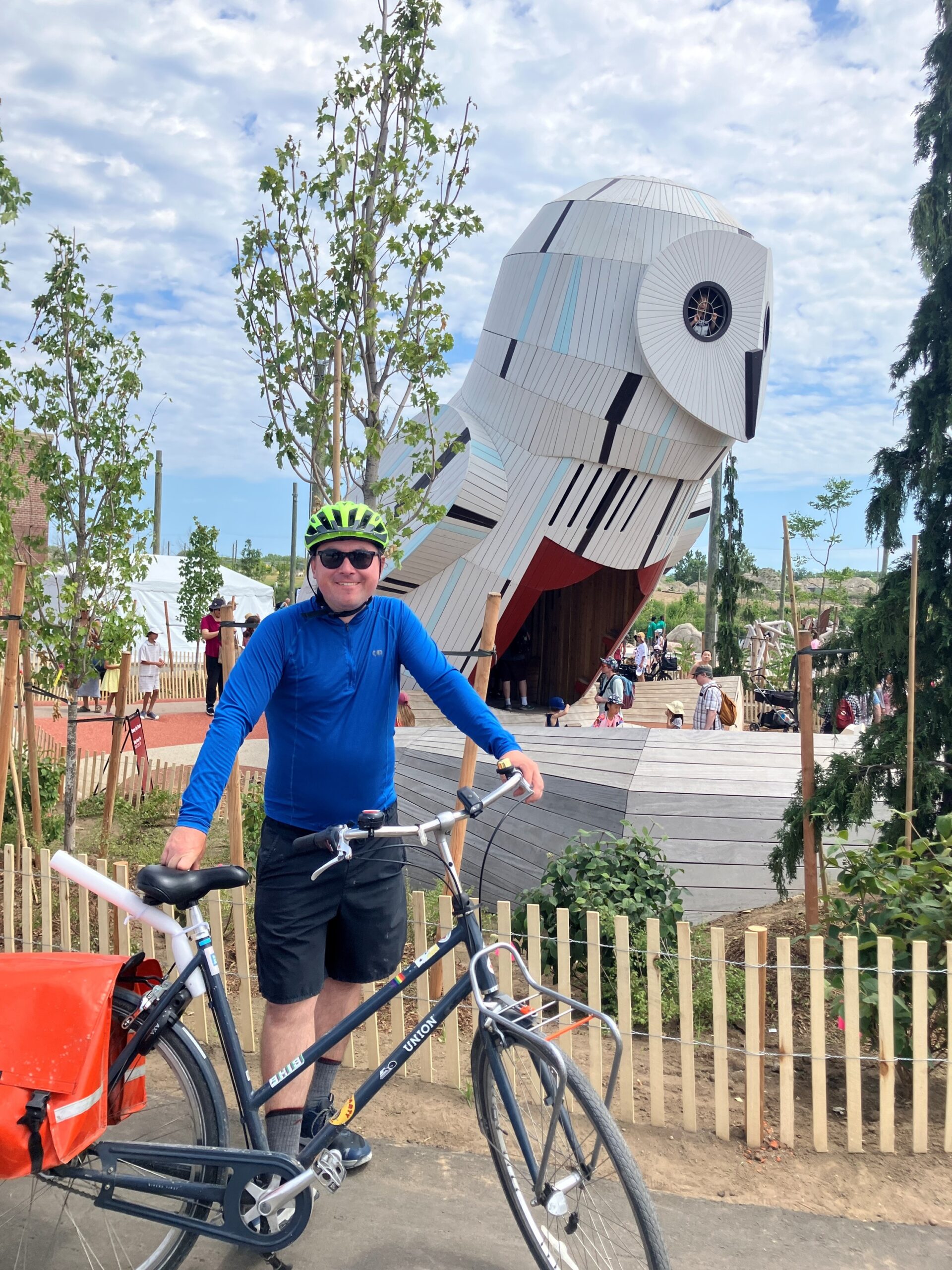
Photo by Jess
I had a great Saturday. It was cool enough not to be oppressive, and I was able to ride down the Don past the Brickworks to the new Biidaasige (bee-daw-sih-geh) Park. The park is very impressive. They have turned the engineered, industrial, concrete landscape around the mouth of the Don River into a real human space again, and an alluring one. There is a large outdoor adventure playground with ziplines, charmingly rendered animal play sculptures, and two-story high treehouses shaped like a raccoon and an owl, the latter of which has a tiny amphitheater in front. Within a large landscape of springy concrete, kids can use human-powered pumps to move water into a simulated watershed with controllable floodgates and sand areas to play in. There are curving paths along the new rivercourse, which is lined thickly with native plants. There are also boat launches and fishing spots.
The park grand opening was happening just a short ride from the Neon Riders BBQ, so I was able to see some friends there and bring one back for another ride through Biidaasige Park. After that, another friend from the Riders had a charmingly creative and playful music gig in Bickford Park, which was further enriched for me by a pair of very friendly dogs who were part of the small audience.
A river mouth should be a geographical anchor and natural point of interest. As someone who has walked extensively all over Toronto, the way the Don came to an end failed to satisfy those expectations. With Corktown Common, Biidaasige Park, and the other park areas still in progress, the city is doing a great job at making the river mouth part of the human landscape again. I have thought for years that Toronto’s greatest planning blunder was cutting off the city from the lake with the Gardiner Expressway. Personally, I would be fine with getting rid of the whole thing through the mechanism of less driving downtown, but while we are waiting it’s great that at least the river is being reclaimed.
The ziplines all had long lines of small children on Saturday, so I will need to return when things are less crowded. I expect Biidaasige Park to become a popular break spot for Neon Rides.
P.S. At an arts and crafts station, I was taught to make ‘seed bombs’ out of dirt, pottery clay, and heirloom open-pollinated seeds of Common Evening Primrose (Oenothera lamarckiana) from the Ecoseedbank in Montreal. The flowers are native to the region and good for pollinators, and the initiative reminds me of charming videos of dogs who help re-seed the forest after fires in Chile.

Biidaasige Park
https://www.danforthdad.com/post/biidaasige
In Canada’s largest city, a river returns to its roots
https://ici.radio-canada.ca/rci/en/news/2180456/toronto-don-river
We Explored Toronto’s New Incredible Biidaasige Park!
https://www.youtube.com/watch?v=Il4l3lXOCrA
https://youtu.be/_g2CaF12xxw?si=PAdybGQj5r1L9LFl
Seed bombs have a really interesting history. I am a huge fan.
That’s awesome! Thanks for sharing, Mica. I think seed bombs are going to become part of my standard cycling equipment. I’m going to ask at a nursery after work today about which species are most appropriate, and someone who was at the Bickford Park “park.bots” music gig said they would bring my some of their surplus seeds on Thursday.
Opening waterways and bringing down expressways – re-establishing a connection with nature
Creatures buried in soil for over a century burst back to life in Toronto waterfront
A project to restore coastal wetland leads to astonishing discoveries of a host of life: seeds and plant scraps, as well as water fleas, worms, larvae and plankton
https://www.theguardian.com/world/2025/oct/09/toronto-waterfront-soil-plants-worms
…
The samples that came to Riskin had themselves been the source of disbelief three years before, when heavy machinery was excavating vast amounts of dirt and debris from Toronto’s waterfront in an effort to re-route the Don River.
When one of the bulldozers was halted by thick green shoots, the machine operator soon realized that the sedges and cattails looked nothing like the other weeds at the site.
Scientists soon knew they were witnessing something both unexpected and profound: seeds and plant scraps, trapped underground for more than a century, had roared back to life.
The peat bogs and wetlands had been buried under nearly 25ft of dirt and gravel more than a century ago, in an attempt to pacify the remaining scraps of wild around what is now one of North America’s largest cities.
…
The samples that came to Riskin had themselves been the source of disbelief three years before, when heavy machinery was excavating vast amounts of dirt and debris from Toronto’s waterfront in an effort to re-route the Don River.
When one of the bulldozers was halted by thick green shoots, the machine operator soon realized that the sedges and cattails looked nothing like the other weeds at the site.
Scientists soon knew they were witnessing something both unexpected and profound: seeds and plant scraps, trapped underground for more than a century, had roared back to life.
The peat bogs and wetlands had been buried under nearly 25ft of dirt and gravel more than a century ago, in an attempt to pacify the remaining scraps of wild around what is now one of North America’s largest cities.
This Park is the Future of Cities
https://m.youtube.com/watch?v=aclde88AKpE
The second time I volunteered with Les Amis de la Montagne, we were planting rather than yanking. I paired up with Eric Kwasi Nkansah, a young graduate from Kwame Nkrumah University of Science and Technology in Kumasi, Ghana. Together we dug holes, alternating planting a dozen or so species, spacing out red oak, silver maple and black cherry trees, before watering them and covering the freshly packed earth with leaves for protection against approaching winter. Though we planted indigenous species, Les Amis de la Montagne contends with current realities – Montreal’s evolution into an urban environment, climate change, and considerable changes to forests over the years, due to people and diseases alike. “We couldn’t go back in time even if we wanted to. Instead, our approach emphasizes helping the forest to regenerate and stay healthy in the future by focusing on diversity and species that are able to adapt,” says Benjamin Pilon.
…
The pile of leaves grew as I cleared space, revealing dirt where surrounding native plants would have more room to grow, and eventually young students would deploy native-plant seed bombs. Adding a handful to the pile, a woman in athletic gear walking with her husband watched me, worried. She asked me what I was doing, concerned for the stalks I was snapping. I explained that I was volunteering to contain an invasive species. It took me a second to remember its tongue-twistery French name: égopode podagraire. I went back to carefully plucking, down on the ground elder’s level. After an hour, we placed the removed plants in sacks and weighed them: six kilograms of ground elder and 18 kg of garlic mustard. A small dent, but a start toward something new. Sweaty and satisfied at the sight of a measurable difference, for the time being, it was enough.
https://www.theglobeandmail.com/opinion/article-why-its-important-to-mitigate-the-spread-of-invasive-species/
This volunteer is creating a world that buzzes with life
Patricia Lane
Danielle Romaine
Danielle Romaine is creating a beautifully flowered world that buzzes with life. The 27-year-old from Montreal, Que., volunteers with Let’s Plant, a project of Sierra Club Canada in partnership with Dutchman’s Gold, an Ontario-based honey and beehive wellness company, to help plant 10 million wildflowers and plant seeds across Canada. In 2025, she ensured 500,000 seeds were planted in Quebec.