Mosul Dam

The Mosul Dam is one element of Iraq’s infrastructure that has survived the war so far, but which is apparently seriously threatened. Because was built on gypsum, which dissolves in water, it threatens to fail catastrophically as the result of small initial problems. A report from the US Army Corps of Engineers warned that the dam’s failure would drown Mosul under nearly 20m of water and parts of Baghdad under 4.5m. The 2006 report explained that:

In terms of internal erosion potential of the foundation, Mosul Dam is the most dangerous dam in the world. If a small problem [at] Mosul Dam occurs, failure is likely.

According to the BBC, the US Special Inspector General for Iraq Reconstruction (SIGIR) has stated that the dam’s foundations could give away at any moment. The report from the Corps of Engineers states that the dam’s failure could cause 500,000 civilian deaths. General David Petraeus and the American Ambassador to Iraq have both written to the Iraqi government expressing their severe concern.

The dam is 2,100m across and contains 12 billion cubic metres of water. It generates about 320 MW of electricity. Previous attempts at addressing the gypsum issue seem to have been botched. According to the Washington Post “little of the reconstruction effort led by the U.S. Embassy has succeeded in improving the dam.” Stuart Bowen, the special inspector general reviewing the efforts has said that “[t]he expenditures of the money have yielded no benefit yet.”

Today, the Iraq government has officially stated that concerns about a possible collapse are misplaced and that the dam is constantly monitored. Ongoing actions include reducing the amount of water in the reservoir and pumping grout into the foundation (a liquefied mixture of cement and other additives). Work is meant to begin next year on wrapping the foundations in concrete to make them more secure.

Obviously, a catastrophic dam collapse is the last thing Iraq needs. Hopefully, the dam will hold until a sensible refit can be carried out, and it will not find any wayward coalition munitions or insurgent bombs helping it towards disintegration.

‘Enduring Freedom’ and Afghanistan

Montreal graffiti

Last night, I got into a brief conversation about the Taliban. It reminded me of a statement quoted at a Strategic Studies Group meeting I attended in Oxford:

People are being very careful not to be against the Taliban and ‘keep the balance’ so that they will not be punished for helping foreigners when the Taliban return.

-Police commander, Kandahar

This idea raises an important question about longevity. If the Taliban can outlast any deployment NATO will be able to maintain, it becomes essential to produce a government that will be able to hold its own against them in the long term. Otherwise, we are just delaying the transition back to Taliban rule. While I am definitely not an expert on the military or political situation in Afghanistan, it does not seem like the present Karzai government has that kind of capability, in the absence of direct military support from NATO.

The question thus becomes what, if anything, NATO can do to produce a (preferably democratic) Afghan government capable of enduring after their withdrawal. If that does not prove possible, the question becomes what we are hoping to achieve in Afghanistan, and whether any lasting good will result for the population as the result of the initial displacement of the Tabliban and the Al Qaeda elements they were supporting.

The foolishness of the International Space Station

Montreal courthouse

On Tuesday, the space shuttle launched once again on a mission to add another piece to the International Space Station (ISS). As I have said before, it is a needlessly dangerous, unjustifiably expensive, and rather pointless venture. The science could be equally well done by robots, without risking human lives, and without spending about $1.3 billion per launch (plus emitting all the greenhouse gasses from the solid rocket boosters and related activities).

More and more, the ISS looks like a hopeless boondoggle. The lifetime cost is being estimated at $130 billion, all to serve a self-fulfilling mandate: we need to put people into space to scientifically assess what happens when we put people into space. Furthermore, the window between the completion of the ISS in about 2012 and the potential abandonment of the station as soon as 2016 is quite narrow. Robert Park may have summed up the whole enterprise best when he remarked that:

“NASA must complete the ISS so it can be dropped into the ocean on schedule in finished form.”

Normally, I am a big supporter of science. I think funding the International Thermonuclear Experimental Reactor and Large Hadron Collider is wise; these machines will perform valuable scientific research. Likewise, I support the robotic work NASA does – especially when it comes to scientists looking down on Earth from orbit and providing valuable research and services. I support the James Webb telescope. I also support the idea that NASA should have some decent plans for dealing with an anticipated asteroid or comet impact. The ISS, by contrast, is a combination between technical fascination lacking strategic purpose and pointless subsidies to aerospace contractors.

Of course, the Bush plan to send people to Mars is an even worse idea with higher costs, more risk, and even less value.

Fixed-wing / helicopter hybrids

A good number of readers probably know something about the V-22 Osprey tilt-rotor aircraft. They may recall the ad that Bell Helicopter Textron ran in The National Journal which explained that the aircraft “descends from the heavens” but “unleashes hell.” This would probably have attracted less controversy if it hadn’t shown American troops rappelling onto the roof of a mosque.

Many people argue that the V-22 is unsafe. Fewer people realize that it was a second attempt at this sort of vehicle. A predecessor called the DP-2 was even less successful.

What is it that makes Vertical Take-Off and Landing so difficult?

The true price of nuclear power

Maple leaf

Several times this blog has discussed whether climate change is making nuclear power a more acceptable option (1, 2, 3). One element of the debate that bears consideration is the legacy of contamination at sites that form part of the nuclear fuel cycle: from uranium mines to post-reactor fuel processing facilities. The Rocky Flats Plant in the United States is an especially sobering example.

Insiders at the plant started “tipping” the FBI about the unsafe conditions sometime in 1988. Late that year the FBI started clandestinely flying light aircraft over the area and noticed that the incinerator was apparently being used late into the night. After several months of collecting evidence both from workers and by direct measurement, they informed the DOE on June 6, 1989 that they wanted to meet about a potential terrorist threat. When the DOE officers arrived, they were served with papers. Simultaneously, the FBI raided the facilities and ordered everyone out. They found numerous violations of federal anti-pollution laws including massive contamination of water and soil, though none of the original charges that led to the raid were substantiated.

In 1992, Rockwell was charged with minor environmental crimes and paid an $18.5 million fine.

Accidents and contamination have been a feature of facilities handling nuclear materials worldwide. Of course, this does not suffice to show that nuclear energy is a bad option. Coal mines certainly produce more than their share of industrial accidents and environmental contamination.

The trickiest thing, when it comes to evaluating the viability of nuclear power, is disentangling exactly what sort of governmental subsidies do, have, and will exist. These subsidies are both direct (paid straight to operators) and more indirect (soft loans for construction, funding for research and development). They also include guarantees that the nuclear industry is only responsible for a set amount of money in the result of a catastrophic accident, as well as the implicit cost that any contamination that corporations cannot be legally forced to correct after the fact will either fester or be fixed at taxpayer expense. Plenty of sources claim to have a comprehensive reckoning of these costs and risks, but the various analyses seem to be both contradictory and self-serving.

Before states make comprehensive plans to embrace or reject nuclear power as a climate change mitigation option, some kind of extensive, comprehensive, and impartial study of the caliber of the Stern Review would be wise.

Sputnik at 50

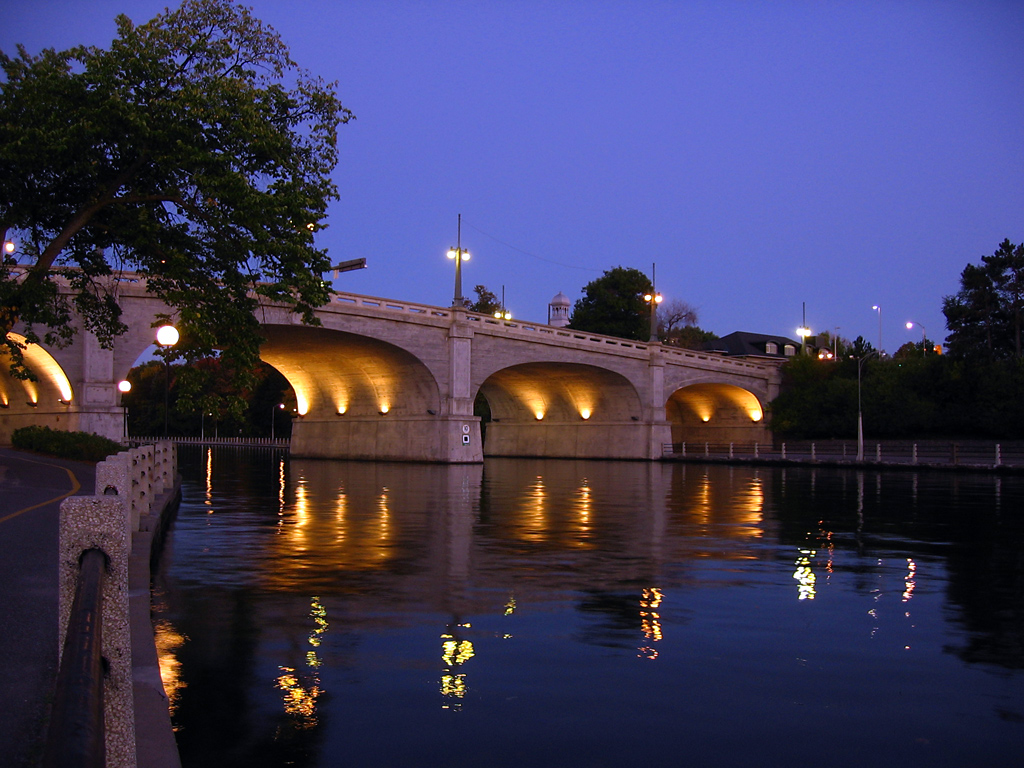
Bridge on the Rideau Canal

Even the Google logo has been altered to commemorate the 50th anniversary of the launch of Sputnik 1: the first artificial satellite. As someone who spends a very considerable amount of time thinking about how things are going to be in 2050 and 2100, it is remarkable to reflect upon both how different the world is from that of 1957 and how similar it is. The big changes that occurred have often been in areas that few if any people would have anticipated the importance of back then. Areas of great enthusiasm, such as nuclear power and space exploration, have only progressed incrementally since the 1950s and 60s.

I mentioned one Sputnik-related irony in a paper published back in 2005:

At the end of August, 1955, the Central Committee of the Communist Party approved the Soviet satellite program that would lead to Sputnik and authorized the construction of the Baikonour Cosmodrome. This facility, the largest of three Soviet launch sites that would eventually built, was the launching place of Sputnik I (and subsequent Sputniks), and the launch site for all Soviet manned missions…

This former stretch of Kazakhstani desert was also, fatefully, the place to which Nikifor Nikitin was exiled by the Czar in1830 for “making seditious speeches about flying to the moon.” He might have taken cold comfort in the fact that in 1955, the Central Committee gave control of the site to the new Soviet ‘Permanent Commission for Interplanetary Travel.’

For all the drama, it remains unclear to me that manned spaceflight serves any useful scientific or practical purpose at this point in time (see previous). In that sense, perhaps Sputnik – rather than John Glenn – was the true template for humanity’s future involvement in space: an 83.6kg ball of metal with a radio transmitter.

PS. My thesis mentions one somewhat surprising connection between Sputnik and climatic science:

A fortuitous bit of funding produced one of the most famous graphs in the climate change literature: the one tracking CO2 concentrations at Mauna Loa in Hawaii. Examining it closely, a gap can be seen in 1957, where David Keeling’s funding for the project ran out. The Soviet launch of Sputnik I on 4 October 1957 led to a marked concern in the United States that American science and technology had fallen behind. One result of the subsequent surge in funding was the resumption of the CO2 recording program, which continues to the present day.

This graph is the jagged, upward-sloping line that Al Gore devotes so much attention to near the beginning of An Inconvenient Truth.

Shake Hands with the Devil

There isn’t really any appropriate way to talk about a film like Shake Hands with the Devil (2007), given the way in which it is a recasting of a historical episode such as the Rwandan genocide. I suppose one can direct blame, as a response: at the great powers, at the United Nations, at Belgium, at the belligerents, at the genocidaires. Appropriate as that may be, the sheer appalling character of what was undertaken by human beings makes me wonder whether it would have been better if nothing in the universe had ever awoken to cognition, if all the atoms in all the rocks and stars had just interacted dumbly from the unfathomable origin of space and time to the entropic silence that will be the end of it.

One thing that is demonstrated by the experience of watching is the power of film as a medium; having read Dallaire’s book and even seen him speak, the horror was never conveyed with anything approaching the same visceral quality. In response, you can’t help but wonder what we really ought to be doing in Afghanistan now, or in Darfur.

Dr. Strangelove in a nuclear bunker

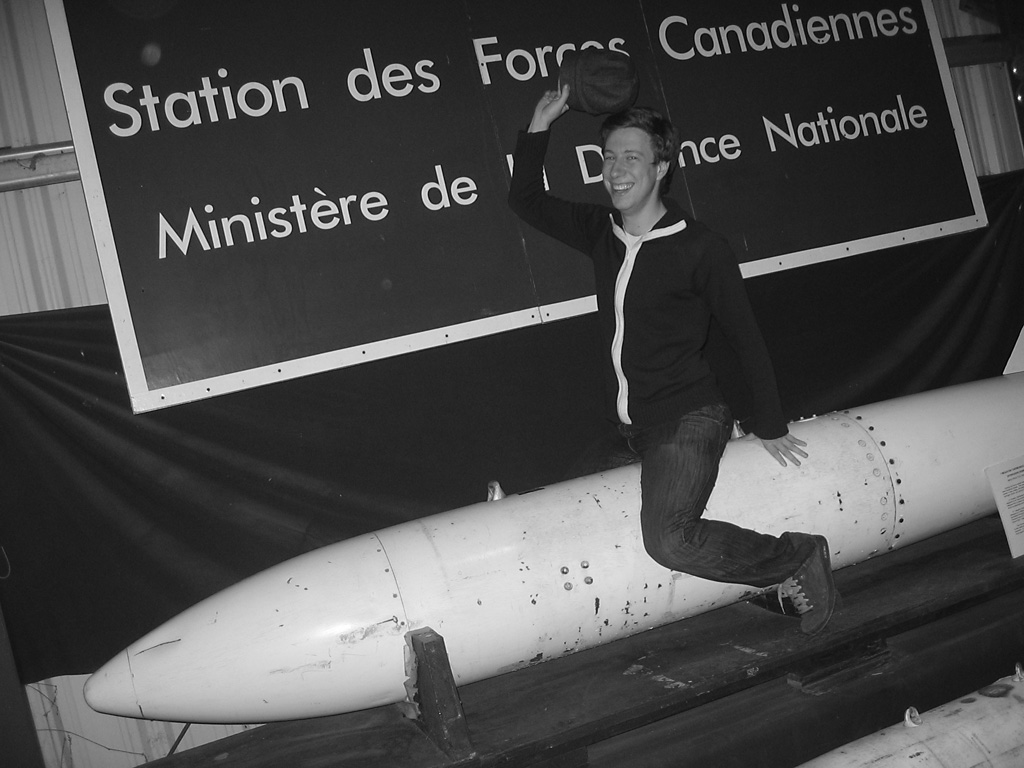
Marc Gurstein rides the bomb

After today’s orientation, I went with some friends to see Dr. Strangelove in the Diefenbunker – the infamous Canadian nuclear shelter, built to protect top Canadian military and civilian leadership in the event of nuclear war. Diefenbunker is actually a general term for shelters of the type: the one near Ottawa is called CFS Carp. Apparently, there is also one in Nanaimo, B.C. One odd thing is that the shelter has a multi-room suite for the Governor General. Presumably, Canada would not have much need for a local representative of the Queen, after the actual Queen’s entire realm is reduced to a burnt, radioactive plain.

Tonight’s film was followed up by Pho with three fellow employees of the federal government. It was all a distinct social step forward, and Ashley Thorvaldson deserves credit for organizing the expedition.

You can read about the Cold War movies events on the website of the Diefenbunker Museum.

The folly of Apollo redux

In an earlier post, I discussed the wastefulness of manned spaceflight. In particular, plans to return to the Moon or go to Mars cannot be justified in any sensible cost-benefit analysis. The cost is high, and the main benefit seems to be national prestige. Human spaceflight is essentially defended in a circular way: we need to undertake it so that we can learn how human beings function in space.

A post on Gristmill captures it well:

Let me be clear. There is a 0 percent chance that this Moon base or anything like it will ever be built, for the following reason: the moon missions in the ’60s and early ’70s cost something like $100 billion in today’s dollars. There is no way that setting up a semipermanent lunar base will be anything other than many times more expensive. That would put the total cost at one to a few trillion dollars.

Assuming that this taxpayer money needs to be lavished on big aerospace firms like Lockheed anyhow, it would be much better spent on satellites for the study of our planet (Some comprehensive temperature data for Antarctica, perhaps? Some RADAR analysis of the Greenland icecap? Some salaries for people studying climatic feedbacks?) or on robotic missions to objects of interest in the solar system.

Hired guns

I heard a lot fair amount about mercenaries when I was at Oxford, but this is the most interesting thing to happen in relation to them in decades. The degree to which war has been privatized would probably shock Eisenhower.

What remains to be seen is the degree to which the United States will respect the sovereignty of the democratic government that all the entire second Iraq war was meant to create.