Canada and Ballistic Missile Defence

Apparently, under the Harper government, there is new talk about Canada joining the American missile defence system. I believe that doing so would be unwise for a number of reasons, with the only real advantage of participation being the possibility of improved relations with the US.

Technically infeasible

The first reason to doubt the plan is that there is no reason to believe it will work. Past efforts at both theatre missile defence, the attempt to protect specific assets in a narrow geographical area, and umbrella missile defence have been failures. During the first Gulf War, the much lauded Patriot missile batteries never actually shot down a Scud – though they did shoot down two British planes by mistake. The Scud is essentially a modified V2: not exactly a modern missile.

Shooting down an ICBM is even more difficult. Lasers are infeasible given the difficulty of tracking the missile with such precision and the potential of reflective coatings and accelerated missile rotation mitigating their destructive effects. This reality is reflected in the new focus on kinetic kill systems, where a missile is meant to be used to knock the first missile apart. Of course, this risks showering the area below with radioactive fallout. Better than having a city hit, perhaps, but certainly not a good option.

There are three major stages in the flight of an intercontinental ballistic missile (ICBM) or its submarine launched equivalent (SLBM). There is a boost phase, where the missile is launched from its silo or missile tube. It is the infrared emission from the launch, as well as the appearance on radar screens, that would first alert the United States to the fact that the missile is in the air. Barring the extensive deployment of space-based weapons, it is impossible to destroy the missile at this stage. The current missile defence plans do not attempt to do so.

The midcourse stage of the missile flight is suborbital, and takes place at an altitude of 1200km. During this phase, the missile can employ a large number of possible countermeasures: electronic signal jamming; the use of decoy warheads, chaff, and flares; and the deployment of metallic balloons that interfere with radar. It would either be at this stage or during the re-entry phase – when the warhead is travelling about 4km per second or about Mach 12 – that the kinetic kill would need to take place.

Even rigged tests that have taken place so far, where the missile trajectory is known in advance, no countermeasures are used, and a beacon is actually fitted in the warhead, have not resulted in success.

Strategic error I

The supposed contemporary enemies of the United States are not ICBM type entities. Intercontinental ballistic missiles are highly sophisticated pieces of hardware. Expensive and technically demanding to produce, they also require an extensive launch infrastructure. While they seem to be increasingly within the reach of states like North Korea and Pakistan, they are definitely not available to any terrorist group.

Moreover, if the United States went to the extreme expense of building an effective missile defence system, it would remain possible to deliver a small number of nuclear weapons by other means. They could be smuggled onto fishing boats or into storage containers. Maintaining a strategic focus on stopping potential missiles with a hypothetical system only tangentially addresses the problem of nuclear proliferation.

Strategic error II

The two hostile states that do have large numbers of ICBMs are Russia and China. Russia has so many, along with SLBMs, that it needn’t be concerned about the kind of missile defence system that is being proposed. That said, it could be used as an excuse to upgrade and modernize existing nuclear forces – especially if the United States resumes the development of its own nuclear weapons, as has been proposed by this administration.

The bigger concern is China. While the exact numbers are secret, it’s probable that China has about 20 missiles capable of delivering nuclear weapons to the United States. The CIA apparently thinks that North Korea could have around five nuclear weapons. It’s hard to imagine a system that would be likely to stop five missiles, but that wouldn’t concern another state with only a small multiple of that number. Deploying missile defence might encourage China to build more missiles, begin putting missiles on submarines, begin fitting multiple independently-guided warheads upon missiles, or developing and deploying more effective countermeasures. It may, in any case, send entirely the wrong message to a state that is emerging as a larger military and industrial power.

Reasons for deployment

From the American position, there are two major reasons to deploy missile defence.

Firstly, it makes it look as though you are doing something to combat a threat almost universally regarded as very serious. This needn’t be an entirely cynical calculation. Given the incredible faith in technological progress within both the American public and the government and military, there is a belief that with enough brains and dollars, the thing can be made to work. It’s a mindset that goes along well with the notions of transformation that keep coming out of Donald Rumsfeld’s Pentagon.

Secondly, developing and building such a system will put billions of dollars into the hands of military contractors. Boeing, Lockheed-Matin, Raytheon, and the rest of them all stand to gain enormously. That has political relevance for the representatives of states where they employ a large section of the population – think of Colorado. It also has importance in a political system largely driven by multi-million dollar campaign contributions. Also, increasingly extensive direct connections exist between the military and military contractors. As such, disentangling their agendas is becoming increasingly difficult.

Potentially, some of the above could apply to Canada. If we were to join on, some contracts would doubtless flow to Canadian firms. I do not, however, think this would be a net benefit to Canada. Spending on defence industries – even if largely paid for by the United States – really doesn’t boost national welfare, at the same time as it would increase national insecurity.

The Canadian military does seem to broadly support missile defence. I can think of seven different reasons for which either the military specifically or the Canadian government generally might back the plan:

  1. The American armed forces are putting pressure on them to support Ballistic Missile Defence (BMD) plans. In some sense, this is almost certainly true. It’s worth remembering the extent to which things like a lack of strategic airlift capability make the Canadian Forces (CF) heavily dependent upon our allies, and especially the United States, in order to be able to deploy. We are also highly reliant upon their military intelligence capabilities.
  2. They are concerned that a future terrorist attack could take place through Canada. If that happened, it was seriously sour relations between the two countries, or at least risk doing so. By participating in American initiatives like missile defence, Canada could stress how we have been doing everything possible to counter terrorist threats. Support for BMD could therefore be a kind of pre-emptive damage control.
  3. The shared military culture of the United States and Canada means that both sets of armed forces are working from similar premises and using logic familiar to each. One issue here is that of non-proliferation. The Bush administration clearly doesn’t have much faith in treaty based mechanisms like the Non Proliferation Treaty (NPT) (a point made in the 5th report of the Senate Standing Committee on National Security and Defence). Do members of the CF see BMD as unlikely to undermine non-proliferation efforts?
  4. The CF sees participation in BMD as a way of maintaining or enlarging the Canadian role in North American security cooperation decision making. Given how much the Americans want to do this, we could get a lot of capital out of it for little cost. It’s worth a lot to the US just to have things look non-unilateral (think of the Iraq coalition).
  5. Strategic considerations are getting trumped by trade. Backing the Americans on missile defence is a way to keep trucks and containers flowing across the border with less trouble and suspicion. Also, Canadian defence firms with BMD related contracts in mind could have lobbied the CF to support the project.
  6. The Americans are going to set up a BMD system anyways. By participating, we at least get the illusion of sovereignty. At best, we might be able to restrain them from doing things that we really don’t want to see happen.
  7. The length of time this has been worked on has generated such a force of bureaucratic momentum that BMD was supported by default. Since the Second World War and, especially since the Cold War, military strategists have increasingly seen North America as a bloc to be defended all together. From that perspective, BMD might look obvious.

Admittedly, some of these are good reasons – at least potentially. Overall, however, I think the concept of dealing with the danger of proliferation by hiding behind a technical shield is profoundly misguided. It leaves the rest of NATO out in the cold, it encourages the development of further nuclear technology by states already so armed, and it contributes to a military-industrial complex that is already hugely expensive and influential.

On balance, I think Canada would be far better off for continuing to decline. While it might be a diplomatic faux pas, it may also be worth publicly pointing out why.

Nuclear Test Sites

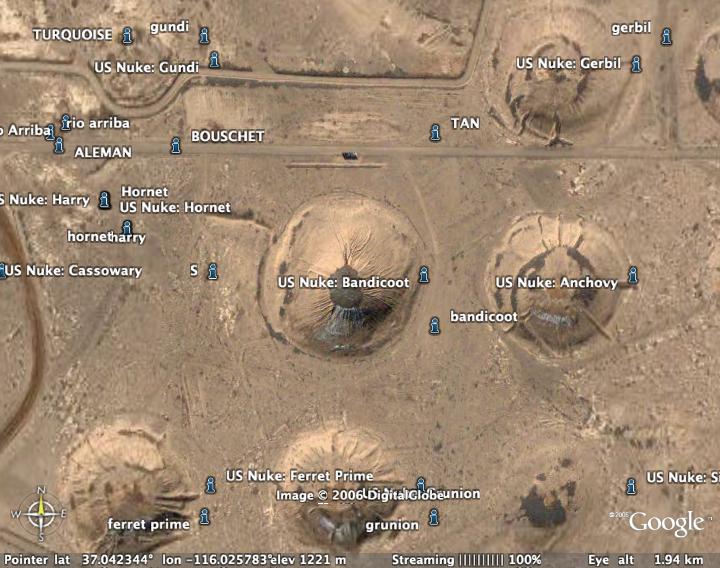
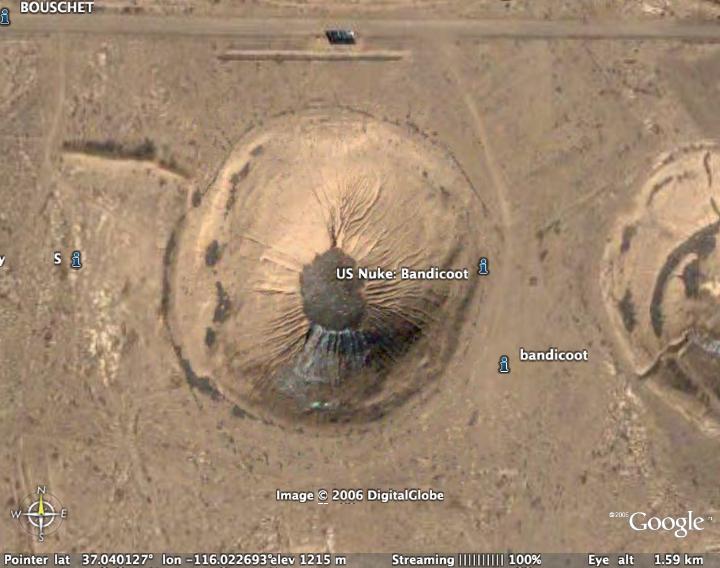
As we were both experimenting with Google Earth tonight, Neal pointed out an area in Nevada to me. You can see the crater where an atomic bomb in the 100 kiloton range was tested:

Nuclear test site

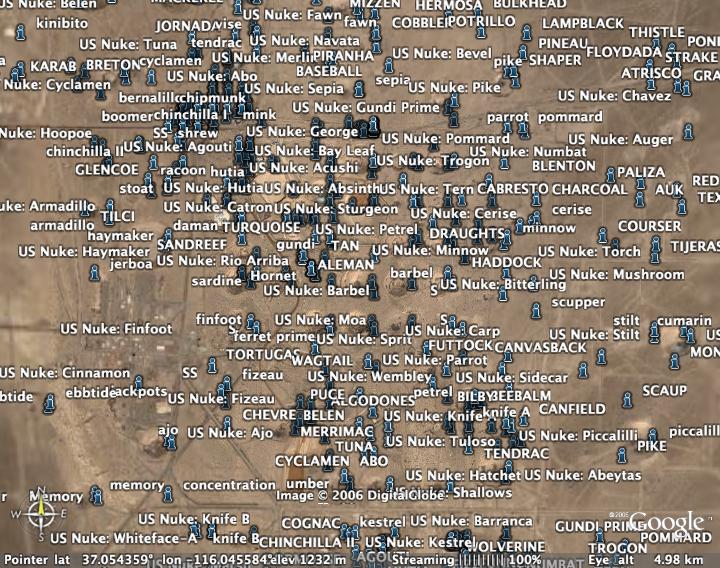
Surrounding it are more test sites:

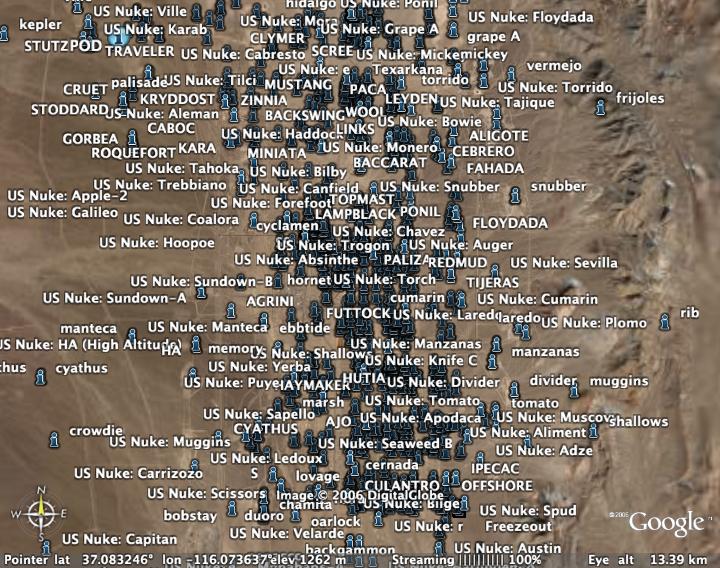
They sure felt the need to make sure these things would work:

Many test sites

It definitely makes you more certain that Eisenhower was on to something when he talked about a military-industrial complex in his farewell address:

Yet more

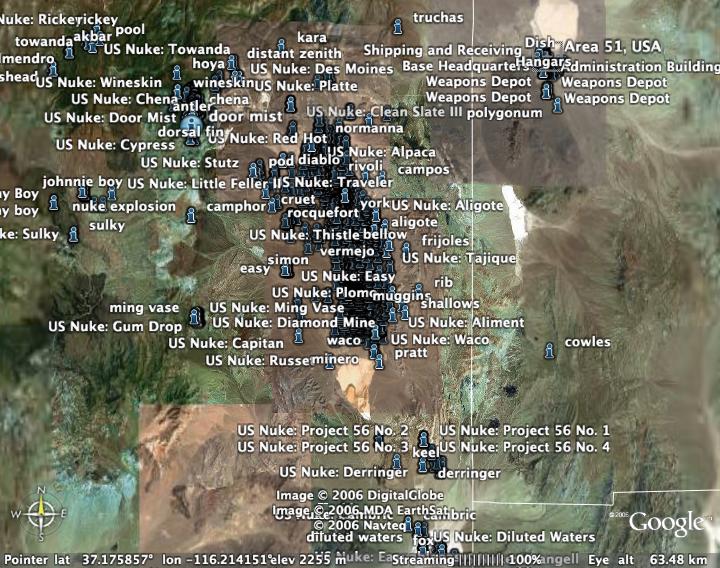
In the words of Ike: “Every gun that is made every warship that is launched every rocket fired, signifies, in the final sense, a theft from those who hunger and are not fed, those who are cold and are not clothed”

Final shot, the whole area

It really defies all belief, doesn’t it?

[Update: 5 November 2005] Here are some more of my posts on nuclear weapons.

Cause I dreamed I went to England…

St. Cross Swashbuckling

The social side of today went better than the academic. Our core seminar was little more than a tired re-hashing of entrenched positions, which didn’t really advance academic argument. It was really quite combattive. We are in the territory now where egos are defined and, frankly, not a great deal of really important work is getting done. Theory for its own sake is much less interesting than thought applied to practical problems.

After the seminar, I met a group of IR people for half priced drinks at the Duke of Cambridge, on Little Clarendon Street. Despite my haste to get to the Strategic Studies meeting, Emily furnished me with some kind of fruit cocktail concoctions. I hope her ambition to go dancing later was achieved.

The Strategic Studies election is a bit of a joke. While there are two candidates for President: Sheena Chestnut and Matt Pennycook, both from my program, I am the only candidate for Vice. I won’t need to go quail hunting with any potential donors. Nobody at all is running for Secretary, though Claire is submitting an application tomorrow. Having an exec dominated by members of the M.Phil in IR would be interesting.

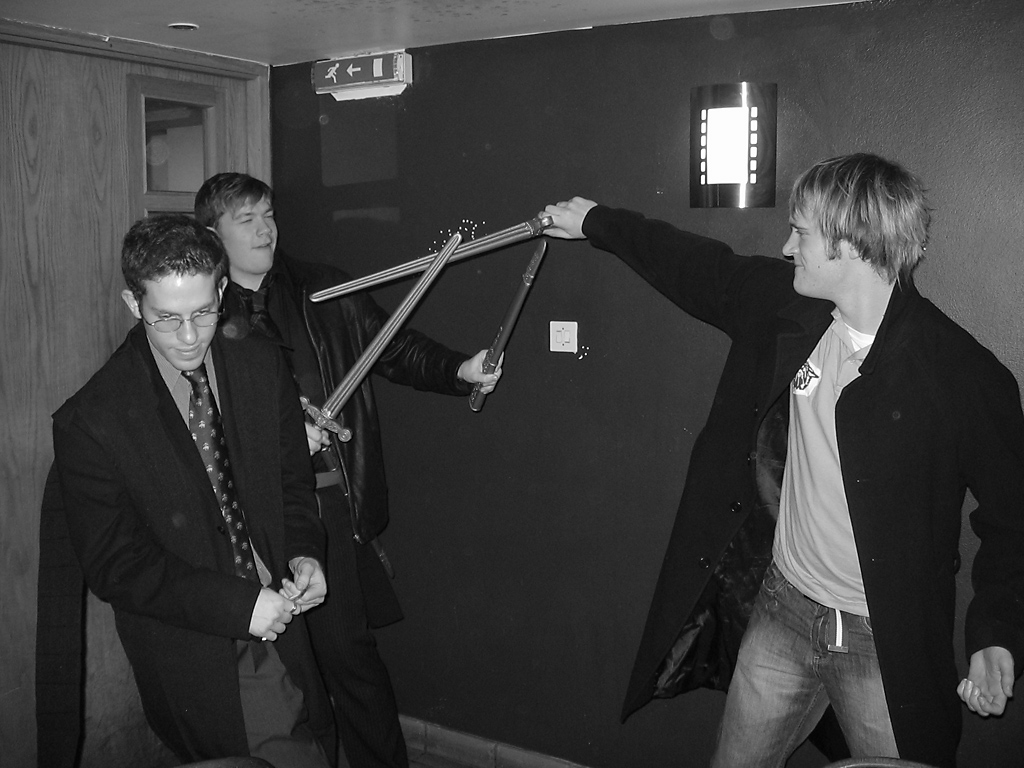
The Strategic Studies presentation itself was on China and Taiwan, and was generally reflective of the conventional wisdom on the matter. Afterwards, I went to St. Cross and met with Claire and a number of her fun friends. There was even fencing involved – both within the confines of St. Cross and outside in Oxford’s rain-drenched streets. I quite enjoy the social atmosphere at St. Cross, as well as the particular characteristics of Claire’s friends there.

Now, I should turn my attention to my complete lack of wearable clothes and the bulk of reading on constructivism to be completed for next week. Tempted as I am to grab a plane ticket to Rome and a train ticket to Turin, I should probably stay the course here. Getting a bit ahead might even help disrupt the boom and bust cycle that has been characteristic of the program thus far. As I discussed with a classmate outside the Duke of Cambridge, it seems more like we are being tested over and over than we are actually being taught specific things.

I really need to take the initiative and start reading more about environmental politics and spending time at the Environmental Change Centre. That, and spending more time with St. Cross people.

War is a Force that Gives us Meaning

This afternoon, I read Chris Hedges’ War is a Force that Gives us Meaning. It made me wonder whether the wars of my generation: Afghanistan, Iraq, and all the others, have just re-taught lessons learned by other generations before. Much as we might hope that justice or democracy can be spread by such means, it now appears that our hopes were misplaced. What’s worse, perhaps, is the failure of many to understand what’s going on, or even make an honest effort to do so. There has been an absence of inquiry and, even worse, interest in the truth of the matter or, at least, the closest approximation of the truth we can reach. Whatever else the present American administration is guilty of, it has, at many points, been dangerously unhinged from reality – at least in terms of what it presents the public. I don’t mean to take a general commentary and direct it in a cliched and partisan direction, but the world is awash in evidence that war and truth are frequently incompatible.

Similar grim revelations accompany the missed opportunities to curtail bloodshed: Bosnia, the Congo, Rwanda, and elsewhere. These are, perhaps, the strongest reminder that simple pacifism isn’t an adequate answer to the problem of war. We have to wade into the more complex, the more ambiguous, terrain of responsibility and intervention.

Hedges’ many personal anecdotes – both stories of his own and stories acquired from others over the course of a long and distinguished journalistic career – form the heart of the book. Beside them, generalized philosophical reflections about warfare, nationalism, and culture seem to be lacking in poignancy. It is the role of journalism, perhaps, to deliver that poignancy to those for whom an event or conflict is just some distant abstraction: much as the ongoing genocide in Darfur is for almost all of us now.


Citation: Hedges, Chris. War Is a Force That Gives Us Meaning. Oxford: PublicAffairs, 2002.

New plans shaping up

Inside the AshmoleanAnother expedition in the works?

My mother’s travel plans are coming together and, in a move that surprised me, she invited me to accompany her to either Greece of Malta at the end of March. In either case, we would be leaving on the 28th. After the Baltic in December, I suspect that the Mediterranean in March would make for quite a contrast. EasyJet doesn’t seem to fly to Valletta, though they do have return flights from London to Athens on the right days for less than £90. I don’t know anything about Malta, save that is discussed in John Keegan’s Intelligence in War, in the context of Napoleon landing there while being chased by Admiral Lord Nelson, prior to the Battle of the Nile. Looking through the Wikipedia entry, the place certainly has quite a history. Particularly for a country that you could walk around in a few days.

Greece, of course, I know much more about. It would be excellent indeed to see the original home of the Parthenon Marbles, which I suppose we would have to stop at the British Museum to have a look at before departing. Going to the very source of Greek food would obviously be a delight, as would visiting the setting of so much classical history and myth. The Greek option is apparently also three days longer than the Maltese.

In either case, I am really excited about the possibility of going. One of the great advantages of living in Britain is the proximity of all the rest of Europe. That, coupled with inexpensive flights from EasyJet and RyanAir, puts a really fascinating section of the world within reach.

An excellent evening

I always leave my supervisions with Dr. Hurrell in very good spirits. Today, we discussed my essay and went into quite a bit of philosophical depth. We discussed a broader reading of Hobbes than international relations theorists generally subscribe to, as well as Rawls, Rousseau, Rorty, and a number of others. Like all of the other supervisions so far, it was a really energetic discussion in which I felt strongly intellectually engaged.

Afterwards, I went for a tour through the Ashmolean with Claire and several of her roommates. Apparently, the place is to be partially torn down by summer, and then rebuilt over the next three years. As a consequence, much of the collection will be inaccessible for a long while. A good amount of what we did see was quite interesting and I should like to go back for a proper, guided tour at some point.

The Strategic Studies Group session tonight was about regulating private military firms, though the speaker only spoke about the kinds that provide direct security (whether in a combat capacity or not). Largely excluded: military contractors like Military Professional Resources Incorporated and logistics firms like Brown & Root. That said, it was quite interesting. I was suprised to learn that international humanitarian law doesn’t apply in cases where private military firms are employed by other private companies: for instance, when companies like DynCorp provide security to Shell, operating in Nigeria, or to the Saudi national oil company.

One rather unfortunate thing I learned is the the OUSSG trip to Brussels – visiting NATO Headquarters, Supreme Headquarters Allied Command Europe, and the European Parliament – is taking place between the 22nd and 24th of March: exactly when my mother will be arriving in the U.K. Perhaps I will be able to go next year. Not that I am disappointed, given the prospect of going to Malta or Greece instead. It’s just regrettable that it happened to be at the same time, especially since the trip is being subsidized by the European Parliament, such that people only need to pay for transport to Brussels.


  • This description of chemical misadventures is short, amusing, and worth a read.
  • Also amusing, some legal bluster from the malware industry, over at BoingBoing. This reminds me of the Legal Threats section at SomethingAwful.com.
  • Trivia fact: I have been wearing a pair of these Sportif Explorer Convertible Pants every day since I arrived in Oxford. As I learned in Vancouver, Italy, and elsewhere – these are a very durable article of clothing. The zip-up side pockets, profusion of other pockets, and articulated knees are all strong selling points. Next time I am in Vancouver, I am buying the fleece-lined version, which would have been nice in Tallinn and Helsinki.

Elliot Cohen and the Canadian Forces

After the today’s core seminar, I went to a Changing Character of War presentation given by Professor Elliot Cohen. Focused on examining the American military, especially with regards to counterinsurgency operations in Iraq, if offered a familiar but well expressed perspective. All the standard big issues came up: public opinion, the differences between the branches of the military with regards to the conflict, current controversies, military relations with allies, private military firms, and the rest. I asked him afterwards about the perspective he has seen on the Canadian armed forces, among those serving in the United States. His response was a typical one: that they are good people profoundly hamstrung and sapped by a lack of financial and material support. The operational tempo of the Canadian Forces has never been higher relative to its capabilities. As Allen Sens so effectively conveys in his Canadian Foreign Policy lectures at UBC: by almost any measure, both long-term procurement and short-term funding are grossly inadequate.

Right now, Canada has about 62,300 active forces personnel (the 60th largest army in the world) and it is funded at the level of $12.9 billion per year. That is 1.1% of Canadian GDP. We have 114 tanks (obsolete, in Germany), about 300 infantry fighting vehicles, and about 1000 armoured personnel carriers. The Maritime Command has four Victoria Class submarines (diesel, obsolete), three Iroquois Class destroyers, and 12 Halifax Class frigates (the backbone of the navy) – all hampered by completely inadequate helicopter support. We also has 12 Kingston Class coastal patrol vessels, used for things like search and rescue and fisheries enforcement. That is one boat per 16,840km of coastline: the equivalent of 2.38 boats to patrol the entire circumference of the earth.

In terms of airlift capability, the best we have is 32 CC-130 Lockheed ‘Hercules’ combat transports. Stripped of all other cargo, they can carry two Light Support Vehicles (ie. jeeps). We entitled the 2005 International Policy Statement: A Role of Pride and Influence in the World, but when we sent the Disaster Assistance Response Team to Asia after the tsunami, we had to rely primarily on private chartered airlift to deliver the bulk of their equipment to the theatre of operations. We do have five CC-150 Polaris aircraft, but they are incapable of carrying large equipment and lack any defensive capability. One of the five was converted into a VIP transport during the 1990s and two more are slated to be converted into air-to-air refuelling vehicles.

At present, more than 1400 Canadians are deployed overseas: more than 1000 of them in Afghanistan as part of Operation Archer. To field a force of that size, about another 8000 individuals need to be in the process of preparing for deployment or returning from one. The next largest commitment is 190 troops serving in the UN Disengagement Observer Force (UNDOF) in the Golan Heights. The next largest operations are 32 people each in the Sinai and Sudan. Of the 15 missions ongoing, five involve ten or fewer people. Eleven involve fewer than 20, according to the Canadian Forces webpage. We may have opted to put Canadian peacekeepers onto some of the new pieces of currency, but we haven’t opted to put terrible many out there in the world. In those places we have, they are often equipped at an inadequate level: the lack of armoured jeeps in Afghanistan being a notorious example.

Canada likes to maintain an international image as a helpful fixer and a leader in peacekeeping. We expect to be treated as an equal by our allies and generally considered a contributing member of the internatioal community. We take pride in backing things like the worldwide land mines ban through the Ottawa Process and the concept of the Responsibility to Protect. If that’s a role we want to play – or at least an image we want to maintain – we’re going to need to commit the necessary resources.

While it’s not particularly clear that any of the political parties running in the present electoral campaign is serious about making that commitment, it’s something that Canadians should be asking about. Whether you support the military or not, whether you support peacekeeping and other forms of international military engagement or not, it seems clear that trying to do these things on the cheap is the worst of all strategies. It endangers the lives of those serving while not producing the security which is the object of the mission. Looking at the numbers above certainly makes Stephen Harper’s plan to militarize the Arctic seem particularly wasteful of scarce resources.

On the ‘bombs and rockets’ side of IR

This afternoon, I got an invitation to attend a briefing on the final recommendations of the Bi-National Planning Group: one of the bodies that we met with in Colorado as part of the NASCA trip. Formed after September 11th, 2001, their mandate is to investigate security cooperation between Canada and the United States and make recommendations for improvements. They have been involved with projects like the Smart Border accord. While I obviously will not be able to go, I encourage the other NASCA participants to attend, if they can manage it. The briefing Dr. Baker gave us in Colorado Springs was certainly a solid demonstration of the good work that the BPG has been doing. When writing the report (PDF), I remember the BPG as an organization that received nearly universal praise. I look forward to reading their final report on enhanced military cooperation, once it gets released in May.

In a related point, I think I should start attending the meetings of the Oxford Strategic Studies Group, as I know some members of the IR M.Phil program have been doing. Much as I try to concentrate on environmental politics, the international use of force is obviously and permanently central to the study of international relations. As an IR scholar, you would never go hungry with war as your area of interest, especially since the pervasive ‘war on terror’ began. The fact that the strategic studies group meets at All Souls is also a significant point in favour of attending.

For me, environmental politics and strategic studies have a number of common factors that are appealing. They involve interaction with professionals who, as a social scientist (a term I remain skeptical about), you need to understand but not replicate. Scientists and soldiers are both fascinating kinds of people for me. They are endowed with specialist knowledge, which inevitably carries cachet for someone embedded in academia. They are also pleasantly straightforward and expected to be. That’s the reason why our NORAD / NORTHCOM briefing was so satisfying, as conversations with military people of all ranks from both countries have generally been. Speaking with Major General Lewis Mackenzie or cadets at West Point, you get the sense that they are at least making honest arguments that they genuinely want you to understand. Their apparent candour makes a nice contrast with the fiddly, theoretical bits of politics that seem to fascinate some of my friends and colleagues and that mostly just exasperate me. The same goes for scientists: whether those working at the UBC Fisheries Centre, people involved in the Northern Contaminants Program and Stockholm Convention, or others. Part of that comes from being unusually willing to admit when something is uncertain: perhaps the true mark of professionalism in such disciplines.

Another appealing commonality is the obvious possibility of making real-world improvements in both our approach to the environment and to war. These aren’t just areas that we should study for the sake of understanding better. We need to step beyond that and direct that understanding towards improvement. Again, the kinds of philosophical arguments that assert that such progress is impossible – that, in some complex way, such efforts are self-defeating – are exasperating to me. If we can significantly reduce the number of people who get malaria or AIDS, who suffer malnutrition from depleted fisheries, or who get killed by unexploded munitions, we’ve taken concrete steps towards a more just, more preferable world. Ultimately, that’s what I want to be a part of.

The Lesson of the Tallinn Occupation Museum

Prison cell door

One lesson you cannot help taking away from the Occupation Museum in Tallinn is that the protection of individuals from government is one of the most essential kinds of security. This is a point that is being completely missed in a wide variety of circumstances, especially as it relates to the so-called “War on Terror.” The question is not whether the government can protect citizens from terrorism, but what the ultimate balance of risks should be. Perhaps giving powers for increased surveillance or ease of detention decreases the likelihood of suffering a terrorist attack, though that is by no means proven. What it certainly does is increase the danger of the arbitrary and unjust use of force against civilians.

Given the enormous power and resources of government, the danger that it is capable of posing to citizens is extraordinary. That is why governmental accountability is absolutely essential. All power entrusted to government simply must be granted in conditional fashion: subject to revocation should it be abused. In turn, the only way we can be aware of the presence or absence of abuse is through public, civilian oversight. Government cannot be trusted to regulate itself, because to do so it to instantly accept a kind of de facto tyranny. Without knowing what is being done, supposedly on our behalf, we run the risk of being subjected to unjustified and difficult to reverse power grabs. There is almost incontrovertible evidence that this has taken place, in almost every developed country, since September 11th. Once again, this point is largely being lost in political debate in the west. As I wrote in the the NASCA Report (PDF), submitted to the Canadian Department of National Defence:

Maintaining openness about the measures being put in place, as well as allowing independent examination and discussion of both threats and responses, is a crucial mechanism for ensuring that an appropriate balance is being struck on matters of security. It is worth recalling that security is always a trade-off: with costs of various kinds rising to greater or lesser degrees as safeguards are created. For those safeguards to be a justified and legitimate part of a democratic society, they must be subject to public awareness and scrutiny. (21)Protection of the individual from unreasonable or arbitrary power – in the hands of government and its agents – is a crucial part of the individual security of all citizens in democratic states. While terrorists have shown themselves to be capable of causing enormous harm with modest resources, the very enormity state power means that it can do great harm through errors or by failing to create and maintain proper checks on authority. (25)

While it’s personally satisfying to have presented a document including such sections to policy makers, I have no way of knowing whether it will ever be taken seriously.

Looking at the photographs above, affixed on the inside of one of a whole line of doors from secret prisons formerly operating in Estonia, drives home the the point of human vulnerability contrasted with the facelessness of power. It’s an image that should stick in our minds when we are choosing to confer legitimacy upon governments, or seeking to withdraw it.

First Cowley Road foray

Margaret and books, Cowley Road

Today was refreshing. I took a walk to Cowley Road with Margaret and was excited by what I saw: intriguing looking ethnic restaurants, the brewery where the Hobgoblin Ale enjoyed at the bloggers’ gathering is made, as well as plenty of bike shops, used book stores, and small grocery stores. I am not sure whether my initial comparison to Commercial Drive is an accurate one. The balance between businesses is quite different (though the profusion of relatively inexpensive barber shops has rekindled hopes that my hair will soon return to a manageable length). The not-inconsiderable distance from Wadham to the area has made me think again about getting a bicycle. They had some used ones available for about eighty quid. I am not sure how much it would cost to have my bike in Vancouver sent by the cheapest form of surface mail, but that is worth looking into as an alternative.

Today also involved a lot of non-academic reading. I read a very interesting thesis about how John Walker – a spy in the American Navy – conducted an incredibly effective espionage campaign on behalf of the Soviet Union over a period of years. In particular, it is illustrative of the kind of huge security failures that can take place when there is inadequate communication between different agencies, as well as excessive secrecy applied in the wrong places. I also read from Terry Pratchett’s Wyrd Sisters, which Nora passed on to me when she found out that I was reading the sequel: Witches Abroad.

I also purchased the Philip Pullman edition of Paradise Lost and read the introduction and first two books. Reading Book II to Nora the other day reminded me what an engaging and enjoyable poem it is, and how worthwhile it will be, in the long run, to have a nice copy. The only bits I have a recall particularly well are the second book and the invocation to the Muse. I am not entirely certain of whether it is the right sort of reading material to mark out the spaces between stats and the study of international history in the interwar period. In the end, though, what could go wrong?

I called Lindi this evening to wish her a happy birthday. It was good to speak with her. She is still working on research for NASA, though her boss is apparently doing classified work for the Department of Homeland Security, as well. In ages of the world long past, Lindi and I were lab partners for Biology 10 – back at our mutual high school. When I was in first year, she lived in the tower adjoining mine in the Totem Park complex at UBC. She had considerable skill at playing the piano, as well as miraculous abilities of cooking better food than the cafeteria could offer, using only a miniature fridge and a toaster oven. Despite the fact that we share an enthusiasm for tramping about in the wilds of British Columbia, I can’t remember a time when we actually managed to do so together.


Surrounded, for the second night in a row, with the bursting and banging of fireworks and self-charged with the role of reporting on life in Oxford, I set out to find Guy Fawkes Night. I should have known better. I began heading southward, down Cornmarket and then St. Aldates, across the Folly Bridge and down Abingdon Street. I was following the boom and flash of explosions that always seemed about a kilometre and a half away: due South. 

What I realized, eventually, is that that Guy Fawkes Day is a decentralized holiday. My efforts to find it fared no better than the efforts of Bilbo and the dwarves in The Hobbit to crash the forest party of the elves. Guy Fawkes Day happens all around, but nowhere where people really congregate – at least, nowhere I could find. Several times, once I was about three kilometres out of Oxford, I passed a field from which a huddled group let forth a few volleys of fireworks, but there were no bonfires to be found and nothing with the appearance of a thing that a stranger can just wander into.

This is the antithesis of Vancouver’s Symphony of Fire: in which enormous masses of people congregate in the same place to watch a large, centrally provided show of pyrotechnics. It’s a different kind of community in Vancouver, I suppose: one too large for an individual to play a role in defining, but one inclusive enough that it can just roll along, adding new people to its bulk.

All that said, the night is yet young – the JCR bop that is to occur tonight hasn’t even begun, though I already have a good sense of what it will involve. Despite the very heavy police presence that Friday and Saturday nights seem to bring to the centre of Oxford, it can be an extremely rowdy place. Not in the sense of violence, but rather extreme noisesomness and general low-level harassment of passers-by.

And in luxurious cities, where the noise
Of riot ascends above their loftiest towers,
And injury and outrage: and when night
Darkens the streets, then wander forth the sons
Of Belial, flown with insolence and wine.
(PL I:498) 

Perhaps, with the passage of a bit more time, I will make another attempt to locate a Guy Fawkes bonfire. It would definitely help to have some inside information from a longer-term resident than myself. Likewise, it would be good to have someone to explore with. The cluster of people with whom I’ve spent the bulk of my time is really very small, and I soon begin to feel guilty for imposing upon them. I must widen my circle of social acquaintances, so as not to excessively press myself upon any of them.

PS. Here is an interesting video (Quicktime) of what you can manage if you are bold enough to attach a Mac Mini driven projector to the side of a Berlin subway car.

I fought the law and… did fairly well, actually

Out for drinks with ITG

Today was mostly marked with good news. The Justice of the Peace who adjudicated my Translink case gave me a very considerable reduction in my fine: from $173 to a much more manageable $15. After the very brief court appearance, I spent a few hours reading The Economist and then having sushi for lunch with my father, near his office. When I got home, I was pleased to find a letter from the domestic bursar at Wadham College informing me that I’ve been granted a room for next year within the main complex of the College. I will be living in the Library Court, immediately above the College library. As my mother suggested, perhaps this will save the the discomfort of lugging a bicycle across half of England.

The one piece of bad news so far today relates to the fish paper. As E.D. Brown said in an email today:

Our referee was fairly positive about your paper though he felt that it could have been more tightly focussed and had a tendency to wander off into related regions/theories. He also noted that it was based on only a handful of secondary sources. Despite these observations, we might well have accepted your paper had it not been in competition with a significant number of other papers. 

Reading it, the vision of an academic life that has been coming into tighter and tighter focus over the last few months wavered a bit. I am still hopeful that some journal can be found that will be willing to publish it. I always thought it more than a bit ambitious to submit it to Marine Policy in the first place, given my position as an interested neophyte in the subject area.

Last night, Fernando and I hammered together the version of the NASCA report which has been passed on to Allen Sens. It has been duly titled: “Common Threats, Shared Responses.” That’s partly to highlight our determination to make constructive criticisms rather than simply anger them with out uncomfortable undergraduate convictions.

In an hour, I am to meet with ITG – partly to discuss the future of the fish paper and partly as a sendoff. I am looking forward very much to the party on Saturday evening, as well as the hike on Friday morning. Alison and Ashley are both on board for the latter, with thoughtful messages from a few others who had to decline to participate.


Having a conversation and a drink with Ian was interesting, as always. Hopefully, he and Daniel Pauly will find some journal willing to publish the fish paper – once I have appropriately modified it for them. He has, in any case, been brought into the rolls of those who have official knowledge of the blog.


Departure in seven days.