Israel’s trilemma

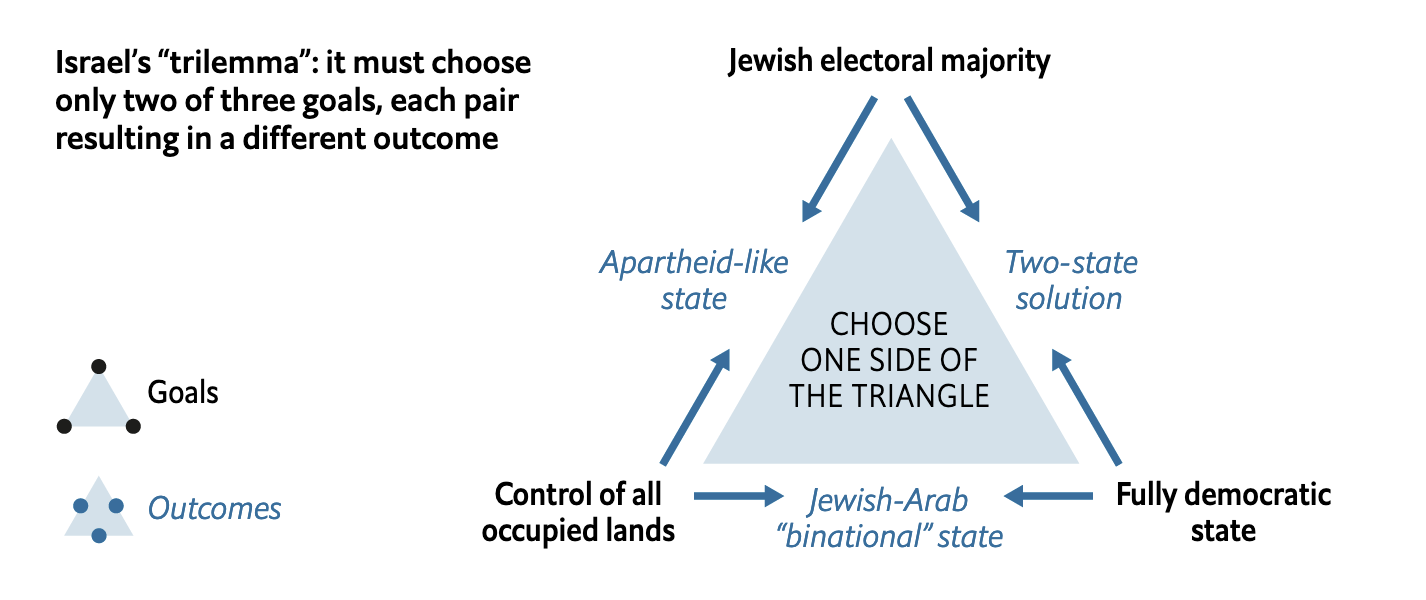
The Economist created a graphic illustrating how Israel must choose between three objectives, without being able to achieve all three at once and with objectionable features arising from choosing one pair over the other options:

They need to make some choice between giving up occupied land, ceasing to have a Jewish electoral majority, and being a fully democratic state.

Prime Minister Benjamin Netanyahu’s recent comment that Israel is the homeland “only of the Jewish people” suggests that this government at least is willing to prioritize continued occupation and a Jewish majority over equal treatment of all citizens.

Shuttle lesson: no crew capsule on the side designs

Of course, the Columbia and Challenger accidents have reminded us we need to be ever vigilant. Despite more than two years of careful work to prevent foam shedding from the shuttle’s main tank, my STS-114 mission lost a large piece of foam on ascent, in a circumstance very similar to what happened to Columbia on STS-107. Preventing foam loss was a top objective for the return-to-flight effort, and while this turned out to be an embarrassment, I believe it sent a clear message—future boosters and spacecraft should be designed to protect the ship’s reentry system (the heatshield) because rockets will always shed “stuff” like insulation and ice during the tumultuous minutes of ascent to orbit. This is why we will see future spacecraft designed with the reentry ship on the top of the rocket, rather than beside it, as was the case with the space shuttle. The STS-114 incident was a very sobering reminder that a complex system like the shuttle can never be made completely safe, despite everyone’s best efforts. Our future space travelers will be safer due to the lessons learned from the shuttle missions.

Leinbach, Michael and Jonathan Ward. Bringing Columbia Home: The Untold Story of a Lost Space Shuttle and Her Crew. Arcade Publishing; New York. 2018. p. 294

Soufan on the ineffectiveness of torture

After [redacted by the CIA] left, Boris had to keep introducing harsher and harsher methods, because Abu Zubaydah and other terrorists were trained to resist them. In a democracy such as ours, there is a glass ceiling on harsh techniques that the interrogator cannot breach, so a detainee can eventually call the interrogator’s bluff. And that’s what Abu Zubaydah did.

This is why the EIT [Enhanced Interrogation Technique] proponents later had to order Abu Zubaydah to be waterboarded again, and again, and again—at least eighty-three times, reportedly. The techniques were in many ways a self-fulfilling prophecy, ensuring that harsher and harsher ones were introduced.

Cruel interrogation techniques not only serve to reinforce what a terrorist has been prepared to expect if captured; they give him a greater sense of control and predictability about his experience, and strengthen his resistance. By contrast, the interrogation strategy that [redacted] employed—engaging and outwitting the terrorist—confuses him and leads him to cooperate. The art of interview and interrogation is a science, a behavioural science, and [redacted] were successful precisely because we had it down to a science.

Evidence gained from torture is unreliable. There is no way to know whether the detainee is being truthful, or just speaking to either mitigate his discomfort or to deliberately provide false information. Indeed, as KSM, who was subjected to the enhanced techniques, later told the Red Cross: “During the harshest period of my interrogation I gave a lot of false information in order to satisfy what I believed the interrogators wished to hear in order to make the ill-treatment stop”.

Soufan, Ali H. The Black Banners: The Inside Story of 9/11 and the War Against al-Qaeda. 2011. p. 423

The CIA holding out on the FBI before 9/11

The [redacted by the CIA] picture [of Khallad, alias of Walid bin Attash] had been in the CIA’s possession when Steve Bongardt and the Cole team had been shown the [redacted] three pictures on June 11, 2011. If it has been shown to the Cole team, Steve and the other agents would have identified the man in the picture as Khallad. We knew exactly what Khallad looked like from the Cole investigation. And if we had learned that the CIA had had a picture of Khallad in June 2001, and had been monitoring him, we would have gone straight to headquarters saying that the CIA had lied about not knowing about Khallad, and we would have demanded that they hand over the information.

If that had happened, at a minimum, Khalid al-Mindhar would not have been allowed to just walk into the United States on July 4, 2001, and Nawaf al-Hazmi, [Mohammed] Atta’s deputy, would have been arrested. At a minimum.

Soufan, Ali H. The Black Banners: The Inside Story of 9/11 and the War Against al-Qaeda. 2011. p. 296

Knowledge and interrogation tradecraft

While I was in the United States, I received an urgent call from [assistant U.S. attorney David] Kelley. “Ali, you need to get to Yemen right away,” he said. “We’ve finally signed the agreement with the Yemenis allowing us to interrogate [Jamal al-] Badawi, but there’s no one who can interrogate him.”

“What about Bob and George?” I asked, “They’re both first-class interrogators and are capable of handling the interrogation.”

“They can’t,” Kelley replied. “The Yemenis gave their own interrogation reports to our team, and Bob, George, and everyone else read it.” I understood the problem: a person reading the existing interrogation report would not know how the Yemenis had conducted their sessions—whether they had used reliable methods or had obtained information by torturing the detainee, for example. But the information would be in their minds, affecting their questions and their judgment, and thus any information gained would be potentially tainted and unreliable. It’s a risk we were not prepared to take, as it could jeopardize the prosecutions. “You’re the only team member who hasn’t read the report,” Kelley added.

“Okay,” I said, “I’ll leave as soon as possible.”

“Whatever you do,” he added, “don’t read anything about Badawi from the Yemenis before you interrogate him.”

Soufan, Ali H. The Black Banners: The Inside Story of 9/11 and the War Against al-Qaeda. 2011. p. 222

Control in an interrogation

An interrogation is a mind game in which you have to use your wits and knowledge of the detainee to convince or steer him to cooperate, and essential to this is to show that you are in control. If a suspect thinks that you lack knowledge of what he’s talking about or sees that you are flustered, enraged, or pressed for time—these would be signs that he was winning and shouldn’t cooperate. We kept the fake smiles plastered on our faces and let Abu Jandal speak.

Soufan, Ali H. The Black Banners: The Inside Story of 9/11 and the War Against al-Qaeda. 2011. p. xvi

Aimen Dean on “How to win”

As Labib al-Nahhas, a senior and moderate voice within the Syrian Islamist group Ahrar al-Sham, put it: ‘The Islamic State’s extremist ideology can be defeated only through a home-grown Sunni alternative — with the term “moderate” defined not by CIA handlers but by Syrians themselves.

Moderate imams — whether in the community or visiting prisons — are not going to impress young men already halfway to jihad. Islamic academics and theologians cannot alone formulate counter-messaging against al-Qaeda and ISIS. They don’t understand what makes these groups tick.

To make an impact, to chip away at the certainty which binds such groups, requires us to recruit respected Salafi fundamentalists, men whose ideological outlook is close to that of the terror groups but who eschew their violence. Men who have already travelled that route and then seen a better way can be precious allies. They can help detect and disrupt radicalization; they can help rehabilitate those either tempted by or convicted or conspiracies. But they have to be credible, and their work can only flourish in a society where tolerance and diversity are championed. A rise in hate crimes; a resurgence of the far right on both sides of the Atlantic; a sense that police don’t afford equal protection to all; discrimination in the workplace — these are just a few of the factors that will undercut any efforts to counter radicalization. There’s a great danger that in Europe, maybe even in the United States, too, Islamist and right-wing extremists will feed off each other in a vicious cycle.

Dean, Aimen with Tim Lister and Paul Cruickshank. Nine Lives: My time as the West’s top spy inside al-Qaeda. 2018. p. 398

Jihadism from frustration with politics

Sadly, many Muslims would subscribe to this perspective [of Islam in conflict with the rest of the world] rather than acknowledge the crisis within Islam. They think the conflicts ravaging their lands stem from a Western conspiracy to steal their natural resources. So perfidious is that conspiracy that many Muslims even blame terror attacks in the West, from 9/11 to the November 2015 gun rampage in Paris, on the CIA and Mossad. They interpret these attacks as wicked plots to put Western boots on the ground and drones in the air across the Middle East.

This persecution complex is the outgrowth of a sense of hopelessness among millions who see their lives are bereft of opportunity and their social environments as stacked against them. They think politics is useless and, unable to change the system, they set out to smash it. Muslin states are home to a proliferation of non-state actors because the state is held in contempt, is corrupt and frequently oppressive. Jihadism has become the Muslim version of anarchy — on steroids.

Dean, Aimen with Tim Lister and Paul Cruickshank. Nine Lives: My time as the West’s top spy inside al-Qaeda. 2018. p. 382–3

Blown by Cheney’s office

‘So let me get this right,’ I said. ‘I am one of less than a handful of people working inside al-Qaeda for Western governments. I have identified senior leaders, was on the inside of plots in Bahrain, Saudi Arabia, and provided the only intel you have on al-Qaeda’s WMD programme. And in my spare time I tracked networks here in England, a job that’s more urgent now.

‘And MI6 thought my work was so important that you shared it with the CIA, which then took it to the White House, which then gave it to a journalist. Which means you now have one fewer than a handful of agents inside the world’s most dangerous terrorist group.’

It was useless. I knew MI6 was not responsible for the leak; there was a bigger play going on. The British liked to show the US they punched above their weight, still brought gold to the table, still knew how to deploy and gather human intelligence better than anyone. In the process, they shared information that was thrown into the roulette wheel of leaks and spin for which the US government was notorious.

Dean, Aimen with Tim Lister and Paul Cruickshank. Nine Lives: My time as the West’s top spy inside al-Qaeda. 2018. p. 322

saganangst — fear of nuclear war, and particularly nuclear winter

We live under constant threat of sudden destruction via nuclear war. It wouldn’t take that many warheads falling on major cities to darken the atmosphere — making the consequences of even a regional exchange (or the payload of a single ‘boomer’ sub) global, and potentially a threat to the integrity of human civilization. The control systems carry a frightening risk of malfunction, particularly in a crisis when nuclear-armed forces may be out of communication with higher level command and at immediate risk of nuclear attack.

The only safe option is to disarm as a global community — spare everyone the costs of the nuclear arms complex, while greatly diminishing the total severity of potential wars.