Taiaiake Alfred’s first scholarly book Heeding the Voices of Our Ancestors: Kahnawake Mohawk Politics and the Rise of Native Nationalism is available as a free PDF through his blog.
Category: Books and literature
Discussion of books and other literature
The Looking Glass War
I picked up a library copy of John le Carré’s The Looking Glass War because all my own books were in moving boxes, and to begin re-habituating myself to intensive reading in the lead-up to my comprehensive exam in August.
The novel is what you would expect from le Carré: not sensationalized, conveying a sense of awareness about realistic tradecraft. The characters aren’t much differentiated, but the writing is very good and the book seems like a nice counterweight to the sensationalism of the general espionage genre. For instance, there are a number of detailed passages about the inconveniences of operating a WWII-era radio using Morse code. The bureaucratic turf war that forms the primary motivation for the action in the novel seems depressingly realistic.
To sum up: it’s a reasonably interesting quick read which provides the sense of a brush with realism that distinguishes le Carré from other writers in the genre.
Illuminated text
New commercial photographic work: manuscript pages from the 12th – 16th centuries
University of Toronto comprehensive exam in Canadian politics
My classmate Emma assembled many recent examples of the U of T major field examination in Canadian politics.
The exam will be based on these sources.
I can either write the exam on May 23rd or August 22nd.
Books to read and understand by August 23rd
238 items in all, this is a draft list of texts for my forthcoming comprehensive examination in Canadian politics.
I can’t help noticing that it was typeset in LaTeX.
“Star Wars civilization”
Humanity today is like a waking dreamer, caught between the fantasies of sleep and the chaos of the real world. The mind seeks but cannot find the precise place and hour. We have created a Star Wars civilization, with Stone Age emotions, medieval institutions, and god-like technology. We thrash about. We are terribly confused by the mere fact of our existence, and a danger to ourselves and the rest of life.
Wilson, Edward O. The Social Conquest of Earth. (New York: W.W. Norton, 2012) p.7 (hardcover)
Matthew 25:29

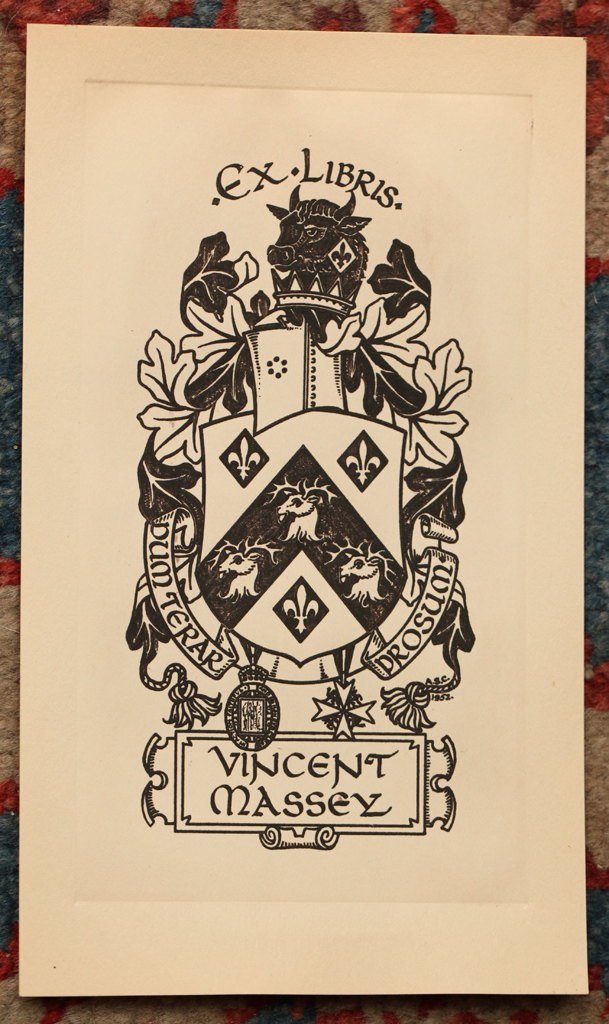
Ex Libris – Vincent Massey
Intrigue
From Kipling’s Kim:
“It was intrigue,— of course he knew that much, as he had known all evil since he could speak,— but what he loved was the game for its own sake — the stealthy prowl through the dark gullies and lanes, the crawl up a waterpipe, the sights and sounds of the women’s world on the flat roofs, and the headlong flight from housetop to housetop under cover of the hot dark.”
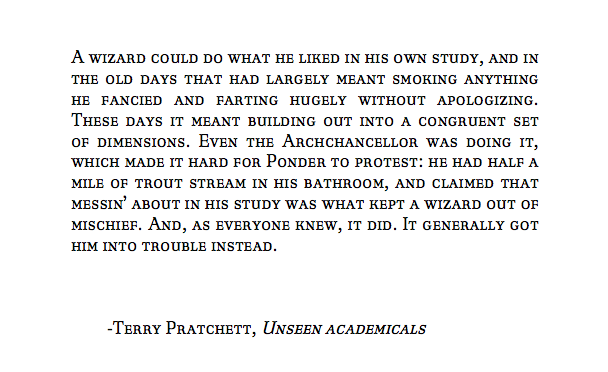
Pratchett on the privileges of wizards