
Writing for The Green Student, Eunice Lao has written an article about the fossil fuel divestment movement at the University of Toronto. It mentions the ‘Toronto Principle‘.
Category: Canada
Anything related to Canada or Canadians
Naviger’s Barn Raising
My friend Andrea Simms-Karp – whose excellent previous albums include Sleeper and Hibernation Nation – has a new album available to stream for free or download for whatever price you choose: Barn Raising.
All the tracks feature her impressive vocals, most are her songwriting, and I have been enjoying it thoroughly. I especially like “Dolly Cassette“.
Divestment and “The Toronto Principle”
An article in The Harvard Crimson focused on the recent report of the president’s divestment committee at U of T:
Last December, a committee at the University of Toronto released a report on the issue of divestment, drawing a clear line by aligning itself with the needs of the Paris agreement. It recommended that the university not finance companies whose “actions blatantly disregard the international effort to limit the rise in average global temperatures to not more than one and a half degrees Celsius above pre-industrial averages by 2050…These are fossil fuels companies whose actions are irreconcilable with achieving internationally agreed goals.”
Hopefully, this principle will be re-affirmed when President Gertler makes the final decision. We expect that at the end of March.
PhD proposal progress
I have come across a lot of exciting material for my PhD project in the last few weeks. Documents like the papal encyclical Laudato Si raise interesting questions about the connections between the faith community’s involvement in the effort against climate change, anti-capitalism, and the moral contemplation of the environment. For instance, there are interesting parallels between this theological interpretation of biodiversity loss and ‘deep’ ecology in which nature is considered valuable for its own sake and not only for human purposes.
Another encouraging development is the universal enthusiasm for the project. I have discussed it with experts in faith and aboriginal communities, people at Massey College, committee members and potential supervisors, people at parties, environmentalists, journalists, and civil servants. People are sometimes skeptical about whether it will prove logistically feasible to talk to so many people and follow the routes of two phantom pipelines, but nobody has argued that the project is not worth trying.
Once the Community Response to the ad hoc committee on divestment’s report has been assembled, my top priority will be the creation of a major new version of my proposal for circulation to committee members and potential supervisors.
“Sanctuary” in the snow

U of T ad hoc committee recommends divestment
The presidential committee at the University of Toronto just recommended divestment!
They lay out criteria for excluding stocks based on their climate change impact and “recommend… that the University of Toronto instruct its investment managers to divest immediately” from such holdings.
They specifically identify ConocoPhillips, ExxonMobil, the Peabody Energy Corporation, Arch Coal Inc., Alpha Natural Resources LLC, Cloud Peak Energy, and the Westmoreland Coal Company for divestment.
Look for more information on this in the hours ahead from UofT350.org and Toronto350.org.
Responses to the Paris Agreement
A bit of what I have seen online so far:
- Grand promises of Paris climate deal undermined by squalid retrenchments — George Monbiot
- James Hansen, father of climate change awareness, calls Paris talks ‘a fraud’
- Why James Hansen is wrong on COP21
- Paris climate deal: nearly 200 nations sign in end of fossil fuel era
- Elizabeth May: Canada was ‘hated’ for its inaction on climate change
My quick take: there is lots to be disappointed about in this agreement. Targets aren’t legally binding. Indeed, the agreement text seems far too aspirational in many places. I can’t help but feel that an international agreement on trade or defence would include more concrete measures for effective implementation. It’s also objectionable that the agreement seeks to prohibit people harmed by climate change from suing those who are causing it for damages.
Even if fully implemented, this text doesn’t do nearly enough to prevent catastrophic climate change. That being said, having an agreement endorsed by so many parties — and which does include mechanisms for increasing ambition over time — makes me a bit more hopeful that this problem can ultimately be resolved.
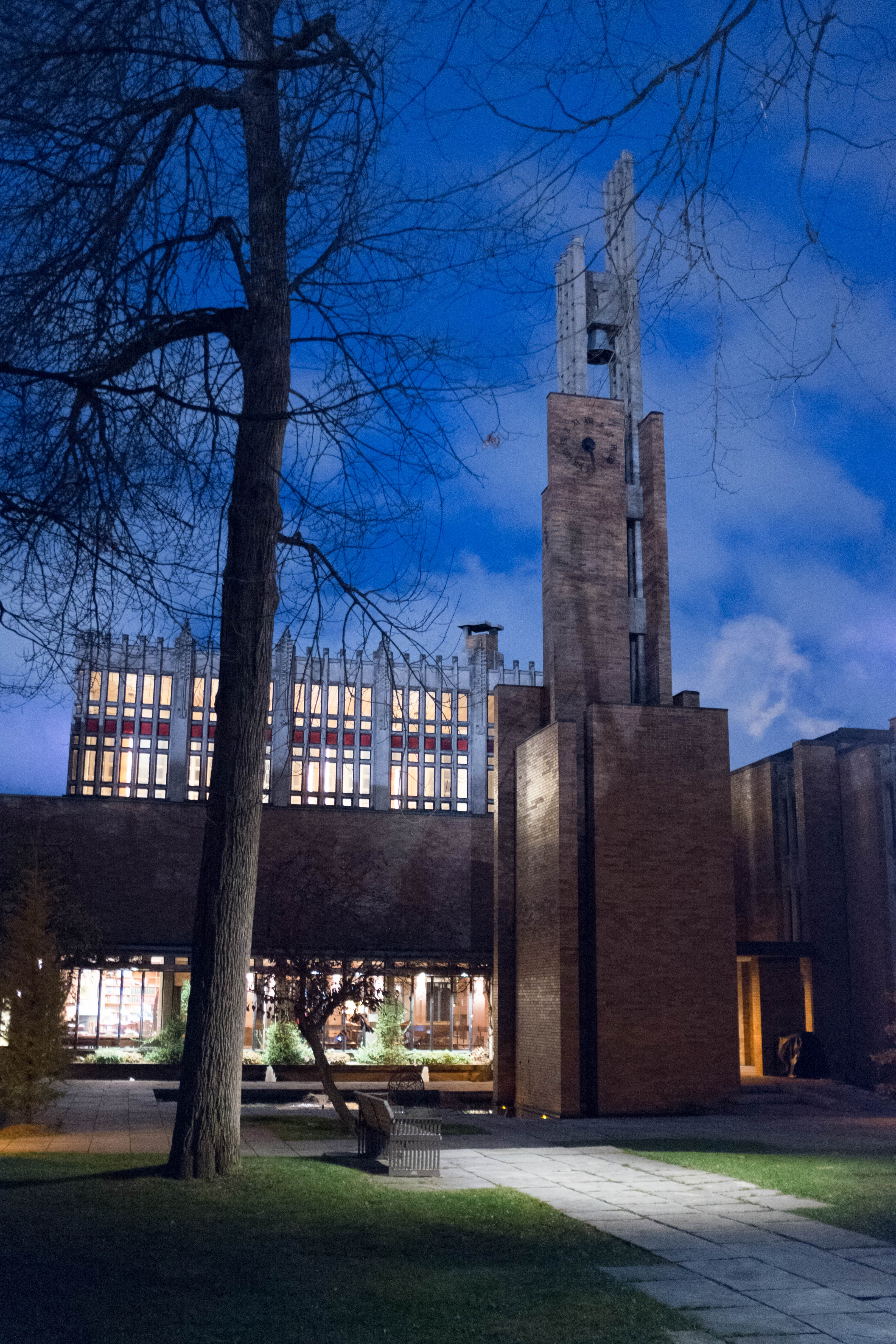
Massey College in November
Alberta’s 2015 climate plan
There’s a mass of news coverage and punditry about Alberta’s newly-announced pre-Paris climate change plan:
- Alberta’s climate change strategy targets carbon, coal, emissions
- Alberta gives the oilsands a climate change deal it can live with
- Alberta’s climate-change plan: Breaking down the numbers
- Alberta pitches a big-bang climate plan: With carbon taxes and phase-outs, the game in Alberta has totally changed. What will it mean for Albertans?
- Bending the Curve: Alberta’s Tectonic Shift in Climate Policy
- Alberta’s New Climate Plan Is Historic, But It’s Not Enough
To me, this seems like a useful step forward: an acknowledgement that Alberta must act to curb climate pollution and that fossil fuel expansion cannot continue forever.
That said, this is all happening late. We should have stopped expansion decades ago and by this point jurisdictions like Canada with high GDP per capita and very high GHG pollution per capita should be on the downslope of cutting back aggressively.
Climate Welcome photos
350Canada.org has organized a four day direct action in Ottawa, calling on the new government of Justin Trudeau to commit to strong climate action before the UNFCCC negotiations in Paris later this month.
I came over to take photos and learn more about how climate activism in Canada is developing.