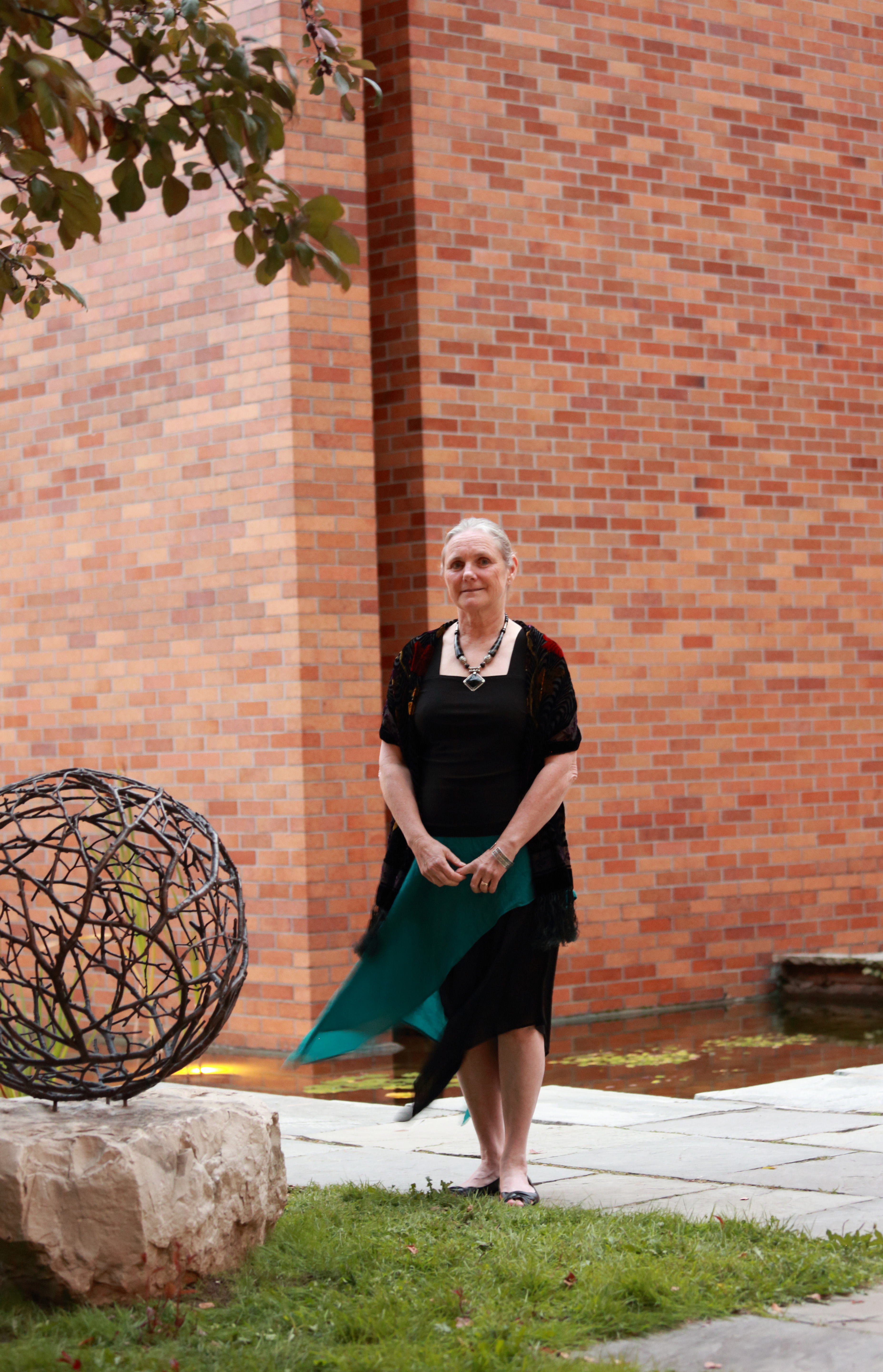
“It is a globe of simple branches.
It represents canopy and the trees that surround and protect the globe, the Earth.
Cast in bronze, it demonstrates the strength of the canopy, while the delicate twigs expose its more fragile nature.”
climate change activist and science communicator; photographer; mapmaker — advocate for a stable global climate, reduced nuclear weapon risks, and safe human-AI interaction

Anything related to Canada or Canadians
“It is a globe of simple branches.
It represents canopy and the trees that surround and protect the globe, the Earth.
Cast in bronze, it demonstrates the strength of the canopy, while the delicate twigs expose its more fragile nature.”
A key part of what makes CBC’s The Current so worthwhile to listen to is the interviewing ability of Anna Maria Tremonti, who manages to be appropriately skeptical and demanding with public figures but who can also demonstrate remarkable insight and compassion when interviewing people with difficult stories to tell.
Her recent segment with bipolar ex-Olympian Suzy Favor Hamilton is an excellent example of what I mean: Olympian-turned-Vegas escort Suzy Favor Hamilton shares her story.
The segment also made me want to order Kay Redfield Jamison’s An Unquiet Mind: A Memoir of Moods and Madness.
I was hired to photograph the launch of Massey College historian Judith Skelton Grant’s book: A Meeting of Minds: The Massey College Story.
The book contains at least two of my photos. There is one of a Massey dinner which I have also made into a mosaic, used as a two-page spread for the front end paper, and one of the college in the snow, used as the back cover.
Justin Trudeau apparently dislikes being reminded about the science of climate change and the implications for Canada’s bitumen sands:
The environmentalist advised Trudeau about accepting the internationally agreed target for a two-degree rise in global temperature means that 80 per cent of the oil sands would have to stay in the ground.
Suzuki said Trudeau didn’t take the criticism lightly and the conversation turned sour.
“He said: ‘I don’t have to listen to this sanctimonious crap.’ I proceeded to call him a twerp. But I realized that he’s playing politics.”
We are eventually going to need politicians who are willing to say that exploiting any significant portion of Canada’s remaining fossil fuel resources would have intolerable global consequences, and that it is simply unethical to proceed along that path. Even if you ignore ethics, the global community ultimately isn’t going to allow Canada to be a rogue carbon state, so major new investments in fossil fuel production will prove to be wasted.
On Thursday and Friday I photographed a conference at the Munk School, hosted in part by the Bill Graham Centre for Contemporary International History: Regional Governments in International Affairs: Lessons from the Arctic.
Anonymous threats of violence against women and feminists at the University of Toronto have appeared online recently.
In response, the women’s caucus of CUPE 3902 organized a demonstration against gendered violence.
At Massey College today a magnificent new sculpture was unveiled in the quad: a bronze cast of birch branches made by Camilla Geary-Martin.
The artwork is dedicated in part to Ursula Franklin — a remarkable Senior Fellow of the College — as well as the late Boris Stoicheff.
Back in 2012, then-Conservative senator Hugh Segal gave an impressive lecture on achieving large-scale poverty reduction in Canada, including through the establishment of a guaranteed minimum income.
Recently, he spoke with The Georgia Strait about how the topic is unlikely to come up during this election.
On Saturday, the Aamjiwnaang First Nation brought in about 200 people by bus to witness firsthand the petrochemical complex that surrounds their reserve.
A number of Toronto350.org members took part, partly as a means of showing solidarity and support for aboriginal communities who are resisting fossil fuel development and climate change.
Stephen Harper’s Conservatives won their first minority in Canada’s 39th general election in 2006, defeating the Liberals under Paul Martin with 124 seats to 103.
In 2008, the Conservatives did better against the Liberals under Stéphane Dion, ending up with 143 and 77 seats respectively.
In 2011, the Conservatives won a majority government with 166 seats. The Liberals under Michael Ignatieff fell to 34 seats and the NDP became the official opposition under Jack Layton.
On October 19th, we will have our 42nd general election. Polls suggest the NDP is most likely to win, but a lot can still change and may outcomes seem possible.
In the long run, I think Canada would be best off if the Liberals and NDP merged into a Liberal-Democratic Party that will be consistently capable of competing with a united right-wing. I respect the fear some people have that a system dominated by two parties will lead to US-style politics. At the same time, Canada’s parliamentary system with executive-legislative fusion has quite distinct characteristics from the US presidential/congressional split.
When it comes to climate politics, we can’t have policies that get reversed with every change of government. Libertarians and conservatives need to acknowledge what we are doing to the planet and endorse effective policies for responding to it. Continued delay will only increase the eventual need for government intervention.