Harperland: The Politics of Control

Lawrence Martin’s 275-page account of the political life of Canadian Prime Minister Stephen Harper is useful reading for those who want to more fully understand how Canadian politics reached the arrangement it is now in, as well as those who wish to speculate more effectively about what the years ahead will involve. While Martin’s account is fairly hostile to Harper, the claims included within it are generally quite focused and backed by evidence. It is definitely written in the style of a journalist: opinionated, but with an awareness that everything will be fact checked. The book is packed with illuminating little details, from the way former Liberal Party leader Stephane Dion first arrived to work in Ottawa by bus to how the election-prompting decision to cut per-vote funding to political parties arrived was conveyed by unexpected BlackBerry message.

At times, Martin is sharply critical of Harper and the decisions of the Harper government. For instance, he objects strongly to the treatment of underage terrorist suspect Omar Khadr, the suppression of information on the torture of detainees in Afghanistan, as well as the fiscal record of the Conservative government. Martin argues that on many different policy files, the Harper government is driven by ideology and actively hostile to evidence. These include minimum sentences, drug policy, the long-form census, and others. The Harper government is also portrayed as obsessed with power for its own sake, rather than for the advancement of a well-articulated philosophy, as well as irrationally hostile to their political adversaries and those who disagree on policy grounds. In addition, the Harper government is portrayed as ignoring Canada’s constitutional conventions on matters like the supremacy of parliament, weakening government overall while strengthening the executive.

At many points, the book touches upon climate change and environmental topics. It probably won’t be too illuminating for people who have been following the file, but the details included strengthen the argument that the Harper government has largely seen climate change as a public relations problem to be managed, rather than a real-world issue of any importance to Canadians.

Written by someone who obviously has a great deal of personal experience with the various recent eras of Canadian politics, Harperland may be an especially worthwhile read for younger citizens who dimly remember the Chretien era that took place when they were children and who do not have any personal basis for comparing the recent Conservative governments to those earlier in Canadian history. The book also provides some personal details and character insights on Harper himself and those closely associated with him. It is interesting to read about how despair often precedes the re-emergence of resolution for him after a setback, or to have some examples of his documented vindictive streak provided. Matin quotes Charlie Angus in describing Harper’s “fundamental flaw” as “a mean streak, a level of viciousness that comes out”.

The book contains many references to the interactions between the political and bureaucratic sides of government, particularly on issues like access to information. There are also detailed accounts of the fates of various ministers and high-level advisors.

At times, Martin’s account is rather passionate – particularly concerning the near-emergence of a Liberal-NDP coalition. Particularly when describing this time period, the author seems to be shouting after-the-fact advice to journalists and the opposition. I haven’t been keeping track of his journalistic contributions elsewhere, so it is possible that he is simply re-asserting claims of his own that he feels have been vindicated by future events.

One thing that annoyed me a bit about the book is Martin’s habit of using ‘the West’ as a synonym for ‘Alberta’. It may look that way to someone who sees Ontario and Quebec as the centre of the political universe, but it looks awfully different from British Columbia.

Harperland does praise some successes of the Conservative government. In the ‘achievement log’ he places “the granting of nation status to the Quebecois, the apology to the Native peoples on residential schools, corporate tax reductions, the softwood lumber accord, and the Haitian earthquake rescue effort”. In the end, however, Martin’s verdict is fairly strongly negative:

As a strongman prime minister, [Harper] was beyond compare. He made previous alleged dictators like Jean Chretien look like welterweights. It was no small wonder that Canadians feared what he might do with a majority government. With that kind of power he could establish a hegemony the likes of which Canadians could not imagine.

Martin will have to provide an update in four years or so.
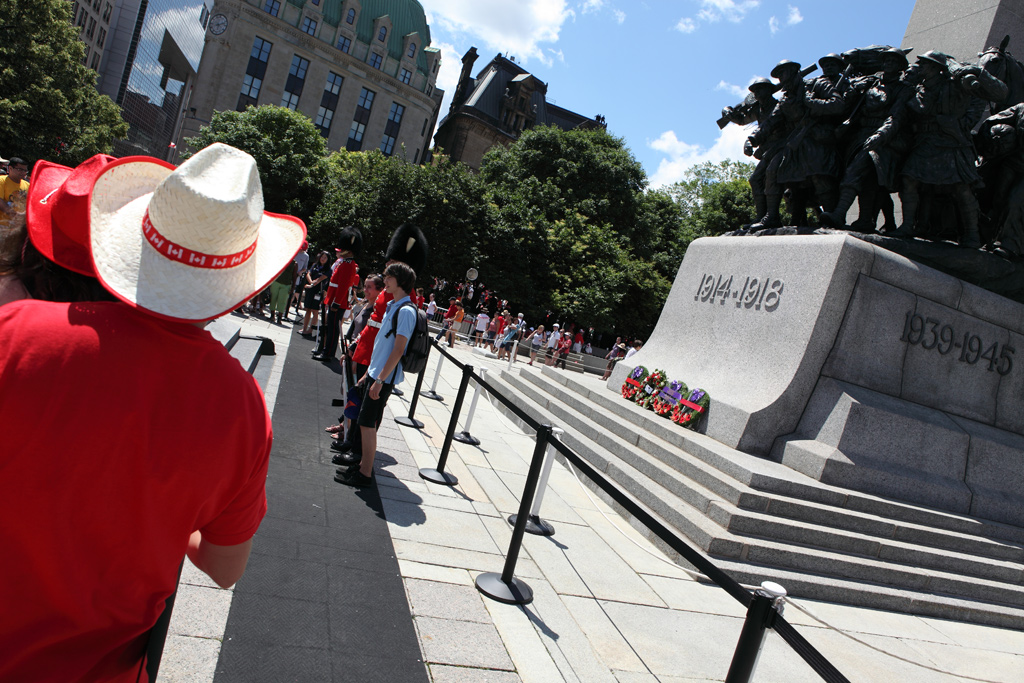
Ottawa’s Canada Day 2011

I am very skeptical of patriotism, generally. Very often in the past, people have done terrible things with that motivation and justification. All human beings are our kin,  national boundaries are arbitrary, and most wars start for bad reasons.

That said, there is something nice about being with people from all over Canada in the capital today. Whichever part of the landmass we are from, we have something in common that does have value. I think a lot of that value lies in the ethical traditions of Canada – traditions like fair elections, the responsible use of power, and the protection of the powerless. They also lie in institutions like the Charter and the Supreme Court. It is those substantive things that we ought to celebrate about Canada, while also recognizing our substantive faults. Aspects of our international reputation are badly tarnished, and there are groups domestically that deserve more protection than they are getting, not to mention those in future generations.

Our imperfections acknowledged, it seems OK to celebrate our commonalities. For instance, the ways in which the lives of Vancouverites are similar to those of Ottawans or Haligonians much more than you might guess, based on the distances between the places.

James Ron on loyalty in the civil service

James Ron, a former professor at Carleton University, has written an interesting piece on the situation faced by bureaucrats who personally object to the policies of the government of the day. It is an interesting read.

One major justification he leaves out is the view that while a particular policy might seem objectionable to the person thinking about it, they simultaneously see that policy as the product of a democratic system of decision-making that they endorse overall. I have written before on why this view is problematic, but it is nonetheless another way of squaring the circle Ron describes.

The end of the mail lockout

In the case of Canada Post, the use of back-to-work legislation to end the labour dispute seems inappropriate. Quite likely, it is a violation of the right to collective bargaining that the members of the union possess.

Losing postal service has not been a catastrophe. It definitely wasn’t too problematic before the management-initiated lockout. As such, the only serious disruption to service that has taken place has been the result of a management decision. Canada Post’s workers don’t deserve to be forced back to work through legislation because of that.

Blowout 2100

The overall aim of governments and political parties in North America an Europe at the moment seems to be serving the interests of people who are about 50 and at least fairly well off. Keep stock prices and house prices up, prop up failing banks and car companies, keep pumping fossil fuels, don’t worry about climate change or what future generations will use for energy. After all, the core supporters of the politicians (especially when it comes to all-important campaign cash) will probably be dead by the time the most serious effects of climate change are felt. The same goes for the people in high-level decision-making positions in government and industry today.

It seems that future generations will have good cause to hate us. We have had climate change endlessly explained to us, with multiple convincing lines of evidence to back up the theory. We have been told what we need to do to stop it, but we have chosen to do nothing because we care about our short-term economic welfare more than anything else.

If that is the implicit attitude of the politics of today, it would be helpful if it was made explicit. “Vote for Party X for 30 or 40 more years of relative prosperity. After that, no promises.”

The Rebel Angels

Robertson Davies’ The Rebel Angels is a novel about a beautiful young gypsy graduate student who has two middle aged professors fall in love with her, but decides to marry a rich young banker. There is also a somewhat perverse ex-monk who kills a third middle-aged professor, also somewhat perverse.

Intermixed is a lot of philosophy and speculation which is convincing and compelling to varying degrees. The much-elaborated theory that personality is closely linked to digestive function doesn’t reek of plausibility, and I am in no position to judge theological speculations. Still, the overall feeling of the book was that the factual claims within cannot be fully trusted – that they are meant to provide a plausible framework for the action, rather than withstand scrutiny on their own. As someone who prefers to read non-fiction (and generally reads fiction for the benefit of the factual elements) this was frustrating.

I also have a dislike of novels in which the narrator varies from chapter to chapter, particularly when they are not identified at the outset. To me, this seems like the sign of an author who is trying to be a bit too clever. Usually, it produces mild frustration and muddles together the various characters, who often do not end up seeming terribly different. For the most part, the characters are easy to become frustrated with – they take themselves much too seriously, and see all their mundane dealings as reflections of essential matters of philosophy.

The book certainly contains some interesting arguments and convincing observations, however. There are some nice little phrases about the common quirks of academics and universities: “Whatever people outside universities may think, professors are busy people, made even more busy by the fact that they are often unbusinesslike by nature and thus complicate small matters” (p.246 paperback). There are also some acute observations about people who are especially prideful about their own capabilities and intellects.

This book was recommended to me by a friend who I am hoping to understand better, so part of the process of reading it was trying to experience it from her perspective. Not only her perspective, but the perspective she had when she first read it. I don’t think I have especially succeeded in that, and I feel a bit embarrassed about responding to the book critically. Still, it seems better to write something honest than falsely claim to have understood the appeal and genius of the book.

There are plenty of books that have affected me in significant ways, but which I think others would be hard placed to trace in me as I am now. Particularly for the young, books that seem really special are often those that serve some acute current need. Even once the need has been filled, there is an enduring gratitude to the book and the author for having filled the gap during the time when it was present. As such, the books that have been important in a person’s life are a bit like the scaffolding used to construct a building. They aren’t visibly present in the final form of the structure, but they affected the way in which it emerged in important ways.

Iggy pot

As shown in a video from the Canadian Press, Liberal Party leader Michael Ignatieff was asked whether he had ever smoked marijuana. Here is what I think he said in response:

I have smoked pot as a young man, yes. I did not. And it’s one of the reasons. And I urge young people not to repeat the experience. It did not ruin my life. I just think there are a lot more important and interesting things to do with your life, including a glass of wine after dinner. I mean, let’s all relax here.

The Globe and Mail captioned the video: “Liberal Leader Michael Ignatieff admits he smoked marijuana when he was younger, but he says, he prefers a nice glass of wine.”

If that’s what it comes down to – a matter of preference – I feel obligated to ask about the severe double standard that exists in the law now. Ignatieff’s drug of choice is available in all of Canada’s finest restaurants. They will bring it to you for free in first class on Air Canada. And yet if you prefer the other drug he has tried, you risk being branded as a criminal, fined, and potentially imprisoned.

It doesn’t make sense to apply a harsh legal regime to drugs that are less harmful than alcohol. If we grant adults the sovereign right to poison themselves with alcohol or nicotine or caffeine, we should acknowledge the same right with regard to marijuana, MDMA, and other comparatively benign substances.

Options for the civically minded

For people who feel a sense of civic duty – a determination to do what they can to improve the laws and policies of their society – it seems to me that there are multiple valid avenues through which to apply your efforts.

The most overt may be entering politics, but it is an option that carries many costs. You might have to spend a lot of time at small-town barbecues wearing a silly apron, to try to convince voters that you’re an ordinary guy like them and not some fancy-school elitist. You might also have to lie about or conceal beliefs that go beyond what the mainstream is willing to accept (better not be an atheist, for instance). Still, if you do take the political route and find yourself in a position of influence, at least you have a pretty defensible mandate to try to implement the ideas you campaigned on.

The civil service is another option. The influence and the constraints of the civil service are both tied to the same role: providing advice. Being someone who provides advice gives you the freedom to use your judgment and the best available evidence to suggest a course of action. The trouble is, you can always be over-ruled by your superiors or by the people who ultimately make the decisions. Civil servants therefore have a moderate level of freedom for expressing their honestly-held and well-justified views, but little certainty that their advice will ever make a difference.

Journalists and academics have the most freedom to speak and defend their arguments in public, but they have even less certainty that their efforts will ever produce concrete changes. Judges, by contrast, know their judgments will have concrete effects, but they don’t know whether that influence will be confined entirely to the case at hand, or whether it will become a more influential precedent.

Setting aside the advantages and disadvantages of different roles, I think it is important to acknowledge that people in all of these roles can be doing their civic duty, in the sense of trying to serve the best interests of their country and the world more broadly. It is possible to serve those interests through obedience – for instance, those who put themselves in physical danger for the good of others – but it is also possible to serve them through honest and open criticism. All governments have made serious mistakes in the past and face major challenges today. If we are to navigate successfully to a safe and comfortable future, there needs to be energetic and open debate based on the best evidence available.