
Live-blogging Keohane

Anyone interested in reading about Robert Keohane’s presentation to the Global Economic Governance Seminar can do so on my wiki. There is still nearly an hour in the session, so if someone posts a clever question as a comment, I will try to ask it. I doubt anyone will do so in time, but it would be a neat demonstration of the emerging capabilities of internet technology in education.

Since this is a publicly held lecture, I don’t see any reason whatsoever for which the notes should not be available. Those who don’t know who Robert Keohane is may want to have a look at the Wikipedia entry on him.

[Update: 7:30pm] Robert Keohane’s second presentation, given at Nuffield on anti-Americanism, was well argued but not too far off the conventional wisdom. I am here taking “the conventional wisdom” to be that in a survey on Anti-Americanism that I am almost sure ran in The Economist during the last couple of years.

Basically: it does exist, more so in the Middle East than anywhere else. The Iraq war has exacerbated it almost everywhere, but the biggest turn for the worse has been in Europe. The policy impact of Anti-Americanism is not very clear. Finally, lots of what would be taken as a legitimate political stance if expressed by an American at home is taken as Anti-Americanism elsewhere.

Keohane distinguished four sorts of Anti-Americanism, three of which have been expressed on this blog. The first was the kind grounded in the belief that the United States is not living up to its own values: what he called Liberal Anti-Americanism. Guantanamo, and everything that word conjures up, gives you the idea. The second is social Anti-Americanism: for instance, objections to the death penalty of the absence of state funded health care. The third is Anti-Americanism based on fear of encroachment into the domestic jurisdiction of your state, what he called the state sovereignty variety. The last was radical Anti-Americanism, which I would suggest is distinguished more by the language used to express it, the degree to which the positions taken are extreme, and the kind of actions justified using it than by the kind of analysis that underscores the rational components thereof.

Party in London with other Canadians

I won’t be able to attend tonight’s party at the High Commissioner’s official residence in London, but other Canadian grad students with the time and inclination should. High Commissioner is a title invented by Canadians to stress how our relationship with Queen and Empire could not be captured through a mere exchange of ambassadors. Partly as a result of the former prominence of that relationship, the High Commissioner has a very nice house and throws fine (if short) parties:

Event details:

Friday, December 1 from 18:30 to 20:30
James R. Wright, High Commissioner for Canada’s residence – 3 Grosvenor Square, London W1 (Bond Street Underground).
Google Map

Last year, just showing up was enough to get in, but you may want to contact Ian Napier (ian.napier@international.gc.ca) to double check, if you are planning to come from far off.

Quebec and nationhood

First Ignatieff said it, and now Stephen Harper has: ‘Quebec is a nation.’

The claim is a tricky one, for a number of reasons. ‘Quebec’ is a federal component of Canada: a province granted particular jurisdictions and roles under Canadian law. Like some other parts of the country, it includes a minority population with unique linguistic, educational, and other concerns. While I am perfectly willing to accept that French Canadians may constitute a “large aggregate of communities and individuals united by factors such as common descent, language, culture, history, or occupation of the same territory, so as to form a distinct people,” to take the definition from the OED, it is clear that Quebec is not synonymous with French Canadians.

The French Canadian nation does not occupy Quebec to the exclusion of other groups. There are Anglophone Canadians, recent immigrants, members of the First Nations, and others. Some, like the Cree, have considerable historical precedence over the settlers of New France; other have arrived recently enough to be subject to the special language laws the province has enacted in recent decades. Just as French Canadians must be given appropriate treatment within the wider federation of Canada, so too do other minority groups within Quebec deserve to be treated with fairness and due consideration under the law. Empowering the government of Quebec with special rights to represent the French Canadian nation must not diminish its obligation to honour the rights of other groups within the province.

The French Canadian nation (if it makes sense to treat it monolithically), is also not confined within the borders of the province of Quebec. New Brunswick is officially bilingual, and there are French speakers and people of French descent throughout the entire country. As such, dealing with Quebec and dealing with the full ramifications of that minority issue are not one and the same.

It will be interesting to see what, if any, concrete policy developments will arise as the result of these declarations. I do not think that recognizing French Canada as a nation, in the sense quoted above, is a threat to the integrity of Canada any more than recognizing the rights of First Nations peoples has been. Being able to accommodate different groups with competing claims is, after all, the root purpose of federalism. Given demographic shifts in Quebec, it makes less and less sense to conflate the issue of French Canadian identity with that geographic zone. Hopefully, the declarations from Ignatieff and Harper have just been pragmatic recognitions of the above.

Paul Martin on economic governance

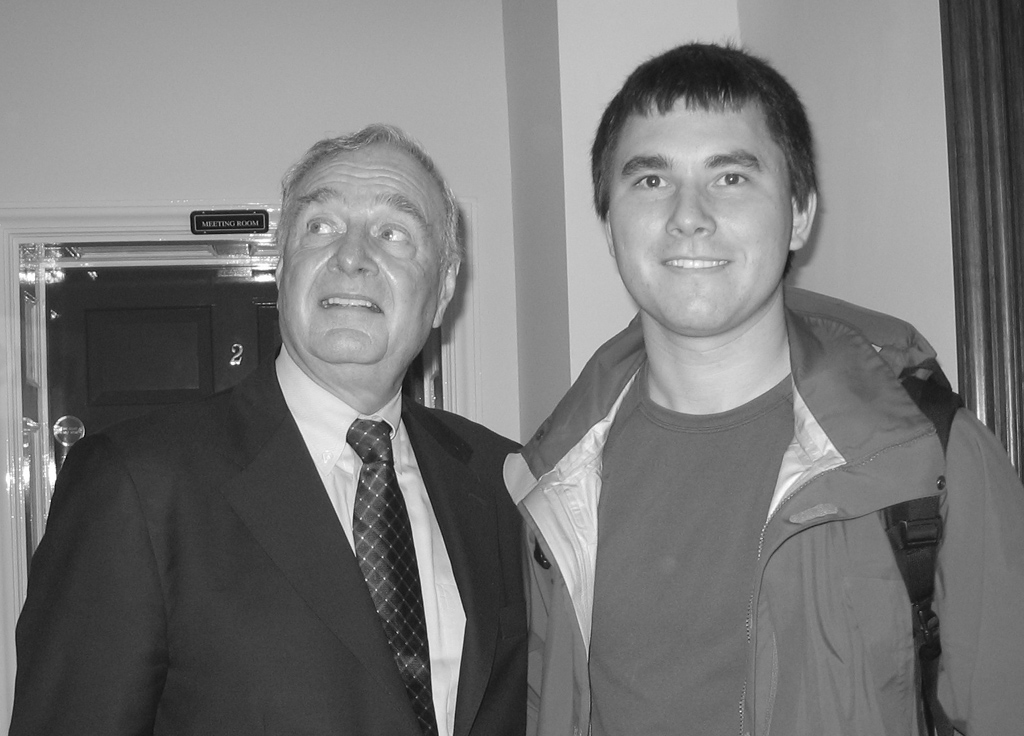
Paul Martin and Milan Ilnyckyj

Former Canadian Prime Minister Paul Martin’s talk was candid, informative and engaging. At a Global Economic Governance Program seminar, he covered a very diverse collection of issues: from China’s hunger for natural resources to the regulation of multinational corporations. I have never seen the room so packed, and the questions were excellent. He managed to get some good laughs, as well. In response to my question about climate change, he said, in part:

“Climate change has long since been recognized as caused by human activity principally.

The net effect is going to be devastating.

Prince Edward Island will disappear; Toronto won’t. That’s a disaster on both sides

That would make a great headline back home, wouldn’t it?”

Generally, he was very open, but there were certainly a few notable questions ducked. He declined to endorse a candidate for the Liberal leadership race when asked, for instance. People should feel free to have a look at my transcript, in which I have tried to quote directly wherever I could type fast enough.

PS. As today’s photo demonstrates, there is a downside to having a camera that takes 2-3 seconds to charge and fire its flash.

Remembrance Day

After reading my friend Michael’s post on Remembrance Day, I find myself rethinking the event. I can think of three different potentially valid understandings of its purpose:

  1. The day as a formalized period of mourning for the specific people who died in the wars commemorated.
  2. A day meant to serve as recognition of the fundamental badness of war in general
  3. A day meant to encourage contemplation of the specific conflicts being commemorated.

The first and second are clearly somewhat contradictory. You can get around that by either saying that war in general is bad, but these ones were noble and important or that waging war is honourable if done defensively, and all of these conflicts were defensive. Another way out is to say that the actions of those who died, specifically, were honourable, regardless of whether the broader endeavour in which they were engaged was.

The most easily justifiable position is to avoid the automatic taking of a moral stance – in response to the occasion – but rather use the chance to reflect on the specifics of the conflicts themselves: how they arose, how they progressed, what they resulted in, and what the importance of all of that is now. Such an approach has the virtue of independence of thought, but probably rather misses the point of a commemorative ceremony of the sort that Remembrance Day is meant to be.

Regardless of the conclusions you reach, the balance you end up contemplating is one between large-scale strategies and small-scale sacrifices. Whether it’s Canadians being blown up by roadside bombs while trying to aid negotiations between the central government and provincial warlords in Afghanistan today or Canadians dying to test the German defences in Dieppe in 1942, such examples force us to think hard about the aims of our foreign policy, and the purposes for which armed force should be employed in the world.

New blog on Vancouver speaking events

Most of what I write here is for people attending or interested in Oxford. Here’s a link for people in Vancouver. My friend Tristan is setting up a blog that lists speaking events in that fine Pacific city. If you have something to suggest, please email him through the links provided therein.

People with web design experience are particularly encouraged to help develop this into a useful service for academically inclined Vancouverites.

Another loan letdown

My student loan appeal has gone through and they increased my allotment by $623: not quite the expansion for which I was hoping. Essentially, the reason for this is that they have pre-set formulas for allotting loan amounts that adapt poorly to the nature of an Oxford education. They are based on the cost of living in Canada, and they do not reflect understanding of how Oxford terms work. They certainly do not reflect the extreme cost differentials between attending graduate school in Canada and doing so in a place like this.

A word of warning to future applicants: do not expect even half as much student loan funding in your second year as in your first; this, they ought to make clear before you go. In my case, seems as though some kind of additional fundraising is going to be required, if I am to make it through Trinity term and my exams.

See also: prior ravings about school related government bureaucracy.

An environmental strike against Canada’s Tories

As Tristan discussed earlier, the National Post has been producing some dubious commentary on the ironically titled Clean Air Act being tabled by the current Conservative government in Canada. The paper says, in part:

Worryingly for the government, the impression has already taken hold that the Conservatives are not serious on the environment, and when [Environment Minister Rona] Ambrose says the Clean Air Act represents a “very ambitious agenda,” people smirk.

The smirking they describe is well deserved. The fact that every other party in government sees the real effect the so-called ‘Clean Air Act’ would have is not evidence of superficial thinking – as the Post asserts. The government that decided to simply walk away from Canada’s commitment to Kyoto is carrying on in past form.

Perhaps the biggest problem with the act is the way in which it confounds issues that are quite distinct. When it comes to the effect of human industry on the atmosphere, there are at least three very broad categories in which problematic emissions fit:

  1. Toxins of some variety, whether in terms of their affect on animals or plants (this includes dioxins, PCBs, and smog)
  2. Chemicals with an ozone depleting effect (especially CFCs)
  3. Greenhouse gasses (especially CO2, but with important others)

In particular, by treating the first and third similarly, the government risks generating policy that does not deal with either well. The Globe and Mail, Canada’s more liberal national newspaper, argues that this approach may be intended to stymie action towards reduced emissions, by introducing new arguments about far less environmentally important issues than CO2.

It is possible to develop good environmental policies that are entirely in keeping with conservative political ideals. Market mechanisms have enormous promise as a means of encouraging individuals to constrain their behaviour such that it does not harm the welfare of the group. While market systems established so far, like the Emissions Trading Scheme in the EU, have failed to do much good, there is nothing to prevent a far-thinking conservative government from crafting a set of policies that will address the increasingly well understood problem of climate change, without abandoning their political integrity or alienating their base of support. To do so, in the case of the Harper Tories specifically, might help to convince Canadian voters that they really are the majority-deserving moderates they have been trying to portray themselves as being since they were handed their half-mandate by those disgusted by Liberal sleaze.

Trading sub fusc for a shirt and tie?

Trinity College gates, on Parks Road

Having thought about it a good bit in the last week or so, I now think it is more likely that I will work for at least one year after I finish this degree, rather than going straight into another one. The reasons this seems intelligent include the following:

  1. When this program ends, I will have been in school for twenty consecutive years, with a few (mostly bad) minimum wage jobs mixed in. Actually seeing the world from the position of a mythical ‘real job’ will help me to make a smarter decision, with regards to whether I should do a PhD.
  2. I am already positively daunted by the thesis. With that in April and four Oxford examinations in June, the stress of crafting custom PhD applications to excellent schools might be a bit much.
  3. Seeing student debt numbers go down instead of up is an idea with appeal.
  4. I will need three references from Oxford for PhD applications. My advisor is one. If I am forced to use both of the people teaching my optional paper this term, there is a lower chance of getting a really good collection of references. I didn’t really interact with the people who taught the core seminars last year for them to serve as thorough references. If, however, I make a point of cultivating the four optional paper instructors over the course of this whole year, there seems a good chance I can get two more better letters.
  5. Right now, I really need to get the idea for my M.Phil thesis together. Having to come up with a whole other research proposal for a PhD is, again, a bit much.
  6. Not having to worry about the GRE this year would be nice. It would allow me to do more academic work, as well as spend more time enjoying Oxford.

Of course, this decision forces me to do one of the things that I am by far the worst at – apply for jobs. I am not even sure of which country to begin looking for jobs in. Both Canada and the US are plausible, with the UK much less so. A job somewhere really far-flung could certainly be an interesting way to spend a year.

Where do people recommend looking? Options with some appeal include working for government, working for an NGO, writing in a journalistic capacity, or doing anything that provides hands on experience with either ecology or environmental policymaking.

Depressive Zeitgeist

Tonight, I spent more than six hours speaking online with a dozen close friends, mostly back in North America. The prevailing mood is one of exhaustion, cynicism, uncertainty, and anxiety. People are going broke and doubting their long-term plans; people are losing faith in the basic moral axioms they have followed, and the basic assumptions that have sustained their efforts.

Hopefully, it is just an analog to the changing of the seasons – as the tilt of this great orb drives us all to spend the greater part of our days in darkness.