Good news

During the past eight weeks:

  1. My thesis was submitted
  2. I found an excellent job for next year
  3. I finished my M.Phil exams

As of today, the college has also replaced our broken refrigerator. It will be good to be able to buy food for a period longer than a few days at a time.

I now have 33 days to arrange my departure from Oxford, return to Vancouver, move to Ottawa, and get to work. I might be able to wheedle in one more trip within Europe before I leave Oxford on July 2nd. I am also looking forward to the third incarnation of Tristan’s Cabin Fever event, to take place between July 6th and 8th.

Exams complete

The Developing World exam was not quite as difficult as I feared. While I didn’t refer to the readings as much as the instructors probably wanted, I do think I wrote solid and interesting answers. I wrote on:

  1. Does ‘dependency’ reduce the ways developing countries can benefit from globalization?
  2. ‘The moral case for aid is eroded by evidence that rich countries use aid to further their own geostrategic purposes. Discuss
  3. Have regional institutions helped improve security in developing countries?

And with that, my final exams are complete. By the end of the month, I will have my grades for them, as well as for my thesis. One enduring question is whether I should apply to graduate in absentia. That is the only way I am likely to graduate in the next year or so, but it would mean I could never attend a graduation ceremony. A complicating factor is that I will not technically have an M.Phil until I have formally received the degree.

In any case, I am going to try to get a bit healthier before tonight’s celebration once the last members of the program finish their exams. I also have my last high table dinner in Wadham tonight, as the term and my Senior Scholarship come to an end together.

Predictable law exam complete

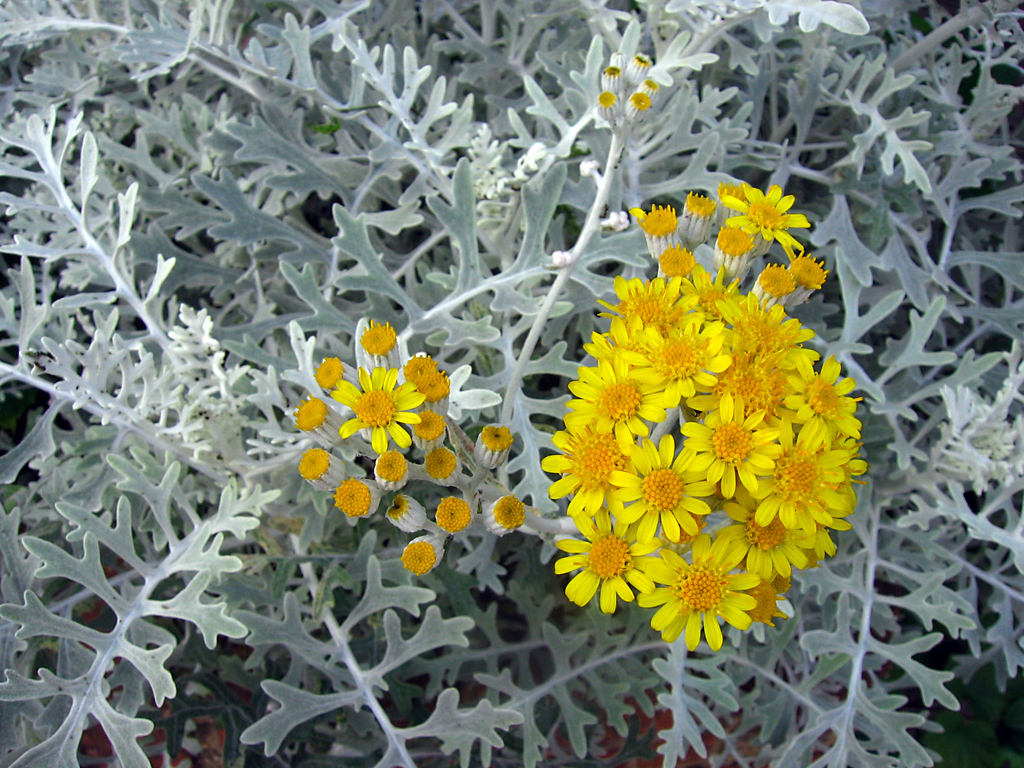
Yellow flowers

The international law has been written, and nobody who took the course can possibly complain about its content. Indeed, it was astonishingly predictable. They snuck on fourteen different possible topics, and I am pretty sure every one of them was either on a previous exam or taken directly from our reading list. As such, the main problem in each answer was effectively summarizing everything you knew about it, rather than wracking your brain in search of anything to write. I wrote on:

  1. Why have international legal efforts to regulate the global atmospheric environment had such mixed success?
  2. Is it proper for the World Trade Organization to be concerned with the elimination of economic inequalities within or between states?
  3. What are the considerations that lead states to comply with provisions on international law?

I only heard after the exam that the assessors might be less than pleased about me answering a question so closely related to my thesis. If so, there is nothing that can be done for it now. Overlap is also a bit of a concern between the second question I answered on this exam and the second question I answered on yesterday’s theory exam. Clearly, I cannot write about either inequality or the WTO during tomorrow’s developing world exam. As such, it is probably go time to brush up on the security issues that exist in the developing world. Just nineteen hours or so away from being finished, now.

Slam poetry

I am in the midst of exams, so instead of writing something entertaining myself, I will just link you to the website of Eric Darby: a slam poet. He has three samples available in mp3 format:

  1. The Chicken Show
  2. I Wish the Motor City…
  3. Scratch and Dent Dreams (also a YouTube video)

You can read more about the genre on Wikipedia.

Lots more slam poetry is on YouTube. The most interesting such poetry I have heard was at Bar 13 in Manhattan. That said, the Café Deux Soleils in Vancouver has some good poetry nights. If you get the chance to see Shane Koyczan, make sure to take it.

James Burke’s Connections

Bike wheel

I have mentioned it before, and may well mention it again. James Burke’s Connections is a television series worth seeing. Each episode wanders through history from one invention to another, with fascinating asides along the way.

As of this evening, someone put a stack of them on YouTube. The series was made at taxpayer expense by the BBC, so there is really no reason for which it shouldn’t already be available online for free. Watch a few episodes and you will learn a wealth of interesting (though often very esoteric) facts to break out at dinner parties.

As is generally the case when I am busy and need to come up with a blog post idea in a hurry, this was yanked from MetaFilter.

PS. By the end of each exam, I was coughing my lungs out. Now, I am taking little sips from my bottle of nasty tasting (and ineffective) cough syrup every three hours or so. Now, I feel like I have an especially nasty cold, with all the ill effects involved therein.

Once more unto the breach, dear friends, once more

Today, we have our history and theory exams. Tomorrow, it’s international law. Wednesday is the exam about which I am most worried: the IR of the developing world. Thankfully, one can draw further inspiration from Henry V (III, i):

But when the blast of [exams] blows in our ears,
Then imitate the action of the tiger;
Stiffen the sinews, summon up the blood,
Disguise fair nature with hard-favour’d rage;
Then lend the eye a terrible aspect;
Let pry through the portage of the head
Like the brass cannon; let the brow o’erwhelm it
As fearfully as doth a galled rock
O’erhang and jutty his confounded base,
Swill’d with the wild and wasteful ocean.
Now set the teeth and stretch the nostril wide,
Hold hard the breath and bend up every spirit
To his full height.

Friends in Oxford should make a point of attending our post-exam barbecue on Thursday at 7:00pm. For those in the IR program, we will be wandering over to Church Walk en masse after the party in the department ends.

[Update: 1:45pm] The history exam is done. I wrote essays on the following:

  1. To what extent was instability in East Asia in the inter-war period a consequence of extra-regional forces?
  2. ‘The key international security institutions were incidental to the maintenance of world order during the Cold War, but they have become central pillars of order in the post-Cold War period.’ Do you agree?
  3. ‘The roots of contemporary conflict in the Middle East are to be found more within its processes of colonization and decoloninization than in the dynamics of the Cold War.’ Is this accurate?

Many thanks to Jason Shell for taking a group of us for lunch at Brasenose College after the exam. My IR theory exam begins in forty-five minutes.

[Update: 6:21pm] With the theory exam, I am halfway through. I wrote on the following:

  1. ‘The Realist and Liberal traditions of International Relations have more in common with each other than not.’ Discuss.
  2. What does the literature on globalization tell us about the relation between international economic inequality and international political inequality?
  3. ‘The issue is not the “right to intervene” of any State, but the “responsibility to protect” of every State when it comes to people suffering from avoidable catastrophe.’ Discuss.

I included diagrams in the first and second essay, as well as calling constructivism a ‘pseudo-counterhegemonic discourse.’

I have now finished the exams I expected to be the 2nd and 4th most difficult. Tomorrow, I have law, which I expect to more more challenging than theory but less so than history. Wednesday, I have the developing world, which I expect to be the most challenging of all.

IR theory and human nature

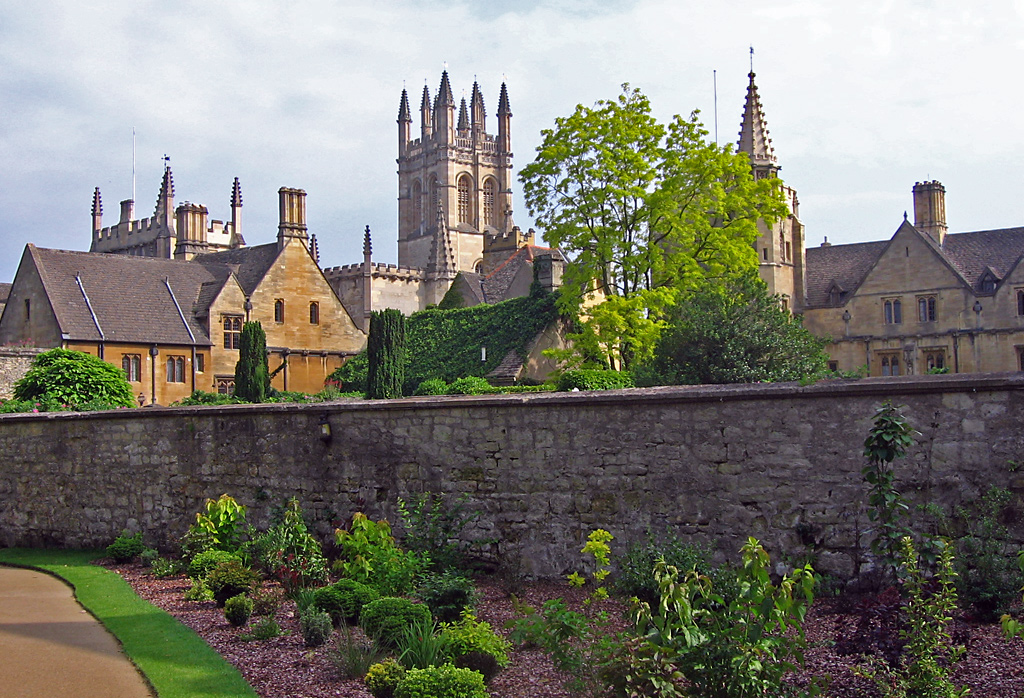
Magdalen College, Oxford

One thing I have always disliked about international relations theory is the tendency to assert a view of human nature as simplistic and unchangeable. Often, I think this is more the result of short descriptions of theories becoming caricatures, rather than the product of theories that genuinely fail to appreciate how human behaviour is (a) malleable within broad limits and (b) critically influenced by context. Lots of fascinating recent psychology has been demonstrating the latter point. Malcolm Gladwell’s work is an entertaining and accessible example. So too, the work on behavioural economics that has been attracting so much attention.

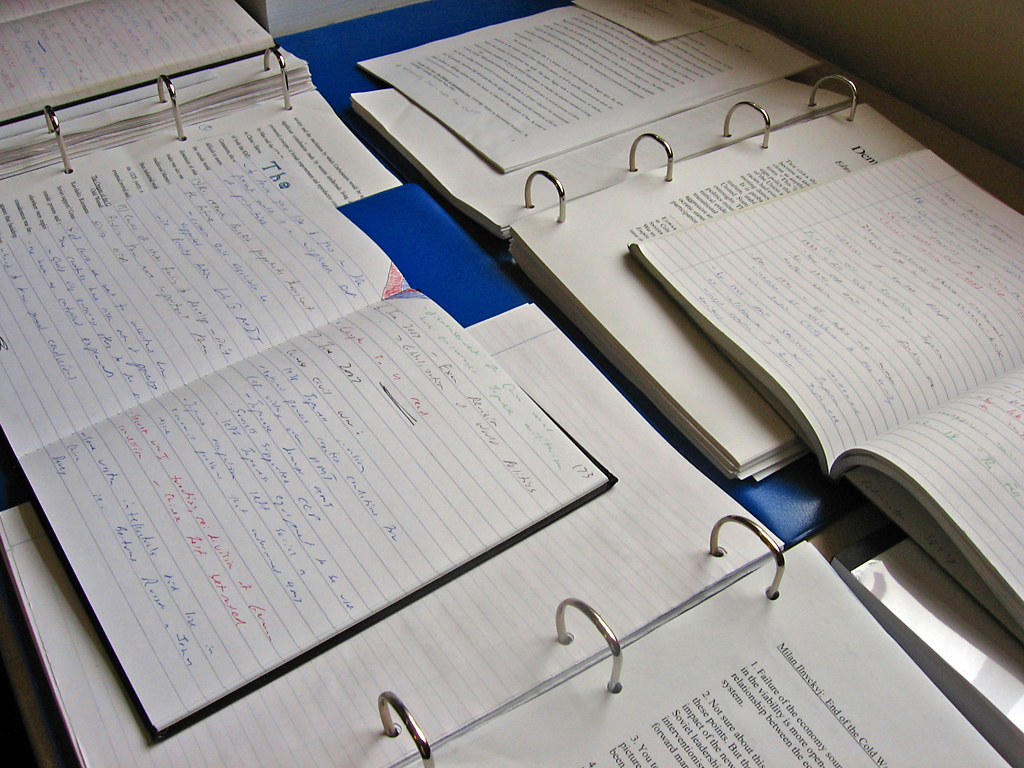
I have a chart on my theory notes listing the major alternatives: Realism, Liberalism, Neoliberalism, Marxism, Feminism, and Critical Theory. In the column for ‘human nature’ the positions given are: ‘Fixed (essentially selfish)’, ‘Fixed (essentially selfish)’, ‘Fixed (essentially selfish)’, ‘Historically determined (corrupted by changeable)’, ‘Varies according to sub-model’, and ‘No fixed nature.’ Firstly, it seems like the issue of whether people generally behave selfishly or not isn’t sufficient to assert the existence of an essential human nature. Secondly, it seems like virtually all IR theories could pretty easily stretch to accommodate how people’s thinking and actions are conditioned by the environment in which they live. It seems like this is one of the major reasons for which neoliberals can continue to hope that conflictual elements of world politics will eventually give way to more cooperative ones. (Of course, we can also question whether the six traditions listed above constitute an appropriate taxonomy of IR theoretical approaches.)

The tendency to caricature I mention is another feature of IR. Because the discipline seeks to cover so much, it is often simplified to a dangerous extent. Key points are pulled out from historical situations ranging from the Peloponnesian War to the Cuban Missile Crisis, while theorists are often understood on the basis of a few quotes and bullet points. In any case, I have never found international relations theory to be a terribly useful or worthwhile enterprise. Both political theory and history have a lot more to say about the major issues involved, and both seem to have a more defensible approach to dealing with them.

Aside: Richard Rorty, American philosopher and inventor of the concept of ‘ironic liberalism,’ died today.

PS. The sore throat and aggressive cough I picked up on the Walking Club trip is still very much with me. I hope it doesn’t distract those around me too much during the exams tomorrow.

By the numbers

Magdalen College, Oxford

According to the Examiners Reports from 2002-2006, here is the breakdown of results for second year students in the M.Phil in International Relations. Please note that the reports are not always entirely clear on whether people got a distinction on exams only, or whether it was on the entire M.Phil course. Results from before 2002 are not used, because they do not mention how many candidates sat the exams.

Year: Total candidates – Passes – Fails – Distinctions

2006: 17 – 17 – 0 – 0
2005: 18 – 16 – 2 – 0
2004: 23 – 22 – 1 – 2
2003: 25 – 25 – 0 – 2
2002: 23 – 23 – 0 – 1

Total: 106 – 103 – 3 – 5
Percentages: Pass = 97.2% Fail = 2.8% Distinction = 4.5%

Given that there are 28 people in our program, it is likely that one person will fail and that one person will get a distinction.

It should be noted that most people who failed re-sat the exam successfully the next year. They have thus been counted both as fails in their original year and passes in the subsequent year. People who chose to withdraw from the course are excluded from these statistics. Those on the Oxford network can read the reports on the departmental homepage.

[Update: 10 June 2007] The figures above have been adjusted in light of this comment.

Last minute hermit

Between now and Wednesday afternoon, I really need to seclude myself and revise. Please do not invite me for walks, an evening pint, or any of the hundreds of other enjoyable Oxford spring activities. I have a date with a stack of notes and a barrel of coffee.

PS. Absolutely no ‘trashing’ on Wednesday afternoon. This is my only suit, and I will need it for my new job.

Revision and diversion

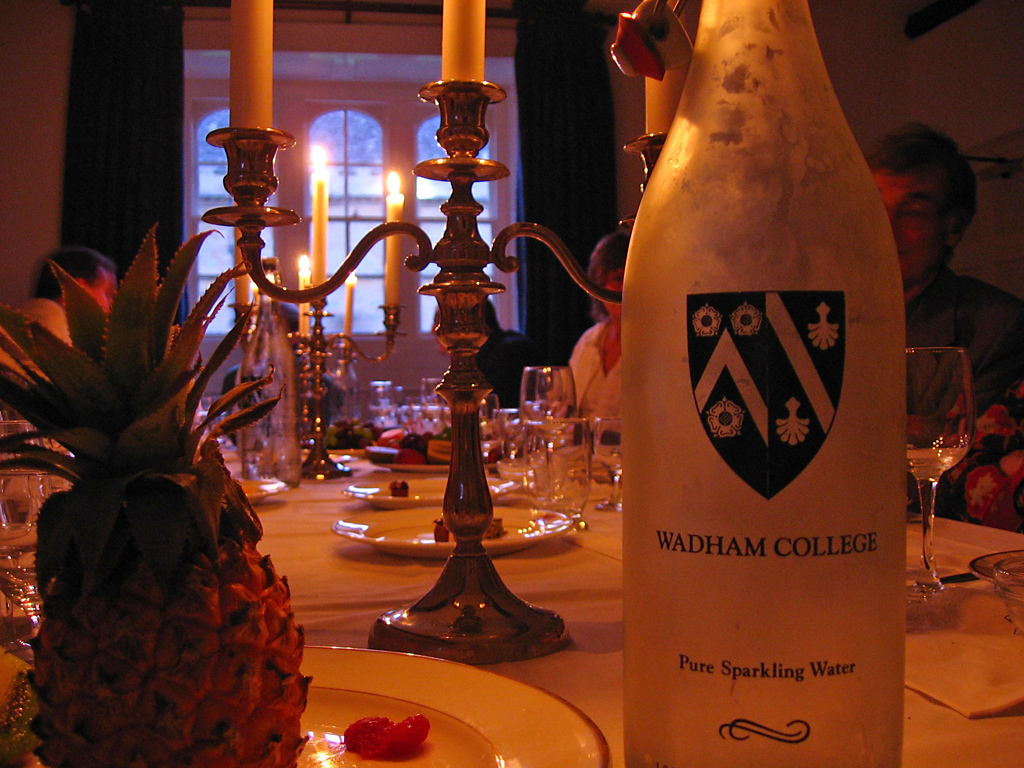
Wadham high table

Understandably enough, anxiety about exams is peaking. Of course, there isn’t a huge amount that can be done about it now. All I can do is spend the weekend reading, thinking, and perhaps writing some more practice exams.

This evening did feature a couple of very nice asides from revision. Emma kindly showed me around Magdalen for a bit – demonstrating just how extensive the college is. Between the Deer Park and the Water Meadow, there is probably more area in grassy space than all of Wadham occupies. Afterwards, I had my second-to-last dinner in college, featuring some very interesting conversation about Marquez, Joyce, Kundera, and Nabokov. For the second time in the last few weeks, I have promised to share some of my slam poetry collection.