Knowing basic stats is not good enough for card games

Beads in Nora and Kelly's window

Many thanks to Nora and Kelly for an excellent dinner at their new flat: across the Folly Bridge from St. Aldates’. Afterwards, along with Bryn, we played a number of hands of Spades – a game with which I was previously entirely unfamiliar. It strikes me as inevitably highly statistical. There is a set probability to every 13 card hand, moderated through the scoring system. On the basis of limited information from a partner, you must play many iterations of a supergame, based on a defined collection of possible outcomes for each game, with appropriate scoring attached. The objective is to acquire points at a higher rate than the other team, until a certain threshold is crossed.

Two major kinds of decisions exist in the game: bidding decisions, and the decision of which card to play. Both are fundamentally strategic, though the first is based on a combination of the probability of your hand, in certain important ways, and on the rules related to winning or losing any one iteration (13 tricks). The second is based on similar probabilities, plus knowledge about previous hands (card counting), plus rules about winning tricks. While I could understand the general dynamics involved, I had neither the concentration to count cards, nor the insight to begin comprehending the emergent properties of the rule set. There are some rules, like the special set associated with nil bids, that add considerable extra complexity to the game, at least as comprehended by a somewhat addled beginner’s mind. Even so, it was fun to play, and I appreciate my fellow players for introducing it.

With a certain perverse logic, I take pride in the fact that Spades is probably a game that can be played as well by a computer as by the best human. Since it’s a collection of computable problems, it seems as though a collection of RAM and transistors should set the bar which the best humans approach. Since we define the ‘real’ difficulty of problems according to the amount of challenge they present to all available resources, and since computers can be programmed by relatively inexperienced statisticians, Spades can be branded as a less-than-enormously-complex game, even by someone completely inept at it. Isn’t rationalization amazing? I suppose when we’re just one century’s worth of random collection of molecules (if we are quite lucky), we need some logical path to not get overwhelmed with our own limitations.

PS. From all I have heard, the Arctic Monkies are an unusually talented new band (I can see all those more clued-in on the music scene laughing at me for saying it. Why not say: “I think this Led Zeppelin group has some ability?”). Trying to keep up with a dozen dozen different areas of human involvement, I cannot be at the crest of every wave. All that said “When the Sun Goes Down” is surprisingly melodic, despite somewhat a somewhat abrasive chorus.

PPS. It looks like I may have three new tutorial students over the first three weeks of August. I am thinking of going to Dublin for the fourth week, then flying straight from there to Prague for the first week of September. It would save me all the cost and bother of coach travel from Oxford to London to random-airport-for-cheap-airlines.

Happy Bastille Day

Canal boat

Thesis reading is progressing reasonably well, amidst all the other tasks in need of completion. I am reading Economics, Ethics, and Environmenal Policy: Contested Choices: a collecton of essays edited by Daniel Bromley and Jouni Paavola. It is somewhat general, but still informative. My intention is to try and sneak a reasonable amount of normative matter into my thesis, in whatever form it ultimately adopts. Sorting that out is my top academic priority at the moment.

The order of business tomorrow is research assistance work. Probably, I will immerse myself in the department with a copy of EndNote and a few of the mysterious coffee/hot chocolate beverages that the machine in the common room dispenses for 30p a piece. More than once, they have helped me bounce a few more notches towards wakefulness before one of the core seminars. Without those two-hour gatherings of classmates and instructors, Tuesday mornings seem rather pointless.

On self-representation

Milan in the mirror

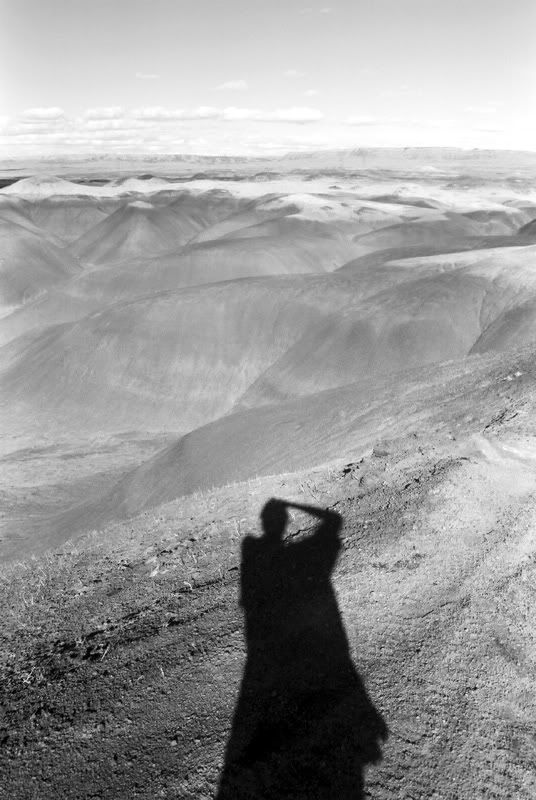
Every photographer understands the impetus behind the self-portrait: not some formal tripod and time-delay creation, but the quasi-accidental inclusion of oneself in a composition, in the form of a shadow, perhaps, or a reflection.

Photography is a curious art-form, for many reasons. Unlike most forms of artistic representation, it requires relatively little ability to translate sight into the moment of a hand. Instead, it required just one firm touch upon a button, under conditions that are recognized as being correct. The difficulty of affirming the originality of that act may partially explain the motivation behind the photographer’s self-portrait.

Mostly, however, I think of it as a playful interchange between photographer and observer. Whereas the two are normally in a conspiracy with regards to the subject (at the same time as the photographer and the subject are in conspiracy against the observer), in this case, there is a kind of simultaneous mutual revealing, which is very artistically and emotively interesting.

Tea

One unexpected stop in London yesterday was The Tea House, near Covent Garden (15 Neal Street, WC2). Sarah and I were lured in because the shop was incredibly fragrant. The same can be said of the 150g of Chai which I purchased there, and which has markedly increased the pleasantness of the smell of my room, just by virtue of sitting there in its bag. Their licorice tea, which Sarah got and which we tried after dinner, was also quite good. The secret, I think, was keeping the level of tea flavour low enough that it complemented, rather than overwhelmed, the distinctive flavour of dried Camellia Sinsensis. There is also much to be said for a shop that unfailingly demonstrates a commitment to the fact that only drinks made with an infusion based on Camellia Sinsensis are deserving of the descriptor ‘tea.’ Rose hips and the like may taste good in boiled water, but they are not tea.

Frequently as I am accused of being a coffee addict, I confess to preferring the aesthetics of tea. Coffee is a working person’s drink – to be consumed out of big paper cups while walking purposefully down a sidewalk, or gulped down from a big mug during a coffee break. Tea is more versatile and, to my way of thinking, more relaxed. As such, a break focused on its consumption is more worthy of that title.

Such talk makes me think nostalgically back to the days of the Esteemed Afternoon Tea Society. For those unfamiliar with this most absurd and memorable of UBC clubs, see the Epic History and the Declaration of War (PDF), which formally began the life of the organization as a potent (and generally highly militant) force on campus.

Quick London summary

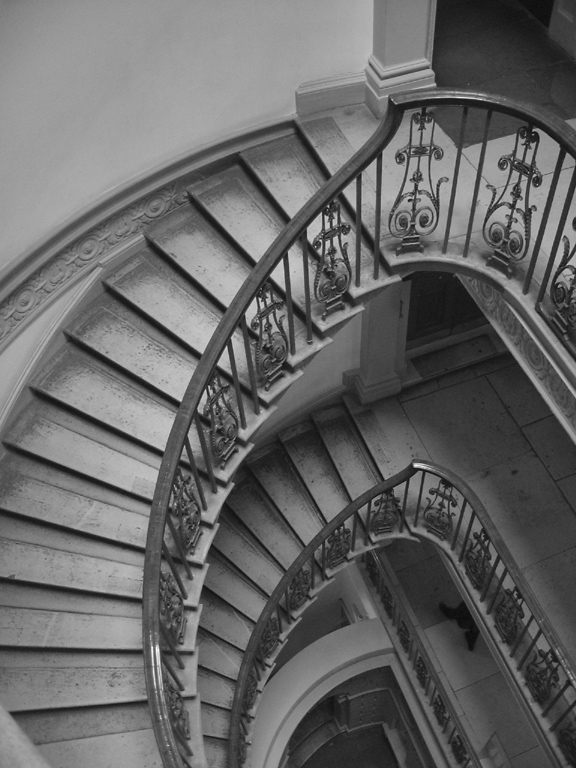
Stairs at Sommerset HouseHappy Birthday Nora Harris

Today’s trip to London was very successful: I got to spend time with Sarah for the first time since her wedding, I saw a large number of new Kandinsky paintings at the Tate Modern exhibition (including the spectacular Composition VI), I saw the Haitian film Heading South at an arty theatre in Soho, and had a number of tasty meals. Meeting Sarah’s husband Peter for the third time, as well as her father again, was also excellent.

Sarah and I saw some of the artwork at Somerset House: another London institution that I had previously known nothing about that turns out to be well-stocked with Gauguin, Matisse, Picasso, and such. They even had a respectable collection of Kandinsky paintings – organized in an identical thematic fashion to the Tate Modern exhibition.

I had seen Kandinsky’s work first-hand before: in New York in 2003, both at the Guggenheim and at the Museum of Modern Art. Of course, their new location had not yet opened at that point, so they were only showing a limited assortment out in Queens. By comparison, the Tate Modern exhibition was a much more comprehensive look into the progression of his work. Of all the paintings there, the massive canvas of Composition VI was most interesting and compelling. I urge people not to search for it online, because on the basis of my previous viewings of it as some little JPEG file, I can assure you that it cannot be understood in that format. You need to see the wall-sized painting to have any comprehension of it at all.

While the trip really deserves more ample description, it is 2:00am. I will do so soon.

Official daily post

Kelly at Puccini's

This has been a weekend full of surprises: mostly good, a few bad, and one simply baffling. Much as I am inclined to respond publicly to a certain recent provocation, I know it will be wiser to simply submerge it, and allow the author to float back to sanity of their own volition, or simply remain out of sight. Not to let that dominate the paragraph, it should be strongly affirmed that life is proving satisfying and interesting at the moment – if also quite tiring. Given my 6:30am projected wake-up time tomorrow, the plan is to be asleep by midnight, at the latest. Hopefully, my neighbour with the passion for early-morning chain-sawing (seriously) won’t be to to their wood-destroying ways tomorrow.

Writingandmacgeekery

For the first time, I found a reason to consider upgrading the operating system on my iBook from 10.3.9 to some version of Tiger (10.4). Namely, a program called WriteRoom that consists quite simply of a completely black screen, onto which you type basic green text. No fonts, no spell checking, no instant messenger windows popping up. Ironic as it might be to upgrade my operating system so as to use a program with fewer features than any text editor I have ever used, there is still a certain appeal. I already use TextEdit almost exclusively for writing on the Mac; Word uses too much RAM and does idiotic things like automatically trying to insert the last names of anyone in my Entourage contact list whenever I type their first names. I type: “He drew… a blank” and it ‘helpfully’ suggests “He Drew Sexmith a blank.” Much as I like to be reminded about friends from high school, this feature is much more trouble than it could possibly be worth.

That said, a new version of OS X is meant to be coming out sometime in the next few months (Leopard). As such, I think I will probably wait until it is possible to move forward by two bounds instead of just one. Of course, doing so will probably require that I get the extra 1GB of RAM that I have been considering. Initially, I was annoyed that I would need to remove the 256MB RAM upgrade that Apple overcharged me for when I bought this computer, but it seems that the mobo of the 1.3GHz 14″ iBook can handle a maximum of 1256MB of RAM anyhow.

Boots and letters

This morning, I got an impressive array of mail. I got postcards from Alex and Bryony (who are still off hiking), as well as from Tristan in New York. Meghan sent me a letter, and my mother sent me a package that can only be my hiking boots. With the second supervision I am teaching in an hour and a meeting with Dr. Hurrell shortly after, I haven’t the time to go through all this right now, but many thanks to all those who sent things.

I am glad to know that nothing now remains in the way of the Scotland trip. My unrelated trip to London tomorrow promises to extend my pattern of minimal sleep. This looks to be another 7:00am or earlier style departure. I should be back in time to catch the tail-end of Nora’s birthday barbecue.

Already July?

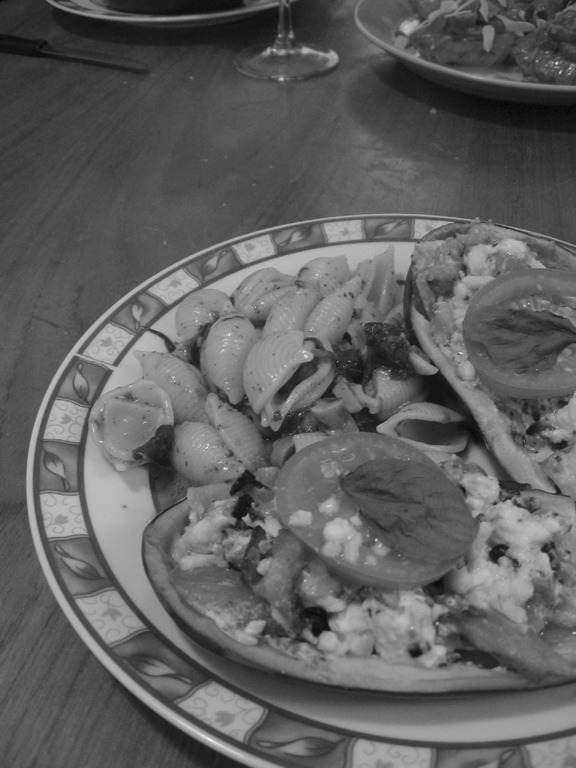
Pesto pasta and stuffed eggplant with feta I hit a rich vein of thesis materials today: a thesis on a related topic that is a veritable gold mine of sources. So often am I likely to be making reference over the next year, I had the thing printed and it now resides in one of the curious two-ring binders that are the UKs equivalent of our three-ring sort. Once I finish it tomorrow morning, and perhaps print off a few of the key cited journal articles, I will be in better shape to discuss the thesis plan with Dr. Hurrell tomorrow afternoon.

Tomorrow will also bring the second tutorial that I am teaching for the St. Hugh’s summer school. I got the essay tonight, so it has become another element of the clutch of reading material that I need to get through in the next fifteen hours or so. Little time remains for Sweetness in the Belly – a novel my mother sent me – or “Barn Burning” – a short story that I told Linnea I would read months ago. I also picked up a used copy of Far From the Madding Crowd. For some reason, I absolutely love the sound of that title. Somehow, the sounds and syllables combine magically in a way that has nothing to do with its meaning, which has never been very clear to me anyhow.

For the rest of the summer, I’ve decided to feel guilty about not traveling whenever I am doing thesis work, guilty about not doing thesis work whenever I am not traveling, and absurdly guilty at times when I am doing neither. That way, I will hopefully manage to accomplish the two major goals of the summer in the time that remains before Michaelmas 2006 begins. To anyone who worries that such guilt will keep me from enjoying things in general, they need not be concerned.

PS. Life is full of unbloggable surprises (though I don’t have time to relate them at the moment, anyhow).

Touristy Oxford summer

Bridge over the Oxford Canal

Summer Oxford Saturdays are utterly saturated by groups of visitors. Between Church Walk, Wadham, Sainsbury’s, and Church Walk I saw at least twenty such groups – many with matching backpacks, hats, or t-shirts. I suppose that is a mechanism to ensure that the various herds stay distinct, and don’t meld or dissolve during the course of their passage through historic Oxford.

The university must spin an enormous amount of money off the summer trade. Conferences, summer schools, concerts and all manner of means of drawing people here and extracting pounds and pence for the greater wealth and glory of the colleges. I know UBC does the same kind of thing, but I don’t think they will ever be able to manage quite the densities that exist here. That is befitting of an old and famous university located close to one of the world’s major metropolitan centres.

Annoying as it may sometimes be to have to push your way through massive crowds to buy groceries or use a library, it would be terrifically wasteful to leave all this capacity essentially idle over the summer. There are streets, beds, and classrooms to be filled – not to mention brain capacity on the part of scores and scores of tutors and grad students who are generally desperately trying to both complete and avoid their own research.

PS. Canadians would do well to read the special report on Afghanistan in this week’s Economist. With more than 2000 Canadians still serving there – either as part of Operation Enduring Freedom or NATO’s International Security Assistance Force – the situation there should be of considerable interest to us all.

Reading, writing, walking

Antonia on a bridge beside the Isis

With all that is ongoing, it has been a busy day. That said, things now seem to be on track for tomorrow’s lecture. Monday, I will be teaching another seminar and meeting with Dr. Hurrell to discuss the lacklustre result of the research design essay. Tuesday, I am going to London to see the Kandinsky exhibition with Sarah Webster. This is especially welcome, as it will be the first time I’ve seen her since her wedding, back in March.

A postcard from Kelly arrived today. She will be returning from Scotland sometime in the next week, though things are uncertain given all the vagaries that attach themselves to what is simultaneously a research trip and a family holiday. Her safe return is much anticipated.

While retracing a portion of the bike ride I described here a few days ago on foot with Antonia this afternoon, I managed to take some photographs with which I am reasonably pleased . Once you have more than 4000 from a place as small as Oxford, it becomes hard to come up with something good every day. As such, I’ve used a few of them to adorn photos from past days that were lacking images. The general idea is that posts without specific topics (ie. this one) should include photographs at the rate of about one per day. This is to compensate for the fact that I am just summarizing things at you.