

Category: Daily updates
Generally musings of the day, usually accompanied by a photograph
Working through and thinking beyond the PhD
Lots on the go — I’ve had a sudden flurry of late year photo bookings, including a three day Canada-UK artificial intelligence conference at the Munk School.
I’m still working on the dissertation of course, continuing with interviews and the literature review while working with my committee to structure the final document.
I’ll be doing less TA work next term to free up time to finish the dissertation.
There’s certainly a lot that’s interesting happening in climate politics. The little-reported but somewhat tactically novel Extinction Rebellion in the UK; UN climate talks in Poland’s coal region; and Alberta getting bitumen sands producers to voluntarily cut back on production to try to raise prices. We’re still nowhere near a politics that integrates the risks arising from unmitigated climate change, or capable of driving emissions reductions fast enough to make something like a 1.5 ˚C or 2 ˚C ceiling remotely possible.
I’m starting to think ahead to work beyond the PhD. During my MPhil I came to understand that climate change is the defining political and civilizational fact of our era. I went to work for the government in hope that I could do some good, but realized that under the leadership of parties like Canada’s Conservatives and Liberals it’s not possible to do the right thing as a civil servant since, for all their platitudes, their policy choices show that they aren’t serious about preventing the worst effects of climate change. I chose to do the PhD because I thought the degree would be useful and that it would provide a freer platform for climate change activism, as it did with the founding of Toronto350.org and the organization of the fossil fuel divestment campaign at U of T.
I really don’t know what’s the best place to go next. It’s hard to judge who is really being effective in changing political conditions to make rapid and effective climate change action possible. It’s possible 350.org’s focus on 100% renewables and alliances with other progressive movements will be fruitful, but it also seems possible that they are making choices that will limit the political constituency they can appeal to. Many activist organizations seem at risk of over-reaching, choosing approaches which appeal to their staffers who are already personally committed to decarbonization, sometimes choosing tactics based on what’s emotionally satisfying rather than what’s part of a strategic plan leading to success. That said, I am ever mindful of the limits of my understanding and ability to foresee what will work. There’s no sense in dismissing emotions as a factor in political change, since our real problem is lack of sufficient motivation and motivation is ultimately emotionally driven.
Getting worn down
There’s a lot of cumulative stuff that’s stressing me out right now, from the burdens of grading to stress about my dissertation to the constant intrusive noise from the renovations beside where I work. A lot of life lately has been about dealing with stuff that’s unpleasant and which I don’t want to do, without much sense of moving forward on things which I think will have long-term value.
Into November
Life at the moment is mostly grading for political science and school of the environment courses, with work on my dissertation slipped into the schedule where there are free blocks.
It’s hard to draw much comfort from the US midterm election results. It wasn’t the theoretically worst possible outcome, with a retained Republican majority in the House of Representatives which Trump could describe as an unexpected triumph, but it seems likely that the constitutional crisis arising from this president’s disregard for the rule of law will accelerate and sharpen as a Democratic House tries to investigate him while a Republican Senate tries to stop them (and blocks any plausible chance of impeachment). Already, Trump is moving to undermine the Robert Mueller investigation. If their work so far gets buried it will deepen partisan animosity as Democrats take it as further indirect evidence of corruption and Republicans choose to see it as a vindication.
Eroded energy reserves
I’m flagging a bit from trying to keep up with dissertation work while also teaching sets of tutorials for two courses along with their associated exam and assignment grading.
It certainly doesn’t help that the third and fourth of the multi-month-long incredibly noisy outdoor renovations in adjacent houses are both in their noisiest phase, with power saws cutting through metal, sledgehammering through apart concrete blocks, and vehicle klaxons from early morning until past dark each day.
Reduced-distraction workplace
Today I got a carrel on the 11th floor of Robarts Library, right near all the social movement books which are most important for my thesis. It’s probably the only physical office I will ever have at U of T and you can’t fault the view, looking west over one of the sections of the library roof and across the varsity stadium.
Two strange quirks of Robarts carrels: you get a special card to check out books into them and those books can be renewed an infinite number of times; however, if someone requests a book which is in your carrel a member of the library staff will slip in and collect it, leaving you a note about what they took.
I’m writing a new 1.5 page overarching narrative for my thesis at the request of my supervisory committee at our first meeting yesterday. I also saw Last Man with Holly, which was outstanding. It’s doubtless one of the best historically realistic space films I’ve ever seen, rivalling Apollo 13 i quality of storytelling, production value, and geek appeal.
Thesis progress
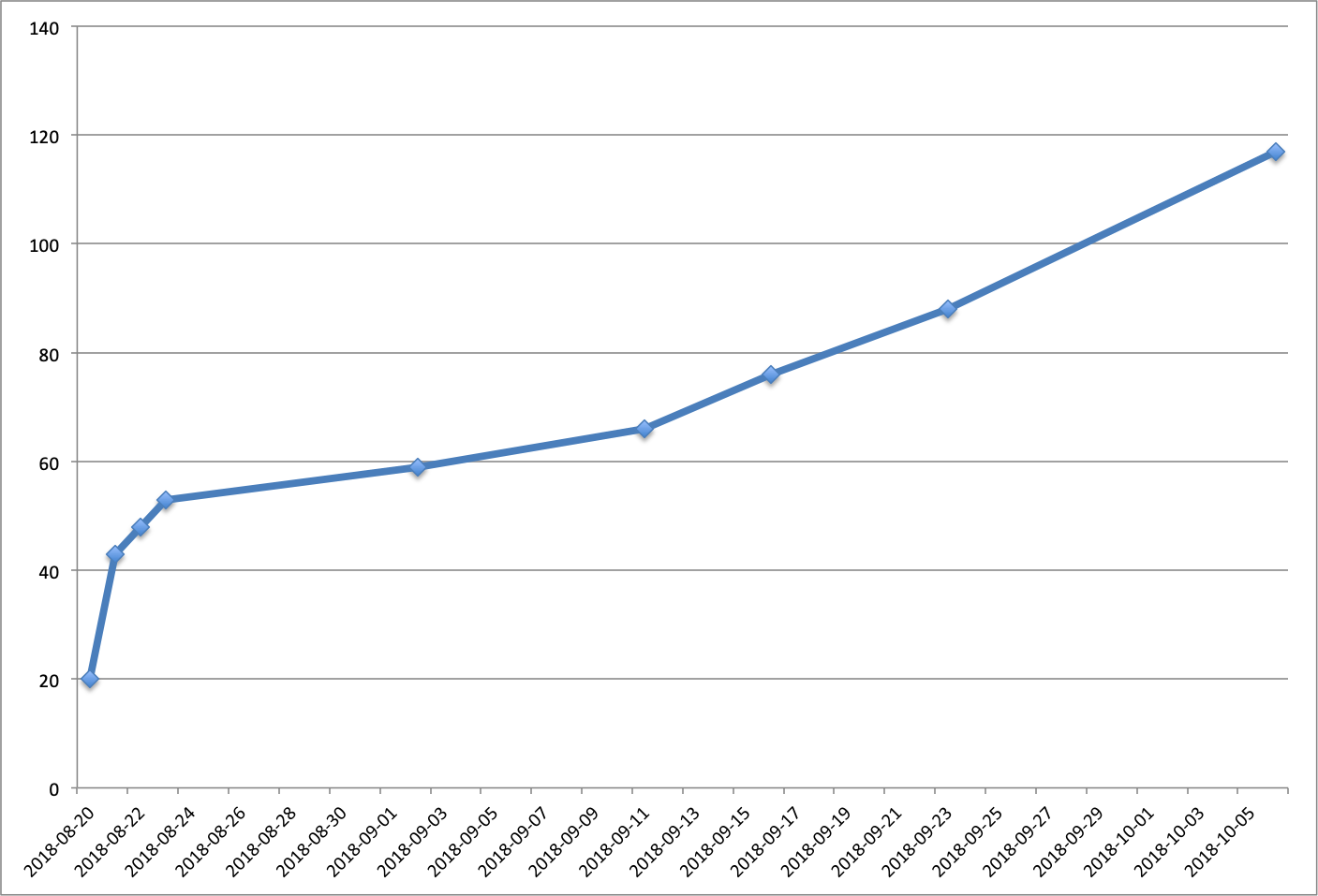
These are double spaced Word pages with placeholder footnotes. None of it has been edited yet, but I expect that most of what’s in these six chapter drafts will be usable for the final dissertation.
A month in
Even before the grading starts, combining five tutorials a week of teaching with all of my dissertation work has been draining at times. I just got home from a long day, but before I can sleep I need to prepare my lesson plan for three tutorials tomorrow and my semi-structured interview questions for two new research subjects.
Independently, I was talking with a friend about our maladaptive tendency in personal social relations to focus excessively on things that have gone wrong and people who either don’t now or never did see us the way we would prefer to be seen. If there’s a range of feelings others can hold about us from -100 meaning absolute loathing to 100 meaning profound admiration and over-riding love, we overemphasize efforts to try to shift the people at -50 back toward the positive — ignoring how the world is full of people who are willing to start us at 0 with no learned skepticism about us.
School’s social side starting
Orientation week is a nice feature of being in school in September. I don’t really remember what happened at UBC / in the Foundations program / at Totem Park residence in 2001, but during my grad orientation at Oxford in 2005 I met my friend Margaret and in my earliest hours at Wadham College I met Nora and Kelly. At U of T so far I have mostly prioritized Massey College orientation events, since I became a junior fellow the same year I began my PhD. This year I have put a bit less emphasis on Massey (being off the JF list, I don’t get invited to most events anyway) and given more attention to the Department of Political Science.
Yesterday evening the department has its start of term party in the Faculty Club. It gave me a chance to ask Peter Russell about the BC Court of Appeals decision on the Trans Mountain pipeline. Firstly, he thought legislation to aid the pipeline’s approval was appropriate and likely, given the political circumstances of the Trudeau government. He clarified that in an ideal world people would share our green sensibilities and no new fossil fuel projects would be going forward, but you can’t get elected in Canada now with such a platform. Secondly, that led to a discussion of whether democracies are capable of solving climate change. It’s especially concerning when you get a radical answer from an 80+ year old emiritus faculty member, but his view was essentially “there are good reasons to think not, and a lot of political theorists and ecologists have gotten into why”.
After the official departmental do, a loose band of us walked a couple of kilometres to what turned out to be a highly interesting informal party associated with GASPS: the Graduate Association of Students of Political Science. I had some great conversations on everything from the world’s ongoing nuclear arms race to sampling methods in field research. Hopefully I will see some of the new people I met again. It’s a bit uncertain because there aren’t many places and circumstances that bring together a large share of U of T’s PhD students. People in the same classes and preparing for the same exams bond, as do people who always work in the same study space, but it’s quite possible to never develop social relations with the broader membership of MA and PhD students in politics.
OSAP and U of T in year seven
Since U of T has replaced the inadequate funding it issues in years 1–6 of the PhD with none at all it is causing new problems and reinforcing my determination to finish and defend my dissertation by September 2019.
First OSAP (the Ontario student loan program) told me I would get no fall payment because it was all being put toward my $9000 in tuition. Today, OSAP contacted me again to say my funding was rejected because U of T says I’m not registered. Digging through the U of T online portal, I found that they will only confirm my registration after I pay $2550.
That’s confusing since OSAP said it was already paying them, but this is probably just a case of two awkward bureaucracies failing to mesh. I made the minimum U of T payment, so hopefully they will tell OSAP to reconsider their rejection.
I don’t want to go through this again in 2019, so there is every reason to get through the literature review, data collection, writing up, editing, and defence expeditiously.