Tickets to both shows of Toronto350.org’s October 15th “Do the Math” screening are available for free via Eventbrite.
[Update: 3 September 2013] There is now a Facebook event as well.
climate change activist and science communicator; photographer; mapmaker — advocate for a stable global climate, reduced nuclear weapon risks, and safe human-AI interaction

Generally musings of the day, usually accompanied by a photograph
Tickets to both shows of Toronto350.org’s October 15th “Do the Math” screening are available for free via Eventbrite.
[Update: 3 September 2013] There is now a Facebook event as well.
Things are not progressing well on my paper for the 31st. I am a bit burned out from my comp on the 22nd, and neither the humidity nor my lack of a proper base of operations is conducive to productivity.
I will need to force myself to grind away at it tomorrow, as the rest of tonight is tied up with the Toronto350.org end-of-month potluck and planning meeting.
In its present format, the PhD program in political science at the University of Toronto requires each student to take core seminars and comprehensive examinations in two subfields. These are chosen from among Canadian politics, international relations, comparative politics, public policy, political theory, and development.
Beyond the core seminar, you need to take a set number of credits in courses related to each subfield.
Provided I passed my comp, I have dealt with the first requirement. The department is pushing me strongly to do international relations as my second option – because they can give me some course credit for the M.Phil in the subject I already completed – but I feel like I have already had more than enough of the core IR literature. I’m really not interested in the realist, liberal, constructivist debate.
My plan is to attend the first core seminar for at least IR, comparative, and public policy and then decide which seems most promising. I can then finalize my selection of an additional course in the field for the first term.
Some of the more interesting options include:
It may also not be a bad idea to take one of the methods courses.
Peter Russell is again teaching Canada in Question: A Country Founded on Incomplete Conquests, which I highly recommend to anyone interested in Canadian politics.
I was also planning to maintain my personal tradition of informally auditing one class per term, with HIS 343Y1-Y: Wesley Wark’s History of Modern Espionage course, for which I already read the textbook, but it seems he isn’t teaching it this term. The course is still running, however, so I may drop in regardless.
I just finished my major field examination in Canadian politics.
It was hard.
I found the toughest part to be just dealing with three significant essays in four hours – keeping them straight in my mind, and making a semi-convincing argument while trying to cram in the maximum number of references.
I should hear if I passed within two weeks.
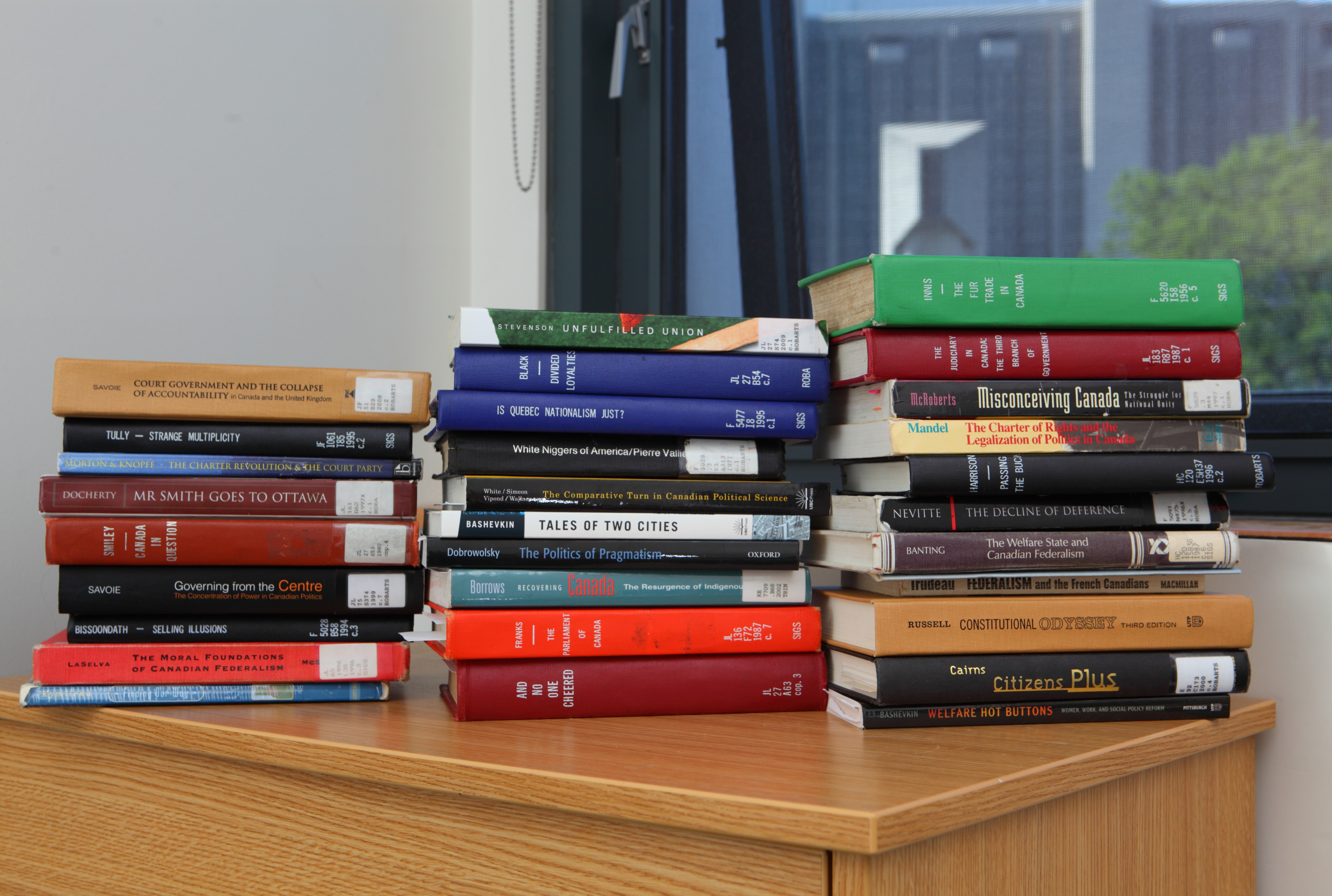
These are some of the books I have out from the library at the moment, while preparing for my comprehensive exam on Thursday. The 249-item reading list (Word, PDF) is quite intimidating, as is the expectation that a large number of sources will be cited in author-year format.
A significant portion of my time between now and Thursday will be spend quizzing and re-quizzing myself on the dates when key books were published.
The major tasks from my July 22nd to-do list have all been advanced, but not yet completed. That will change over the next three weeks:
At the same time I will be moving from Morrison Hall to temporary accommodation with cousins, and then into Massey College. I am also attending my cousin Ivanka’s wedding on the 31st, and serving as an unofficial auxiliary photographer.
I am really looking forward to having all my data (books, papers, and hard drives) in one place, so I can do a mass sorting and consolidation. My laptop and iMac are both groaning from a huge amount of photographic data, so one big project for September will be acquiring a file server, shifting big blocks of data around so all my computers are happy, and developing and implementing a new backup regime for the whole shebang.
Living in a residence where nobody knows anyone else and where no action can generally be attributed to a specific individual illustrates what happens when the bonds of community are thin.
The refrigerator is often crammed with rotting, stinking food – all of it heaped together in opaque plastic grocery bags. Someone has been dumping a pot worth of tea leaves into the sink twice a day all summer, never throwing them away or even washing them down the drain. Someone also seems to have a habit of drinking 4-6 disposable cups of coffee in one of the bathrooms, then leaving the cups strewn across the floor. The other day someone stole my (inexpensive) razor, which I had been using since I was an undergraduate and which I left in the main unisex bathroom accidentally for a few minutes. Desirable food regularly goes missing, the kitchen and common room are always gross (especially during weekends when there is no staff to clean), with stained couches and carpets, sticky counter-tops, and a microwave spattered with vaporized remnants of instant meals. People are often raucous and loud at night. At one point, someone discarded a large amount of food belonging to other people so they could put four 24-can flats of Coca Cola into the shared fridge at once.
Morrison Hall has been good in terms of proximity to libraries, air conditioning, and extremely fast internet access. I will naturally be happy to move back into Massey on August 30th. I just wish it were possible to do directly, without the 9-day purgatorial period that arises from Morrison’s August 21st move-out date.
More than a year has now passed since I left the public service. The most surprising thing about that is how I don’t feel like I have ever regretted the choice. There are individuals who I miss, and I certainly miss the regular paycheques, but there have seldom if ever been times when I would have exchanged my current situation as a student for a magical instant return to being a full-time civil servant.
This contrasts, for instance, with my choice of PhD program. Most of the time, I remain convinced that the University of Toronto was the best choice from among the schools that accepted me. That said, there have surely been times – living in an inhospitable city where the traffic makes me too afraid to cycle – when I ponder what it would have been like to study at the University of California, Santa Barbara – and with three times as much funding, to boot. Naturally, I have also felt open at many times to the appeal of being at the University of British Columbia and back in Vancouver.
By contrast, memories of the civil service never leave me feeling a desire for sudden transplantation. I am grateful for the time I spent there; it is certainly a good way to learn about how this country operates. Oftentimes, however, my strongest sense when thinking about the institution is about how sad and disturbing it is that our federal civil service is so inactive about climate change. Indeed, it is probably a net contributor to the growing severity of the problem, given how much priority advocating for oil pipelines and for scrapping rules and processes for environmental protection has gotten over the actual implementation of policies with real potential to substantially diminish Canada’s greenhouse gas contribution. I feel like people in fifty years will find it surprising to learn about how unconcerned our leaders were about the problem, how wilfully blind they were about the disjoint between the policies they supported and their supposed goal of avoiding dangerous climate change, and how ignorant and complacent the Canadian population at large was about the problem. The gap between our policies and what climate science shows to be necessary is so wide that it makes our present approach look like little more than a distracting facade, designed to sustain the public misperception about how insufficient our current approaches are.
As the above probably makes clear, my main feelings about the public service are anger, frustration, and sadness. Sadness because of the gap between what we are capable of, and what we are actually doing. The civil service is full of intelligent, dedicated people who are making a substantial and genuine effort to make Canada and the world a better place. At the same time, they are confronting the chasm between an elected government that has never been serious about curbing climate change and a situation in the world where the problem is increasingly evident and threatening. The full effects of today’s emissions won’t be felt for decades, so if we are to avoid truly terrible outcomes, global emissions need to start diving soon. Yet that is far from what’s on even the ambitious side of the political agenda. The real policy we are enacting is for a perpetuated status quo of ever-growing fossil fuel production, despite the clear scientific basis for seeing that status quo as suicidal.
Much can change politically if real and immediate disaster does come to pass. The general public might finally accept the argument that imposing climate change on future generations is an intolerable wrong; or they may simply perceive it happening quickly enough to seem like a threat to themselves. Politicians may finally accept that fossil fuel companies aren’t primarily generous tax-payers and contributors to election campaigns – but rather entities working hard to undermine the habitability of the planet. Something on par with a major war may blow up the issue enough psychologically for it to rise to an appropriate level of urgency.
Wherever the impulse for change comes from, it won’t be from the federal civil service, which is entirely too contented with continuing to support policies that propel us toward planetary catastrophe. It may well not be in academia either but, at least for the present moment, the latter seems a more promising place to dedicate my energy for now.
Andrea’s wedding was great. However, the ‘stay one night in Ottawa with no accommodation’ plan is shaping up badly. The rain was unexpected, as was losing my suit bag and being unable to change. Also, the bus station is closed from 2:30am until 5:00am.
Tomorrow I am doing a rapid jot over to Ottawa for the wedding of my good friends Andrea and Mehrzad.
It will be four and a half hours on the bus tomorrow, starting at 10:30am and accompanied by comprehensive exam reading material. The wedding is from 7:00pm until 2:00am. I will then be hanging around an all-night diner in Ottawa until it is time to head for my 9:30am return bus.
Spending a bit of time in Ottawa relaxing and visiting friends would surely be pleasant, but many projects are looming over me and I need to prioritize them over other considerations until the end of August.
Photos from the wedding will go online once I find time to process them.