On failure

Here’s a hypothesis I have been trying out lately:

If you aren’t failing and getting rejected a lot, you aren’t being ambitious enough.

It’s a point of view that helps keep a person going when they are applying for job after job, with no interviews so far. It could also be of some comfort to those who had solo Valentine’s Days.

And, it might even be true, to boot! If we are going to expand ourselves as people, we need to do things which we feel uncomfortable about: give lectures to more people than we feel at ease with, play Starcraft II (or your piano) at a higher level of difficulty than you feel comfortable with, take on an ambitious project, submit work to journals that might reject it, give an honest answer to a challenging question in hopes that it will be well received…

Depending on the field of endeavour, it seems fair to say that you should be failing 90% of the time – with ‘failing’ meaning that you think in retrospect that you could have done something better, in undertaking whatever you just did (whether you succeeded or failed). If more than 10% of your attempts are going off absolutely perfectly, you should probably try something more challenging.

Reader mobility

Just out of curiosity, how many of the readers of this blog still live in their place of birth?

For those who live elsewhere, how many different places have you lived for a good stretch of time (say, more than a year)?

I was born in Vancouver and now live in Ottawa. Aside from those two cities, I lived in Oxford for two years and Montreal for three months.

The CBC is growing on me

I wasn’t always the biggest fan of the CBC. I found the argument that we have plenty of diversity in commercial stations relatively convincing. More recently, I have found myself more appreciative of public broadcasters including the CBC and – for international news – the BBC. They do cover politics well.

In addition to providing good content with no advertising, they both run very useful websites.

Express mail and spectacles

I really appreciate the efforts of everyone who helped me get my Action Canada fellowship application together – both my references and the people who have helped to assemble everything across oceans and continents, especially my friend Antonia.

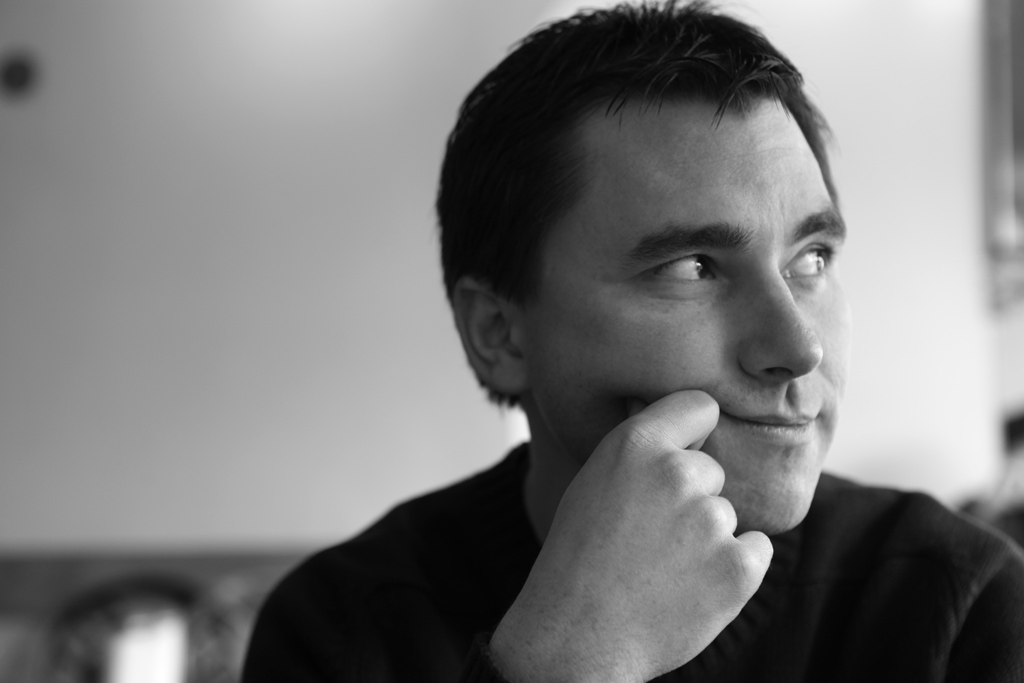
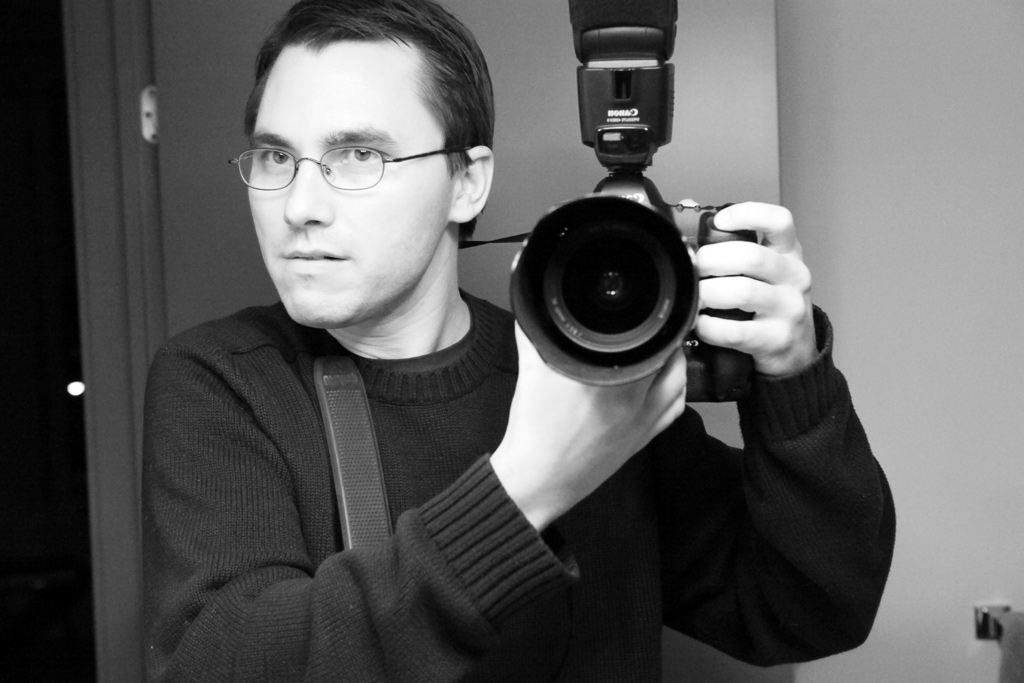
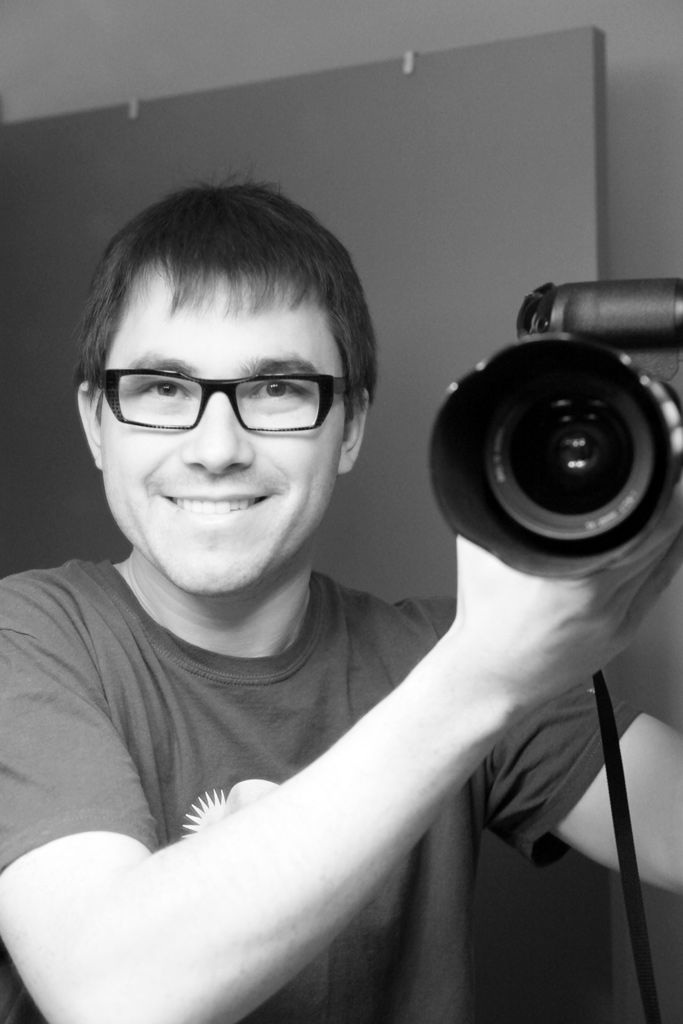
Aside from dashing around getting reference letters and mailing a priority courier package today, I also got some new glasses from Albert Opticians on Sparks Street. They are much bolder than my old ones, and my prescription seems to have changed a fair bit since I got my first pair in 2001.

Indeed, the world has quite an uncanny quality at the moment. Everything is much sharper than I am used to it being; I don’t need to squint to read; and the three-dimensionality of everything is much more noticeable than normal. Walking around for the first few minutes, things were so different, I felt unsteady on my feet. Even now, it is super noticeable when a computer screen is being viewed from an angle other than straight-on. Also, three dimensional objects seem distorted when examined close up, as though being viewed through a wide-angle lens.

For comparison:

Bonus: My father in specs

[Update: 12 February 2011] Here’s a more human shot with the new glasses.

Technology for content creators

As a technology geek, I can see the appeal of devices like the Kindle and the iPad, especially as far as portability goes. It would be great to have a device small and light enough to carry around all the time, yet less annoying to use than a smartphone.

That being said, the iPad in particular seems to have major disadvantages as a content-creation machine. The web browser has trouble with some parts of the back end of WordPress (creating posts, editing posts, dealing with media, etc). The multitasking capabilities of the device are also somewhat lacking. Rather seriously, copying and pasting on the iPad is far from easy or intuitive – a pretty critical failure for someone who needs to move text between emails, blog posts, blog comments, other webpages, etc.

To me, the MacBook Air looks like a far superior option for people actually heavily involved in the creation of content. It’s a real computer that is fully under your control (you can even install Flash!), and it has a real keyboard and real web browser. If you are doing more extended work, you can plug in a mouse. It lets you take content from a USB key, or plug in your iPod to charge. Alongside all of that, it is remarkably small and compact – especially the 11″ version. It’s not as powerful and capable as a full computer, but it is plenty capable of accessing the internet and email, which would be the critical functions for me. If I need a computer that can do some heavy lifting, I can always go home and use my Core2Duo iMac.

If I wasn’t in the process of saving up for an uncertain financial future, I would almost certainly go out any by one to replace my heavy and increasingly non-functional G4 iBook. As it stands, if I do find myself heading off to join an academic program, it is probably an investment I will make.

Ballet announcers

It occurred to me that one reason why having an announcer is useful when watching a competitive sport being played is because it reduces how much you need to know and think in order to understand what is going on. Announcers describe things like the histories of particular players, the roles of people in each position, and strategies. This lets you enjoy the spectacle without remembering everything about it, and without having to exert excessive effort to understanding what is going on. That is particularly useful in complicated sports with lots of rules, like baseball and football. Sports obsessives may find it surprising, but I think ordinary people tire of remembering a million complicated rules (just as ordinary people probably tire of the numerous and often arbitrary rules of grammar adored by pedants).

It also occurred to me that there are sports that forego announcers, often at least partly because they clash with the sport’s aesthetic. Dancers, figure skaters, and ballet dancers are expected to be silent and make it look easy. Having announcers overlaid on top of them seems crass, and like it would detract from the art.

It could be an interesting performance piece, however, to overlay constant narration onto an athletic performance that usually lacks it. A ballet with hockey-style announcers might be more accessible to people who don’t know much about ballet and who don’t want to spend the whole show puzzling about what is going on (the same reason there are short summaries at the start of Shakespeare’s plays – perhaps modern novels should have those too).

Widening the search

A while ago, I wrote about how I am looking for climate-related jobs in Toronto. So far, the search has not gone especially well. Positions listed tend to be either very junior or too senior. Also, most of what is available looks more tedious than meaningful or engaging.


For a number of reasons, I am now broadening my focus beyond Toronto. I am looking for jobs anywhere in the world that would offer the opportunity to apply my knowledge and skills to meaningful work on helping to fight climate change. I am also considering academic programs that would be useful, that would put me in contact with people doing interesting work, and that would put me in places where new and important ideas are developing.

If readers have any suggestions, please let me know.

High school science

Talking with Emily the other night, I was reminded of something that happened to me while I was attending Handsworth Secondary School, in North Vancouver. I can’t remember which grade it was in, but I had a large group lecture in ‘science’ (back before they were split by sub-discipline) and one topic covered was buoyancy.

The lecture was taught by Mr. Salkus, one of the two or three teachers who I remember being seriously important for me in high school. At the end, he presented a problem to the class: working out how many five gram helium balloons of a set volume it would require to lift him. Naturally, his weight was provided.

Because I left elementary school having read all the science books I could handle, I started high school with quite a head start in chemistry, physics, and biology. I remember the The Usborne Illustrated Dictionary of Chemistry and the The Usborne Illustrated Dictionary of Physics being favourite childhood texts. (Parents, buy them for your children!) As a result, I was allowed to take Science 8 and Science 9 simultaneously, and move to Science 10 in 9th grade.

One problem with this approach is that my math lagged behind. Math also wasn’t a subject I was particularly strong in. Along with French and gym, it introduced Cs into my high school report cards. I remember, in Chemistry 12, having my brilliant lab partner explain that a problem could be solved easily using an integral, but having no idea how such a thing was done. (Later, as an undergrad, I had a similar experience in an early economics course with regressions.)

So, at the time of this balloon lifting problem, I was not comfortable with algebra. I knew that an algebraic equation would be the way to work out the answer: first by comparing the density of air and helium, then by working out the net lift from each balloon. What I didn’t know was the mathematical technique for doing this properly. Instead, I solved it using an arithmetic kludge.

A prize had been promised to whoever got the answer right, and I remember submitting mine (one of only a small few who did) with nervousness, given that I knew my approach to be somewhat faulty. The next lecture, however, Mr. Salkus gave me a mini Toblerone bar, along with the two students who had actually solved the problem correctly. Maybe he realized that my math classes had lagged behind my science classes; maybe he just felt inclined to reward my effort. In any case, it was one of the things that made me remember him as an unusually good teacher.