New tripod

For several years now, I have been wondering about the fate of the Manfrotto tripod that I purchased back near the very beginning of my photographic hobby. I remember the aluminum tripod and ball head costing more than my first SLR and lens: a Pentax MX Super with a manual 50mm lens. I left the tripod in a closet when I went to Oxford and haven’t seen it since, despite a fair bit of concerted searching during a couple of the periods when I was in Vancouver.

Due to a holiday promotion, I have bitten the bullet and picked up a new Manfrotto tripod. This one – a 725B Digi – is a bit smaller and lighter than my old one, through the overall design and construction is very similar. The two biggest things it lacks, in comparison to the one I hopefully still have in some obscure Vancouver corner, are (a) the ability to position the legs at any of three stable angles (due to push-in aluminum blocks) and (b) the option to invert the centre column for use very close to the ground. The biggest advantages are the somewhat smaller overall dimensions and lesser weight. Other differences include (a) a lever rather than a screw for tightening the centre column, (b) a different design for the lever that secures the ball head, and (c) four-segment legs rather than three-segment ones. The two models are different enough that I will not be annoyed if the old unit does turn up in the course of future rummaging.

Given the reality that I will be at work during most of the daylight hours between now and the spring, having a tripod on hand makes a lot of sense. It is also nice that this model is compatible with the tripod plates from the previous stabilizer, including those affixed to the bottom of my Elan 7N and Rebel G.
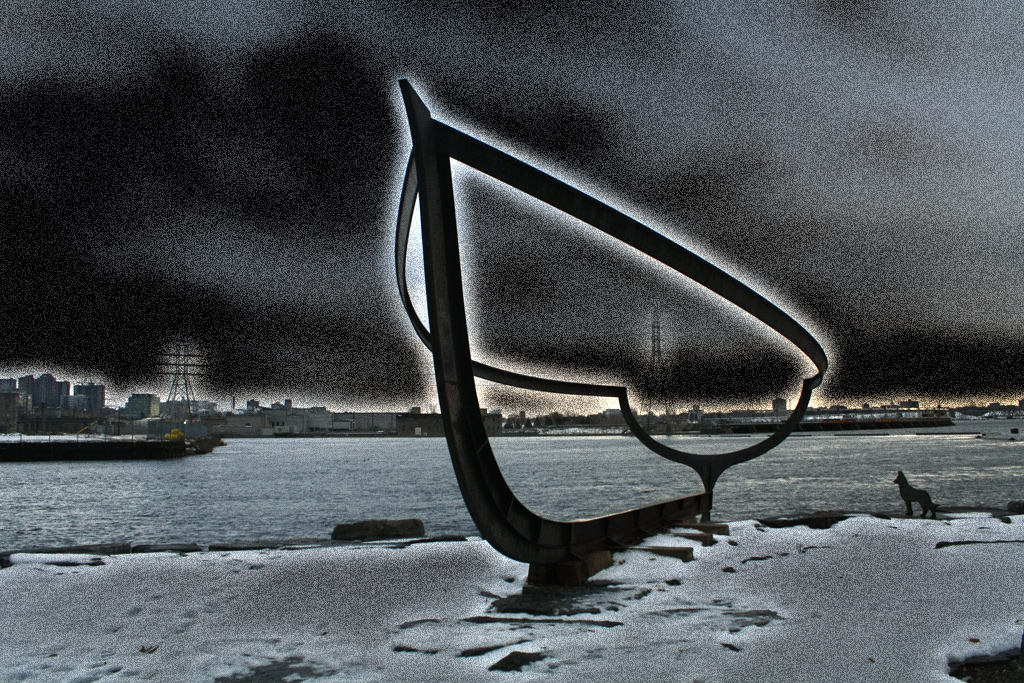
The cold in Ottawa

In my experience, Ottawa has a pretty standard multi-level system to how cold it is in any particular environment. This is reflected on two scales: a static scale based on how cold you would feel in ordinary indoor clothes and a dynamic scale based on what you were wearing in order to deal with the conditions shortly before.

This is the dynamic scale:

  • The hottest part of the scale is where you are seriously bundled up and unexpectedly delayed in a warm environment. For instance, you hop onto a bus to go a couple of stops and it gets stuck in traffic. You are about to go out, so you don’t want to disrobe, but remaining in the heat is very uncomfortable.
  • The level varies depending on the amount of wind. Sometimes, it is the ordinary transition from being outdoors to being in a warm building or vehicle. Sometimes, it is the transition from being somewhere windy to being somewhere outside but protected. In some cases, the latter transition is actually far harsher. There have been times when after waiting for a bus in an exposed area, I moved to a covered area and felt almost as warm as in the topmost scenario above.
  • Below those is the neutral level, in which you are basically adequately dressed for your surroundings and can operate comfortably for a good period of time at your current level of activity.
  • The next level is cold due to something lacking: either the result of being slightly less active than you were recently, or because you are missing one or two items that would make you comfortable. For me, those things are most often a hat, adequate gloves, or warm socks overlapping with long johns.
  • The next level is being significantly cold temporarily, either while your body heat spreads through clothing you just put on or while you ramp up to whatever stable level of physical activity you will be maintaining.
  • With the next level, minor persistent suffering arrives. Usually, this is the result of poor planning. Most often, this is a case of not expecting to leave a place as late as you did and ending up walking by night instead of by evening. Wind of unexpected ferocity can also cause this.
  • Beyond that, the levels aren’t really distinct. At the extreme edge – which I have experienced once or twice – you are actually cursing your way through savage winds from doorway to doorway. In this situation, you will actually feel that injury (and ultimately death) will result before long if you remain out in the cold and wind.

In my experience, the best way of coping with all this is to be prepared, try to anticipate the conditions in which you will find yourself, and dress in ways that are conducive to moving both up and down the scale. Having long johns, a wicking layer, two fleece layers, and a wind/waterproof outer is a lot better than having a wicking layer, one absurdly warm layer, and a shell. The former lets you move through the scale in one-step increments, while the latter commits you to two or more.

One odd consequence of the relationship between warmth and activity can be just how much those of us with stingy thermostats need to wear in order to sleep comfortably. On nights where walking around in moderate garb is perfectly tolerable, actually sleeping in my flat may require two wool hats, long johns, trousers, a fleece, two pairs of warm socks, a fleece sleeping bag liner, and a down duvet. The question then becomes whether you will be woken by cold as the night progresses (likely if you went to sleep early), or by unbearable heat when the sun finally starts to thaw the city at dawn.

Talkin’ ’bout a coalition

The prospect of an NDP/Liberal coalition is certainly an intriguing one. For one thing, there is a lot of history to be made in parliamentary procedure. What can the Conservative government do to resist falling? How should, must, and will the Governor General act in different scenarios? If a coalition did come into being, how would it govern and how long-lasting could it be?

Given the NDP’s opposition to Stephane Dion’s ‘Green Shift’ carbon tax, it is especially unclear what sort of climate policies would emerge from a coalition government. They would be in a doubly weak position to create rules that would govern industry for years. Firstly, well-founded questions about the longevity of the coalition would make regulated industries wonder whether spending to meet new requirements makes commercial sense. In the absence of certainty about long-term climate policies, intelligent investments cannot be made. Secondly, there is uncertainty about what will happen to climate policy in the United States. How much of a priority will it be for the new Obama administration? Will Congress press forward or hold back on the issue? Will the US seek a national system, or will they try to come up with an integrated North American system as proposed by the Harper government? What will happen to the regional climate change organizations, such as the Western Climate Initiative?

These are certainly interesting times. Hopefully, the uncertainty will not serve to perpetuate inaction.

[Update: 28 January 2009] As of today’s Liberal response to yesterday’s Conservative budget, it seems the possibility of a coalition is dead, at least for now.

Distributing hydrogen

Among a number of other strong points, this WWF report (PDF) on “The end of the oil age” highlights some of the problems with hydrogen as a fuel, particularly for vehicles. One major issue raised is the difficulty of transporting the stuff:

Despite having a high specific energy (i.e. energy content per unit mass) of 142 MJ/kg, the physical density of hydrogen is just 84 g/m^3, which means that one kilogramme of the gas occupies around 12 m^3 at normal temperature and pressure (NTP). By comparison, one kilogramme of natural gas displaces 1.4 m^3 and packs a specific energy of 54 MJ/kg. This means the volumetric energy density of hydrogen is only one-third that of natural gas, making the cost of a hydrogen pipeline around six times higher than a natural gas pipeline of equivalent energy capacity. The IEA projects that worldwide investment required to develop a hydrogen pipeline network might be in the order of US$ 2.5 trillion, while noting that the energy required transporting hydrogen via pipeline is on average 4.6 times higher per unit of energy than for natural gas. This equates to an efficiency loss of ten percent over a distance of 1,200 km; the same energy would move natural gas 5,000 km.

As an alternative to pipeline distribution, like natural gas, hydrogen may be either compressed to around 200 atm or chilled close to absolute zero for transportation via truck or ship. Both processes are energy intensive, resulting in additional efficiency losses in the hydrogen supply chain, and super-cooling requires venting that can further deplete the stored fuel. According to one study, it takes 22 tube trailers at 200 atm or 4.5 liquid hydrogen tankers to carry the energy contained in a single gasoline tanker of the same gross weight.

Comparing the hydrogen distribution efficiencies with our electron pathway, we know that electricity grid transmission and distribution (T&D) losses of around 6-8% are typical in OECD countries. Whether carried by pipeline, tanker or ship, it is therefore inconceivable that centrally-produced hydrogen will ever match the efficiency of the electricity grid. Only if it is synthesised at or close to the point of use would hydrogen avoid significant energy losses associated with distribution. Even then, mindful that our guiding principle is the exclusive use of energy from sustainable renewable resources, hydrogen produced in localised facilities would still need to be compressed for storage and/ or delivery directly to the vehicle, which would of course incur further energy losses.

As I have said several times before, hydrogen is a low quality fuel, difficult to handle with low energy per volume. Even with electrolysis at 80% efficiency, the report concludes that hydrogen vehicles would have an overall efficiency of 28%, when production, transport, and the operation of fuel cells are taken into account. Given that vehicles using hydrogen fuel cells would actually be using electricity to drive their motors anyhow, it seems more sensible to focus our efforts on battery technology, which the report concludes to be 23% more efficient, with a lot less new infrastructure to build.

4^2 + 3^2

On the occasion of my 25th birth{}day (intentionally misspelled to protect against spam robots), I will briefly enumerate the best things that happened in the past year:

  1. Spending the summer with Emily
  2. Surviving an Ottawa winter, without losing any fingers or toes
  3. Visiting Montreal and Toronto many times
  4. The well-attended party in North Van last December
  5. Taking about 10,000 photos (a few of them quite good)
  6. Meeting some friendly locals
  7. Being visited by some non-local friends
  8. Learning a lot about climate change, the environment, and government
  9. Adventures in beardedness
  10. Seeing both my parents in Ottawa
  11. Writing a lot about climate change
  12. Camping, canoeing, scaring geese, eating pike
  13. New Year’s at Nick’s
  14. Interacting with voles, bulldogs, Goliath beetles, groundhogs, and Mr. Mistoffolees
  15. NYC and Vermont
  16. Cycling along rivers and canals
  17. Moving from a cubicle to an office; mitigating an office flood
  18. Spending time with my aunt, uncle, and cousins in Bennington
  19. Paying down student debt (though not so much as to not get a new computer and camera)
  20. Reading several good books
  21. Seeing Obama get elected
  22. Formally graduating from Oxford
  23. Having 46,157 blog visitors, including 1,234 on August 4th, using 32,119 different computers.
  24. Introducing Sasha to roller-coasters
  25. Spending time with Tristan, Gabe, Alison, and Meaghan

Hopefully, the coming year will involve the same sort of contact with friends and family, though a few Grand and Operatic Events of Colossal Magnitude and Importance would not go amiss.

First venture into RAW

The photo above is the first one I ever produced after the fact, using the RAW data from a digital sensor. Given my current suite of software (iPhoto ’08, Photoshop CS, and Canon’s Digital Photo Professional), using RAW is a bit of a pain. iPhoto imports RAW files incorrectly (producing odd black frames), at least when you have your camera set to generate both RAW and JPEG files simultaneously. The Canon EOS utility works, when it comes to getting the .CRU (Canon’s proprietary RAW format) off the camera, but it does so slowly and imports redundant copies of the JPEG files.

All that being said, there are good reasons to put up with the bother. RAW lets you adjust the white balance and exposure far more effectively after the fact than JPEG does, and ultimately represents a far superior digital negative. For now, RAW files may be an awkward annoyance even on my excellent new Mac. In a few years, the storage space and processing power to deal with them will be ubiquitous.

In short, it seems worth shooting RAW+JPEG whenever there is a decent chance you will want to use any photo in an artistic way.

To any friends currently in Toronto

If you are a friend of mine and happen to be in Toronto today, please let me know. Emily and I are having a joint birthday party at Tristan’s house, and your phone call or email will lead to directions being sent to you.

Please don’t be offended if you haven’t already received a personal invitation. It is quite challenging to keep track of who is where at what time.

Vegan curry is promised.

Curt and distant medical personnel

When I compare my experiences as the curious voluntary subject of medical experiments to the recent experiences of my family interacting with medical personnel due to issues with their own health, I am left with the clear sense that the researchers were a lot more courteous, and seemed more genuinely concerned about the welfare of those they were interacting with. All this in spite of the fact that the research subjects were generally healthy.

I realize people in the health system are stressed and over-worked, but I think their work would proceed very nearly as quickly and rather more pleasantly for all involved if they had a more developed bedside manner, or at least made the effort to treat people attentively and politely.

Climate information from nuclear tests

One effect of the testing of nuclear weapons was the introduction of large numbers of unusual radioactive isotopes into the atmosphere, from which they migrated into the seas, developing ice sheets, and living things. As a consequence, a wide variety of physical and biological systems got inadvertently tagged with markers that could be traced. As with the radioactive dyes used in some forms of medical imaging, the isotopes allowed scientists to study various flows in the atmosphere, hydrosphere, cryosphere, and biosphere.

For example, nuclear testing taught scientists about deep ocean currents. Unlike the atmosphere, where wind and temperature surveying had been happening since the air forces rose to prominence in the Second World War, there were no systematic records of oceanic data. By acting as tracers that could be measured with great accuracy, fallout from atomic testing allowed for oceanographic and ocean-atmosphere models to be improved. In a prior connection between atomic testing and climate science, Roger Revelle had actually been working on the Castle series of thermonuclear tests in the Marshall Islands when he did his first work on oceanic absorption of carbon dioxide.

A more recent example was uncovered by Ohio State glaciologists, though it was actually the absence of artificial radioisotopes that triggered their attention and concern. The absence of strontium, cesium, and radioactive chlorine from the Naimona’nyi glacier in the Tibetan Plateau demonstrates that the ice formed during the nuclear tests of 1952-58 has already melted.

This is worrisome because the glaciers of the Himalayas play a role in water availability for agricultural areas downslope and the formation of the Asian monsoon.

Cold, glass, and condensation

Users of cameras and eyeglasses will be familiar with the phenomenon of fogging, which occurs when one goes from a cold and dry place into a warm one. This occurs because air can hold about 7% more water per unit of volume for each ˚C of additional temperature. That means that air in warm places is naturally more laden with water than that in cold ones. When the water-laden air hits cool glass, it condenses into a fog that confounds the bespecktacled and shutterbugs.

The other night, I witnessed a special elaboration of this phenomenon unique to conditions including (a) a very cold and dry night (b) a fairly large volume of glass and (c) an instant transition to a warm and relatively humid coffee shop.

The normal fogging occurred, but it would not dissipate after several minutes of waiting. It was then that I noticed that the glass on which the fog had formed was cold enough to freeze it – leaving a thin sheet of ice of the lens. The remedy was a few minutes of huffing to melt the ice, followed by a few more waiting for evaporation.

I am a bit surprised not to have experienced this working with cameras in Finland or Estonia. Like getting mild frostbite walking home from a party, it seems to be an Ottawa experience.