Voice echoing off cave walls

Posting two entries a day with little or no personal content is: (a) time consuming and (b) seemingly uninteresting to the long-suffering readers of this blog. As such, I am declaring one post a day to be the standard, with unlimited allowance for additional posts if I feel inspired.

Sometimes, it is hard to know if anyone is even reading. If you have been, but you never leave comments, I would really appreciate if you did so here.

Sputnik at 50

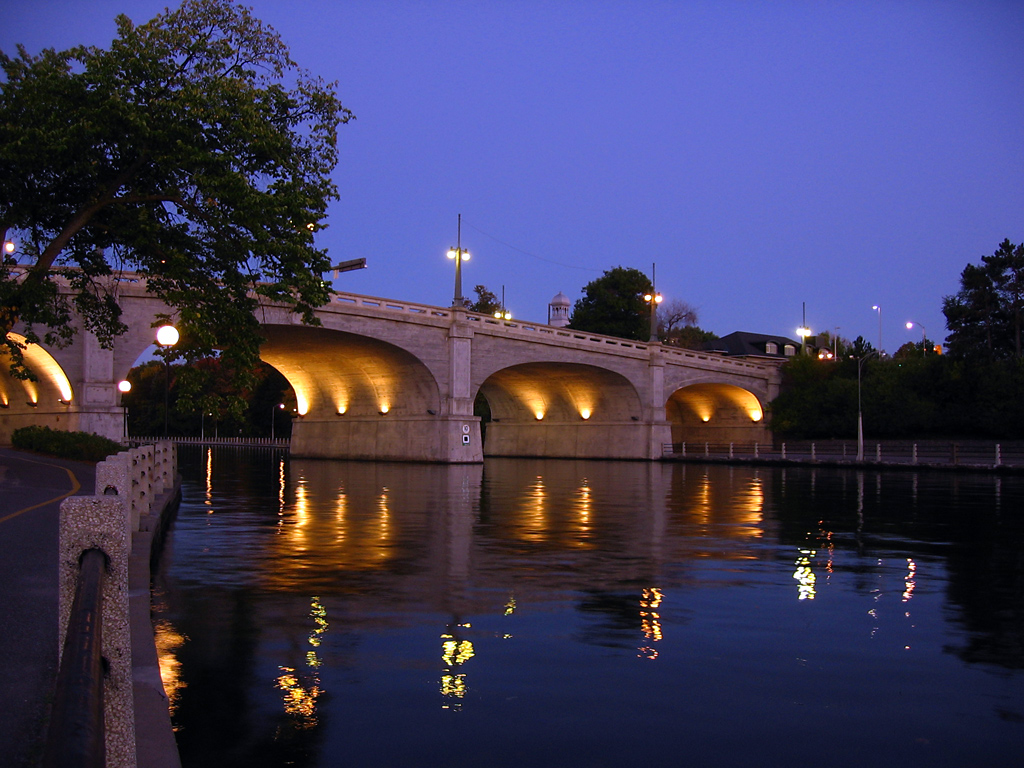
Bridge on the Rideau Canal

Even the Google logo has been altered to commemorate the 50th anniversary of the launch of Sputnik 1: the first artificial satellite. As someone who spends a very considerable amount of time thinking about how things are going to be in 2050 and 2100, it is remarkable to reflect upon both how different the world is from that of 1957 and how similar it is. The big changes that occurred have often been in areas that few if any people would have anticipated the importance of back then. Areas of great enthusiasm, such as nuclear power and space exploration, have only progressed incrementally since the 1950s and 60s.

I mentioned one Sputnik-related irony in a paper published back in 2005:

At the end of August, 1955, the Central Committee of the Communist Party approved the Soviet satellite program that would lead to Sputnik and authorized the construction of the Baikonour Cosmodrome. This facility, the largest of three Soviet launch sites that would eventually built, was the launching place of Sputnik I (and subsequent Sputniks), and the launch site for all Soviet manned missions…

This former stretch of Kazakhstani desert was also, fatefully, the place to which Nikifor Nikitin was exiled by the Czar in1830 for “making seditious speeches about flying to the moon.” He might have taken cold comfort in the fact that in 1955, the Central Committee gave control of the site to the new Soviet ‘Permanent Commission for Interplanetary Travel.’

For all the drama, it remains unclear to me that manned spaceflight serves any useful scientific or practical purpose at this point in time (see previous). In that sense, perhaps Sputnik – rather than John Glenn – was the true template for humanity’s future involvement in space: an 83.6kg ball of metal with a radio transmitter.

PS. My thesis mentions one somewhat surprising connection between Sputnik and climatic science:

A fortuitous bit of funding produced one of the most famous graphs in the climate change literature: the one tracking CO2 concentrations at Mauna Loa in Hawaii. Examining it closely, a gap can be seen in 1957, where David Keeling’s funding for the project ran out. The Soviet launch of Sputnik I on 4 October 1957 led to a marked concern in the United States that American science and technology had fallen behind. One result of the subsequent surge in funding was the resumption of the CO2 recording program, which continues to the present day.

This graph is the jagged, upward-sloping line that Al Gore devotes so much attention to near the beginning of An Inconvenient Truth.

Ice and pollen

Brick and electrical metres

With good reason, ice cores have been getting a lot of attention lately. Their careful analysis gives us priceless insights into the history of Earth’s climate. Using cores from Greenland, we can go back more than 100,000 years, tracking temperature, carbon dioxide concentration, and even solar activity (using beryllium isotopes). Using cores from Antarctica, it is possible to go back about 650,000 years.

Ice cores can be even more valuable when they are matched up against records of other kinds. Living and petrified trees can be matched up, year for year, with the ice record. So can pollen deposits at the bottom of seas and lakes: arguably the richest data source of all. By looking at pollen deposits, it is possible to track the development of whole ecosystems: forests advancing and retreating with ice ages, the species mix changing in times of drought, and the unmistakable evidence of human alterations to the environment, going back tens of thousands of years.

Lake Tanganyika, in Tanzania, offers an amazing opportunity. 676km from end to end, it is the worst’s longest lake. It is also the second oldest and second deepest – after Lake Baikal in Siberia. Core samples from Tanganyika have already documented 10,000 years worth of pollen deposition. With better equipment and more funding, scientists say that it should be possible to collect data from the last five to ten million years: increasing the length of our climate records massively.

I am not sure if such an undertaking is already in the works. If not, it seems like the kind of opportunity we would be fools to pass up. If no government or scientific funding body is willing to stump up the cash, perhaps a billionaire or two can be diverted from their tinkering with rockets.

The coming cold

Mean monthly temperatures for Vancouver, Ottawa, and Oxford

Presenting the mean monthly temperatures of Vancouver, Ottawa, and Oxford on the same graph generates an interesting image. Vancouver is basically Oxford plus a couple of degrees in the winter and about five degrees in the summer. Ottawa is much more variable. In the zones where the lines intersect (around April and October), the mean temperatures for all three places are fairly comparable. That may partly explain why I have been finding the weather so pleasant recently.

I wish I had some data that included standard deviations of temperature on a month-by-month basis. I really have no idea which of the three places would have the most intra-month variability, though my suspicion is that it would probably be Ottawa.

The data for Oxford is from the Radcliffe Meteorological Station. The data for Vancouver and Ottawa is taken from the Meteorological Service of Canada.

The Two Mile Time Machine

Fire hose reel

Richard Alley’s The Two Mile Time Machine: Ice Cores, Abrupt Change, and Our Future provides a good, though slightly dated, explanation of the science of ice core sampling, as a means for studying the history of Earth’s climate. Alley focuses on work conducted in Greenland prior to 2000. The book combines some surprisingly informal background sections with some rather technical passages about isotopic ratios and climatic cycles. Overall, it is a book that highlights the scientific tendency to dive right into the details of one area of inquiry, while skimming over many others that actually relate closely – especially if you are trying to use the science as the basis for sound decision-making.

This book does not really warrant inclusion in the first tier of books to read on climate change, but it certainly provides some useful background for those trying to develop a comprehensive understanding of the area. Arguably, the best contribution it makes is explaining the causes and characteristics of very long climatic cycles: those stretching over millennia or millions of years, with causes including orbital variation, continental drift, and cryosphere dynamics.

Given the amount of new data and analysis that has been undertaken since this book was published, a new edition may well be warranted. In particular, the very tenuous conclusions of Alley’s concluding chapters should either be revised, or defended in the fact of the new data.

Cycling in southern Ottawa

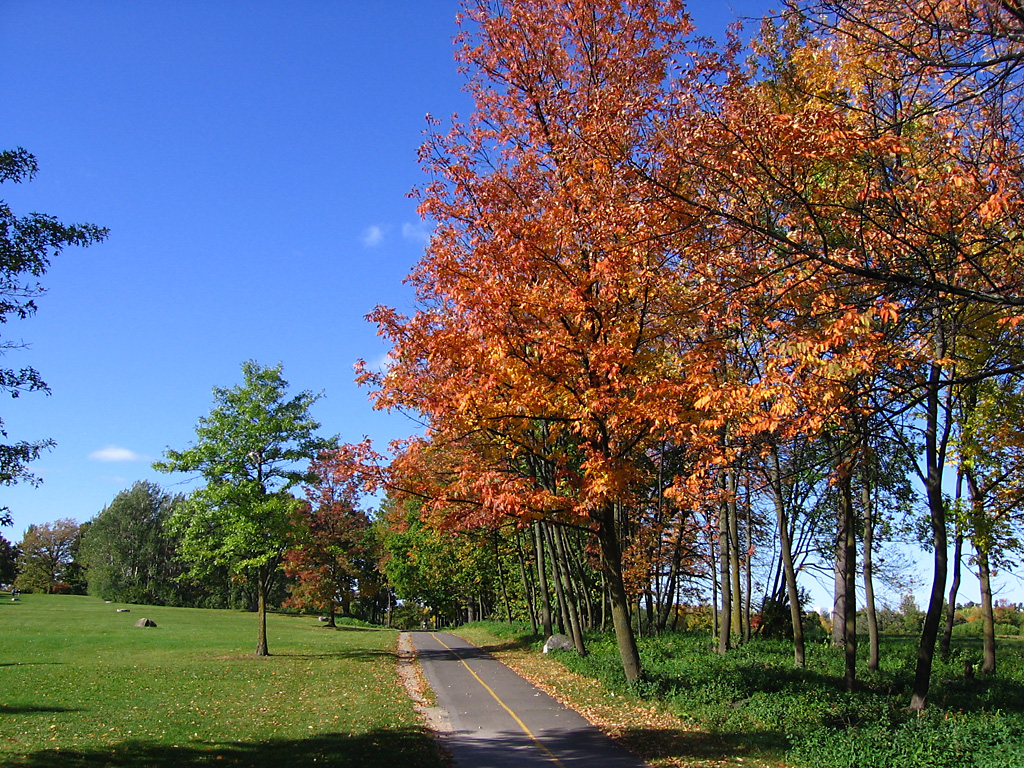
Ottawa bike path

This was an ideal day to explore the Ottawa environs par velo. It was bright and pleasantly cool, and the fall leaves are changing colour. Mostly, I explored the paths south of Centretown on the side of various watercourses: the Rideau Canal, Rideau River, etc. I found Carleton University by accident, and discovered a very nice 10km loop that begins and ends at my house: you head north through the Lebreton Flats to the Ottawa River, then take the riverside paths to the Rideau Canal locks beside Parliament. Ride up that hill (it is good that it is near the beginning of the route), then follow the path alongside the canal until you reach the point where it widens to a well-sized lake. At one end of that lake is a kind of grey floating pavilion, which is actually at the southern foot of Preston Street. Returning to the road system there, you can cycle through Little Italy and back to my flat in a few minutes.

All told, I went a bit more than 46km. The bulk of it was excellent, though my hill-climbing muscles definitely need some re-conditioning after more than two months of bikelessness. Another well-learned fact is that it is foolhardy to cycle along most of the major roads in Centretown. It’s just one red light after another, with irate drivers all around you furious that you seem to be delaying their arrival at the next stopping point by up to three seconds.

I think a bit more random wandering in in order, before I get a cycle map. As with the lake pavilion / Preston situation, it is quite satisfying to have two pieces of your mental map of a city click together on the basis of exploration, rather than the consulting of a pre-prepared guide.

Wheels and muscles

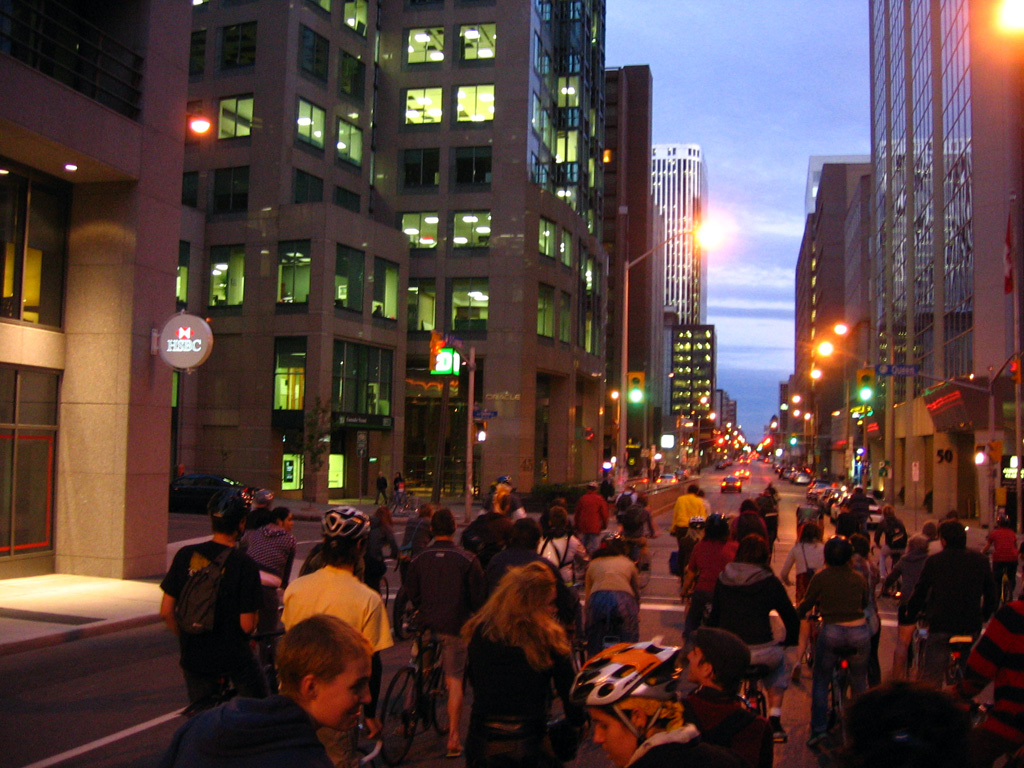
Ottawa Critical Mass

The new bike and I did Critical Mass tonight. This is the third city where I have participated, along with Oxford and Vancouver. This one had the narrowest demographic; every person there looked like they were a stereotypical leftist undergraduate. There’s nothing wrong with that, but it would be good for the event to represent a wider cross section of the bike-using community.

In any case, I am planning to put some kilometres on these wheels tomorrow – perhaps heading along the river until I get bored and/or completely lost, then finding my way back by GPS. Suffice it to say, I am thoroughly excited about this new mode of transport.

A banking analogy for climate

[Update: 22 January 2009] Some of the information in the post below is inaccurate. Namely, it implies that some level of continuous emissions is compatible with climate stabilization. In fact, stabilizing climate required humanity to have zero net emissions in the long term. For more about this, see this post.

Every day, new announcements are made about possible emission pathways (X% reduction below year A levels by year B, and so forth). A reasonable number of people, however, seem to be confused about the relationship between emissions, greenhouse gas concentrations, and climatic change. While describing the whole system would require a huge amount of writing, there is a metaphor that seems to help clarify things a bit.

Earth’s carbon bank account

Imagine the atmosphere is a bank account, denominated in megatonnes (Mt) of carbon dioxide equivalent. I realize things are already a bit tricky, but bear with me. A megatonne is just a million tonnes, or a billion kilograms. Carbon dioxide equivalent is a way of recognizing that gasses produce different degrees of warming (by affecting how much energy from the sun is radiated by the Earth back into space). You can think of this as being like different currencies. Methane produces more warming, so it is like British Pounds compared to American dollars. CO2 equivalent is basically akin to expressing the values in the ‘currencies’ of different gasses in the form of the most important one, CO2.

Clearly, this is a bank account where more is not always better. With no greenhouse gasses (GHGs), the Earth would be far too cold to support life. Too many and all the ice melts, the forests burn, and things change profoundly. The present configuration of life on Earth depends upon the absence of radical changes in things like temperature, precipitation, air and water currents, and other climatic factors.

Assuming we want to keep the balance of the account more or less where it has been for the history of human civilization, we need to bring deposits into the account in line with withdrawals. Withdrawals occur when natural systems remove GHGs from the atmosphere. For instance, growing forests convert CO2 to wood, while single celled sea creatures turn it into pellets that sink to the bottom of the ocean. One estimate for the total amount of carbon absorbed each year by natural systems is 5,000 Mt. This is the figure cited in the Stern Review. For comparison’s sake, Canadian emissions are about 750 Mt.

Biology and physics therefore ‘set the budget’ for us. If we want a stable bank balance, all of humanity can collectively deposit 5,000 Mt a year. This implies very deep cuts. How those are split up is an important ethical, political, and economic concern. Right now, Canada represents about 2% of global emissions. If we imagine a world that has reached stabilization, one possible allotment for Canada is 2%. That is much higher than a per-capita division would produce, but it would still require us to cut our present emissions by 83%. If we only got our per-capita share (based on present Canadian and world populations), our allotment would be 24.5 Mt, about 3.2% of what we currently emit. Based on estimated Canadian and world populations in 2100, our share would be 15 Mt, or about 2% of present emissions.

Note: cutting emissions to these levels only achieves stabilization. The balance in the bank no longer changes year to year. What that balance is depends upon what happened in the years between the initial divergence between deposits and withdrawals and the time when that balance is restored. If we spend 100 years making big deposits, we are going to have a very hefty balance by the time that balance has stabilized.

Maintaining a balance similar to the one that has existed throughout the rise of human civilization seems prudent. Shifting to a balance far in excess carries with it considerable risks of massive global change, on the scale of ice ages and ice-free periods of baking heat.

On variable withdrawals

Remember the 5,000 Mt figure? That is based on the level of biological GHG withdrawal activity going on now. It is quite possible that climate change will alter the figure. For example, more CO2 in the air could make plants grow faster, increasing the amount withdrawn from the atmosphere each year. In the alternative, it is possible that a hotter world would make forests dry out, grow more slowly, and burn more. However the global rate of withdrawal changed, our rate of deposit would have to change, as well, to maintain a stable atmospheric balance.

Here’s the nightmare possibility: instead of absorbing carbon, a world full of burning forests and melting permafrost starts to release it. Now, even cutting our emissions to zero will not stop the global atmospheric balance from rising. It would be akin to being in a speeding car with no control of the steering, acceleration, or brakes. We would just carry on forward until whatever terrain in front of us stopped the motion. This could lead to a planetary equilibrium dramatically unlike anything human beings have ever inhabited. There is a reasonable chance that such runaway climate change would make civilization based on mass agriculture impossible.

An important caveat

In the above discussion, greenhouse gasses were the focus. They are actually only indirectly involved in changes in global temperature. What is really critical is the planetary energy balance. This is, quite simply, the difference between the amount of energy that the Earth absorbs (almost exclusively from the sun) and the amount the Earth emits back into space.

Greenhouse gasses alter this balance because they stop some of the radiation that hits the Earth from reflecting back into space. The more of them around, the less energy the Earth radiates, and the hotter it becomes.

They are not, however, the only factor. Other important aspects include surface albedo, which is basically a measure of how shiny the planet is. Big bright ice-fields reflect lots of energy back into space; water and dark stone reflect much less. When ice melts, as it does in response to rising global temperatures, this induces further warming. This is one example of a climatic feedback, as are the vegetation dynamics mentioned previously.

In the long run, factors other than greenhouse gasses that affect the energy balance certainly need to be considered. In the near term, as well demonstrated in the various reports of the IPCC, it is changes in atmospheric concentration that are the primary factor driving changes in the energy balance. Things that alter the Earth’s energy balance are said to have a radiative forcing effect. (See page 4 of the Summary or Policy Makers of the 4th Working Group I report of the IPCC.)

What does it mean?

To get a stable atmospheric balance, we need to cut emissions (deposits) until they match withdrawals (what the planet absorbs). To keep our balance from getting much higher than it has ever been before, we need to do this relatively quickly, and on the basis of a coordinated global effort.

Unlocking the iPhone

There is a lot of huffing and puffing going on about people ‘hacking’ the iPhone. At the heart of the matter are the twin definitions of the verb ‘hack’ that are not always well recognized. Many people take ‘hacking’ to mean malicious invasion of electronic systems, for instance in order to steal credit card numbers. An older definition of the word is simply to tinker with technology. In this sense, a ‘hack’ might be a clever modification of a bicycle or a mobile phone.

Apple has been exploiting all the hype about the iPhone to make highly preferential deals with individual carriers. This has happened in the US and UK already, doubtless with more to follow. These arrangements seem to benefit Apple and the carriers, but I doubt very much that they benefit the consumer. It is like Toyota building cars that can only be filled at Shell service stations, then trying to prosecute people who try to remove the restrictions, allowing them to be filled elsewhere. Just as the people own the cars and should thus be free to modify them in ways that do not endanger others, people who own iPhones should be able to tinker with them. Likewise, just as the Toyoto-Shell case is clear-cut collusion of the kind governmental competition authorities police, so too does the Apple-cell carrier situation.

See also: Forbidden features and If you can’t open it, you don’t own it.

Hybrid-ed

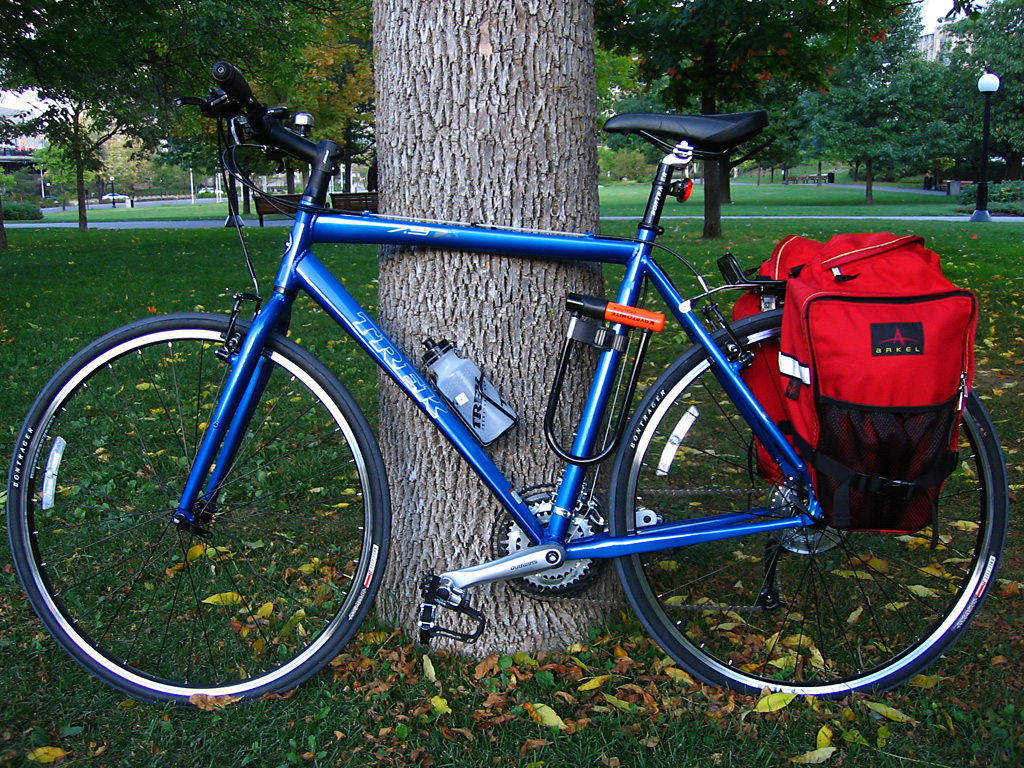
Milan’s Ottawa hybrid

I got my new bike today, and it is a thing of beauty. It seems to weigh about half as much as my Oxford hybrid and the components are dramatically sharper and more precise in their operation. I had them swap the grips for some with more traction, as well as replace the pedals with solid metal ones with cages. I have never ridden a bike with the latter before and have mixed feelings about them. With my feet in the cages, it is a bit awkward to stop at intersections. With the cages hanging loose under, they can scrape the ground on the inside of a turn.

In addition to the bike, lock, and helmet, I got a pair of 14L Arkel panniers. They aren’t the most attractive looking things, but the fabric they are made from seems extremely durable and the staff of the shop were very keen on the brand. At present, the left one has an awkward habit of sometimes brushing the back of my foot when my toes are inside the cage. I will need to adjust it somehow to avoid that.

I celebrated the acquisition of the bike and panniers through the purchase of about 35kg of dense foodstuffs: from yams to big tins of beans to salsa. Tomorrow, I am looking forward to Critical Mass. This weekend, I am looking for cycling further afield.

PS. I also want to express the degree to which I appreciated G.M Bertrand Cycles. Their staff was dramatically more helpful than those at any other place I visited. They gave me a good deal, fit the bike to me (with my pedaling on this odd stationary platform), promised a year’s maintenance, installed all the accessories I bought, did the grip and pedal switch for a pittance, and were otherwise exemplary.