Waterloo commits to divestment

The University of Waterloo has joined the set of Canadian schools committing to fossil fuel divestment, specifically with pledges for a “50% reduction in carbon emissions by 2030” and “no material positions in fossil fuel exploration and extraction companies by 2025.”

Cindy Forbes, chair of Waterloo’s Board of Governors, specifically cited the financial case for divestment and argued that it is compatible with fiduciary duty:

To protect our investments, we’re making the decision that we will reduce our exposure to carbon. In doing so we are protecting our primary fiduciary duty to maximise pension fund and endowment returns using measurable science-based targets.

While it contradicts the justice-based framing preferred by most climate activists, purely bottom-line driven divestment arguably has greater potential to spread through the financial system, since the system’s norms heavily emphasize an obligation to reduce risk and maintain profits, whereas commitments to justice and equity are at best controversial.

CBC on the war against the fossil fuel industry

The CBC has two new podcast episodes related to my research. Front Burner has an episode on the movement to divest from the bitumen sands, which tracks the movement’s progression from church groups to universities to major banks and insurers. It notes that only half as many insurers are willing to cover the industry as before the divestment movement began in 2011/12. The second describes Supran and Oreskes’ new analysis of how ExxonMobil has worked to delay climate action and mislead the public, notably by emphasizing consumer responsibility (like the idea of carbon footprints) to try to avoid regulation.

The International Energy Agency (IEA) on the carbon bubble

The International Energy Agency has released a report on what would be necessary to achieve a ‘net zero‘ global economy by 2050: Net Zero by 2050 A Roadmap for the Global Energy Sector.

Unsurprisingly, it replicates the carbon bubble / stranded assets argument: “The global pathway to net‐zero emissions by 2050 detailed in this report requires all governments to significantly strengthen and then successfully implement their energy and climate policies. Commitments made to date fall far short of what is required by that pathway.”

It also asserts the basic concept of a contraction and convergence framework for global equity in emission reductions: “advanced economies have to reach net zero before emerging markets and developing economies, and assist others in getting there.”

Most encouragingly, it avoids the assumption that massive carbon removal technologies will be deployed, meaning a net zero pledge based around effective fossil fuel abolition:

Net zero means a huge decline in the use of fossil fuels. They fall from almost four‐fifths of total energy supply today to slightly over one‐fifth by 2050. Fossil fuels that remain in 2050 are used in goods where the carbon is embodied in the product such as plastics, in facilities fitted with CCUS, and in sectors where low‐emissions technology options are scarce.

This is naturally an enormous challenge to the companies and governments choosing to pretend that there will be an easy technological fix which reconciles controlling climate change with continued fossil fuel use.

Unsurprisingly, the CBC describes Canadian reactions to the report as “mixed”.

Greyhound shutting down in Canada

After shutting down everywhere in Canada except Ontario and Quebec in 2018, Greyhound is now shutting down in Canada completely, aside from some routes across the border by the American company (Toronto to Buffalo and NYC; Montreal to Boston and NYC; Vancouver to Seattle).

When the government is so keen to help out those who drive or fly, I can’t understand why they are willing to let intercity bus services come to an end. Particularly given the safety concerns about hitchhiking or traveling informally in remote areas, I think it would make sense for the government to take over intercity bus services as a nationalized entity if there is no commercial operator willing to do it. With passenger train services as slow, expensive, and infrequent as they are in Canada, there ought to be an option for people unable to afford flying or unwilling to use such an emissions-intensive form of transport.

China emitting over 14 gigatonnes of CO2 equivalent

In a development that illustrates the global dynamics of climate change China’s emissions now exceed those of the entire developed world put together.

Since at least the 1990s the basic nature of a global deal to control climate change has been clear. States like Canada with the highest historical and per capita emissions need to cut their fossil fuel use dramatically. At the same time, rapidly developing countries need to choose a lower carbon development path than the states that preceded them.

Canada is massively reneging on this deal. We have never hit our climate targets and our leaders continue to act as though continued fossil fuel development can somehow be compatible with climatic stability. We also treat the emissions from the fossil fuels we produce as someone else’s problem, just as we treat the emissions that go into our imports (some of those Chinese emissions are making stuff for the benefit of Canadians, and people in all rich countries).

Persisting with the status quo is a suicide pact, yet states and citizens have not yet displayed the wisdom of recognizing and acting upon that. With so little time left to change course and avert the worst impacts of climate change we cannot keep accepting governments that abstractly promise that emissions will fall in the far future while working in practice largely to protect business as usual.

U of T grad school statistics

Someone recently posted a link to the Graduate Association of Students in Political Science (GASPS) email list to the University of Toronto’s School of Graduate Studied Data Dashboards.

There is data on admissions, enrolment, funding, degree completion, and career outcomes.

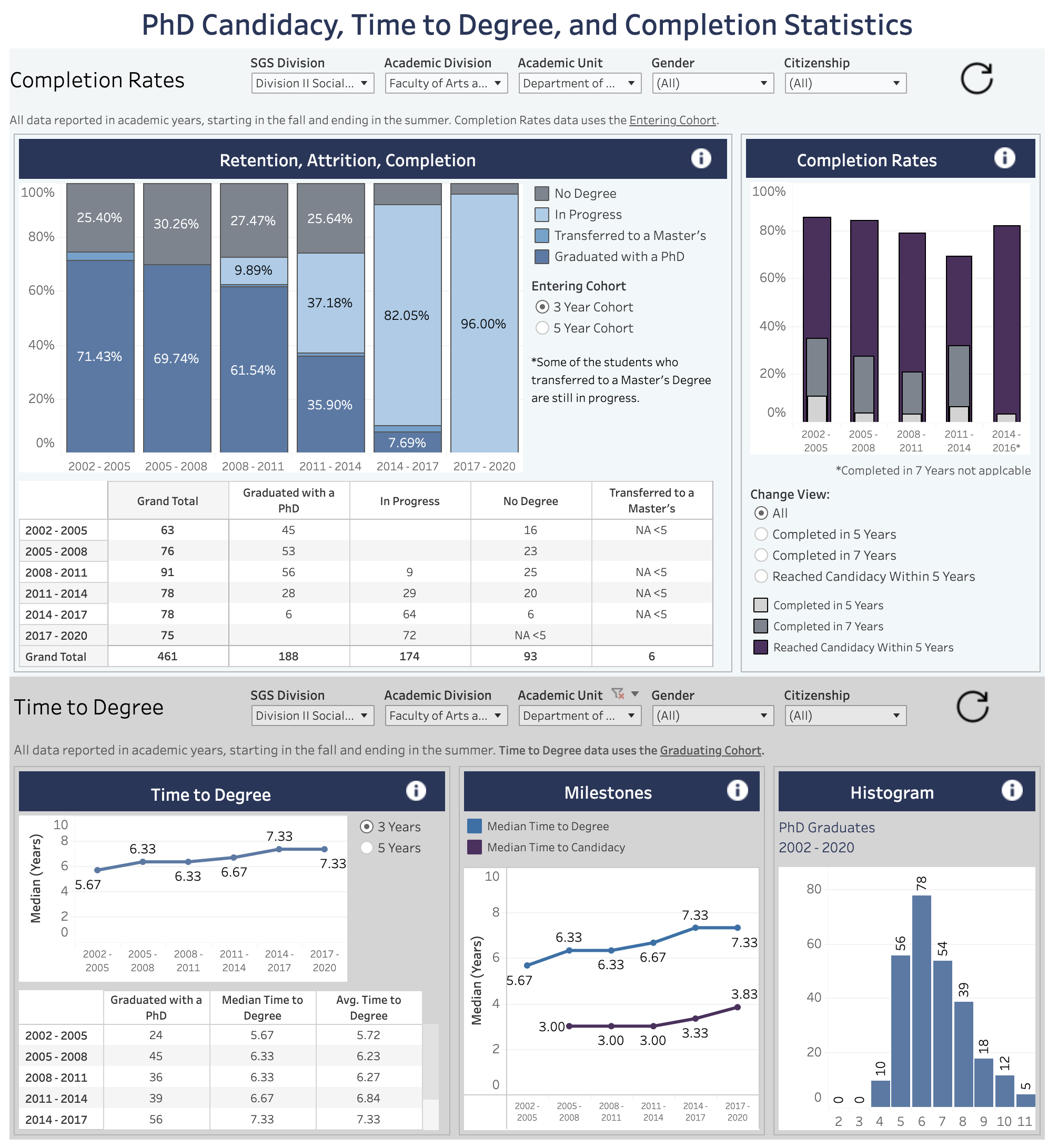
The data on people doing the PhD in Political Science specifically is quite interesting:

Elements that jump out at me: it seems like about 25-30% of people admitted never complete the program, the median time to a degree is 7.33 years, and most people finish in 5-8 years.

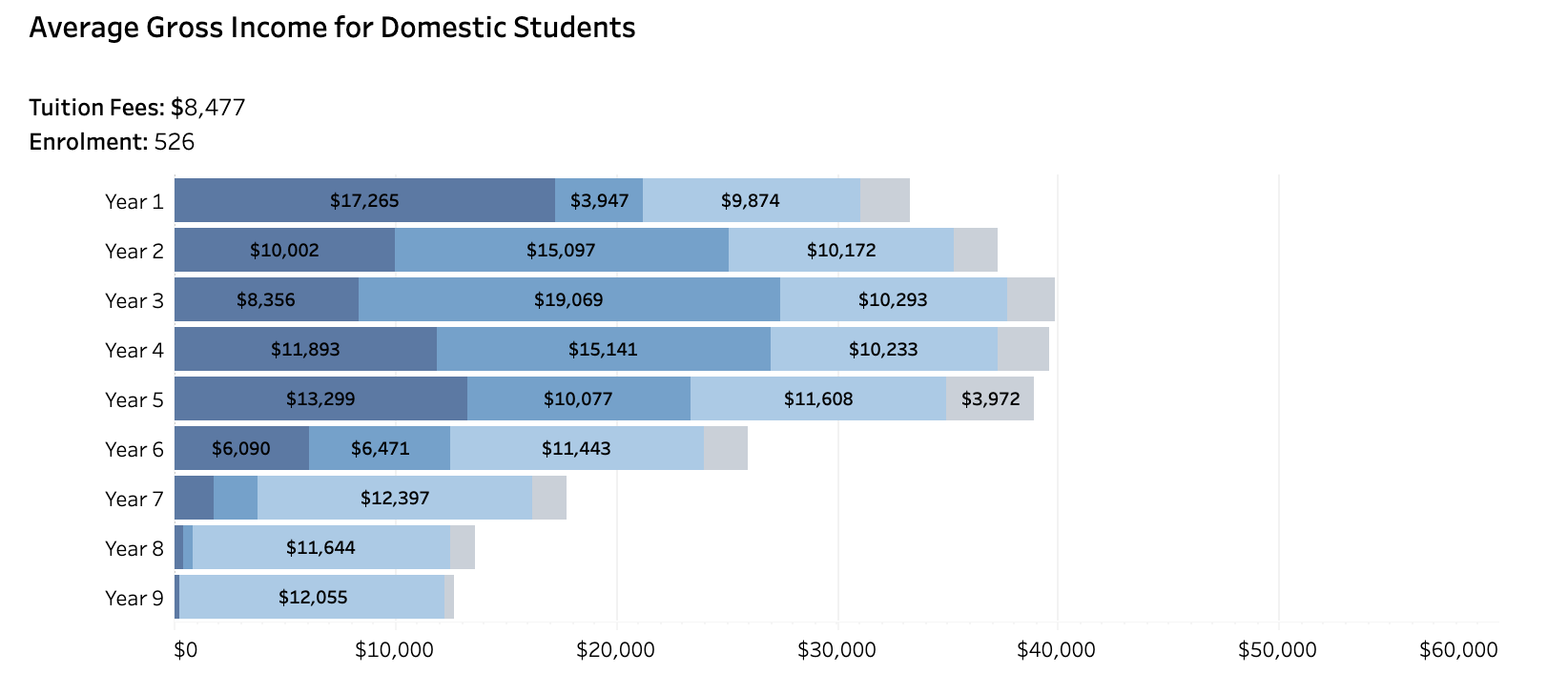
The chart on average gross income for domestic students in the polisci PhD program is also interesting:

The dark blue is the funding package which gets halved in year 6 and eliminated thereafter. The medium blue shows external awards, which are substantial for people in years 2-5. You really can really see the limited degree of income for people in years seven and beyond, almost all of which comes from teaching and research assistant work (the light blue), which while financially necessary for most probably hurts the completion rate for people who reach those years.

Related:

Would Scottish independence mean an end to the UK deploying nuclear weapons?

Britain’s Armageddon weapon are their four Vanguard-class ballistic missile submarines: Vanguard, Victorious, Vigilant, and Vengeance. Since decomissioning their aircraft-dropped bombs in 1998, the subs have been the only means of delivery for British nuclear weapons, with each possessing 16 ballistic missile tubes for Trident D5 missiles, each built to carry as many as 14 of some warhead types.

Oddly, and despite the obligation under the Nuclear Non-Proliferation Treaty for existing weapon states to work toward disarmament, Prime Minister Boris Johnson announced in March that as part of his government’s ‘Global Britain’ agenda they will raise the cap on the number of warheads deployed on submarines from 180 to 260.

All of the British subs are headquartered at Her Majesty’s Naval Base, Clyde at Faslane in Scotland. Today, The Guardian is reporting that if Scotland chooses to secede from the UK it would raise difficult questions about what to do with the subs, in part because building an equivalent facility in England or Wales would be very costly and would provoke intense opposition.

Even if done out of constraint rather than principal, it would be encouraging to see a nuclear weapon state stop deploying its weapons. As Richard Rhodes summarized in his fourth volume on nuclear weapons:

It followed, and follows, that there is no military solution to safety in the nuclear age: There are only political solutions… The impossibility of resolving militarily the new situation that knowledge of how to release nuclear energy imposes on the world is the reason the efforts on both sides look so desperate and irrational: They are built on what philosophers call a category mistake, an assumption that nuclear explosives are military weapons in any meaningful sense of the term, and that a sufficient quantity of such weapons can make us secure. They are not, and they cannot.

Threatening to use or using nuclear weapons in warfare has always been highly questionable under international law. However they are used they would have downwind consequences which would not distinguish between combatants and civilians, and it will always be questionable whether the use of such weapons is proportional to any provocation or whether it would serve a purpose of military necessity. A mass nuclear exchange literally threatens the existence of humanity, since smoke from burning cities would rise high into the stratosphere and cause drastic global cooling with appalling agricultural and humanitarian consequences.

Keeping such weapons for the sake of national prestige, and thus running all the associated risks of miscalculation or accidental or unauthorized use, is neither prudent nor justifiable in a world where a nuclear arms race is already apace.

Related:

The rational mind as storyteller not decider

There is an intriguing hypothesis about the rational mind: while we think of it as a weigher of evidence that contributes to the decisions we make when faced with a choice, it’s possible that its real role is to construct a story after the fact about why we made the choice we did for instinctive or emotional reasons.

Chris Voss alludes to this in his book about negotiations:

In Descartes’ Error: Emotion, Reason, and the Human Brain, neuroscientist Antonio Damasio explained a groundbreaking discovery he made. Studying people who had damage in the part of the brain where emotions are generated, he found that they all had something peculiar in common: They couldn’t make decisions. They could describe what they should do in logical terms, but they found it impossible to make even the simplest choice.

In other words, while we may use logic to reason ourselves toward a decision, the actual decision making is governed by emotion.

Voss, Chris. Never Split the Difference: Negotiating As If Your Life Depended On It. Penguin Random House, 2016. p. 122 (emphasis in original)

It has occurred to me that while the fundamental units of the physical universe may be the particles of the standard model or superstrings or something similar, the fundamental units of the psychological universe may be stories. We make decisions — perhaps — by analogy and imagination, using the stories we know as templates for projecting what could happen from one or another course of behaviour. This is compatible with the idea that generals are always fighting the last war, or that decision makers find an analogy as a schema for assessing the options before them in the present case (famously, the notion that states blundered into the first world war arguably motivated the appeasement policy toward Hitler which was later judged to have contributed to the second, while the lesson learned about the dangers of appeasement fed the undue combativeness of the cold war).

The idea that rationalization is after-the-fact storytelling risks feeding in to a nihilistic perspective that our decisions are just uncontrollable emergent phenomenon, coming out of a black box which we cannot control or influence, but that does not follow if we accept that we can influence the conditions that influence our emotions and train ourselves in how we respond emotionally. Voss’ book elaborates on this view with numerous practical details and examples, not taking for granted that people are emotional so they just do as they do, but highlighting how often-subtle mechanisms for influencing how people feel can powerfully influence how things turn out.

Related:

Open thread: global tax coordination

U.S. Treasury Secretary Janet Yellen has raised the idea of a coordinated global minimum corporate tax, with the aim of disrupting ‘race to the bottom’ dynamics in taxation and the shift of assets to tax havens.

Global coordination is likely a necessary prerequisite to effective wealth taxation.

It could also help to improve the tolerability and effectiveness of carbon taxes, as domestic producers would be less able to use inaction elsewhere as a way to resist decarbonization policy proposals.

UBC’s financial analysis of divestment

During the U of T campaign, a validating source like this memo from the University of British Columbia’s Vice-President Finance and Operations would have been amazing for responding to the argument that divestment is financially irresponsible:

Results of Mantle’s analysis (full report attached as Appendix A) indicate that the link between climate change and the financial viability of investment assets is clear. Carbon intensive companies will be exposed to climate related financial risk as the world commits to reduce carbon emissions through regulatory, legal, market or technology shifts away from fossil fuels. Rapidly evolving trends – such as greater corporate disclosure of climate risk, commitment to a “Paris Aligned” future, the acceptance of a “carbon budget” – are greatly increasing the risk in holding shares of companies whose value is derived from the continued growth and expansion of global fossil fuel use.

Seeing the arguments about the carbon bubble from Bill McKibben’s movement-instigating article and our own divestment brief affirmed by university executives and their consultants demonstrates the degree to which the argument against continued investment in fossil fuels is sound, as well as how it has diffused beyond activists into the thinking of decision makers.

Tonight’s thesis reading will be more than unusually encouraging, between this and today’s Supreme Court of Canada ruling on the carbon tax.