Not so jolly: the economics of gift giving

Victoria Island, Ottawa

As anyone who has ever been disappointed by what they found under the wrapping paper knows, gift-giving can lead to the misallocation of resources. Gift givers misanticipate the value a particular thing will have for the recipient, and thus devote more resources to the purchase than the recipient would. Joel Waldfogel, writing in The American Economic Review back in 1993 discussed this and other related economic issues in a notorious article called “The Deadweight Loss of Christmas.” (Available through JSTOR and Google Scholar)

Imperfect knowledge and non-ideal choices

The paper includes the gloomy conclusion that “gift giving destroys between 10 percent and a third of the value of gifts.” On this basis, the paper estimates that the deadweight loss of holiday giving in the United States in 1992 was between $4 billion and $13 billion. The article does note one possible saving grace: when recipients are ill informed about the existence of things they might enjoy, a gift can be worth more than a transfer of the equivalent quantity of cash. Of course, providing the cash and the information would achieve the same effect, without the risk that the choice will be different from what the recipient would have done with the money themself.

Gifts from friends and significant others are most efficient (largely because they know the preferences of the recipient best), while “noncash gifts from members of the extended family” are most likely to be valued by the recipient at less than their cost of purchase. Recipients value gifts from friends at 98.8% of their actual value, while those from significant others are valued at 91.7%. Parents and siblings give gifts worth 85% of their cost, while aunts and uncles manage only 64.4% and 62.9%, respectively. These conclusions were reached largely on the basis of surveys given to Yale undergraduates (favourite targets for psychological and economic experiments). Waldfogel notes that a social stigma can exist against giving cash gifts, but it is weakest where aunts, uncles, and grandparents are concerned – not coincidentally, the least effective choosers of gifts.

The thought counts

I have a more wide-ranging response of my own. Thankfully, there is a phenomena that partially offsets imperfect gift choice losses: the extent to which the very status of something as a gift increases its value in the eyes of the recipient. I can think of scores of cases where a product or service that would not have been particularly gratifying if purchased for myself was especially welcome and meaningful when received from someone else. In many cases, this creates utility significantly greater than that which could be achieved through personal spending of an equivalent sum.

I was reminded of all this when I saw Waldgofel’s article mentioned on Marginal Revolution, an interesting economics blog.

A (very) partial response to David Suzuki

Last night, I saw David Suzuki speak at a conference on health and the environment. To my surprise, I was far from impressed with most of what he said. He essentially presented a false binary: conspicuous consumption on the one hand, or the preservation of pristine nature on the other. While I certainly acknowledge that a lot of consumption is unnecessary, that doesn’t mean that all sacrifices are of the same moral variety as him choosing not to fly to Australia.

The view that pesticides should not be used in farming was broadly echoed. No doubt, there can be abuse of pesticides and there is a human and ecological cost associated with employing them. That said, it hardly seems that we can take a message of pesticide abandonment to a world of six billion, in which one and a half billion live in extreme poverty. Calling for an end to economic growth means something rather different in Canada than it does in Brazil or Bangladesh or Bolivia. Likewise, not everyone in Canadian society can switch to more ecological (and expensive) options while making only trivial sacrifices.

As a public relations figure, Suzuki obviously has to simplify his messages and present things in a form that is fairly easily repeated and absorbed. That said, the parks-versus-SUVs form of environmentalism doesn’t have much chance of being relevant outside the thinking of a privileged global elite.

Public broadcasters and the web

The existence of the internet changes the economic logic of public broadcasting. Where, at one point, the BBC was a collection of channels, each showing one bit of their vast archive at a time, now much of it is online. That creates a huge database of materials, paid for by taxpayers, and ideally free to be accessed without copyright concerns. Being able to view documentaries like Dangerous Knowledge upon demand is a notable benefit, and one not adequately captured by private sector content generators who are not concerned about societal benefits not captured in their profits.

If all the world’s national broadcasters and other public generators of knowledge would open up their libraries comprehensively, it could make the internet an even more valuable thing than it already is. Unfortunately, that process seems likely to be piecemeal and marked by set-backs. Witness the BBC iPlayer dispute.

Gore’s ten points

Leaves and bright water

Al Gore has recently presented a ten-point plan for the United States to deal with climate change over the course of the next few decades:

  1. An immediate “carbon freeze” that would cap U.S. CO2 emissions at current levels, followed by a program to generate 90% reductions by 2050.
  2. Start a long-term tax shift to reduce payroll taxes and increase taxes on CO2 emissions.
  3. Put aside a portion of carbon tax revenues to help low-income people make the transition.
  4. Create a strong international treaty by working toward “de facto compliance with Kyoto” and moving up the start date for Kyoto’s successor from 2012 to 2010.
  5. Implement a moratorium on construction of new coal-fired power plants that are not compatible with carbon capture and sequestration.
  6. Create an “ELECTRANET” — a smart electricity grid that allows individuals and businesses to feed power back in at prevailing market rates.
  7. Raise Corporate Average Fuel Economy (CAFE) standards.
  8. Set a date for a ban on incandescent light bulbs.
  9. Create “Connie Mae,” a carbon-neutral mortgage association, to help defray the upfront costs of energy-efficient building.
  10. Have the Securities and Exchange Commission require disclosure of carbon emissions in corporate reporting, as a relevant “material risk.”

A much more detailed discussion of the points can be found on Grist. It is safe to expect considerable elaboration in Gore’s upcoming book: The Path to Survival. It will be available as of Earth Day (April 22nd) of 2008.

It is an interesting – and distinctly American – mix. It seems like number one is the uber-recommendation, while the others are more specific subsidiary policies. Exactly how such a freeze could be implemented – politically, economically, and legally – is a massive question. That said, it is a list that targets many of the major opportunities for domestic emission mitigation. It will be interesting to see whether any of these get the endorsement of Democratic or Republican candidates in the run-up to the 2008 Presidential election. If so, it will make for a big break with past half-hearted and voluntary measures.

PS. Those unfamiliar with the American mortgages will understand number nine better if they read about Fannie Mae and Freddie Mac: America’s huge and bizarrely named quasi-government-backed mortgage corporations.

Passivhaus

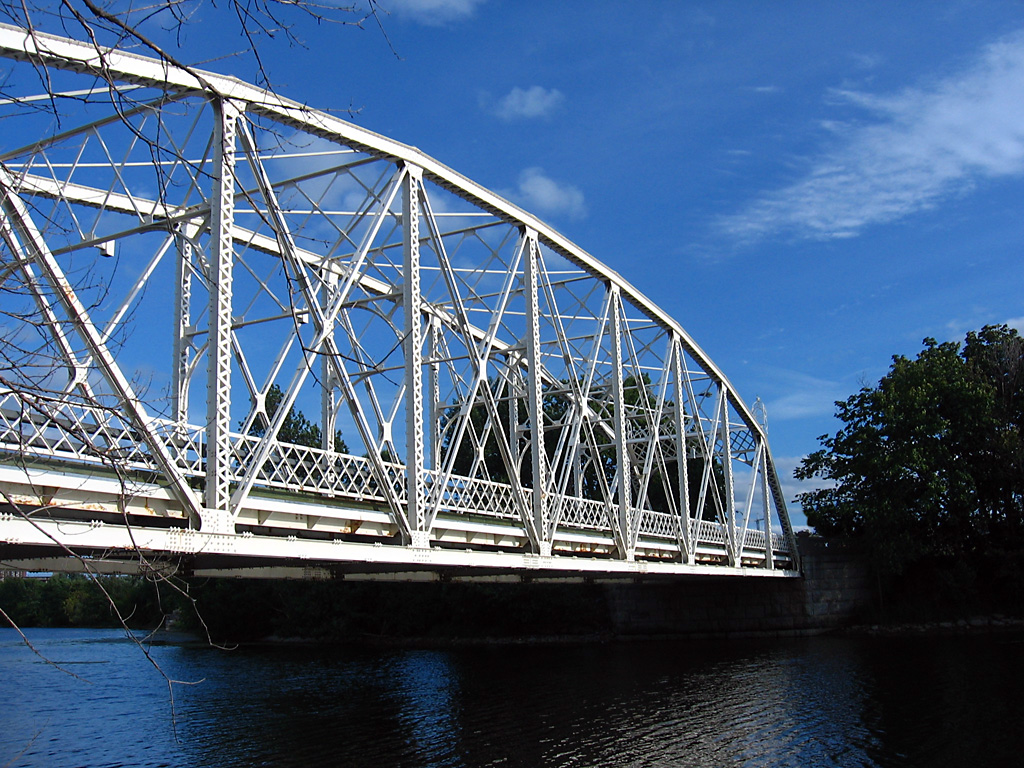
Steel arch bridge

There has been a lot of talk lately about compact fluorescent light bulbs. Huge billboards of David Suzuki looking like a genie, with a glowing CF bulb floating above his hand, dot the landscape. While these bulbs are a lot more efficient, they aren’t likely to make a huge difference in the long run. Arguably, it would be better to focus on encouraging the building of passive houses, which require no energy for heating, rather than making marginal improvements in existing dwellings. It may be entirely desirable to do both, but when it comes to finding a symbolic signal issue to rally around as energy conservationists, the latter option is a lot more impressive.

To qualify as a passive house, a building must use less than 15 kWh per square metre per year for heating. That works out to less than $1 per square metre at current energy prices in Ontario. Total primary energy usage for such houses (heating, hot water, and electricity) is not to exceed 120 kWh per square metre per year. The technology to do this isn’t absolutely cutting edge: a passive house has been continuously inhabited in Darmstadt since 1991.

Apparently, building super-insulated houses with the ability to heat and cool themselves using just the ambient light and heat in their surroundings does not cost significantly more than building ordinary houses (though it requires different materials and more expertise). Given how virtually none of them exist in North America, it seems fair to say that consumer demand – even with high energy prices – is not sufficient to drive a large scale shift.

A number of different policies could help boost adoption: municipalities could require that a certain proportion of commercial and residential buildings constructed be passive in this way, subsidies or tax breaks could be given to firms that choose to employ such construction methods, and so forth. At the very least, government could make a concerted effort to do most of its own building in this way.

Masses of additional information is online:

As environmental statements go, building or living in such a house is probably much better than driving a Prius.

Chevron’s climate game

Remember when the BBC came up with a climate change game? Well, now Chevron has done so, as well. Apparently, all the data in the game came from the Economist Intelligence Unit. The BBC game suffered a fair bit of well-deserved criticism. I have yet to give the Chevron simulation a comprehensive try, but I am waiting with a fair bit of curiousity for a chance.

You can read a bit more about the Chevron game on R-Squared: a popular energy blog.

[9 September 2007] This game doesn’t really have much to it. By constraining you to the management of a single city over the span of a couple of decades, it excludes both the chronological and geographic scale at which real change needs to take place. Still, it is interesting from a corporate public relations standpoint. Unsurprisingly, the game simply forbids you from using a power balance that excludes petroleum.

Shrimponomics

Ashley Thorvaldson and Marc Gurstein

Here is an interesting blog post analyzing theories about why people are eating more shrimp than was previously the case. In short, people without training in economics seem to focus more on the demand side than people with such training.

One response that surprised me was “a rise in the number of vegetarians who will eat shrimp.” Now, if you are a vegetarian because you think it is wrong to kill cows and chickens for food, that may be a sensible position. If you are a vegetarian for general reasons of ecological sustainability, it is a lot less valid. As fisheries go, shrimp is one of the worst when it comes to bycatch. The UN Food and Agriculture Organization says that the present shrimp catch is at least 50% above the maximum sustainable level. Shrimp also tends to be collected through a process called bottom trawling: where large steel rollers smash and kill everything on the ocean floor.

Shrimp aquaculture is arguably even worse. There are all the problems attendant to all agriculture – close quarters, disease, harvesting other creatures unsustainably to turn into feed, antibiotics, etc – and then there is the fact that mangrove swamps are ideal for conversion into shrimp farms. The UN Environment Programme estimates that 1/4 of the total destruction of these important ecosystems has been brought about by shrimp farming.

From an ecological standpoint, vegetarianism (and probably veganism) remains a far preferable option, compared to eating meat.

Chronic disease worldwide

People tend to think of heart disease and cancer as the diseases of the rich world, while AIDS, malaria, and tuberculosis afflict the poor. The latter idea is certainly true: among those, only AIDS kills an appreciable number of people in rich states (though antibiotic resistant tuberculosis may start changing that).

Just because infectious diseases tend to kill a lot more people in poor states than in rich ones, it does not follow that infectious diseases are the greatest health threat there. According to the World Health Organization, heart disease and cancer kill more people in poor states, as well, and together cause 45.9% of all global deaths. Add in diabetes and other chronic diseases, and you find that 63.5% of all deaths are caused by chronic diseases, compared with 29.7% for all infectious diseases (injuries kill 9.3%).

A forecast for the period between 2006 and 2015 predicts that deaths from infectious diseases will fall by about 4% in poor countries, while deaths from chronic illnesses will rise by about 20%. Partly, this is the result of growing affluence – particularly the ability to afford cigarettes. People in China, Russia, and Indonesia already spend between five and six percent of total household income on cigarettes.

The Millennium Development Goals include two targets relating to infectious diseases:

  1. Halt and begin to reverse the spread of HIV/AIDS
  2. Halt and begin to reverse the incidence of malaria and other major diseases

While these are obviously worthy and important goals, there is a danger of funds not being well matched to where they can do the most good. Shedding a few misconceptions about the relative health challenges of rich and poor states may help avoid that. So too, the further recognition that lifestyle factors like diet, exercise, and smoking have an enormous influence on overall morbidity and mortality.

The trouble with jets

Giant spider

Air travel is one of the trickiest ethical issues, when it comes to climate change. In most situations, the difference between a high carbon option and a zero carbon alternative is essentially a matter of cost. If we are willing to spend enough, we can replace all fossil fuel power with renewables. We can get electricity, heat, ground transport, and energy for industry from sources that do not contribute to climate change. Air travel is different. Even for one million dollars a ticket, there is no way to get someone from New York to London in about eight hours that does not release greenhouse gases. Likewise, there is no feasible way to capture those gases for later storage.

Let’s consider a series of propositions:

  1. Climatic science strongly suggests that allowing global greenhouse gas concentrations to rise beyond 500-550 ppm of carbon dioxide equivalent will have very adverse affects. These will be concentrated in the poorest states. It is highly likely that exceeding these limits will directly lead to large numbers of deaths, especially in the developing world. (See: these Stern notes)
  2. At present, per-capita emissions in developed states are far higher than those in developing states. Canada’s emissions per-capita are about twenty times those in India.
  3. Essential human activities, from heating to agriculture, produce greenhouse gasses.
  4. People have equivalent moral claims to the basic requirements of survival.

If we accept these claims, we find ourselves in a tricky spot. To stabilize the level of a stock, you need to reach the point where inflows are equal to outflows. Even if we ignore how global warming is reducing the ability of the forests and seas to absorb carbon dioxide, it is clear that such stabilization requires deep cuts in total emissions. At the same time, taking the last two points seriously means acknowledging that developing states do have the right to comparable per-capita emissions. As such, the only option that is fair and capable of stabilizing overall concentrations requires very deep cuts in developed states.

Aside from being inextricably linked to fossil fuels, modern air travel compounds the harm done by the burning of that kerosene. This is partly because of where in the atmosphere it is deposited. It also seems likely that jet aircraft affect clouds in ways that increase their impact on climate change.

Imagining a world stabilized at 500 ppm, with reasonably similar per-capita emissions for all states, it seems quite impossible that there can be air travel at anything like contemporary levels. It is possible that some miracle technology will allow high-speed flights to occur without significant greenhouse gas consequences, but no such technology is even within the realm of imagination today.

As someone who has long aspired to travel the world, this is a very difficult conclusion to reach. It now seems possible that air travel bears some moral similarities to slavery. Before people become overly agitated about the comparison, allow me to explain. Just as slavery was once a critical component of some economies, air travel is essential to the present world economy. Of course, economic dependency does not equate to moral acceptability. If our use of air travel imperils future generations – and we are capable of anticipating that harm – then flying falls into the general moral category of intentional harm directed against the defenceless. After all, future generations are the very definition of helplessness, in comparison to us. We can worsen their prospects by fouling the air and turning the seas to acid, but they will never be able to retaliate in any way. (See: these Shue notes)

While I personally fervently hope that some solution will be found that can make continued air travel compatible with the ethical treatment of the planet, nature, and future generations, I must also acknowledge the possibility that people in fifty or one hundred years will look upon us as sharing some moral similarities with plantation owners in the United States, prior to the civil war.

Freight shipping and greenhouse gases

Travelling 100km by car produces about 10.8kg per person of carbon dioxide (assuming an average of 1.5 passengers per car). Doing the same by bus produces about 1.3kg, while taking a modern electric train produces about 1.5kg (based on the energy balance in the UK). What is remarkable is that shipping freight by truck produces 180 grams of CO2 per kilometre, while doing so by train produces just 15. Clearly, switching freight transport modes offers considerable scope for emission reductions (as does reducing the total amount of freight shipped).

When you factor in how much damage heavy trucks do to roads – as well as the expense and carbon emissions involved in rebuilding them – it seems pretty clear that disincentives to ship freight by road make sense. Yet another externality that road pricing and carbon taxes could help address.