Mica’s Michelle video

Mica has a new video online, made for his girlfriend Michelle. I think it’s really sweet, somewhat explicit, and almost perfectly reflective of his overall character.

I hope she is the kind of woman who will appreciate it. The very last segment, shot at Cleveland Park in North Vancouver, definitely makes the greatest impression, for me.

PS. Remember to keep voting for his contest video.

Summer day, time to vote for Mica again

With the summer solstice nineteen days away, it is dazzlingly bright outside and all of Oxford’s green spaces are strewn with sleeping, reading, shirtless, ice-cream eating, ultimate-playing students. The University Parks look like English Bay, in Vancouver, on a sunny summer’s afternoon. While I don’t overly appreciate being irradiated by the sun, myself, I enjoy the spirit that seems to accompany the collective exodus to the outside world: even if I am appreciating it through library windows.

On Mica’s ‘Hives’ video
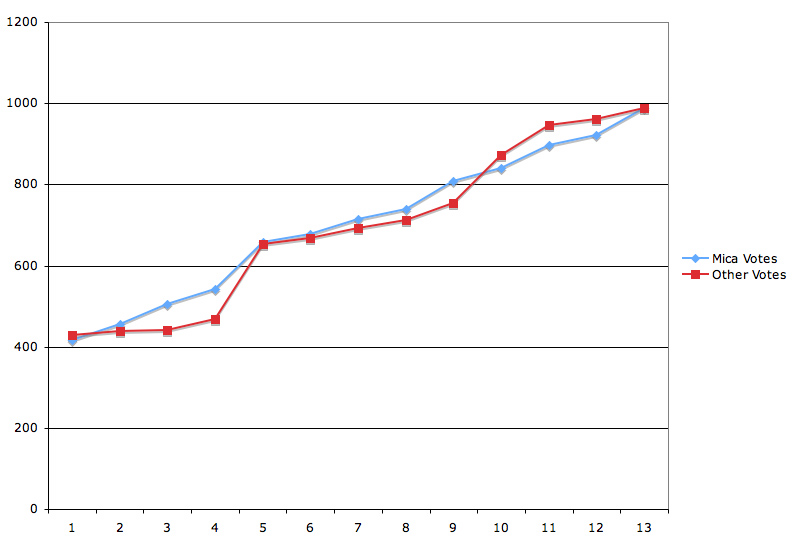
On a different matter, my brother Mica’s video has made it to the quarter final of the ‘Google Idol’ competition. I highly recommend that people take the time to go vote. You can also leave him comments on his blog. He is winning by a rather smaller margin this time, so people are especially encouraged to have a look.

My post about the previous round is here.

For my part, I am going to read a few more articles before heading off to Anna’s birthday party, way down Abingdon Road. I will also continue to dream of Amsterdam, where I feel increasingly compelled to go for a week or so, once classes end. Ideally, it’s a trip that I can convince someone interesting, with whom I have a stable and engaging relationship, to accompany me on.

Brick

Projector at the Phoenix Cinema, OxfordTonight, for the first time ever, I saw a film in a theatre in the United Kingdom: Brick at the Phoenix Cinema in Jericho. If pressed, I would call the film a kind of satire of your classic gangland genre. The characterization, plot, and dialogue are all similar to those films, though this one is set among a group of high school students. In one scene that depicts the protagonist and a Vice-Principal in a kind of police officer/informant dynamic, the comic elements of the satire are most apparent. At other times, the brutality of the film made the possibility that it was made with some kind of comic intent seem very distant.

Billed as a successor to Donnie Darko, I thought that Brick was more clever, all in all. At least it didn’t involve the agony of some of that film’s attempts at humour. To me, Donnie Darko had too much of what might be termed ‘LiveJournal angst’ – the sort that seems extremely authentic to the person experiencing it, and perhaps people in very similar circumstances, but which fails to travel beyond there and seems shallow for it. By contrast, Brick portrays teenagers as almost hyper-confident and self assured. They speak and act with a directedness quite at odds with the experience of adolescence.

In the end, the film is an experiment that doesn’t always work. Some of the visuals are intriguing, just as some of the dialogue is a clever take on film noir. At the same time, some of the characters lack any clear motivation and the reasons for layering that kind of plot onto these actors and this setting is never entirely plain. This sort of film is certain to find resonance with some people, and in this case is clever enough, on the mean, to deserve it.

Mica’s video in a contest

Many of you will already be familiar with the fact that my brother Mica makes movies. You can see a collection of them on his website, as well as search for them on Google video.

Additionally, he is presently competing in an online film contest. His video for “Walk Idiot Walk” by The Hives is in the rock category of the ‘Google Idol’ competition (not affiliated with Google Inc.). He has already made it into the final eight. Apparently, anyone who wishes to can vote. I very much encourage everyone to have a look; you can also leave him comments.

For those not familiar with any of his videos, I endorse the following particularly:

[Update: 20 May 2006] Mica’s video won the quarter-final round, with 1,061 votes to 234. I can’t find a link to the semi-final round yet, but when I do I will put it here.

The Constant Gardener

I saw The Constant Gardener with the European Film Society tonight. I found the film to be very powerful, and thoroughly dispiriting. While the specific evils portrayed are obviously fictional, there is a grim plausibility that accompanies them. Humanity has a long way to go.

The pharmaceutical plot was actually the weakest part of the film. Not to spoil it for anyone, but you can’t license a drug in the rich world on the basis of unsupervised clinical trials in Africa. That said, the portrayal of machine-gun wielding horsemen terrorizing villagers in the Sudan is probably quite accurate. Hopefully, it induced at least a bit of reflection on the part of various audiences about the moral responsibilities people in the developed world bear towards those elsewhere facing genocide or other forms of large-scale violence. Likewise, some of the depictions of the horrific toll of AIDS formed part of the realistic backdrop for the film.

Appropriately enough, immediately before the film started, I began reading the copy of Race Against Time that my mother sent me, along with some extra illumination for my bike. Written by Stephen Lewis, it is a printed version of the Massey Lectures that were delivered across Canada, and it opens with the line: “I have spent the last four years watching people die.”

I will probably finish it tomorrow, then lend it to Emily. I feel as though I should say more, but I am thoroughly overwhelmed.

Music and frustration: copy protection schemes

Chained pig, BathHaving spent the last few minutes explaining to a friend why a brand-new, legitimately purchased CD will not play in her computer due to the copy protection EMI has included, I am reminded of my considerable indignation about how the music industry is treating their customers. Yes, in this case, it was possible to disable the copy protection program just by holding shift as the CD was inserted into a Windows computer, but there is no guarantee at all that music you buy today is either usable or safe.

In the worst case, such as the notorious Sony BMG rootkit, inserting a legitimate music CD into your computer intentionally breaks it. It also causes it to report what you listen to to Sony, even if you choose ‘no’ when a screen comes up asking for permission to install software. It also creates really sneaky back doors into your system that can be exploited for any number of purposes, by Sony or random others. While Sony is currently facing lawsuits for this particular, infamous piece of malware, it isn’t nearly enough to put my mind at ease. If some 16 year old had written something comparably dangerous, they would probably be in jail.

Legitimately downloaded music is little better. Songs you buy from the iTunes music store may work with your iPod today, but they won’t work with another portable player. They won’t even play in software other than iTunes, and there is no guarantee that they will still work at some point in the future. Spending a great deal of money on songs from there (and they’ve just had their billionth download), is therefore probably not very wise. You don’t actually own the music you are buying – you’re just buying the right to use it on someone else’s terms: terms that they have considerable freedom to change.

Personally, I will not buy any CD that contains copy protection software. I will not buy a Sony BMG CD, regardless of whether it does or not, nor will I be buying any of Sony’s electronics in the near future. This is a business model that needs to change.

All in all it was all just bricks in the wall

Pouring fake Champagne at Abra's birthday

Substantive stuff

This has been proving quite the period on the international relations front: spats over gas between Russia and former satellite states, Ariel Sharon knocked out of politics, Hamas elected to power, the Iranian nuclear program again generating international attention, and the Conservatives emerging from twelve years of opposition in Canada to take a minority government. All are eminently worthy of commentary, though I haven’t a huge amount of time in which to do so.

At the same time, however, you need to ask how different this really is. Russia has been clinging to the trappings of power ever since it lost the cold war. Political systems that elect old men with unhealthy lives will produce leaders who die in the midst of their political careers. Corruption spawns the rejection of the corrupt: at least in reasonably democratic systems. It’s at times like this when I have the most sympathy for Waltz (sympathy for the devil?) in acknowledging the importance of the system, in understanding the dynamic between the units.

Personal stuff

A promising possibility has emerged on the housing front. Most of the details are still up in the air, including whether this will only cover the next academic year or whether it will include the summer as well. In the former case, I suppose I will have to find another place to live while I am working. Hopefully, that won’t mean carting everything I own too far on my back and in suitcases.

I began Alexis de Tocqueville’s Democracy in America today. It seems to be one of those books that basically all enlightened academics, journalists, and pundits have delved into. While it’s not directly relevant to the essay I am writing for tuesday (Topic: What is so ‘liberal’ about neo-liberal institutionalism?), I am guessing it will pay dividends in the longer term.


  • In honour of something I read today, I present the following list. My favourite fictional characters, an inexhaustive listing:
    1. Lyra (Silvertongue) Belacqua
    2. Hobbes (the Tiger)
    3. Ender Wiggin
    4. Motoko Kusanagi
    5. Diane (“A little bit crazy, a little bit bad. But hey – don’t us girls just love that? “)

    Without Google, can anyone identify the origin of each? I wonder what the collection says about me as an individual, and what kind of choices people I know would make.

  • Once again, though three of this week’s readings are supposedly in the Wadham Library, none are actually on the shelves. I don’t know if they are sitting in one of the many stacks of books that people like to decorate the desks with or if they have been stolen. In either case, it is frustrating.
  • Kudos to Bill Gates for making a staggering personal contribution of $600M to the Global Plan to Stop Tuberculosis. That’s more than ten times what the entire United Kingdom is donating.

A day of intellectual engagement

Yet another Oxford sunset, sorry.

Happy Birthday Nick Sayeg

The most surprising thing about my three pound Tesco brand radio alarm clock is that came set to use one of the BBC talk channels as the wake-up noise. I’ve never changed it, and it has been influencing those precious dreams you get in snippets, punctuated by the smashing of the ‘snooze’ button. It is an odd thing indeed to be cajoled out of bed by the sounds of men with British accents discussing recent novels, developments in physics, or U.K. politics. I’ve never been someone who listens to the radio, except as a means of being jolted out of repose. It is too random, too filled with commercials, and too attention intensive in the wrong ways. It’s not something I can ever really enjoy, though it frequently annoys me.

Today’s ‘Advanced Study of IR’ lecture was delivered by Gavin Williams about the politics of development or, as he called it, the politics of most of the world. I particularly appreciated some of the methodological questions that were raised and then discussed among those present. Regrettably, only four of the twenty-eight members of the IR M.Phil were in attendance. After the lecture, I spoke with Dr. Williams for about forty minutes. We talked about British and Canadian politics, the tendency of sub-state political regions with newly-discovered oil reserves to contemplate succession, and the reasons for which institutions persist in making and perpetuating bad policies.

Aside: Thesis considerations 

This evening was also the first chance in quite a while when I got to talk about my intended thesis topic . Dr. Williams’ enthusiasm has reaffirmed my hope that it will be a useful project, though I need to decide upon a way to pare it down to an M.Phil thesis sized question. The general project is to examine institutional and legal mechanisms for dealing with the advancement of environmental science. Environmental science involves quite a bit of uncertainly. By definition, complex dynamic systems (like ecosystems and the climatic system) are hard to understand. What we need are policies that are based on the best knowledge we have, aware of the extent to which those conclusions might be incorrect, and able to respond to new developments. Basically, the people doing the science and the people making the policy need to talk to one another, understand what is being said, and care about it.

The basic point is that there are separate intellectual communities: scientists, lawyers, policy makers, etc, who don’t manage to communicate effectively about environmental issues in many cases. That, or they fail to produce outcomes that make long-term environmental sense. Members of all these groups can also be co-opted by those who profit from the status quo. We need to consider interests and incentives, as well as modes of communicating and types of interpersonal connection. It’s not just who reads what journal, goes to which conference, or understands which piece of jargon; it’s who pays for the research, who pays attention to the policies, and who stands to lose or gain from all of this.

The question has many faces. You can look at the professional discourse of the different groups and try to understand where they understand one another, where they do not, and why. You can concentrate on the incentives presented to each group, particularly in terms to how they relate to one another. Are policy-makers rewarded for basing their strategies on sound science? Are rewards long-term or short-term? Perhaps the best way to tackle many of these issues would be to choose a case study. An obvious choice is climate change, due to the lack of scientific certainty and the level of political involvement, but I shy away from it. It’s too big, too politically charged, and it involves uncertainties that are too great. It’s not that climate change isn’t happening or that people aren’t causing it. What we don’t know is what the consequences of climate change they will be, who will bear the costs, and whether the cost of dealing with climate change exceeds the cost of stopping it. I don’t think we have the science to answer these questions right now, though it would definitely be good to have an effective and relatively de-politicized channel for turning increased certainty into more refined policy once we do.

I called Meghan briefly tonight, to say thank you for the Klein Bottle. Apparently, her graduation was yesterday and she gave the student address. I hope her family and friends were there to see it, and that enjoyment was had all around. My felicitations to Meghan Lynn Mathieson, B.A. Hons. (UBC). Best wishes in future endeavours.

Later, Nora prepared an excellent veggie casserole for Bilyana, Bryn, Kelly and me. It was thoroughly enjoyed by all and, furthermore, it was good to spend some time talking with other Wadham students. I’ve barely seen Bilyana since first week. As a mathematician, she was also particularly qualified to appreciate the Klein Bottle, which I felt near-obligated to show her.

Tomorrow evening, I have supervision with Dr. Hurrell: discussing the paper on the Chinese Civil War. Afterwards, I am supposed to watch Spirited Away with Margaret. For those who haven’t seen it, I thoroughly recommend it. It’s my favourite Studio Ghibli film: notably for creative combination and reinterpretation of elements of several different strains of folklore. Also, the artwork is quite stunning. Studio Ghibli also made Princess Mononoke, My Neighbor Totoro, Howl’s Moving Castle, and Castle in the Sky. The studio is headed by the extremely talented Hayao Miyazaki, and I recommend their work without exception.


  • Lauren sent me some Nina Simone songs, and I like them a lot. Especially good is the song “Feeling Good.”
  • Here’s another Oxford blog, with a unique premise.
  • I now have 24 hour access to the Manor Road Building and the Department of Politics and International Relations. Don’t you envy the fact that I could be in there, drinking in the greenish light and pouring over readings or stats assignments every Saturday night, all night long?
  • Penn Jillette on athiesm. From Jessica.
  • The L.A. Times has a distressing article about the treatment of pre-war intelligence. (Via BoingBoing)
  • I am quite curious about what has happened to Kerrie Thornhill. I knew she was going to Ghana, but not exactly when. Unusually, all five or so of her blogs are silent. If anyone knows what’s up, I’d appreciate being filled in.
  • Today’s big environmental politics story