Getting a gravatar

People reading comments recently will have noticed that this site now supports Gravatars. (Globally Recognized Avatars). These little pictures go beside any comments you leave, allowing you to express yourself a bit and others to identify you at a glance.

Getting one is free and easy and is done from the site linked here. Once you have one, it will appear beside all the comments left on this site using your email address, as well as on all other sites that have Gravatar support in place.

[Update: 5 May 2008] I am trying out Identicons as a default image for those without Gravatars. They are automatically generated based on IP address and may make conversations with many commenters easier to follow.

The Game Plan

The Game Plan : A solution framework for climate change and energy is a slick, Creative Commons licensed slide presentation covering issues of energy and climate change. It’s like a more numerically focused, more technical, open-source version of An Inconvenient Truth. Clearly, it is aimed at a very different audience. Still, it is interesting and potentially useful as a source of graphics and information.

A seven megabyte PDF version is also available. A PDF of the speaking notes, likewise.

WordPress 2.5

WordPress 2.5 doesn’t look much different from the perspective of the reader, but the administrative controls are much slicker. Upgrading seems to be relatively painless, and my plugins seem to work.

One really nice thing is that you can now change the default thumbnail size from within the interface (under Settings > Miscellaneous). My thumbnail size hack can now be cheerfully thrown into the dustbin of historical code.

I remain impressed that the WordPress team continues to produce such excellent free software – the best blogging platform available.

[Update: 14 Apr 2008] WordPress 2.5 seems to have a lot of bugs. Often, it hangs when I try to post comments, then tells me the comments are duplicate. I am getting lots of Error 500 pages. Sometimes, when I make a post WordPress says that it failed. It then becomes a draft with random incorrect categories attached to it.

The new page for writing posts has an awkward layout. The scheduled posts page doesn’t show the time when posts will appear. The image uploader sometimes refuses to let you add titles or descriptions to things you just uploaded, with the option to insert them into posts similarly vanished.

Hopefully, a new version that fixes all these issues will emerge soon.

[Update: 15 Apr 2008] The Flash uploader in WordPress 2.5 is quite terrible.

Photoshop express

Adobe has released a free web-based version of their most popular image editing program, called Photoshop Express. The software allows for a number of fairly basic modifications, including cropping, exposure correction, saturation and white balance changes, and sharpening. One nice touch is that it does allow the conversion of images to black and white using any of several virtual colour filters. The free service includes two gigabytes of storage, and seems to include mechanisms for integrating with Facebook, Photobucket, and Picasa.

The web version has nothing on the full version of Photoshop – lacking tools like levels and curves, not to mention paths, masking and the thousands of other things that make Photoshop so versatile. That said, it’s a nice thing to be able to use in a pinch, when nothing more capable is readily available.

Israel’s electric vehicles

Fuel research lab

Shai Agassi has a bold plan to transform personal transportation in Israel: electric cars built by Renault and Nissan using lithium-ion batteries from NEC. The crucial difference between this plan and those simply intended to encourage customers to buy individual electric vehicles is that Agassi’s company plans to provide battery infrastructure, in the form of recharging outlets and battery swap stations. Each battery is initially expected to provide 124 miles (200 km) per charge, with recharging happening both at parking-meter type stations and at centres where depleted batteries can be swapped immediately for charged ones. The batteries are expected to last 1,500 charges, or 150,000 miles (240,000 km).

The pricing model is also interesting. While it is still evolving, it will probably take the form of a monthly fee based on expected mileage. The company selling the battery exchange plans will subsidize the purchase of the cars, to some extent, increasing the rate at which people switch over from gasoline vehicles. The Israeli government has pledged $200 million to help get the scheme running. Given the incentives for clean vehicles that the government has promised to maintain until at least 2015, company officials suggest that their electric cars will cost half as much to buy and operate as gasoline ones would.

Israel does have unique characteristics that arguably make this approach especially suitable. Foremost among those may be its small size. One of Agassi’s batteries would be sufficient to drive across it from east to west, with two or three being required to go from north to south. That said, if this model proves successful, one could certainly imagine it working in other relatively confined high-density areas, from Manhattan to Shanghai.

Any used computers kicking around?

I find myself with a renewed interest in setting up a VNC compatible Linux-based terminal server. I don’t want to use my existing laptop because (a) I don’t want to leave it all on the time and (b) I don’t want to expose it to possible attack from the wider internet. As such, I am looking for a fairly basic used system – PC or Mac – that someone is willing to let go cheaply. A computer that got relegated to a closet when a newer one was purchased might be perfect.

Do any readers in the Toronto/Ottawa/Montreal area have any such hardware kicking around? It only needs to be capable of running a virtual private network client, terminal server client, and web browser.

Snake oil in science magazines

Climbing wall

One odd tendency I have noticed is the frequency with which popular science magazines contain ads for very dubious products and services: often, precisely the sort you would expect the scientifically knowledgeable to shun. Looking through this month’s Scientific American there are ads for ‘stress erasing’ gizmos, a machine that supposedly makes you fit and muscled on the basis of four minutes of exercise a day, and dubious dietary supplements. I recall that Popular Science regularly featured ads for hypnosis machines and virtual reality helmets supposedly capable of teaching you a new language in hours.

Why do companies selling such things consider the readers of science magazines to be a good target audience? One element is probably that actual scientists don’t read these magazines. The articles they publish are not peer-reviewed and can sometimes be quite low-brow (Scientific American, in particular, seems to have made a big shift towards the Popular Mechanics end of the intellectual spectrum). While the readers are unlikely to be scientists, they are likely to have an acute interest in scientific things, novel ideas, and new technologies. Probably, advertisers are taking advantage of the way in which seeing an ad in a trusted publication already full of novel claims provides it with more legitimacy than it might accrue on its own.

In the broader picture, this is just one reflection of the fundamental problems of authenticity and verification that exist in our society. People can’t decide if climate change is happening, whether taking vitamins is helpful and worth the cost, or whether radiation from cell phones is dangerous. Perhaps more than ever before, people are in a world that is incomprehensible due to the abundance, rather than the absence, of information. Those looking to bring in a few dollars from gullible armchair scientists are taking advantage of that confusion.

Rainbow tables

Transit archway

I have previously written about one-way hash functions and their importance for cryptography. Recapping briefly, hash functions take some data (a password, a picture, a file, etc) and pass it through a mathematical algorithm. This produces an output with two special features. First, it should be very difficult to find two pieces of data that produce the same output (collisions). Second, it should be very difficult to work backwards from the hashed version to the original. By ‘very difficult,’ I mean ‘challenging for a government with cryptoanalysts and millions of dollars worth of hardware.

Rainbow tables are a novel way of reversing hash functions. Basically, these consist of massive databases of hash and plaintext data. Rather than trying to calculate back from the hash you have to the password you want, you can use the hash in combination with the latter to get the password quite quickly. Since many applications and operating systems use hashed passwords to increase security, having access to rainbow tables could make them significantly easier to compromise.

This is just another example of how math-based security is constantly challenged by evolving technology and falling prices. Being able to afford enough storage for rainbow tables alters the security of hash functions generally. MC Frontalot definitely had it right when he argued that: “You can’t hide secrets from the future with math.”

PS. As with slugs, the best defence against rainbow tables probably consists of using salt.

Ideas for smarter elevators

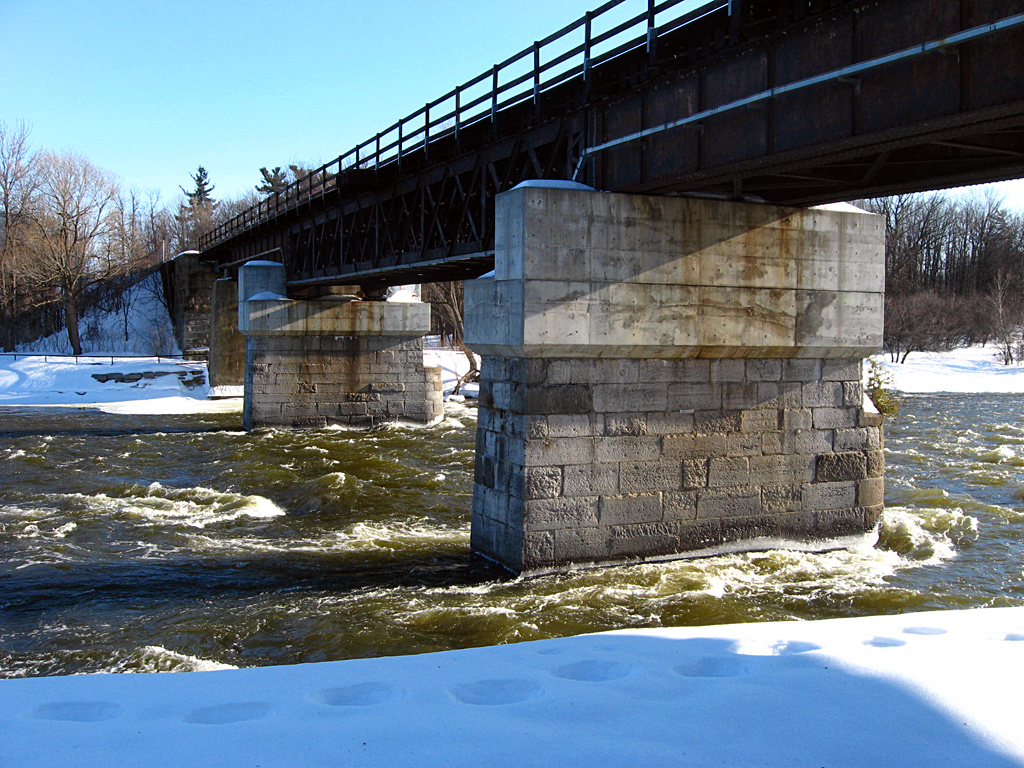
O-train bridge, Ottawa

I am not sure if any elevator manufacturer has done so, but it seems to me that adding some sensors and algorithms could significantly improve the efficiency of the machines in tall buildings. It could be a very practical application of utilitarianism, aiming to reduce the average per-person journey time as much as possible.

For instance, if there are two elevators moving past a floor where someone has requested a stop, the one carrying fewer people could be assigned the pause, even if the fuller cabin would be there sooner. Similarly, if a number of people got on at once and only one additional floor was selected, the movement of that elevator to that floor could be prioritized, bypassing people waiting on other floors.

To implement this, all you would really need is weight sensors in the elevator floor (or a tension sensor on the cable) and perhaps thermal sensors in the waiting areas to identify how many people are awaiting an elevator on any particular floor.

Another good mechanism might be a panel on the ground floor – or any sky lobbies – where each person waiting indicates their destination floor. They could then be routed to a particular elevator. For example, if ten people are all waiting on floor 1 to go up to floor 40, an elevator might be assigned just for them, saving them the delay of a dozen stops up along the way.

One last idea is a phased return system following fire drills and other sorts of evacuation. Having random collections of people enter elevators ensures stops every few floors. It would be fastest to carry everyone who is going there to the second floor, then do the third, and move on up the building.