Hydrogen and helium as sources of lift

Here is a random counter-intuitive fact about chemistry: while the atomic weight of hydrogen is 1.00794 grams per mole and that of helium is 4.002602 grams per mole, the helium nonetheless has 92.64% of the buoyancy of the hydrogen. This is because air weighs about 1.3 grams per litre, while hydrogen and helium gasses weigh 0.08988 and 0.1786 respectively. It is the difference between the density of air and the lift gas that is important and, in absolute terms, hydrogen and helium are not that different.

Ultimately, both hydrogen and helium are capable of providing about 1kg worth of lift per cubic metre of gas at room temperature and pressure. The major reason for which helium is popular as a lifting agent for balloons and zeppelins is because it is not flammable (it is actually a remarkable unreactive element). Unfortunately, helium is a lot more costly, has other uses (such as cooling superconductors), and is in the midst of significant shortage.

One Laptop Per Child

Bronze maple leaf

People who do not spend half their lives on the internet may not have heard about the One Laptop Per Child Program. This non-profit initiative has produced an inexpensive laptop meant to be used as an educational tool by children in the developing world. The device has been reviewed by the New York Times and, while it is limited in some ways, it seems to serve its intended purpose very well. Furthermore, it does some things that no other available laptop can, such as on-the-fly mesh networking: where computers close together automatically link up, allowing internet connections to be shared and collaboration within applications. It uses a $10 battery that is good for four times more charges than a normal laptop battery, while also providing six hours of power with the screen’s backlight engaged or 24 hours without. The machines also have built-in video cameras and microphones.

Through the ongoing Give One, Get One promotion, people can spend $400, receive one laptop for themselves, and donate one to a child in the developing world. Needless to say, one of these would make an amazing Christmas gift for a young person (the keyboard is apparently too small to be used comfortably by adults). Dust-proof and spill-proof, these things seem to be safe in the hands of the average child. Not only do they come with some very neat software, they really embrace the philosophy of letting children learn how it all works. One button reveals the code behind any website or program being used on the machine: potentially breeding a new generation of skilled programmers.

That last part is important. Some people have argued that laptops are hardly a priority in a world where people lack access to the basic requirements of life. In many places, that is certainly true. At the same time, having access to technology of this kind can help both individuals and societies push themselves along the path to development. It is more rewarding and sustainable, in the long run, to do that through the accumulation of expertise and skill than by continuing to rely upon what can be caught in nets, cut down, or dug out of the ground.

How trustworthy is Wikipedia?

Every page on Wikipedia has an accompanying ‘Talk’ page, where people discuss the main article and propose changes to it. Having a look at some of the talk pages is informative because it really shows off the lack of expertise among the people who are working on these articles. Much as I enjoy and admire Wikipedia as an effort, seeing things like the discussion on ‘tar sands’ makes me wonder how trustworthy the site is as a source of information. Often, the arguments on talk pages seem to be superficial and unsupported by evidence or strong argumentation.

As with everything else, we need to try to retain healthy skepticism about new information without becoming dogmatic about what we already believe. That is a tough thing to accomplish – especially given the scope and complexity of issues affecting us all.

SONAR and modern naval warfare

Gatineau in the snow

Arguably, submarines are the greatest threat to a modern carrier battle group. Aircraft can be detected at long range using over the horizon RADAR and picket ships. Subs generally need to be located using SONAR, though magnetic anomaly detection can sometimes locate them as well.

Warm surface waters are separated from the chilly bulk of the ocean by a layer called the themocline. The fact that this layer reflects sound makes SONAR based detection across it highly challenging: especially when the contact is something as quiet as a modern hunter-killer submarine. It is possible to use active sonar (the pinging thing from movies), but the sound produced by such systems reveals your position to others for a distance ten times greater than the effective detection range of the device. It also horribly damages the ears of whales, especially when used at crazy amplitudes like 250 decibels.

One way to deal with the thermocline problem while still using undetectable passive SONAR is to use a towed variable depth sonar array. For a ship, that would be pulled along beneath the thermocline. For a sub, it would probably be deployed above the layer. Another approach is to exploit convergence zones. Because of the nature of water under pressure, sound gets reflected off the ocean floor and back to the surface at intervals of 61 km. Sounds originating in one place can thus be best detected at points forming concentric circles.

Problems with SONAR are much worse in shallow waters, where high levels of noise from animals, waves, and tide noise make passive SONAR pretty useless. As such, modern navies avoid such waters as much as possible and behave as though they have already been detected by enemy forces whenever forced to operate within them.

LCD picture frames

Walking through a packed mall the other day, I actually saw a product that had not previously occurred to me but which was nonetheless quite appealing: electronic picture frames. They ran from about $150 for a 4 x 6″ frame to about $350 for an 8 x 12″ version. The latter is the size I would go for, if purchasing such a thing. It doesn’t make too much sense to show off photos at sizes smaller than that.

Basically, you put a bunch of photos on a memory card, put it in the frame, and see them presented for whatever span of time you like. So far, my intention to make some prints has not been fulfilled. This would be more portable and varied than a bunch of framed prints, anyhow.

The idea of an ever-changing photographic feature for my living room is appealing. My flat would seem a bit less impersonal with such an element. It is also true that the presentation of photos in an actively luminous way (slides or a screen) has advantages over prints that simply reflect available light. For one thing, the colours seem to look nicer.

Does anybody know which brands make attractive and reliable screens of these sorts?

Some nuclear facts and figures

First Nations art

The first nuclear reactor to generate electricity was the EBR-1 experimental reactor in Arco, Idaho. Previously, reactors had only been used to produce materials for the military: especially plutonium for bombs of the kind dropped on Nagasaki on 9 August 1945. Four years after the EBR-1 reactor became operational (producing a paltry 100 kilowatts of power), it became the first nuclear reactor to suffer a partial meltdown.

The contemporary nuclear industry includes 439 nuclear reactors worldwide, producing 6.5% of the world’s energy and 15.7% of the world’s electricity. According to the International Atomic Energy Organization, 31 different countries operate reactors. Two countries – France and Japan – produce 57% of the world’s nuclear power, with nuclear producing 80% of all French usage. In terms of sheer output, the United States produces more nuclear power than anyone else in the world. US nuclear output in 2005 was about 406 terawatt-hours. They also have the largest and safest nuclear navy (Russia has had 18 serious nuclear accidents on subs, producing seven sinkings and 241 deaths).

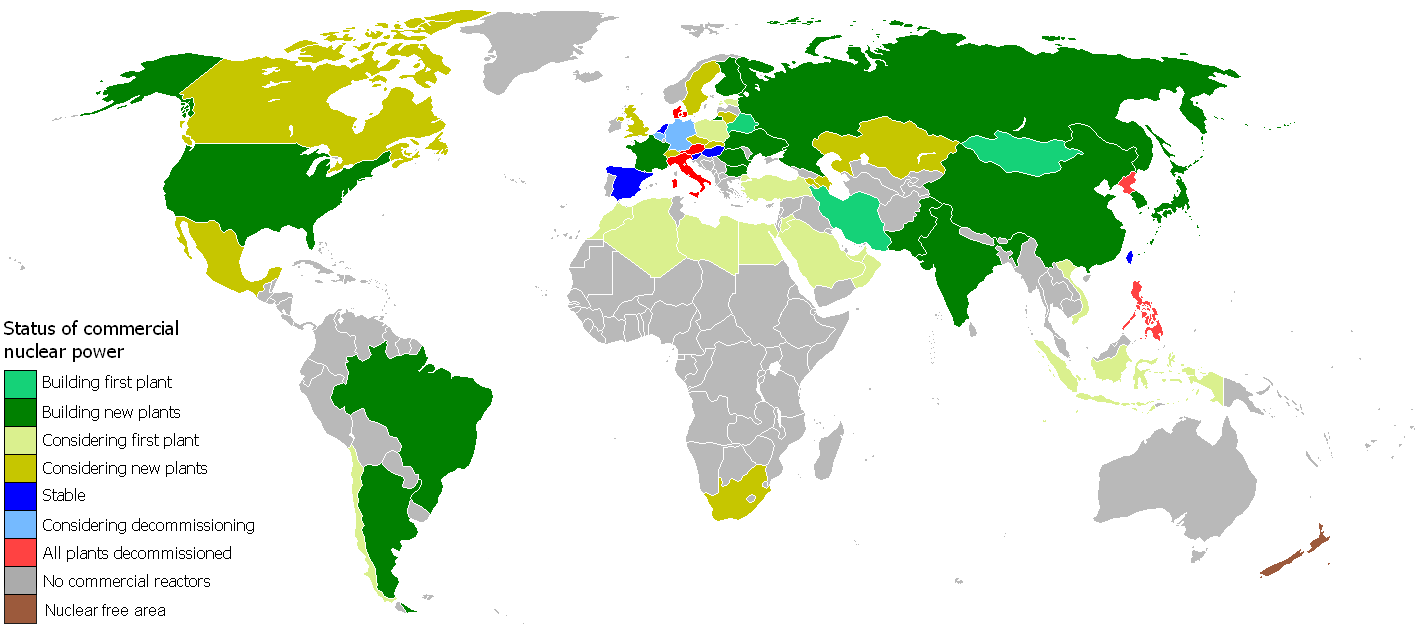
As far back as 1952, a Presidential commission (The President’s Materials Policy Commission) produced a pessimistic report on the prospects of nuclear power for electrical generation, suggesting that money be devoted to solar power research instead. Now, the combination of concerns about energy security and concerns about climate change is prompting a possible re-birth within the industry. Here is a map showing who is considering new nuclear facilities.

It would certainly be useful to know the true price of nuclear power, as well as whether anyone will actually open a geological storage depot for spent fuel in coming years.

Reloaded with non-fiction

I have officially abandoned my earlier initiative to finish all my pending books before purchasing more. Mostly, that is because I finished all the non-fiction on my list and all of the fiction I have read recently has been depressing. While much of the non-fiction can also be dispiriting, it feels less like emotional self-flagellation to read it.

My new crop of non-fiction:

  • Bodanis, David. Passionate Minds. 2006
  • Collier, Paul. The Bottom Billion: Why the Poorest Countries are Failing and What Can Be Done About It. 2007
  • Easterly, William. The White Man’s Burden: Why the West’s Efforts to Aid the Rest Have Done So Much Ill and So Little Good. 2006.
  • Overy, Richard. Why the Allies Won. 1995.

The Easterly book was endorsed by Emily Paddon during one of our pre-seminar conversations in Oxford. It is also one of those books that I have heard mentioned in conversation often enough to feel concerned about not having read. The Collier book is clearly on a related theme. I saw Paul Collier speak many times at Oxford and always found him candid and informative. Richard Overy’s book was one of the best I read in the course of two history seminars at Oxford; I look forward to having the chance to take my time in reading it, rather than having it as one of several urgent items in an essay’s source list. Finally, I got the Bodanis book because I have heard it well recommended and know little about Voltaire and even less about Emilie du Chatelet.

I will certainly finish the fiction eventually, but I will do so interspersed with meatier stuff.

Comedy cut-off

I haven’t seen The Daily Show or The Colbert Report in ages. The American Comedy Central site is blocked in Canada, and the Canadian site you get re-directed to isn’t Mac compatible. For a while, the new Daily Show website worked here. Now, it just shows a never-ending string of ads.

These shows were the only television news I had ever watched with any regularity. Until their online infrastructure changes, it seems that print and web sources will be my sole connection to the mass media.

[20 August 2008] Ashley has kindly informed me that full episodes of The Daily Show and the Colbert Report are available in Canada through CTV.ca. It looks like I won’t need to set up a special US proxy system after all, though Pandora may still tempt me to do so.

Reliable Replacement Warheads

Old Montreal

Since July 16th, 1945 the United States has been a nuclear power. The first American thermonuclear weapon was detonated in 1952. During the span of the Cold War, tens of thousands of hydrogen bombs were assembled and mounted inside artillery shells, torpedoes, submarine launched missiles, cruise missiles, land-based ICBMs, and aircraft-mounted bombs. Now, these weapons are starting to age and a debate has emerged on what should be done with them.

Many of these weapons are highly complex. A standard submarine-based missile has a conical warhead. Inside is a uranium casing that serves to contain the original blast until a maximum amount of fission has occurred. At the bottom of that casing is a ‘pit’ of plutonium which is at a sub-critical density. Around that is a casing of brittle, toxic, neutron-reflecting beryllium. Inside it may be a cavity containing tritium and deuterium gas (in the case of a “boosted” primary). Around the beryllium outer sphere is a shell of high explosives designed to explode with fantastic precision, crush the plutonium pit to supercritical density, and initiate the fission reaction.

This whole assembly exists to initiate fusion in the ‘secondary,’ located higher in the outer uranium casing. The material that undergoes fusion – usually lithium deuteride – is wrapped around another sphere of uranium and is, in turn, wrapped in more uranium. All this is to create the largest possible yield in a relatively small and light package. The small size and conical shape allow eight or more of these devices to be placed on a single missile and then independently targeted once that missile is at the height of its ascent.

The 2008 budget allocated $6.5 billion for the maintenance of the American nuclear stockpile. That consists of 9,900 assembled warheads – 5,700 of them deployed operationally. In addition to these, about 7,000 plutonium pits are stored at the Pantex Plant in Amarillo, Texas. As the weapons age, concerns are developing about their reliability. They all contain high explosives, toxic chemicals, and corrosive agents. While it is possible to upgrade many of the non-nuclear components and replace them with more stable variants, the newly assembled bombs could not legally be tested: potentially leaving military commanders in doubt about their usability.

That is, in essence, the core of the ongoing debate about the Reliable Replacement Warhead (RRW). The program would begin by refurbishing 100 kiloton W76 warheads, which is already undergoing a less ambitious retrofitting. The hope is that the program can produce weapons with long durability and lower maintenance costs, and be able to do so without requiring full-scale tests of the devices, as were conducted in Nevada and the Marshall Islands during the Cold War. I won’t get into the details of the debate here. More than sufficient information exists online and in recent newspapers and magazines. What is less frequently considered are some of the aspects of international law relevant to nuclear weapons.

The whole program should remind people about an oft-forgotten element of the Nuclear Non-Proliferation Treaty. Everyone remembers the bit about signatories without nuclear weapons pledging not to acquire them. People forget that the treaty also obliges existing nuclear powers to reduce their arsenals as part of an overall progression towards de-nuclearization. Upgrading your nuclear arsenal to endure further decades of operational status is hardly consistent with this requirement. It also signals to other states that the United States continues to consider operationally deployed nuclear weapons an important part of their overall military strategy.

Individuals and organizations contemplating a sizable RRW program might also do well to re-read the Advisory Opinion on the Legality of the Threat or use of Nuclear Weapons set down by the International Court of Justice. While such legal considerations are relatively unlikely to affect whatever decisions are made in relation to the RRW, examining the status of the law can be a good way to reach decisions about the respective rights and obligations of states.