Summer thunderstorm and Ubuntu Linux

Today’s thunderstorm was good news for the parched lawns of Oxford: deprived in past weeks as the consequence of a watering ban. I’ve always been an appreciator of thunderstorms. I like the drama. I like the sense of immersion in nature. Naturally, it is most poignant when you are out on the middle of the lake with a canoe. Not the most pleasant or safe way to experience one, but something that everyone should try at least once.

Another aspect of thunderstorms that I appreciate is how they psychologically empower me to hunker down and feel absolutely no guilt about doing so. They are a kind of free pass from all but the most pressing of obligations. Naturally, there isn’t a lot of appeal to going outside under such conditions, so I spent the time cooking and fiddling with some computer stuff I had set aside earlier.

Warning: computer jargon ahead

Continue reading “Summer thunderstorm and Ubuntu Linux”

Spelling, grammar, and public writing

Flowers in Woodstock

Talking to people about some of the essay editing I have been doing, in various capacities, I find that there are two general positions when it comes to grammatical and typographical errors. Most people fit pretty squarely into one or the other group, and a fair amount of animosity seems to fly between the two. Normally, my impulse is to call for restraint in in the prosecution of such campaigns. In this case, however, I think the argument in favour of the second position is quite clear-cut.

The first group feels that the important thing is just making clear what you mean. Misspelling a proper name, using the wrong homonym (its v. it’s), and similar errors are not of great consequence, because anyone can tell what you meant. I have some sympathy for this view, particularly because it can lay some claim to being anti-exclusionary. English is a weird language and it is hard to learn. A lot can be said for tolerating those who are in the process of doing so. The internet and other venues are richer for their contributions, and it is unreasonable to expect perfect use of language from those who are still getting used to it. Indeed, I would be extremely hard pressed to write a perfect post or comment in French.

At the same time, those who are capable of writing proper English have little excuse not to do so, whether online or in a different context. The second group – to which I belong – sees writing properly as a duty the writer owes to their audience. To just throw unedited text at people is disrespectful, because it shows that you don’t care enough about them to present them with something polished. I am not talking here about Joyce or e.e. cummings bending the rules – that is the privilege of anyone who knows them well enough to toy with them. A style deliberately different from standard English is not comparable to carelessly written English. I am talking about those people who can’t be bothered to check their spelling and read over what they wrote to make sure it accords with the basic conventions of English grammar. With built-in spellchecking and nearly effortless editing fundamental to modern word processing, there is really no excuse.

A secondary benefit is that taking the time to re-read what you’ve composed lets you better make sure that you aren’t about to put something malformed or uninformed into a public place, where it may embarrass you to many people, and where it may be hard to remove.

Movie physics

Apparently, the physics in The Da Vinci Code are no better than the history or theology. (Though this review is more about general plausibility than physics, per se.) Let it be known that Insultingly Stupid Movie Physics is among the greatest of all websites.

The review of The Core is funny enough to be worth reading, even if you haven’t seen that awful, awful film. People making films should probably take a careful look through their generic list of bad physics. Of course, scientific accuracy may not be terribly likely to put people in cinema seats, or sell DVDs.

On password security

I was talking with Kelly today about passwords, and how they are a fundamentally weak form of security. Supposedly, we are all meant to have different passwords for every site, so that one database being compromised by an external hacker or malicious insider won’t lead to our email and other sites being at risk. Also, we are supposed to use long and complex passwords with case-changes, numbers, punctuation, etc. (Think ‘e4!Xy59NoI2’) Together, these two requirements far exceed the capability of most human beings.

The real solution is to back up passwords with something else, so that they don’t need to be so strong. This is called two-factor authentication, and it could include something like a smart card that people carry and slot into computers along with a password so as to authenticate themselves. This is already used in cars. Inside the key or newer cars is a little chip with a radio antenna. When you try to use the key to start the car, a radio message is broadcast by the car. The chip detects it, does a bit of thinking to generate a response that authenticates the key, and re-broadcasts it. Using both the physical profile of the key and the radio challenge-response authentication system, attacks based on picking locks or freezing and cracking the cylinder inside them can be circumvented. The system obviously isn’t impossible to foil, but it is substantially more difficult in relation to the additional cost.

In the computer context, such two-factor authentication could take other forms: for instance, a little card that listens to a series of tones from an external source (over the phone, or from a computer), passes them through an algorithm and emits a series of tones in response to authenticate. This is just doing with audio what a smart card does with electricity. Ideally, the second factor would be like a credit card, in that you could have it cancelled and re-issued in the event that it is lost or stolen, immediately disabling the missing unit.

Until such a system emerges, it seems sensible to have tiers of passwords. I have two really weak passwords for things that I sometimes share with close friends. Then, I have a password for low-risk sites where there is no real harm that can come from my account being compromised. Then, I have a cascade of ever-stronger passwords. Something like LiveJournal has a pretty strong password, because it would be a pain if somebody took it over. The general vulnerabilities of passwords are:

  1. Someone could guess it (either manually or with a brute force attack)
  2. Someone could watch you type it in
  3. Someone could install a hardware or software keystroke logger on a machine where you enter it
  4. Someone could break into a database that contains it, then try using it on other sites you use
  5. Someone could extract it from a program on your computer that stores them in an insecure way (like Windows screen-saver passwords, which can be learned using a simple program)

Most of these require physical access to a machine that you use. I would guess that the most common of these is number four. Given that most people use the same password for everything, some underhanded employee at your ISP or webmail provider could probably grab it pretty easily, as well as information on other sites you use. (Hashing algorithms are one way this risk can be mitigated, on the server side, but that’s a discussion for another day).

At the top level, there are things that demand a really strong password: for instance, webmaster control accounts or anything connected to money. For these, I use random alphanumeric strings of the maximum permitted length, never re-using one and changing them every month or so.

Obviously, I cannot remember these for several banks and websites. As such, I write them down and guard them. I am much better at guarding little bits of paper than at remembering random strings of data. I regularly carry around little bits of paper worth tens of Pounds, and little bits of plastic worth thousands of Pounds, if only until disabled. Indeed, I have been guarding bits of paper for well over a decade.

WordPress v. Blogger

A decent amount of time has now passed since I migrated my primary blog from Blogger to WordPress. In general, the move has been for the better. I have more control now and needn’t spend hours pulling out my hair when the Blogger servers are down (as they often are). The biggest advantages are:

  1. Control – Since all the WordPress code, including content management, lives in your own webspace, you have much more control over it than you do with Blogger. That means you can play with fairly advanced stuff like PHP scripts, MySQL databases, and htaccess files. On the server side, WordPress is just a more powerful, more versatile system.
  2. Features – Categories and trackbacks come to mind immediately, as do some of the excellent plugins available for WordPress. Spam Karma 2 is especially valuable. The ability to create and integrate static content pages (everything under the ‘Pages’ heading in the sidebar) is also a significant plus.

Of course, there are a few problems as well:

  1. Poor image implementation – With no effective integration of image uploading and thumbnail creation, I need to do everything by hand. Download files from my A510 to iPhoto, choose the photo of the day, extract it to a jpeg, create a full sized and thumbnail version in Photoshop, upload the two copies using Fetch, change the permissions for them, then insert the thumbnail as an image and like it to the full sized file. In Blogger, everything after “extract it to a jpeg” is basically done automatically.
  2. Awkward upgrades – Because WordPress lives on your server, you basically need to replace the bulk of the code when an update comes out, even a minor one. Because you would be a complete fool to do this without a full backup, it makes for a fairly serious hassle. You also need to go through the bother of making sure all the aforementioned useful plugins still work properly, after the change.
  3. WYSIWYG editor glitches – When pasting a complete blog entry from TextEdit, the What You See is What You Get editor built into WordPress will frequently separate paragraphs using double line-breaks, rather than paragraph tags. More seriously, it also has a habit of leaving tags open. It’s not usual after a complex formatted post to find that everything on the page below it has been left italicized or indented.

All in all, I am glad to have made the change. I like being in control of my own system, even if I don’t know all the complexities and there are some associated frustrations. Not counting all the headaches involved with Google when you switch your permalinks, the process of moving is very easy. To people with webspace using Blogger searching for better templates and more control, I recommend WordPress.

Mapping virtual selfdom

Working in the Department of Politics and International Relations

There’s nothing like seeing all the websites to which you have contributed listed in one place to make you feel like a hardcore geek.

Now, back to being the only person in the Department of Politics and International Relations. At 8:45pm on a Sunday. Surrounded by books on the Middle East, and drinking Red Bull.

[Update: 11:59pm] After three hours of editing, I have something with which I am actually pretty happy. It is definitely much better than my decolonization essay. I am going to go home, then give it one last check over before giving it to Dr. Hurrell tomorrow. Just one paper left!

Pringle-saturated satirical news

The Comedy Central website – once a much prized source of Daily Show and Colbert Report clips – has become unusable. Now, every single clip is preceded by a truly insipid 30-second Pringles commercial: the same ad for every clip. Given that both The Colbert Report and The Daily Show post about 6-7 one-minute clips on each day from Monday to Friday, watching them all would involve watching that Pringles video more than ten times in a half hour period: something I am not willing to put up with.

I can understand the need to pay for bandwidth, but this is just too annoying a way to pull it off.

PS. The Show and The Report are also under discussion here, at the moment.

Strategy time – time strategies

I have been trying to learn what I can learn during these last few days of the Google Idol contest, in hopes of being able to maximize Mica’s chances. The first potentially relevant fact is that the website hosting the contest is registered in Brisbane, Australia. I had often found it difficult to guess what time the server would be ticking over into the next voting day, allowing all the IP addresses that had already voted to do so again.

This round ends on June 24th, but nowhere does the website specify at what time. As such, the earliest it could possibly end (00:01 Brisbane time) would be 2:01pm Oxford time on the 23rd. The latest it could possibly end (23:59 Brisbane time) would be 1:59pm on the 24th. If someone has figured out at what time of day their server ticks over, it would be very useful information.

Why?

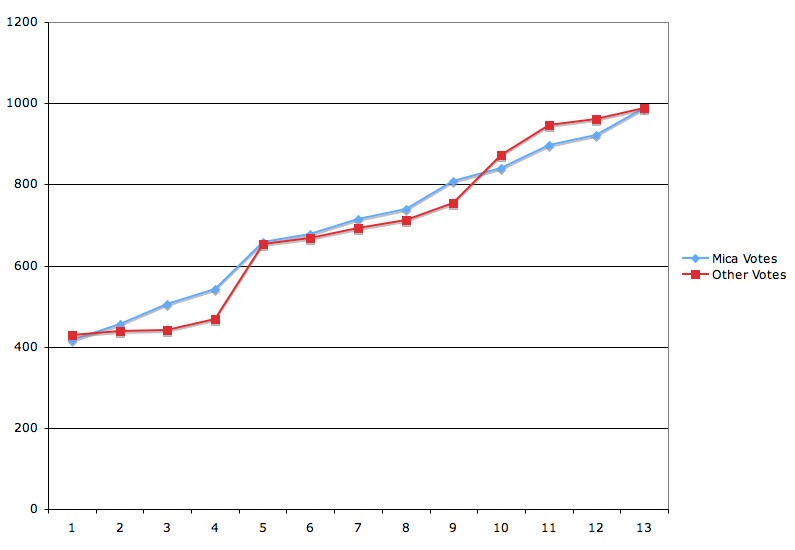
Because the lead has been cyclical:

Chart of voting patterns

Chart based on data between 22:00GMT on the 18th and 22:00GMT on the 20th.

As you can see, the distance between the number of the votes for each video rises and falls according to an orderly pattern. I would guess that with ‘Twan, Sjoerd, Manuel en Iwin’ living in Western Europe and Mica coming from the West Coast of North America, there is about an eight hour lag between time equivalencies in the areas where most of their respective voters will be living. Those of Mica’s competitors rise eight hours earlier, vote, and go to sleep eight hours earlier.

The fact that the slope of Mica’s line is more constant may be the product of how I have been cajoling people on the east coast of Canada and the United States – as well as in the UK and elsewhere – to vote for him as much as possible. Alternatively, I may have nothing to do with it and people voting for him just vote at times more distributed across the day for some other reason or collection of reasons.

As such, it would be helpful to work out what time it will be in each place when the contest ends. Ideally, we would probably want it to end around midnight Vancouver time, when it will be about 8:00am in Europe. I think that would be about 6:00pm in Brisbane.

[Update: 22 June 2006] I have created a chart that shows the amount by which Mica has been winning or losing at various times when I have checked on it.

Not polyglot

Perhaps the ultimate demonstration of just how low a click-through rate spammers need in order to justify sending emails is the huge number of messages written in Asian scripts that I receive every day. Since my email address is posted in several places on several different websites, it it unsurprising that all manner of spam robots have collected it. Because of my general willingness to give my ‘real’ email address to various websites and companies, I generally get more than 100 spam messages a day. Thankfully, GMail catches nearly all of them.

Given that all the websites from which my email address has been taken are in English, you would think that an even moderately intelligent spam robot would direct English spam towards addresses listed thereon. I now get more than twice as much non-English spam as English spam, and almost all of that in Asian scripts. Not that I mind being the target of Chinese, Japanese, and other sorts of spam – I don’t even need to skim the titles to know that they aren’t for me.

First eBay sale

I’ve joined the ranks of those who have at least listed an item on eBay. In this case, it’s the Sony headphones that I want to sell in order to get money for a snazzier pair. These are brand new and in the original packaging.

I may have set the minimum bid a bit high, but you can’t set a reserve price under £50 and I’m really not willing to sell these for less than £15 after spending almost £25 on them. In any case, we will see how this experiment in commerce goes.

[Update: 21 June 2006] With exactly 12 seconds left in the auction, someone placed a bid. Looks like I am offloading these headphones for £15 plus the cost of shipping.

The economics of it all:

Price initially paid on Amazon: £25.66 C$53.01

Payment received from eBay: £15.00 C$30.99
Shipping fee from eBay: £2.00 C$4.13

eBay listing fee: £1.29 C$2.68
PayPal currency fee: £0.86 C$1.77
Cost of packaging: £0.49 C$1.01
Cost of shipping: £0.68 C$1.40
Net eBay income: £13.68 C$28.26

Amazon cost – eBay income: -£11.98 -C$24.75

In the end, choosing to buy these headphones cost me about twenty-five bucks for three months’ usage. Let’s hope the ones I choose to replace them with last much longer.