
Threatening clawback

A central aim of the climate change activist movement is to discourage further investment in fossil fuel projects. This is closely tied to economic analyses showing that the total cost of the transition depends critically on how quickly it starts and how effectively long-term high-carbon projects are avoided. It’s also the inverse of a frequent claim made by pro-fossil proponents: that investor confidence is necessary to keep billions flowing into fossil fuel infrastructure investment. That was the logic that made Canada’s federal government buy the Trans Mountain pipeline, in order to demonstrate to investors that Canada still has a legal and economic climate in which major fossil fuel projects are possible.

A potential strategy that could help avoid further fossil fuel infrastructure investments is the threat that profits earned in the near-term will be clawed back in the longer term to pay for some of the damages arising from climate change. It’s not something that today’s governments in North America are willing to threaten (not least because the longstanding purpose of corporations is to protect investors from personal liability for the actions of the firms they invest in). Nonetheless, it’s something that can be emphasized as a risk in the future in order to increase investor reluctance.

One practical way could be to begin tracking which entities large enough to be worth targeting in the future are profiting from fossil fuels today: fossil fuel corporations directly, but also major stockholders receiving dividends. Having some claim to being able to credibly track the flow of profits is essential to this strategy; otherwise investors will likely believe that they will have spent the profits by the time there is any demand for compensation, or that they will have shifted them through so many other investments as to have ‘cleaned’ them in a sense akin to money laundering.

The threat of clawback could be an argument to use when advocating divestment from the fossil fuel industry, since it would protect the institutional investor from such future claims of compensation, at least as far as future fossil fuel profits go.

It may seem pointless to suggest an idea like this when it is so far outside the political mainstream today, but a central point in the entire stranded assets / carbon bubble argument is that the political possibilities of the future will be different, and governments may grow far less accommodating of fossil fuels as decarbonization proceeds and the impacts of climate change worsen. Putting a little asterisk beside fossil fuel profits (* may be clawed back in the future to pay for climate damages) would both be a fair representation of a reasonable prospect, which can be made more probable through activist effort, and a way to make fossil fuel related returns seem less valuable and more tenuous than returns from alternative investments.
Fixed-term elections and the confidence convention

I have always been taught that the idea in Canada, the UK, and other Westminister-style Parliamentary democracies is that Parliament is sovereign and that the prime minister and cabinet must maintain their confidence to rule legitimately.

A recent Economist article on Brexit makes several references to how their fixed-election law ambiguously alters that:

[T]he Fixed-term Parliaments Act of 2011 upturned established conventions on confidence votes within the Commons, leaving confusion among MPs over both how to bring a government down and what happens when one falls. And the quirks of British parliamentary procedure provide various ways in which a sufficiently bloody-minded prime minister might force a “no-deal” Brexit without a majority in Parliament. This has all the makings of a constitutional crisis.

The Fixed-term Parliaments Act got rid of the power that prime ministers had previously enjoyed to call an election at any time, thus reassuring the Lib Dems that the Tories would not cut and run as soon as they fancied their chances.

The country may thus see a new conflict over where sovereignty lies—the constitutional question which, above all others, Brexit has dragged into the light.

Some of the subsequent mess rests on the back of the Fixed-term Parliaments Act of 2011. Before this a prime minister whose flagship legislation was voted down—just once, never mind repeatedly—would have been expected to call an election. If he or she had not, a vote of confidence would have followed which a minority government would have been near certain to lose. The 2011 act replaced this convention with statute which says that a lost confidence vote triggers a two-week period during which any mp can attempt to win the backing of the Commons and form a government to avoid an election. When asked what this would actually look like, the clerk of the House of Commons responds: “I really don’t know—I don’t think anybody knows.”

It seems remarkable that an ordinary piece of legislation can muddy or upend the most important constitutional convention in Westminister democracies — the confidence convention — and that the legislation in turn was to solve a short-term coalition management problem.

The article also discusses another change that got limited consideration but which has important and open-ended effects: “The hurried inception of the Supreme Court was, in the mocking words of its former president, David Neuberger, ‘a last-minute decision over a glass of whisky’.”

Shareholder activism and fossil fuel corporations

One argument routinely used against divestment from fossil fuels is that, as investors, institutions like universities and pension funds might be able to discourage the most wasteful and damaging new fossil fuel investments and encourage fossil fuel corporations to use their resources and expertise to advance decarbonization.

In the U of T divestment brief we explained our doubts about this justification. Nonetheless, it remains an approach that some are trying:

Bruce Duguid of Hermes Investment Management, who worked with bp on behalf of Climate Action 100+, says that disclosure will help investors understand if the billions which bp continues to spend on oil and gas creates too much risk. bp will describe how big new capital projects stack up against the Paris goal of keeping warming “well below” 2°C relative to preindustrial times. Equinor, Norway’s state behemoth, agreed to something similar in April. As with Shell, bp’s resolution does not require it to cut oil and gas output. Greenpeace, a combative ngo, blocked entrances to bp’s headquarters in London ahead of its annual meeting on May 21st.

For the time being, though, Shell, bp and ExxonMobil remain members of the American Petroleum Institute, which has sought to ease rules on emissions of methane, a potent greenhouse gas. They also maintain links with the Western States Petroleum Association, which last year fought a carbon tax in Washington state. bp spent over $13m directly to help defeat a ballot initiative in favour of the levy.

Others are beginning to question the value of shareholder engagement. The Church of England has said it will divest by 2023 if no advances are made. “Investors’ patience is not limitless,” says Mr Logan. “It’s going to be measured in years, not decades.”

There are many reasons to doubt how meaningful shareholder activism can be, and to ask whether it’s a “shadow solution” that creates the impression that action on climate change will happen, while really justifying the continuation of the status quo. These firms have an enormous financial interest in keeping the fossil fuel reserves they own usable, which in turn means blocking climate change action. Furthermore, neither executives nor shareholders can be expected to meaningfully support a transition to decarbonization which would make these firms irrelevant.

Highly detailed, well-sourced, powerful testimony from Jody Wilson-Raybould

“For a period of approximately four months between September and December 2018, I experienced a consistent and sustained effort by many people within the government to seek to politically interfere in the exercise of prosecutorial discretion in my role as the Attorney General of Canada in an inappropriate effort to secure a Deferred Prosecution Agreement with SNC-Lavalin. These events involved 11 people (excluding myself and my political staff) – from the Prime Minister’s Office, the Privy Council Office, and the Office of the Minister of Finance.”

“In my view, the communications and efforts to change my mind on this matter should have stopped. Various officials also urged me to take partisan political considerations into account – which it was clearly improper for me to do. … We either have a system that is based on the rule of law, the independence of the prosecutorial functions, and respect for those charged to use their discretion and powers in particular ways – or we do not. While in our system of government policy oriented discussion amongst people at earlier points in this conversation may be appropriate, the consistent and enduring efforts, even in the face of judicial proceedings on the same matter – and in the face of a clear decision of the DPP and the AG – to continue and even intensify such efforts raises serious red flags in my view.”

Read the full text of Jody Wilson-Raybould’s statement to the House of Commons justice committee

The marriage of climate and economic justice

Something occurred to me as I was walking through the snow this morning. There’s an episode of Yes Minister (The Bed of Nails) in which the hapless minister Jim Hacker is charged with implementing an integrated national transport policy. His savvy and manipulative chief civil servant explains:

It is the ultimate vote loser… If you pull it off, no one will feel the benefits for ten years. Long before that, you and I will have moved on… In the meantime, formulating policy means making choices. Once you do that, you please the people that you favour, but infuriate everybody else. One vote gained, ten lost. If you give the job to the road services, the rail board and unions will scream. Give it to the railways, the road lobby will massacre you. Cut British Airways investment plans, they’ll hold a devastating press conference that same day.

Ultimately, the minister and his permanent secretary conspire to be freed from the job, first by proposing a service-slashing approach to transport reorganization, in which they deliberately alert the prime minister about unpopular changes it would imply for his constituency, and then using Sir Humphrey’s second strategy:

We now present our other kind of non-proposal… The high cost, high staff kind. We now propose a British National Transport Authority with a full structure, regional board, area council, local office, liaison committee, the lot. 80,000 staff, billion-a-year budget. The Treasury will have a fit! The whole thing will go back to the Department of Transport.

What occurred to me in the snow is that while Hacker and Humphrey may have been using these approaches as a dodge, one could say metaphorically that those calling for strong climate change policies have in some ways pressed the same two strategies.

First there was the dream of an economically efficient solution via a carbon tax. All the most sophisticated and credible economic analyses projected that the best way to solve climate change was to put a rising cost of carbon across the entire economy and then let individuals and firms make their own economic choices to adjust. This policy was favourably contrasted with trying to reduce fossil fuel use and the resultant greenhouse gas (GHG) emissions through regulation. It was also tailored to appeal to people on the political right: rather than imposing particular technological choices it relies on the free market to adapt naturally to the increasing cost of a previously-neglected factor of production, just as they do every day as commodity prices like oil and copper spot prices do.

What seems to have sunk this strategy is the willingness of those on the political right to play Russian roulette on climate change, assuming the damage we do won’t be that bad or that some future technology will solve the problem painlessly. Coupled with that is the unreasoning hostility to taxes that has been embraced by some right wing populist figures, movements, and political parties. Proposing an environmental policy that can be given the derogatory label “a tax on everything” is challenging in a climate where such figures are influential, and can make it easy for an incoming right wing government to scrap on the basis of “giving money back to [insert name of jurisdiction] families”.

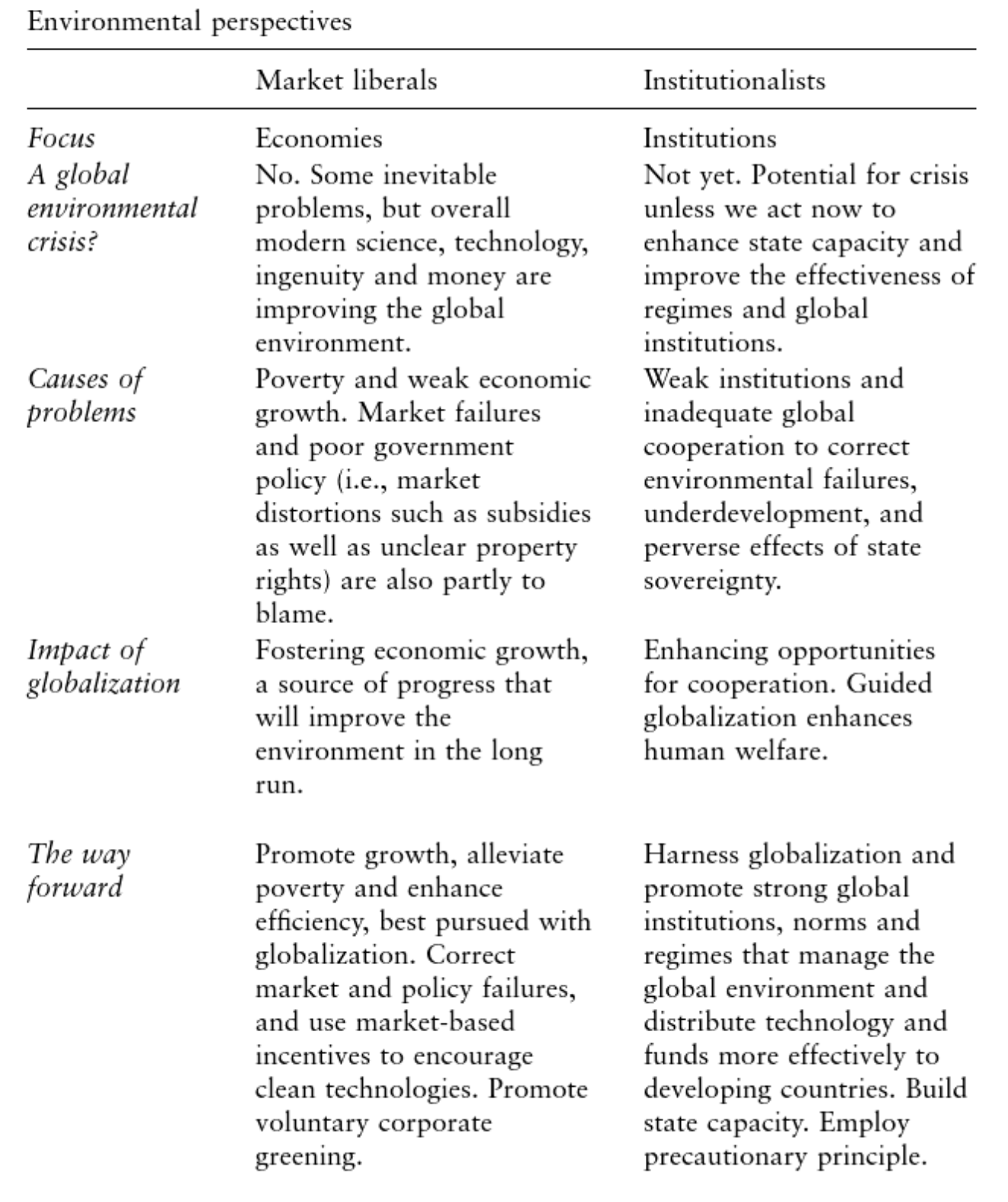
The carbon tax idea was always an awkward fit for the “social greens” to use Clapp and Dauvergne’s terminology. In Paths to a Green World they differentiate between four broad streams within environmentalism: market liberals, institutionalists, bioenvironmentalists, and social greens:

If your analysis is that our system is beset by an ever-destructive capitalism which must be deconstructed, the virtues of a carbon mitigation measure designed to function through efficient capitalist markets was never likely to appeal. Perhaps it speaks to the climate justice dimension when carbon tax revenues are put to purposes that aid the disadvantaged, as with refunds to those with low emissions under a cap and dividend scheme or proposals to use carbon tax revenues to fund a basic income system.

That’s the second set of policies that occurred to me in the snow, corresponding to Humphrey’s “high cost, high staff” straw man. That’s the mainstream media criticism consensus on proposals like the Green New Deal: that they can’t see the rational connection between proposed elements like a job guarantee and climate change, and that the set of new government benefits being proposed seems unreasonably costly.

We surely can’t know what strategies will succeed on climate change. There has never been a problem sufficiently similar to serve as a credible model, so we can never say with complete confidence that one or another past movement suggests the best activist strategies in the world today. We’re going to need to keep trying multiple strategies, especially if we’re committed to democracy. Under a democratic system the populace must ultimately begrudge and tolerate any burdensome actions their society is undertaking for the sake of a stable climate. It has to be akin to the general tolerance of taxation, and be an expected and embedded norm to be part of a society progressively moving away from carbon fuels.

It’s great that social greens are so passionate and able to turn a belief that they’re fighting for justice into enthusiasm and motivation. It probably helps to have a comprehensive vision for societal reform, as opposed to the rather abstract and unemotive “what strategies for decarbonization can work, if we put it ahead of all other priorities?”.

The monarchy and Canada’s Indigenous relationships

John Fraser, former head of Massey College, has an article in today’s National Post: Canada’s First Nations and the Queen have a kinship like no other.

I’d like to see a rebuttal from someone like Pamela Palmater. Personally I think it’s rather questionable to be upholding the idea that the crown has behaved honourably less than four years after the Truth and Reconciliation Commission of Canada finished its work.

Redwater Energy Supreme Court decision

A bit of good news: Supreme Court rules energy companies cannot walk away from old wells.

The fossil fuel industry has huge future cleanup costs, including the UK’s North Sea platforms, and of course Canada’s bitumen sands. The CBC story notes:

Alberta has been dealing with a tsunami of orphaned oil and gas wells in the past five years. In 2014, the Orphan Well Association listed fewer than 200 wells to be reclaimed. The most recent numbers show there are 3,127 wells that need to be plugged or abandoned, and a further 1,553 sites that have been abandoned but still need to be reclaimed.

The industry functions by socializing costs and privatizing profits: for instance, imposing climate change on everybody while directing revenue to shareholders, staff, and executives. The post-productive phase for oil, gas, and coal projects can be a major opportunity to divert costs that should legitimately be borne by the corporation onto the public.

Open thread: climate lawsuits

People are making use of nearly every possible mechanism to try to cajole, convince, pressure, or force governments into adopting plans that are ambitious enough to avoid dangerous climate change.

One possible avenue of remedy is lawsuits, like when the Urgenda Foundation convinced a Dutch court to require the government to tighten its 2020 emission reduction target.

In October, The Economist reported:

The state of New York filed a lawsuit against ExxonMobil, claiming that it misled investors about the risk that regulations on climate change posed to its business. The suit alleges that the oil company “built a façade to deceive” how it measured the risk and frequently did not apply the “proxy cost” of carbon, which accounts for expected future events, to its decisions.

There are attractive and unattractive features to using the courts. On the plus side, they may be more open to evidence than politicians, who are generally loathe to do anything that might threaten jobs or economic growth in the near term. The biggest limitation is probably the courts aren’t policy-makers and defer to legislatures to actually design government policy. Also, because both the causes and the effects of climate change are spread across space and time it’s impossible to say that emissions from source X caused consequence Y. Also, since the people harmed are all around the world and largely in the future there is no court that can hear petitions from all of them.

That said, there is cause for hope that lawsuits will be part of an effective path forward and a means to hold governments to account when they want to claim to be climate champions while simultaneously favouring and protecting emitting industries.

Related: