Academic Hiccough

Oxford in the afternoon

Today’s supervision really didn’t feel as though it went well. While some of the discussion had the kind of energy that has been characteristic, there was also a lot of vague sparring and misunderstanding. I don’t know exactly why this was the case, but I suspect my essay was of lower quality than normal. That’s partly because the question was so large and, when I picked and chose elements to address, I didn’t really explain why adequately. As such, it was open to all sorts of attack. I will do better next time. Next time, I really should make an effort to have someone else at least glance over my paper, before I produce the final version. Thoughts that never get interrogated risk being really flabby the first time someone does; if that happens in supervision, it reflects really badly.

Despite sleeping quite a lot in the past few days, I remain frequently and thoroughly tired. I don’t really have an explanation for it, but it’s very bad for overall productivity. It may well have something to do with my continued failure to establish anything like the five-track ideal life: one in which you always have five different things happening at once, in different areas. When that’s happening, it’s hard for everything to go wrong at once. It is also hard to get caught up in general listlessness. The ginseng that Jonathan suggested I try does not seem to be helping.

At Robert Wood’s suggestion, I am going to read Daniel L Nielson and Michael J Tierney, Delegation to International Organizations: Agency Theory and World Bank Environmental Reform, International Organization 57 (Spring 2003): 241-276. Hopefully, it will be useful for helping me to answer, in 2000 words, the question of the take-home assignment:

Is the principal-agent framework useful for understanding international institutions? Using the example of a specific institution [Ed: The Inuit Circumpolar Conference] outline the strengths and weaknesses of this approach to studying international institutions.

It’s not the easiest case study to deal with, but I chose it before I knew what the question would be. The principals are presumably the 150,000 or so Inuit people in Canada, the United States, Greenland, and Russia. As for how power is delegated to agents, I don’t know all that much. A group that represents so few people doesn’t generally have an extensive literature around it, and certainly not one that is accessible from so far away. Basically, I am going to talk about it as a stakeholder group that shows how organizations aside from states – and not even composed of states – can play a role in global environmental policy negotiations. There are all manner of conclusions that can be drawn from the Stockholm episode.


  • I was listening to Elliot Smith’s album Figure 8 today. Some of it is very good, but it suffers from being too similar to the stuff that isn’t overly good. It all blends together on the basis of the very similar nature of most of their songs, not unlike The Smiths.
  • Apparently, they just found a new tomb in the Valley of the Kings in Egypt. The first such find since 1922. It will be nice to have one more properly excavated: presumably with artifacts to remain in Egypt. (Source: BBC)

Still not FoodSafe, but much better

Over the course of an hour and a half this afternoon, Nora and I executed the kitchen cleanup. With freshly purchased Sainsbury’s bleach, anti-bacterial spray, and various abrasive implements, I set about rendering the inside of the fridge, the counters, and all other surfaces relatively free of grime and microorganisms. After fifteen minutes trying to remove the molasses-thick, 2mm layer of pure grease (decorated with dead and dessicated insects) atop the hood on the cooker, I gave up the attempt in favour of some braver soul who will come after me. Nora helped with the kitchen shelves, all the abandoned dishes, and much else. Nobody else turned up, despite every member of Library Court having to pass at least two signs advertising this several times a day.

Almost all of the food in the fridge – from the dark brown mayonnaise to the sausages that were best before November 1998 – has been discarded, as well as much of the putrified matter on shelves and in cupboards. Walking out into the night, the sky was dancing with lines of luminescence – probably the result of 90 minutes in an enclosed, non-ventilated environment with high concentrations of sodium hypochlorite and sodium hydroxide in the air.

Perhaps they will add a sparkle to the final version of my essay, before I march it over to Nuffield and return to finish up my Inuit presentation.

Mid-term craziness

I wrote another essay today. Taking an hour-long nap during the process probably increased the quality of the final product, but it has not advanced my particularly daunting schedule for the next few days. Nearly adding boiling water to milk in an attempt to make breakfast cereal for dinner revealed both the state of culinary achievement I have reached of late and how addled you mind can become on the basis of sleeplessness and long bouts of reading.1

Now, I just need to proofread this paper (on democratic peace theory) before delivering it to Nuffield tomorrow. Since I am running for an executive position, I should probably attend tonight’s Strategic Studies Group meeting. Then, I need to finish my presentation on the Inuit Circumpolar Council for Thursday. The weekend promises to include the take-home exam for qualitative methods. In addition to that, there is always reading for next week’s core seminar. Of particular importance is that I need to collect information on the two scholarships I am applying for in early March and send it to referees. Also, submit my request for vacation residence time as soon as I know when the trip with my mother will be. They certainly keep us on our toes here: always something new to be done, even if there isn’t necessarily much time for reflection or creativity.

I’m particularly irked by the knowledge that I will need to spend a good chunk of this weekend dealing with the take-home exam. There is a mess of reading for the institutions section of that course that I will probably need to do in order to do a good job of the exam, whatever form it ends up taking. The annoying thing is the confluence of the three days during which the exam absolutely must be done and Louise’s visit. I shall try to balance them as best can be managed.


[1] I got a much better dinner after the strategic studies meeting.

  • Apparently, the provincial government has released a plan to protect 2 million hectares of the Great Bear Rainforest in British Columbia. Good for them. I wonder if this area is connected with the bear research Kate Dillon has been doing. This will be an expansion of the 45,000-hectare protected zone in the Khutzeymateen Valley.
  • This New Yorker article on profiling, to which Bryony originally referred me, is quite interesting. As you would expect from Malcolm Gladwell, it includes connections between quite disparate areas of study. Since I can’t write any more here now, people looking for something to read should definitely have a look at this.

Amateur Oxford sociology

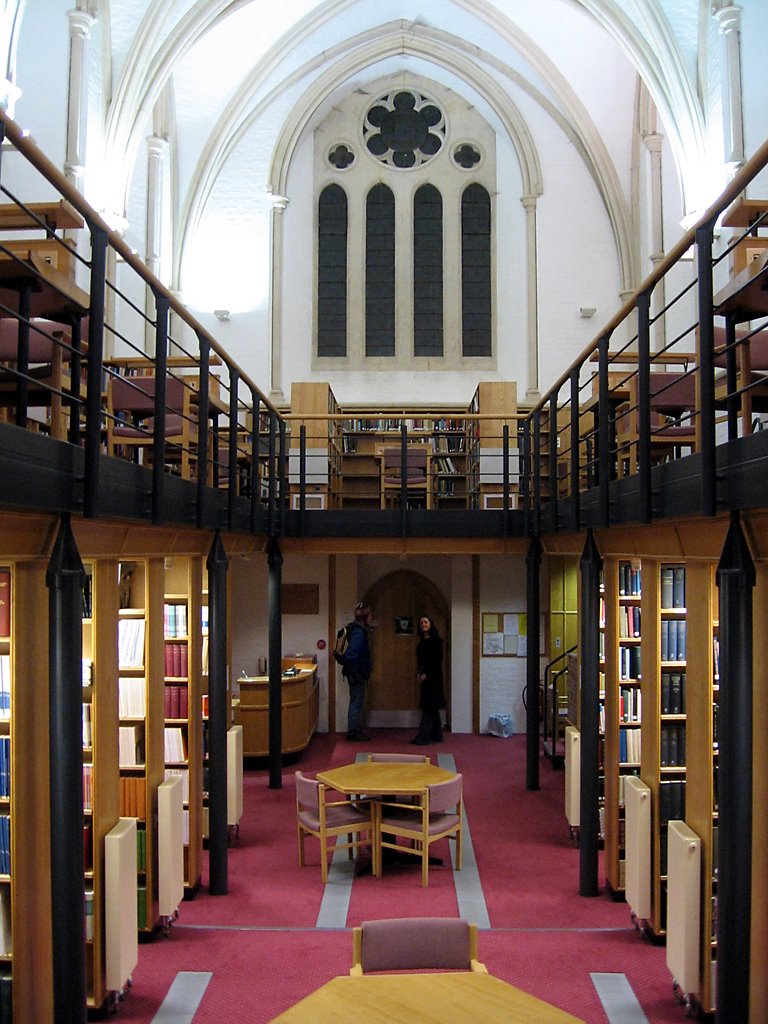
St. Antony's LibraryHappy birthday Iason Gabriel

After lectures this morning, I spent much of the day working on the Connolly and Barkawi books. The Connolly book is interesting, but includes a lot of fairly general language and not a lot of direct examples. General points about theory are more memorable, comprehensible, and valid when they can be affirmed through at least one concrete demonstration. You can talk about symbol construction all you want, but one good case study on the construction of ‘Palestine’ as a symbol in contemporary Middle Eastern politics strikes me as quite a bit more worthwhile and useful than a lot of generalization. It’s an anti-parsimonious ideal that may set me outside the ‘discipline’ of International Relations: out amongst the historians, journalists, and policy makers.

Dinner with Alex, Claire, and Iason tonight was an affirmation – once again – of how fun people in my program are. I was meant to meet Emily afterwards, but things once again didn’t manage to work out. It’s interesting to observe the sociology of the M.Phil group: who spends time with whom, what kind of inside jokes develop, and how people conceive of themselves in the program. Personally and intellectually, I feel like I am undergoing a second adolescence here. I am very actively defining my beliefs and personality in a way I can never recall doing before. I think it’s the combination of a new place and having finally reached a level of self-affirmation where I can brush off most criticism. It’s an empowering mix.

Hopefully, it will empower me to get a decent draft of my paper for Dr. Hurrell done tonight – after a brief foray to the King’s Arms with Alex, Claire, and some of Claire’s St. Cross friends. I could write much more, but I really should get some reading done now if I am going out again later.

PS. Tristan has a new batch of photos online, including a really odd one of Meaghan Beattie and I. Tristan frequently seems to post more photos of people in a day than I do in several months. Partly, that’s because there have been problems in the past with posting photos of people on the blog. Even so, I will try to show a less de-populated Oxford during the next while.

On travel, a new project, and thesis planning

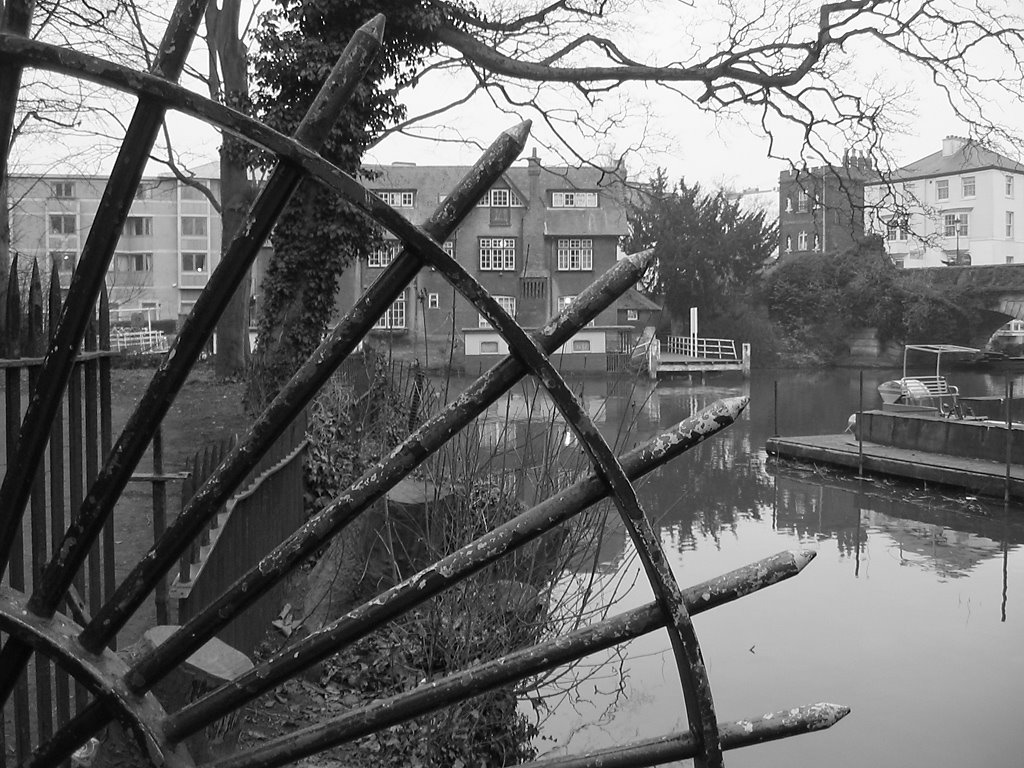
Spikes near Christ Church Meadows

Speaking with my parents over Skype today, I was reminded of how difficult it can be to communicate through a speech-only medium. It’s especially frustrating when you are making the attempt with someone who you really do want to speak with, but you are having difficulty doing so with any clarity or skill. The extra fraction of a second of Skype-to-phone lag definitely contributes to the difficulty. So plainly, in fact, that when I use SkypeOut to call people, they frequently suggest going on Skype themselves so as to increase the quality of the connection.

Partly for these reasons, I am especially looking forward to seeing my mother in about a month’s time. It’s still not certain whether we will go to Malta, Portugal, or Greece – though the middle option is increasingly looking the most likely. The kind of trip that is being proposed is a package-deal type hiking trip, with 4-10km walks every day and arranged hotels. While quite different from the kind of travel I have generally done, I find the idea to be an interesting one, and one that is likely to be enjoyable. I found travelling with Meghan Mathieson et al to be especially interesting, precisely because it involved traveling in a group and according to a set itinerary that I didn’t control. Hopefully, this expedition will mimic the best attributes of that one.

Oxford life

At the end of this year, I think I should condense the mass of experience I’ve had here into a trio of short guides: one for people considering coming to Oxford, one for people considering Wadham, and one for people thinking of doing the M.Phil in IR. It would offer me a chance to be both balanced and concise, while offering a perspective that people may find valuable. While the information that would be included is already embedded in blog posts, I don’t think anyone is likely to go through the whole collection of hundreds of entries just to gain insights that might be better expressed in three to five pages on each topic.

Thesis planning

I have been investigating the Oxford Environmental Change Institute and it seems like a resource that could conceivably be extremely helpful for my research topic. Their website quotes Dr. Anna Lawrence, of the Human Ecology Program, as saying: “Researchers must find ways to incorporate the experiences and values of other stakeholders in their research.” This is exactly the kind of thing I want to do: look at the means by which such cooperation and outreach is taking place. If I can find some way to get involved with this organization, it might contribute a great deal to my ability to say something new and important on the subject. While it can be difficult to deal with segregation between different areas of academia, the very lack of connections makes it a really exciting place to do work. There is much to be discovered there.


Library Court Kitchen Cleanup

8 February 2006, 5:00pm

I’ve finally become sick enough of the stench from the fridge, and the shelves full of food that was purchased when Khrushchev was still in power, that I am organizing a purge and cleanup of the Library Court kitchen. Hopefully, I will not be the only one who shows up and people will pay heed to my signs requesting that they remove any food they don’t want discarded for those few hours. I shall have to buy some bleach. A haiku, for the occasion:

Bad prokaryotes
Multiply in the kitchen
Kill them all, with bleach

The plan is to empty the fridge, discard all the random, smelly, moldy food that has been in there all year, and then wipe it down with bleach and hot water. Also, I plan to clear the shelves of the dust and dead insects that have been accumulating there, as well as taking a chisel (as Nora suggested) to the more tenacious bits of dirt on the stove and counters.

Anyone from Library Court or Staircase 19 who wants a more sanitary kitchen is very much encouraged to come help. If someone has access to bleach, that would save me the small annoyance of having to go buy some.

Misty Oxford Wandering

Geese!

This afternoon, between bouts of reading Connelly’s The Terms of Political Discourse, I went for a long solitary walk along the darkening riverside. It was reminiscent of my long wander in the cold in Helsinki and it effected a fairly comprehensive shift in the way I was feeling. In contrast to the increasing gloom, I found my mood progressively lightening. That may be partly because the river is the only place in Oxford where you see significant numbers of animals, aside from police horses. There were herons and Greylag Geese, as well as teams of rowers moving in elegantly coordinated fashion along the Isis. I know this is the second time these particular waterfowl have been the subject of the photo of the day, but I feel a considerable amount of affection towards them. They have a look that I really appreciate, and they are completely fearless when it comes to people, which makes it easier to photograph them.

Walking along the tributary of the Isis that breaks northward towards Merton College, while listening to Vivaldi’s “Winter” (perhaps my favourite piece for strings), I felt almost perfectly at home. Because of the cloud and gathering darkness, I was the only person in the whole vast area, a circumstance that cannot help but conjure a sense of liberation. Returning to Starbucks to carry on reading, I felt like my brain had been completely reset and that everything that had happened in the last few days had taken place a long time ago. Paradoxical as it may be to feel at home in disconnection, it makes sense to me. The times when the world seems most incomprehensible are exactly those where the precise place and time you are at become critically important.

As I mentioned to Bilyana earlier today, Oxford life has reached the point of mental saturation for me. Like the vague feeling of eternal placement you get a few months after returning to school after a break, it has become something so automatically present as to comprise almost everything you can remember or imagine. This isn’t really a positive or negative development, in and of itself. It’s simply reflective of comprehensive immersion in an environment. All this is partly a reflection of comfort: I know the city now and would never think of carrying around a map, as I did during my first few weeks. Also, I know from my first-term evaluations that I am at least meeting the standard for my program – an enormous relief to someone a bit anxious at starting at a new school.

Oxbloggers meeting postponed

On the matter of the bloggers’ gathering initially planned for this Friday, it seems that most people want the date shifted. Since there isn’t really a mechanism for coordinating otherwise, I will just arbitrarily dictate a new date that seems to work for most people. I hope to see many of you there.

New Oxbloggers’ Meeting date: Tuesday, February 21st. 8:00pm. The Turf Tavern.


  • The Sainsbury’s Chunky Vegetable Chili soup is quite good, probably their second best vegetarian soup after Tomato Basil. Given that I’ve eaten about thirty litres of the latter, it’s nice to have something new to try. I appreciate that the chili soup is at least slightly spicy, and that is has beans in it. I can’t even look at the Carrot and Coriander soup, since I bought fifteen of them when they were on sale for 20p each.
  • Some particularly clever articles from The Onion: on endangered species and American politics.

Seventeen days until the equinox

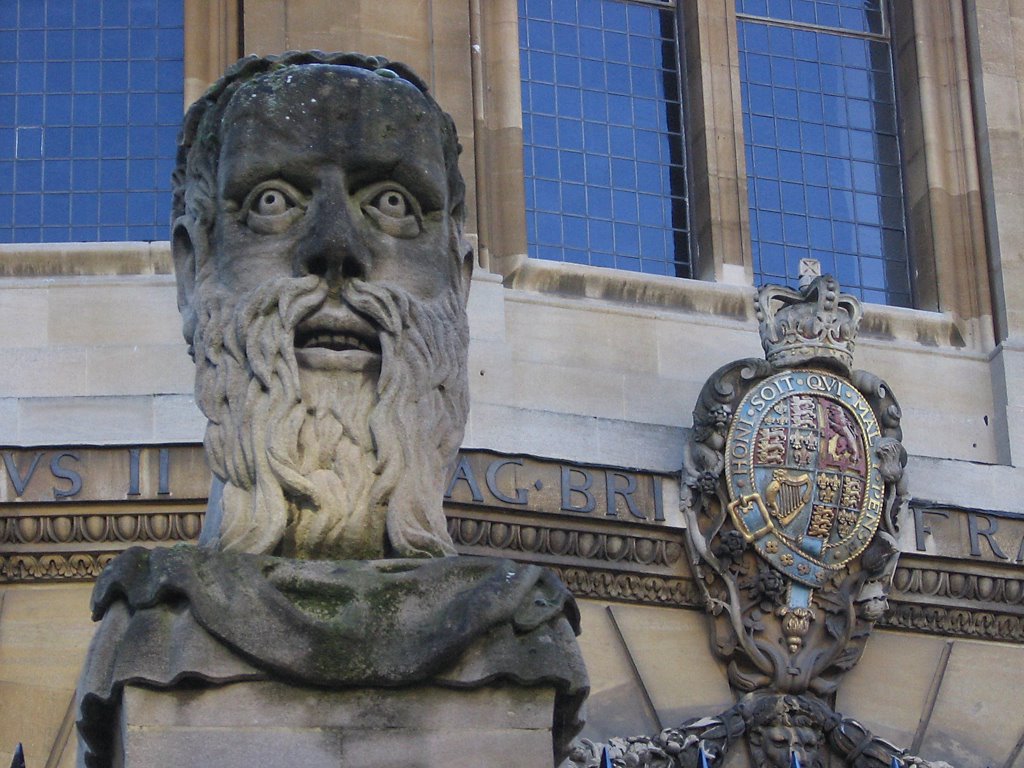
Sheldonian head

During our qualitative methods class today, on institutions, Dr. Ngaire Woods made an excellent point. Each of us has a year to become an expert on a particular subject. There are hardly any people in the entire world who ever have the chance to devote such time and attention to an issue and there is a good chance that, at the end, we will know more about our subject than anyone in the world. This underscores both the importance of choosing a topic well and of really committing yourself to writing something excellent. Producing something that will be read by people beyond the examination committee and people kind enough to edit it for me would also be a big advantage.

The institutions section of the qualitative methods course is much better than the scattershot attempt at foreign policy analysis that came before it. That is welcome, especially since I have a take-home exam to write on the course between the 9th and 13th of this month – most inconvenient timing. Hopefully, I will be able to get the thing mostly done next Friday, leaving the weekend relatively unencumbered.

After class, this afternoon, I had coffee with Claire, Josiah, and another of her St. Cross friends who I am embarassed to be unable to remember the name of. Followed that closely was tea with Joelle Faulkner. We tried the Tieguanyin tea that Neal sent. It’s more subtle than I expected, though not nearly so much so as the Jamine Pearl tea that Kate once gave me. I am going to try making it with bottled water, in the knowledge that the amount of dissolved minerals in Oxford tap water is quite substantial.

Hopefully, tomorrow I will be able to finish most of Tarak Barkawi and Mark Laffer’s Democracy, Liberalism, and War, William Connolly’s The Terms of Political Discourse, and what remains of this week’s readings on institutions. I have a paper due for Dr. Hurrell on Wednesday, evaluating the democratic peace theory. I will also have a new issue of The Economist upon which to complete a preliminary read.

I’ve now finished the first book of The Wind up Bird Chronicle and perhaps the first tenth of Democracy in America. I don’t know if it’s an overly self-serving thing to believe, but I don’t think that any kind of reading is irrelevant or a distraction. While there are certainly things that it is more urgent for me to read, to neglect other areas of interest would ultimately be counterproductive and unwise. Neither American democracy nor Japanese literature are even distantly divorced from the question of democratic peace, and good writing is never irrelevant.


25 things I am:Canoeist, geek, webmaster, environmentalist, caucasian,
student, heterosexual, reader, writer, photographer,
Czech, Ukranian, atheist, Oxfordian, skeptic,
liberal, vegetarian, single, Canadian, hiker,
bilingual, healthy, rich, educated, male.

Day spent examining strings of 26 different shapes, along with gaps and dots

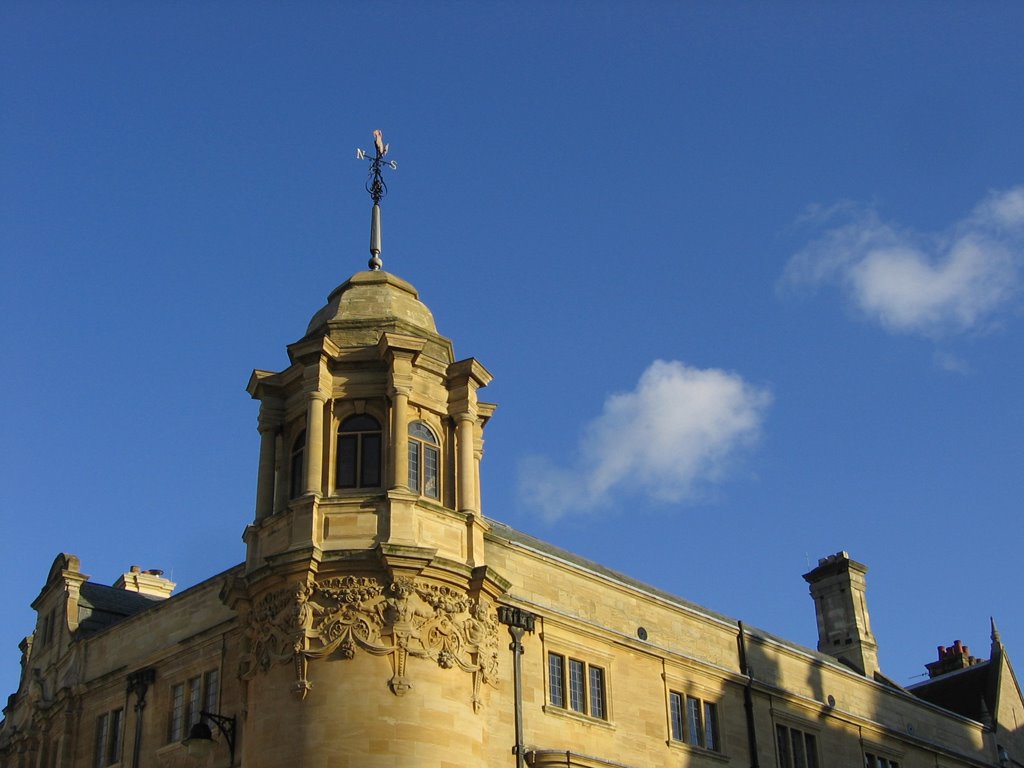
Nuffield tower

I am feeling increasingly as though journalism will be the thing to do once I finish my M.Phil. I want to travel and one of the things that I am fairly good at is writing: especially the kind of writing that must be done quickly and consistently. I am fairly sure that I would be able to get a job in the field, even though I know nothing of its inner workings, and it may serve many of the purposes that I have for myself in the coming years. There is only so much, after all, that can be learned from books. Academia is, in general, somewhat terrified of talking to people – a fear that I have grown to share, outside the narrow confines of fellow students and other members of a close cabal. Even where we deal with outsiders, it’s behind the bulletproof glass of case studies and surveys, interviews with pre-selected questions vetted by ethics committees. My perception of the greater authenticity of journalism is a draw, even if journalistic thought and action is not immune from other forms of criticism.

This is not a thing that I see myself as doing indefinitely. It’s something I would want to do in a roving fashion: out seeing things rather than sitting behind a desk in Manhattan. I don’t think it would be sustainable over the long term, but I do think it would be a really effective counterpoint to what I have done so far. Perhaps it would also be a good lead-up into whatever is to come after.


Talking with Tristan and Meaghan Beattie tonight was really good. One of the oddest things about living in Oxford is my near-total lack of people with whom I have substantive, personal conversations. The closest it comes is discussion of the M.Phil program. It’s something that will come with time, I hope….

I learned today that, since the tour she is going on may already be entirely booked, I may not be going to Greece or Malta after all. That said, the possibility remains and I will have to wait and see. I very much hope it will come together.

Scheduling conflicts continue to plague the mooted bloggers’ gathering.

Critical theory and normative politics

During today’s seminar, which was every bit as energetic as I expected, I was stuck by a question. The discussion centred around the grand and frustrating neo-neo debate, where neoliberals and neorealists fall over themselves to prove how much more scientific they are than one another. While this kind of thing blasted back and forth between the two sides, some interesting critical theory questions started to come up at the periphery. What is the role of theory? How does it affect power relations within and between states? Which elites does it serve, and how? What effect does the person making theory have on the theory produced, and can that impact be bracketed or ignored?

The kind of self-awareness that such questions call upon theory to deliver demonstrates one of the ways in which critical theory might be extremely helpful to us. Indeed, if we can deal with the empirical and ontological problems and assumptions that underlie classical liberalism, perhaps we can rescue it. Classical philosophy has the great virtue that it is explicitly concerned with the good life. Not to imply that this is a monolithic thing, in terms of content, but it is a monolithic thing in terms of human intention. We’re all constantly pondering what the lines of our obituary will say, the way we are and will be remembered. As such, there is a fundamental humanity to projects that personalize political questions.

Obviously, theories like liberal institutionalism can be helpful to us. Maybe they will help us develop effective institutions to deal with real problems. The fear many people seem to have about critical theory is that it will hopelessly erode our ability to say anything of value about the world, much less act in a meaningful and progressive way. The idea that struck me – and it’s really nothing more than a shadow of an idea – is that perhaps we could use critical theory to replace some of the puffery about rational individuals and black boxes that exists in classical theory with something more philosophically rigorous. Perhaps it could enable unashamed action, rather than binding us forever in a kind of grim relativism.