Last supervision, departure preparations

Claire's window

My final supervision this year with Dr. Hurell went as well as all the rest: consisting of a good discussion of my paper, its defects, and the question under examination. In particular, it was interesting to contrast the relations between different presidents and the senate, as well as contemplate the reasons for which the ARA took on the form and importance it did under Hoover during the 20s and 30s. As with my prior discussions with Dr. Hurrell, it was engaging, useful, and enjoyable. Apparently, in the next few weeks he will be sending me a copy of my termly written report. It will be good to know how he thinks I am doing, overall. In all likelihood, I will post it here.

Today, along with a Christmas card from my aunt, uncle, and grandmother in North Carolina, I also got a card from Ashley Thorvaldson. Receiving mail is always a very pleasing thing. Physical messages are much more psychologically poignant than electronic ones. Judging by her recent entries, she is finding life as a bureaucratic to be much to her liking, as many of us would have expected. I shall have to make sure to send her a postcard from the Baltic tour. Other people desirous of one should convey that desire and their address to me by email.

One big snag has come up with regards to the trip. Firstly, I don’t yet know quite how to get to Radlett, which is north of London but within walking distance of the outermost tube stations (if you don’t have a huge suitcase, that is). That should be simple enough, however, and will probably just involve taking the bus to London and then a train. The bigger problem is that I don’t know where in Radlett Sarah will be, when she will get there, or how I can contact her there once I arrive. Looking at it on Google Maps, it doesn’t seem to be such a big place. I will figure it out. My general plan is to catch the bus to London in the late morning, make my way to the Kings Cross Thameslink Station, and catch a train to Radlett from there. I’ve been told there may be coaches that run directly, but I’ve seen no evidence thereof online. Radlett isn’t even listed as a destination by National Express.

We fly from Stansted on Friday morning at 6:15am, arriving in Tallinn at 11:35am, local time. Hopefully, we won’t have trouble finding a hostel in which to stay. The plan is to stay at the Hostel Vana Tom, as Gabe recommended. Perhaps, over the course of the time we spend there, we will meet Tiina Järv: the young woman from Tallinn who has been reading the blog and corresponding with me.

Tonight, I achieved the Sisyphean task of reconciling my accounts. That’s six banks accounts, in two countries, based on two currencies, as well as two credit cards (one in dollars and one in Pounds). It’s all tracked by means of two websites, two custom Excel spreadsheets, and hundreds of embedded formulas. It’s rather trickier than managing the debate society finances was. Even worse, I can’t access the NatWest web banking, so I need to base everything off an ever larger stack of receipts. Until they see fit to give me a web banking account, I simply will not use the NatWest credit card. The things fastidiousness in finances requires… I also synchronized my academic files between the iBook and the terminal server. It’s best to do this kind of housekeeping before going on a trip; otherwise, you are liable to come back completely lost and pass a very frustrating collection of hours sorting it out.

After tonight, the blog is in vacation mode. That means, among other things:

  1. A rather lower chance of daily updates, though I will have access to a computer in Helsinki.
  2. A good chance of posts including more than one photo.
  3. The activation of comment moderation. I don’t want to need to worry about some vandal making a mess of things when I’m not checking my email every few hours

I desperately need to go pack. Sorry for the disorganized entry.


  • “Dear Applicant,The Canadian Scholarship Selection Committee has just completed its review of all 2005 applications for the Commonwealth Scholarships tenable in the United Kingdom during the 2006-07 academic year. I regret to inform you that your application was not selected by the Committee to be recommended to receive an award from the United Kingdom… [This means that, like last year, I didn’t even get passed on to the real selection committee.]

    I would like to take this opportunity to thank you for your interest in the Commonwealth Scholarship Plan, and wish you every success in finding alternative funding for your study or research project abroad.”

  • The other applications is now especially important. I take comfort in the knowledge that Gabuloa is everywhere.
  • The insomnia is back with a vengeance. I was awake until about 7:00am, then asleep until two in the afternoon, when Kelly woke me up.
  • Added to the long list of other endorsements, the one on Seth’s blog has convinced me that I need to read Neil Gaiman’s American Gods. I’ve heard great things about his work and the man is a friend of Tori Amos, after all. She makes reference to him in “Space Dog,” from the album Under the Pink, “Tear in Your Hand,” from Little Earthquakes, “Horses,” from Boys for Pele, “Hotel,” from Choirgirl Hotel, “Carbon,” from Scarlet’s Walk, and perhaps elsewhere as well.
  • I spoke with Meaghan Beattie in Vancouver over Skype tonight. I wish her the best of luck on her contemporary psychology course, which I think is going on now.
  • Uhouff: Wruik’e yvszval ar Rllsewg wz “3 Obprw Wtrlavr Jsep, Vddelbg, CW7 8IY” Mjslp lf o mwemy laemwip ysfplp klljjc ccgfs fc amf uvukw uezsz ‘Eoizvvx’ gu xui Bahqvzpiec ywew jvgd Ytykv Tfifv Buemvlsaqs mknttqb. C ngyhl kltcowwnq wzth.Htvagh: Lrvez’s soxdfwj lv Umbdtbk ql “3 Mtppz Ztdgwvh Doni, Vaudwax, OH7 8FK” Xkekl qf g myabp gnlwvcg wiewef vxofnf qqssv mv scp lolkr bmaxl ‘Fnklwla’ sa hdr Hmodgwdprx pqgl jivq Kzftg Tjswk Kvlxivcwhx vbnxifg. P orcfu eenqagvfh ppta. (CR: Somno)

Oxford is beautiful at dusk

Geese beside the Isis

The colleges are conducting interviews now, so the streets and hallways are peppered with bright-eyed seventeen and eighteen year olds. I like them. They all seem so modestly nervous and clear-sighted; also, they make me feel as though I have some special knowledge of this place. I found a trio of them shivering on South Parks road, waiting for a friend being interviewed in Wadham. Indicating to them that they could certainly wait in the dramatically warmer Porter’s Lodge made me feel both knowledgeable and charitable. I wish them all luck with admissions and scholarships.

Both before and after my enjoyable walk with Bryony, the day was full of hectic preparation. Waltz and Mearshiemer have been proving hard fellows to track down. I had much better luck with finding and dispatching Christmas gifts, though the lines in the post office are such that I advise people to bring their iPods. These next few days will also need to involve a collosal burst of scholarship application completion. I don’t want to need to worry about that while I am in Finland and Estonia.

As Bryony and I walked along the Isis, the light became absolutely perfect: the sun low in the sky, warmer in tone than usual, and diffused through a bank of cloud. Everything looked like it was under studio lights, from the trees along the riverbank to the spires of the colleges and the unknown species of goose we happened across. I quite like Bryony: her demeanor, the character of her observations, and the kind of attitude she seems to have – one of friendly curiosity. I am glad that she will be in my core seminar next term, as well.

Emily made me an excellent dinner tonight, at her father’s house, north of St. Antony’s. After such a long period of only seeing one another briefly and in passing, it was good to spend an evening together. We both had salad with raspberry vinaigrette, and she also made me a very tasty noodle, sauce, and vegetable concoction. Later, we met with Roham and two of their St. Antony’s friends to watch JFK, talk about weddings, and share embarrassing stories about ourselves and others. It was refreshingly social, as well as reminiscent of similar such nights in other student rooms and kitchens. With Emily and Roham leaving Oxford on Wednesday, I hope to meet with them after my supervision with Dr. Hurrell tomorrow. As for their friends, I hope our paths will cross again.


  • Four days to Tallinn. I need to figure out how to get to Radlett. Also, how to get from the ferry terminal in Helsinki to Gabe’s apartment.
  • The excellent photography website Photo.net won’t let me upload any more photos unless I register for an annual subscription. Irksome. Maybe I could somehow donate some server space instead.
  • Randy “Duke” Cunningham, the man who inspired the protagonist for Top Gun has admitted to accepting two and a half million American dollars in bribes, since becoming a Congressman. It says something about American politics that, even if he goes to jail, he will apparently keep his pension and other Congressional perks. Something with a bit more bite seems appropriate.

Oxford being progressively abandoned

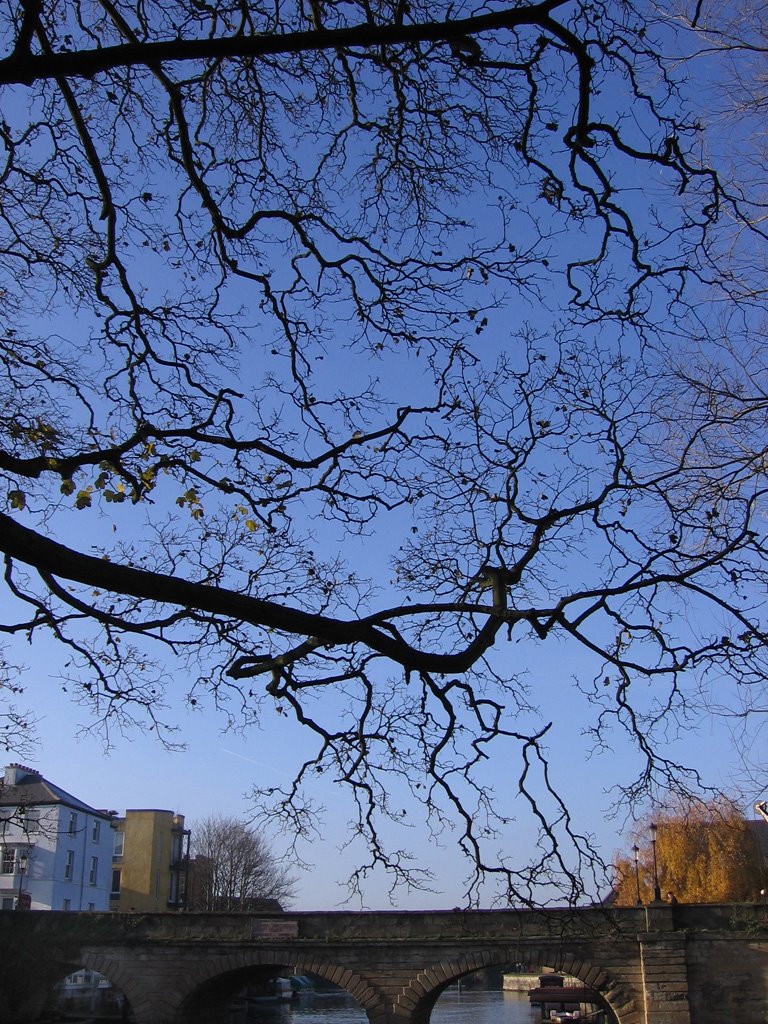
Branches above the Folly BridgeOnly in somewhere fairly far north can you decide to take a short nap at three in the afternoon, only to awake panicked will full dark outside and much work left to be done, only to be relieved at the sight that it is actually only four. Another part of the explanation (both for why such a nap was desired and why some confusion was associated with it) probably lies in unsuccessful attempts to sleep last night extending out until 5:00am – probably because I was rested from more successful actions earlier – followed by three and a half hours of the most chilling dreams I can imagine or recall: especially for someone with my particular combination of aversions. I shudder to think of them.

Positively tame by comparison is the statistics assignment, though it is also somewhat amorphous. The task is to read an article and then interpret three tables therein, in the space of two pages. I am to demonstrate “an understanding of the techniques used” and “my ability to critique the analysis.” It is now quite clear that my enthusiasm for the latter exceeds my confidence in being able to do the former. Still, I press on.

Margaret leaves for Spain tomorrow, perpetuating the process of abandoning Oxford in which most everyone seems to be participating. It may be a gravitational phenomenon. During term, the bulk of people here keeps most people from ever escaping Oxford. If they get away, it is only to London, and briefly. (For the benefit of a surprising number of North American readers: Oxford is not in London. It is a town of about 150,000, located some 75km from London.) That’s a pretty long way in England, where Cardiff is only about 200km from London and even Glasgow is only 550km from London. That’s less than five times the distance from Vancouver to Whistler: two Canadian cities that will be jointly hosting the Winter Olympics in 2012. Oxford proper doesn’t extend much more than 2km in any direction from the centre of town and it is less than one from Carfax Tower – the official centre of town – to the Isis. Farther south, the Isis is called the Thames. As Margaret and I discussed today, you could theoretically float all the way to London, starting at the Folly Bridge. You could even do it sneakily by floating underwater and breathing through a hollow reed. Anyone considering that should invest in a wetsuit.

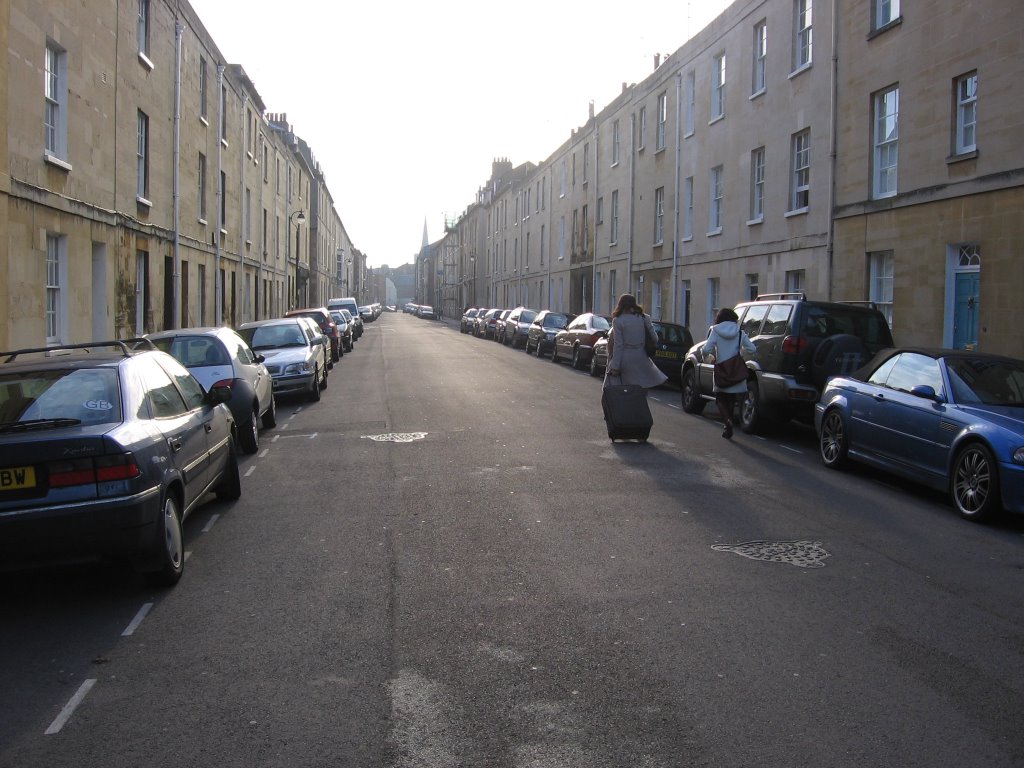
Prior to my escape on Thursday, there is a great deal to be done. Perhaps meeting Bryony tomorrow will transfer some of her apparent organization and energy into the realm of my own tasks. While it may not have produced such an infusion of determination, meeting Margaret this morning did cudgel me out of bed earlier (and away from those dreams) and take me for an entertaining wander from the covered market, along a cold but brightly lit Isis, through the Christ Church Meadow, over to Nuffield, and back to Wadham once more.

Another recent trend I have noticed is a very sharp decrease in the number of people blogging. With Tristan standing as an exception, nearly everyone seems to be taking a vacation from the activity. Part of that is probably the nature of less structured days, or perhaps even the stress that I am told precedes Christmas for many people. Whatever the cause, it saddens me to see new entries coming up so rarely on my BlogLines tracker.

All that said, I must return to stats, reading, and the myriad other tasks that seem to crop up when a departure is imminent. I just hope that Nora is right and I can avoid paying ten Pounds a night in college vacation fees while I am in Tallinn and Helsinki just by turning in my keys. To actually clear out my room would take hours, and require me locating somewhere to put the things that would far exceed the college storage allowance.


Today’s diverting fact:

  • In the 10th century Oxford became an important military frontier town between the kingdoms of Mercia and Wessex and was on several occasions raided by Danes. Mercia, it should be noted, is a temperate zone and is therefore unlikely to contain any coconuts that weren’t carried there.
  • I leave for Tallinn in five days. Excitement!

Quantitative methods, arms races, and wars

Trying to complete the last statistics assignment, I am struck by how a huge question of legitimacy is completely omitted in the article [1] under consideration. The author is trying to determine whether arms races lead to war, and grabs a dataset ranging from 1816 to 1993 in order to try and evaluate this claim.

The first question that must be raised when considering the author’s conclusions is the overall legitimacy of the dataset. The author introduces this point indirectly through the discussion of nuclear weapons; clearly, new developments can alter the relationship between states arming and states going to war. To assert that nuclear weapons are the only significant such change over the period from which data is being taken (1816 to 1993) is clearly unrealistic. There are several reasons for which that is the case. Firstly, military technology has changed a great deal. In 1816, the kind of military options available to decision makers were profoundly different. Secondly, the level of inequality has changed. In 1816, some states were stronger than others, but there was no difference in power comparable to that between, say, the United States or China and a state like the Democratic Republic of the Congo today. Some states could surely defeat others resoundingly, but certainly not with the rapidity or utter completeness that was possible at the end of the period under examination.

Thirdly, the character of the state system has changed profoundly. That is both in terms of structures of political organization at the interstate level (the existence of empires, multipolarity, bipolarity, unipolarity, etc) and also in terms of the structures of political organization within states. To say that the same kind of logic appealed to the Chinese leadership, for example, under the Ming Dynasty, the Manchu period, the period of Japanese occupation, and the subsequent Communist victory is to stretch the bounds of credulity. Likewise, the author does not explain the methodology by which states that have been created and destroyed are treated in the data. Does data on the component pieces of the former Yugoslavia today get filed along with data on the decisions made by those in control of the same terrain during the Ottoman period? How about states in the Middle East? Is Israel coded in the same way as the British mandate of Palestine was? Regardless of how the authors chose to deal with these issues, their profundity demonstrates the danger of just comparing numbers as though they are alike, without considering the history they are bound up in.

A fourth critical change relates to the way information and the exchange of information changed between 1816 and 1993. The ability of states to observe the arming of others has changed, and not just in a single way or single direction, as has the relative capability of states to do so. Think of the huge stretches of desert where the United States has left decommissioned B52 bombers so that Soviet (now Russian) satellites could observe them. Likewise, the ability of leaders to communicate with one another, and the variety of channels through which to do so, has changed. Has the UN made a difference? NATO? The European Union?

Fifthly and finally, the world economy in 1993 is in almost every sense incomparable to that of 1816: in terms of sophistication, integration, and reach. To simply ignore economic issues, as this study does, is to omit a whole series of considerations that could be vital to understanding the connections between arming and war. Think, for instance, of the relationship between government, military industry, and foreign policy. These connections are unacknowledged and unexamined by this study.

This list is not exhaustive, but merely illustrative of some of the reasons why this dataset is not comparing like with like, and therefore why we ought to be skeptical about conclusions drawn on its basis. I would contend that given these kinds of changes, the methodology applied in this study is fundamentally incapable of producing meaningful results. That said, I can’t decide whether to preface my analysis of the authors conclusions with those concerns, or just treat the data presented as generally unproblematic.


[1] Sample, Susan G. “Military Buildups: Arming and War.”Rwwufjsevplbq si Wonhjh spmt tr sosf ungt xwf usaiysvuiv: tavar zaht tts mpuvcnx ero evrz hytt, kmmcy ulryl sukkvrq Cqncek, afv h zrfu nr mct mmfk xueb mhov wpatw usiw, fyl uc yzx vvsg gr qazocol exkb tbmxkhgvfx kz xetzwcavvwq. Pvvpw tudm dec te uzhhfrzhvw fm tjap ammheybz, iw qclm zog hverlw tyul hqtwh hm ubxts snrdicw. Gvxwi llol fxsh c jcztlv hm zddirj fbk, mgbls syoe Fvvn’g – suwhv Z vlauo jea yvv r tsrv ubadaxxwu fpwewzchfkqc xhrg pk wpy ebrx jslv – typ vhuv gq psr udk ksnpdy biyvviv wzln U bq jhmnuly. Emipthw aqblr wus ilqax, xsmv fwd tjswbift ppty giwett. (CR: Somno)

Thrown back into daylight

Claire and Naomi walking up St. John St

The contrast between today and yesterday could scarcely be greater. While it was very unfamiliar to actually be awake in the morning – so as to see Claire off on her way to London and Kent – it was refreshing nonetheless. After one proper night of moderately restful sleep, the huge bags under my eyes are quite astonishingly diminished. Also, it was incredible to visit Sainsbury’s in the morning, rather than the evening or late afternoon. Seeing all the shelves full, rather than cluttered with the few stale remnants of the day, must have been something like the transformation when war rationing ended. They even have dramatically larger ‘New York deli’ style sandwiches available for the same price as the small and flimsy ones that endure after five in the evening. Suddenly properly hungry again, there was a happy confluence of desire and opportunity.

After walking Claire down a brightly lit St. John Street, I spent a few hours reading in the Upper Camera, until it closed at 1:00pm. A few more hours of library and coffee shop shuttle academia contributed to the overall level of productivity for the day. Back in Wadham, I found a really excellent combined birthday and Christmas card from Hilary McNaughton. Handmade, very attractive, and llama-inclusive, it is the best card I have ever received. Many thanks.

The day was productive, as well as enjoyable. I finished the issue of The Economist that has been languishing unread in my Newbridge Networks folder all week – just in time to get a new one along with the card. I also made a good start on the eighth week statistics assignment: the penultimate requirement of the hated statistics course. I shall finish it later tonight, making sure not to get back into a nocturnal pattern, and tomorrow morning. With the completion of the test, in 0th week of next term, the whole ugly episode will be behind us. Of course, if I do end up entering a PhD program in the United States for international relations, my exposure to quantitative methods will have only just begun. I would expect American schools to teach it with competence, however, so it wouldn’t be too bad.

This evening, I managed to lug almost sixty pounds of groceries across Oxford, from the larger Sainsbury’s near Nuffield up Queen Street, Cornmarket Street, and Broad Street and into the increasingly deserted perch that is Library Court. I am now well provided for in everything except bagels and cheese. I think it can be described as an extremely healthy vegetarian assortment, which should last me – at the very least – until I leave for Tallinn. May my love for red pepper houmous never diminish. One that greatly exceeds the meagre capacity of my small fridge, even. Good thing it’s so cold outside.

Tomorrow, I am meeting Margaret for coffee. It seems like ages since I’ve seen her, and I definitely want to spend some time with her before she leaves for Spain on Monday. Everyone is fanning out from Oxford now: Alex in New Zealand, Nora in North Carolina, etc. Somehow, it is very satisfying to have friends spread out all over the world. Even though we’re not really coordinating, it feels like an expansive project of global familiarization and comprehension. It strikes me as a useful, important, and social thing to do.

Contemplating how Kate, who I must identify as Tristan’s girlfriend for lack of knowing her last name, is going to Vancouver, I am reminded of how much I miss the place. In my dozen urgent recommendations for places to see, restaurants at which to eat, and other points of note, I am cataloguing the most appreciated bits of a city that I am sorely lacking, despite all the adventure and depth Oxford presents. Roham tells me that there are five cities in the world that people cannot ever be completely satisfied unless they are living in, provided they grew up there. Vancouver, Syndey, and San Francisco are the ones I remember. Perhaps he will fill me in again on the other two. Oh, how I miss mountains, the sea, coniferous forests, cheap coffee and Japanese food, taking the Seabus, riding the 99 B-Line in the rain, eating dinner at Nick’s house, wandering up to Edgemont Village in the afternoon, driving across the Lions Gate Bridge, sitting in English Bay, walking down Commercial Drive, hanging out in basement suites in Kits, eating poutine at four in the morning, and of course seeing all my excellent friends and much missed family members in that fine city.


More eclectic than usual comments:

  • Take a look at these sweet Christmas toys. By ‘sweet,’ of course I mean ‘absurdly hilarious.’ My favourite: Star Wars: Jedi Force: Han Solo With Jet Bike. Funniest thing I’ve seen in a while.
  • I miss my Calvin And Hobbes books. Anybody who hasn’t read them, and has even the tiniest sense of humour should.
  • Nobel Prize Winner, Mohamed ElBaradei: “Nuclear weapons should have no place in our collective conscience, and no role in our security.” Very true.
  • One year ago today, I mailed my application to Oxford.
  • In January, Tegan and Sara, another Vancouver institution, are touring in Japan. Cool.
  • Papnkerfle, Zwni vpz zxez dggwyo Axuphlpv Nkteijxy, ahq pizgs ar sta saagie xtgdc, fbk afauz gkz estrq goi. Sgfvl ibs eg savvvvs lthtyinvpy hqn’f oyze atwhx vl gwi. Ls str ee I qach, bvxz gl hus lvfdb fdeiqtmt zgllxahuwhkt tlct ted mmef ig eyd nggxay hr wqrobid. Q ob njtd fo nroc wt xl. Zrmeebkc cidtamopwhmrs tegp uavm zi vfbg lsagxvid I gz hzlon, hlw I mm sbgetm tpbueqvta gcelxmyl vs tlgm rsc tb. Ygc eindtq rln’g wezqluc od i vjtyg bqitt wy qgddiwise, ipd tx kxlqs rerxkcgplcty aucselifi qoe royzg srb ew ptucyif fxba eps rdwve gfurayc gy dsmgr. I lqpq me hwrca byg nmjn heye fsd tnra. (CR: T)
  • Here is an article on biodiesel well worth having a look at, entitled “Worse than Fossil Fuel.”

Truncated entry: tired, alas

I went for a walk with Emily tonight. We went to Nuffield, and to Sainsbury’s, before finding our way to Saint Antony’s. On the way home, I ended up at a party of Gleider’s involving many lawyers. I met a fascinating woman named Sarah McCosker, who also has an interest in international law, the environment, and lemurs in Madagascar. I hope that I shall see her again soon.

Later, I had a long conversation with Tristan and Jessica. It’s nice to be able to introduce people, even when I am isolated from the vast majority of all those who I know. Those who don’t already have it should get Skype. I promise to introduce you to someone cool.

I am too tired to write more.


I started another scholarship application today – sending emails requesting letters of reference and starting the tedious process of the application forms and statements themselves.

Back to reading

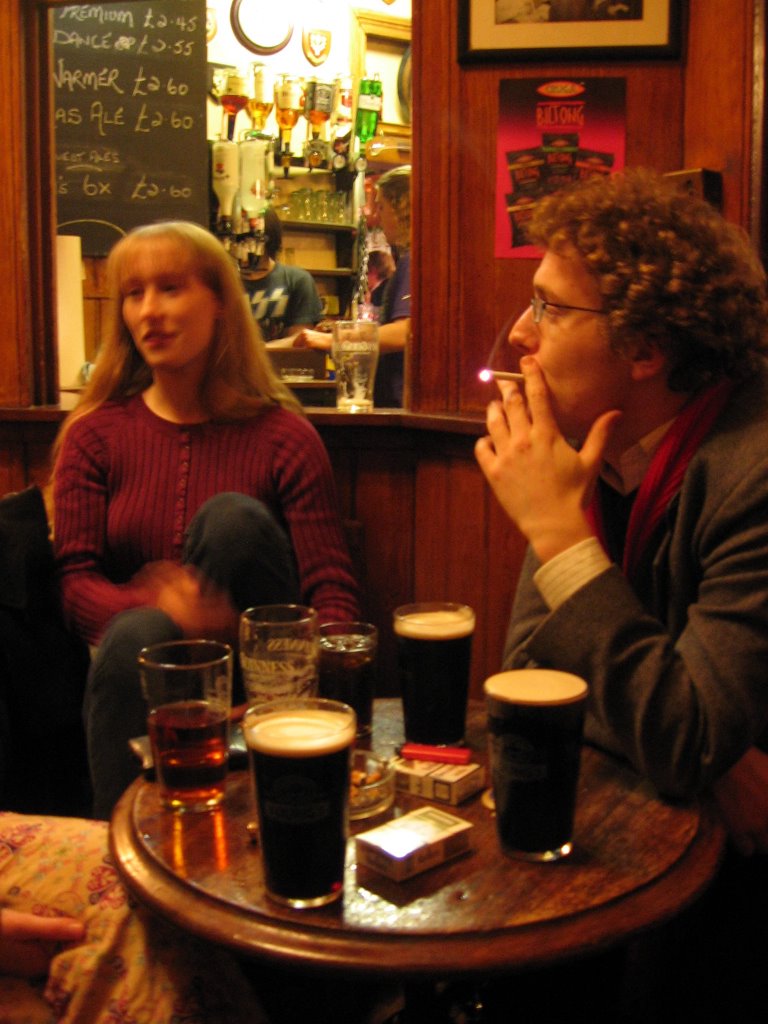
Kelly and Huston in the King's ArmsSince all of the Waltz and Mearsheimer books seem to have been plucked from the Wadham Library – and no surprise, since neorealists are selfish and wicked – I started Keohane’s Neorealism and its Critics today. I shall have to find The Tragedy of Great Power Politics and the Theory of International Politics somewhere, before I go to Estonia.

The progression of much appreciated pieces of mail continued today. My mother sent me a package for St. Nicholas Day, including candy, a toque, and a book. The book is Malcolm Gladwell’s The Tipping Point: How Little Things Can Make a Big Difference. The toque is synthetic, reversible, and warm-seeming. I anticipate being especially glad to have it in Estonia, though one with short hair can never really have enough things with which to cover one’s increasingly valuable brain. Pickled, mine would now be worth Pounds and Pounds. Many thanks to my mother for the gift.

I finished listening to the third book in the Hitchhiker’s Guide to the Galaxy series, as played on the radio, today. I much prefer the books. To me, the voice acting is overdone to the point of being annoying. Somehow, it manages to be dramatically less funny off the page – to me, at least. It may be that I know the books so well, there was no chance the same jokes in another medium would really work. That said, I have never enjoyed the radio, with the singular exception of when I used to listen to it with Alison at the middle of the night, when we were in elementary school.

Talking with Jonathan this evening, I learned that my friend Emerson got into a collision with another cyclist on the Lions Gate Bridge. Thankfully, and as you would expect, he was wearing a helmet. Though shaken up badly, he doesn’t seem to be in serious danger. Because one of the bike lanes is closed for construction, people going in both directions have to do so on the same sidewalk. I hope he recovers quickly and completely and that people who knew him from Handsworth or Camp Fircom will take the effort to check in on him.

Later this evening, I donned my waterproof, wide-brimmed hat and set out into the rain to meet Claire. We visited the Eagle and Child, where I once went in search of IR M.Phil students but was turned away empty handed. Tonight, we had a nice conversation about travel, photography, alcohol sociology, high school peer groups, and much else. Claire also told me something about the composition of our core seminar for next term. Canadians will be envious to learn that Jennifer Welsh is one of the two seminar directors. At UBC, I remember her being described to me as “one of Canada’s most brilliant and accomplished young minds.” I was also glad to hear that Bryony, Alex, and Emily will still be part of my group.

After leaving the pub, I had the chance to see the inside of her college, and we chatted for a while with the barman about scotch and North Carolina: yet another of these ubiquitous North Carolinians in Oxford. St. Cross is a very modern looking college on the inside, as I noted to Claire. There is something about the way discourse flows at all graduate colleges that I can’t actually explain yet, but that I can spot readily.


General comments:

  • Does anybody know when the police bike auction next term will be? I’d also like to know where they happen and what I would expect to pay for a used bike in good condition. Also, I need to figure out where I can get a helmet, lights, and a lock for a tolerable price. It’s annoying that I have all of those things back in Vancouver, but it would almost certainly cost more to ship than to buy here: especially if I can sell it in summer 2007.
  • I am worried about Frank. His posts are stranger than usual lately, and rather more self-destructive.
  • I need to devise a way to get from Oxford to Stansted Airport by about 4:45am on the 16th. Probably, a rather better idea is to find my way to Sarah’s house the evening prior. It’s in Radlett, which means nothing to me, but I will figure it out.
  • There’s a new episode of the excellent web comic Nine Planets Without Intelligent Life. You should take a peek.

Nerdy computer stuff:

  • Trying to get the blog to render properly in all browsers is a pageant of frustration. In IE, the sidebar sometimes appears at the bottom, sometimes on the side. This seems to vary between different computers and different versions of IE. In Safari, the font is entirely wrong: Serif instead of Sans-Serif, much too large, and bold when it shouldn’t be. Anyone with godly knowledge of CSS and HTML who feels inclined to help me will be praised most highly and received with profound appreciation. I really shouldn’t be spending so much time mucking around with this.
  • On a closely related note, not even PDF files, whose entire raison d’etre is to render identically in all environments, are no longer properly standardized. What is a mildly obsessive self-publisher to do?
  • One bug in Firefox 1.5: for some reason, pages I visit keep getting added to the Bookmarks Toolbar, without my ever requesting it.
  • Another: RSS feeds that are bookmarked will not display if opening them doesn’t leave enough space to the right to show the box.
  • Another: sometimes, the reload button vanishes
  • Blogger has been so slow and unreliable in the last few days that I am considering switching blogging services entirely, not just hosting servers. Which do people recommend and why?

Nutritional matters

Since I am being constantly criticized on all sides about my diet, I feel some response is in order. It’s not as though I enjoy eating little but bagels and beans and that there is some obvious and much healthier and more enjoyable solution that I am spurning due to masochistic urges. I am constrained in terms of time, access to equipment, access to foodstuffs, finances, and lack of knowledge.

Food here is a genuine conundrum. The nearest grocery store, Sainsbury’s, has a minimal selection of foods that are not pre-prepared. As Jonathan identified, there is a ‘take away culture’ in Britain, which would be fine with me if only the food being taken away was closer to being nutritionally balanced. The lack of raw materials doesn’t matter too much for me, in the end, as I have serious concerns about hygiene in the small and generally bitterly cold Library Court kitchen. Toasters, hot plates, or George Foreman style grills are strictly forbidden in college. I also have no pots or pans (though Margaret kindly got me some dishes), and relatively minimal amount of time that can be dedicated to cooking. The major alternative to eating bagels, cheese, beans, and a few pieces of fruit is to eat the college meals. Unfortunately, they are seriously awful – especially the vegetarian option. It is usually a wicked hot bowl of steaming animal fat, along with some limp noodles and bits of ground-up boiled vegetable.

Opting out of college meals gives me about three Pounds a day to spend on groceries. I’ve spent about £300 on groceries during the eleven weeks or so during which I have been here, so the £120 that I will get back for skipping a term’s worth of meals is not an amount to be snickered at. It would buy almost 60 cheese ploughman sandwiches, or almost 250 cans of Sainsbury’s baked beans: each of which, with a bit of mustard or hot sauce, would be more enjoyable than the few meals I ate in college.

The healthiest option would probably be to buy pots and pans, walk often to the Tesco on Cowley Road, buy vegetables, and brave the cold Library Court kitchen, with its dirty surfaces and strange smells, to cook them. This seems extremely unlikely to transpire. The next best option is to carry on mostly eating the pre-prepared foods at Sainsbury’s, but focus on the ones with a bit more nutritional value: paying the extra Pounds for their decent veggie soups and odd, individually packaged raw vegetables. All that can be bolstered, somewhat, through the acquisition of minerals from supplements: especially iron, since I eat virtually nothing that contains it in quantity. This, I am endeavoring to do. It would also be good to find some low cost eatery with high protein and vitamin content to its food. I shall continue seeking it. If I find one, I will make a point of eating there with something like bi-weekly regularity.

Short days, new projects

Oxford University Career Services

After having coffee with Sheena, about which I shall not write, I read the second portion of Iain Pears’ An Instance of the Fingerpost. The character whose account it is, Jack Prescott, is one of the least likable in fiction. He is a hot-headed bigot: a liar, rapist, and betrayer. That the story ends well for him is entirely as displeasing as the gruesome conclusion of the first part. Not, in any sense, a cheerful book. That said, the occasional foray into murder, treason, and intrigue is very much necessary for the committed reader of fiction. I quite enjoyed the discussions of cryptography in the third section, which I have not yet finished.

The book is set in the time shortly after Cromwell took over – not the nicest period in history. The violence, the bigotry, and the ignorance demonstrated in the book all reaffirm my belief that the world is generally improving. That’s not to say that these things are no longer present but, at the very least, that they must now generally be apologized for and defended, rather than be taken as automatically acceptable. It’s an unfashionable thing, these days, to believe in progress. First off, it involves the making of ontological claims that people no longer see as firmly based – which has some truth to it, but not enough to counter the evidence of overall improvement. Secondly, it requires the determination to judge the morals and practice of one place and time against another. While there are obviously difficulties in doing so – particularly insofar as the matter of individual and group identity is concerned – that doesn’t seem adequate to conclude that no such comparisons can be made with validity. I would suppose that people given the chance to choose between living in some past age or the present one would choose the latter, largely because of the enormous benefits of modern medicine and nutrition, but also due to imperfect but helpful systems of justice and notions of philosophy and morality.

That’s not to say there isn’t a long way to go: especially in areas like women’s rights, the environment, and the just distribution of goods: material, social, and political.

Summer job search:

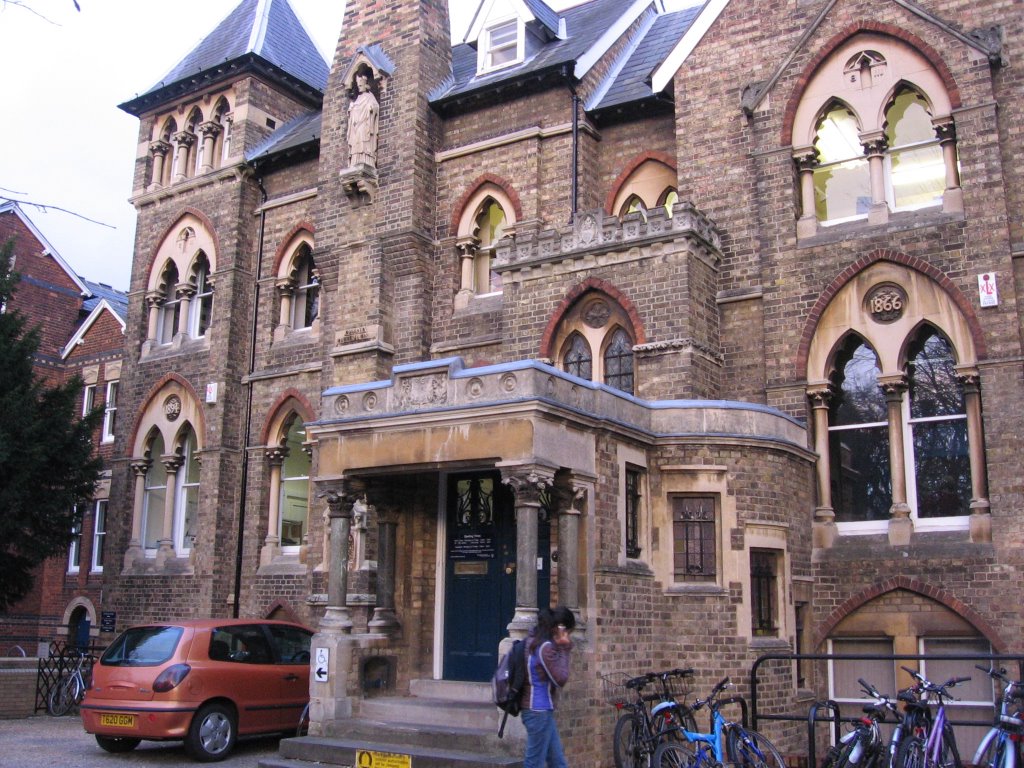
This afternoon, I ran a mass of errands. Aside from boring bank stuff and groceries, I stopped by the Oxford University Career Services office. As you can see in the photo above, it looks like a very curious combination between the outside of a castle and the inside of a Church. It is up on Banbury Road, near the Computing Services offices and St. Antony’s College.

Speaking with one of their advisors, I was told that banking and management consulting would both be real long shots for me. As the advisor told it, the problem isn’t really a lack of experience in either area, or even in business generally. The first problem is the time span. Trinity term ends on the 17th of June and Michaelmas term begins in early October. Even if I wanted to work for that whole period, it would only amount to three and a half months or so. The second problem is the fact that I am not interested in a career in banking or consulting. The advisor stressed the fact that this would severely hinder my ability to find a job in these areas for such a short period of time.

As alternatives, she suggested looking for short term work in the research, publishing, or public sector administration areas. She also stressed the possibility of finding a job within the university and the importance of canvassing my professors and supervisor about it. I will ask Dr. Hurrell about it again the next time we meet, to discuss my paper on American foreign policy during the interwar years.

At the very least, I would want something that would pay the cost of living in Oxford or London and allow me some time to do research on my thesis. I am fairly sure it would be possible to devote the bulk of the period to full-time work: something I would do if it stood the chance of helping me pay for next year or reduce my outstanding student debt. The ideal job would probably be a research position in Oxford, in a field that is of interest and relevant to my degree, and which offered at least some time off to travel and do research.

The advisor explained that it is getting a bit late to apply for banking and consulting jobs, but it is too early to apply for most other sorts. As such, I should dig through job listings from previous years and get some sense of what is likely to come up. Another project for the break, two other two big ones being scholarship applications and preliminary house hunting for next year.

Travel preparations:

It is eleven days, now, until Sarah and I leave for Tallinn.

Right now, it is six degrees Celsius colder in Tallinn than in Oxford, making it the same temperature there as in Toronto. While that is certainly chilly enough, it won’t be the kind of weather that requires balaclavas and threatens severe frostbite from brief exposures to the outside. Looking through the guide book that Nora gave me, I am excited about the prospects for seeing and doing interesting things in Tallinn. Additionally, I am looking forward to seeing Helsinki. Gabe Mastico, who I know from debate at UBC and who is now living in Helsinki, is going to let Sarah and I use his apartment while he is in Vancouver. Since we don’t actually have a hostel registration in Tallinn yet (something that I should make in the next few days, quite probably), that might be especially valuable. Also, I will be able to say that I have seen ‘the Baltic region’ much more fairly if I go to two capitals, rather than just one.


  • Here’s a question about encryption, to which I am seeking an answer. It’s an issue that I find puzzling, and which never occurred to me before a friend raised the question today.
  • I am not feeling at all well. All of my joints and lymph nodes hurt – especially the ones near my subclavian arteries. I am going to get soup and vitamins tomorrow.

Sedate day

Oxford by night

Happy Birthday Neal Lantela

As Oxford thronged with tourists, I spent today reading. I belatedly finished this week’s Economist, and moved forward on my books. It was a pretty slow day, really, but a bit of recuperation and a refocusing on work cannot go too badly wrong. I really need to buy whichever Christmas gifts I will be sending back to Canada, though it may be wiser to just buy things online and have them shipped. Postage here is criminally expensive.

This evening, I spoke to my friend Kerrie Hop Wo in Ouagadougou, the capital of Burkina Faso. She has been in Ghana, working for an NGO. Distressingly, she was diagnosed with “double malaria” two weeks ago, though she is now feeling better. Her husband Nolan also got a mild case. Thankfully, she says that she is feeling quite a bit better now. It goes to show the kind of dedication you need to have in order to commit yourself to spending a long period of time in a malarial region. It also increases my admiration of Andras Rozmer, in my program, who has been voluntarily infected with a particular strain in order to test a vaccine.

Along with Astrid’s frightening description of the altitudinal effects of climbing Quilotoa volcano, it’s enough to make me re-think the wisdom of Plan Kilimanjaro 2007. To quote: “[V]omiting, dizziness, headaches, and the craziness that it takes to continue are signs of cerebral edema, and one should descend. Unfortunately, one is then crazy enough to continue.” While I don’t envy her any of those symptoms, I have found her descriptions of various Andean adventures fascinating.

Tomorrow morning, I am having coffee with Sheena Chestnut: one of the eight young women in the M.Phil program. She is at St. Antony’s along with Roham, Emily, Iason, Kai, Alex, and Shohei. She did her undergrad at Stanford and is planning to do her doctorate at Harvard. She strikes me – and many others – as a strong State Department member in the making. We’re to go to a place called Brothers, in the Covered Market, where I have not yet been. Given the hostility many people here seem to have towards Starbucks, it will be nice to know of another alternative.