
This is the do-or-die month for the dissertation. Either I will get a full manuscript to the internal external examiner in the next 30 days or the school of graduate studies will kick me out for taking too long.
Category: PhD thesis
Aidid on fossil fuel divestment at Canadian universities
Shadiya A. Aidid’s Master of Health Sciences thesis from Lakehead University is the latest major scholarly publication on the campus fossil fuel divestment movement: From divestment to climate justice: perspectives from university fossil fuel divestment campaigns
The thesis examines case studies of “Divest Concordia based at Concordia University, Climate Justice UBC based at the University of British Columbia, and Fossil Free UW based at the University of Waterloo.”
Related:
- Canadian Campus Fossil Fuel Divestment Successes
- Open thread: academic writing on fossil fuel divestment
- Institutional memory on fossil fuel divestment
- Sources on fossil fuel divestment
- Lessons from successful fossil fuel divestment campaigns
- Maina, Murray, and McKenzie summarize the literature on campus fossil fuel divestment
- 350.org, fossil fuel divestment, and the campaign in a box
- The transnational nature of the climate change activist movement
- Growing campus fossil fuel divestment bibliography
- CFFD campaign timelines and institutional memory in Canada
The most important (as opposed to the most powerful) audience for my PhD dissertation
I have always intended my research to be of more interest and use to activists than to anyone else. Nonetheless, I think my tendency in academic writing to criticize weaknesses in the climate movement is ultimately motivated by a desperate determination to collectively take our best shot at avoiding climatic disaster.
Operating under those conditions, I contend that we cannot afford to be congratulatory or to prioritize making activists feel positive over what they have done over continuing to pursue the goals which motivated them. I got into CFFD activism already expecting climate change to be the main work for the rest of my life. My experiences with the Keystone XL protests in Washington in 2011, with Toronto350.org between 2012 and 2017, with the first University of Toronto divestment campaign, and with conducting this research has shown me how many others share that sense of purpose and importance. When I criticize the work of activists it is because I think we cannot afford to fail and that learning is a critical skill and practice for us all, not because I don’t respect the thought and effort which they have put into it.
Plus, I don’t expect anyone to take what I say for granted. One advantage of academic-style writing is that there are clear standards of attribution, with an expectation of identifying where your supporting information comes from. One thing I would say confidently about volunteer-based environmental organizations is that we’re always muddling through and doing the best we can amid our limitations and constraints. Even if you end up fully disagreeing with an idea which I try to advance or defend, perhaps it will prompt you to rethink or refine your view on the topic. It’s through adjustments of perspective like that we can all become collectively better informed.
Dissertation progress, early June 2022
They’re not 100% finished, but tonight I was able to send 2 of my 4 core chapters to my third committee member.
Some things which I am still looking for more evidence about:
- The salience of climate change as a political issue had risen before the divestment movement began in 2012
- Climate change is especially salient to young people
- 350.org encouraged campus fossil fuel divestment campaigns to use informal, non-hierarchical forms of organizing
I am working on incorporating corrections to chapter 2/4 (on mobilizing structures) within the next day or so. Then I can move on to wrapping up chapter 4/4 (framing) with more rounds of comments and changes with committee members. Then I can re-write the introduction and conclusion, fill in any remaining important gaps, and get the whole dissertation to the internal external and external external examiners.
Bert Robinson Park, 11:32pm
Four substantive chapters make up the argument of my dissertation, covering metaphors or categories from the academic literature on contentious politics: the political opportunity structure where activists develop approaches to advance their goals; the mobilizing structures they use to choose priorities and make decisions; the repertoires of contentious actions they perform; and the framing which comprises their world view and theory of how to achieve political change.
I have written many versions of each, in drafts going back for at least a couple of years now. Continuous interaction with my advisory committee is making them more concise and focused on defending specific claims.
I had a fourth version (v4) of the thesis a couple of years ago, but it was an intolerable 700 pages and my committee members had many other comments on what was important to conclude and how to structure the argument.
A few months ago I had a sixth version (v6) available for the committee (the fifth was clean sheet rewrite which I never got far into). It was cut to about 50 pages per chapter to leave room in a standard 300 page dissertation for an introduction and conclusion.
Since then and in close consultation with my committee I have been revising the introductions to each substantive chapter — which lay out a structure and argument and explain how the content of the chapter relates to the through story of the dissertation. With a round or two of meetings or comments we revise an introduction, then I redraft the rest of the chapter based on the largely-formed raw material of v6.
Tonight I sent the revised version of the repertoires chapter, which along with political opportunity and mobilizing structures (which they have already seen and told me to proceed from) will comprise 3/4 of the main text.
I have been very grateful for an enormous amount of sympathy, aid, and support from family members and friends. The whole PhD experience has been shaped by the people who I have been fortunate enough to be close with over these years. Your aid has been indispensable throughout this process of coming up with a book-size idea… and then wrenching it out of my brain as an actual book.
Diss progress
I sent the updated (v7) version of the mobilizing structures chapter late Friday night. The task due today is to review v6 of the repertoires chapter and comments from supervisors on v4 and then write the opening 3-4 pages for what will become the structure of the new chapter.
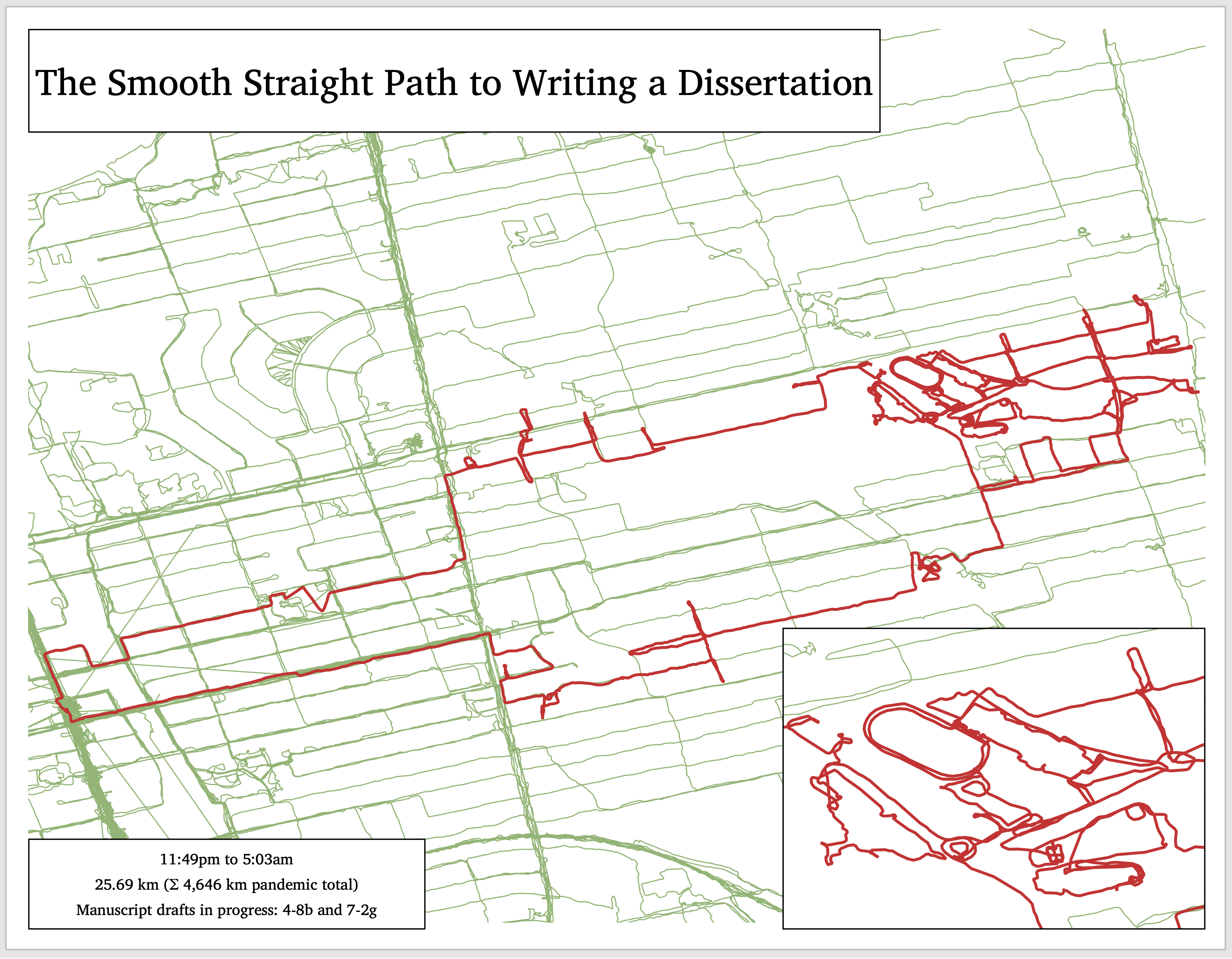
Exercise walk after another step toward the next draft
U of T divestment in Briarpatch
Sydney Lang and Amanda Harvey-Sánchez have an article in the May/June issue of Briarpatch: Divestment and beyond.
The “wow” from delayed source discovery
There ought to be a name for the experience, when involved in the long process of writing up a dissertation or scholarly book, of coming across a scholarly source and thinking: “Wow! I wish I had read this several years ago when it was published!”
Going through such a document line-by-line in printout form while making extensive marginal notes serves several valuable purposes. It gives you something else to respond to and cite, knowing it has already crossed the bar of being accepted as scholarly. That’s good if they broadly agree with you (adding another reference with a short citation) and probably even better if they disagree, since it lets you contrast yourself with something specific and scholarly. It directs you to yet other potentially useful sources. Finally, it provides an example of a complete and successful piece of scholarly writing, which is always an inspiration and even a source of comfort when striving to produce one of your own.
The struggle for focus and productivity
Due to an overwhelmingly stressful family situation, which kept me up all night Friday and Saturday with racing intrusive thoughts, I have deleted my WhatsApp account and disabled the phone and messaging features on my cell phone.
I gave my committee a commitment that I would have a complete political opportunities chapter done this weekend for version 7 of the dissertation. Working during the great majority of my waking time, I am getting close, though there are still some gaps to fill and the whole thing to review.
Related: