The science section at the Rideau Chapters

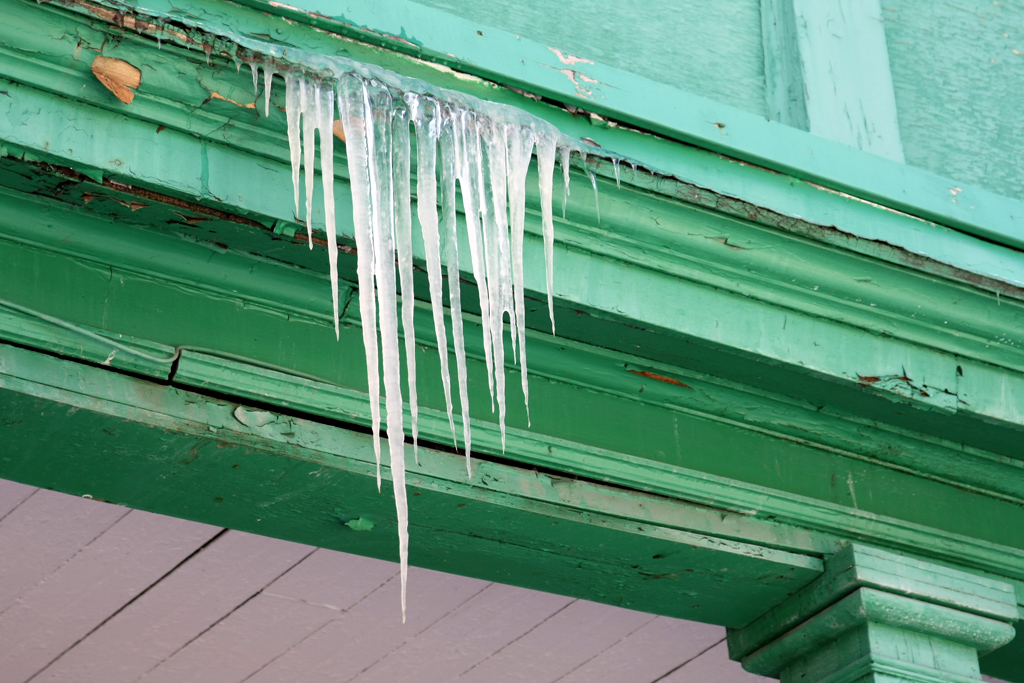
Icicles on green wood

The science section at the Rideau Centre Chapters always depresses me. It is often the most disorganized section of the store – tucked, as it is, in the very back corner. Books have frequently been relocated by customers and not re-shelved by staff, and the organizational system is deeply flawed even when properly implemented. For one thing, it has too many confusing sub-sections. It hardly makes sense to have a single shelf set aside for ‘physics’ books, when it is almost impossible to guess whether a specific tome will be in ‘physics,’ ‘mathematics,’ or the catch-all ‘science’ category. To top it all off, the catch-all category has been alphabetized in a bewildering serpent pattern, twisted back against itself and interrupted with random intrusions.

My two final gripes are that the science section is mysteriously co-mingled with the section on pet care (our most sophisticated form of understanding about the universe, lumped in with poodle grooming) and that the science section contains so many books of very dubious scientific merit, such as paranoid and groundless exposes on how MMR vaccines supposedly cause autism (they don’t, though they have saved countless infant lives).

While commercial pressures may legitimately dictate that the pilates section be more accessible, better organized, and more well-trafficked than the physics or biology sections, it is nonetheless saddening.

The Seventh Seal

Tonight, I watched Ingmar Bergman’s The Seventh Seal with Gabe. My overall impression is that the film is a bit like high runway fashion: impractical, often incomprehensible, but likely to filter down and become part of many subsequent pieces of mainstream art.

All told, I prefer more straightforward storytelling. Excessively arty and intellectual films annoy me. This film doesn’t quite cross into that territory (unlike films like The Hours and Lost in Translation, which I strongly disliked), but it has a similar rarefied, abstract quality. I don’t feel annoyed for having watched it, but I don’t think I got any of the messages the film-maker intended, either.

A few Canadian climate news items

The last couple of days have been an active period in Canadian climate science and policy:

  • An expedition led by David Barber concluded that the Arctic is likely to be ice-free in the summer, as of 2015.
  • Environment Canada scientist Don MacIver resigned from the group organizing the next World Climate Congress after the federal government revoked his permission to attend and speak at the ongoing United Nations Framework Convention on Climate Change (UNFCCC) meeting in Poznan, Poland.
  • Gordon McBean, a prominent Canadian climate scientist, speculated that Environment Canada is not “functioning in a way that is conducive to providing the kind of leadership that we need.”
  • Chief Phil Fontaine told Indian Affairs Minister Chuck Strahl that: “The actions of Canada in Poland are designed to undermine the rights of indigenous people here and elsewhere.”

Certainly, Canada’s negotiating position has been a problematic one. Many people have pointed out the disjunction between demanding binding emissions reductions from ‘all major emitters’ (including India and China) and stating that Canada has no intention of meeting the target it chose for itself under the Kyoto Protocol.

It is very hard to say that any Canadian government has played a constructive role in the development of international climate policy. Hopefully, that will begin to change as we are dragged reluctantly into the mainstream.

Extreme environmental recklessness

As a metaphor for better understanding the relationship between humanity and nature, some people have used the image of a lifeboat. A more appropriate one is that of a submarine. It captures the complexity of our surroundings, as well as the real danger that messing around with critical systems in an unenlightened way will have dire consequences. Right now, humanity is in the process of setting fires that test the air filtration capabilities of the machine, altering the gas mixture in ways likely to produce unexpected results, and banging away at the outer hull with wrenches, based on the unthinking assumption that our ignorant pounding won’t produce critical leaks.

When one looks at the state of our resource, pollution, and climate policies and actions, one is left with little hope that the future will be a long or pleasant one for humanity. This is not a matter of protecting endangered species or pristine areas of forest; it is about not compromising the basic physical and biological systems that provide the fundamental requirements of human prosperity and existence.

Leadership on climate, viewed in retrospect

A quotation from Joseph Romm highlights the differences between current and future perceptions of leadership quality:

Future historians will inevitably judge all 21st century presidents as failures if the world doesn’t stop catastrophic global warming.

Certainly, future generations forced to endure catastrophic climate change will consider their ancestors to have failed, whether they focus the blame on political leaders or others. I doubt the leaders of the 21st or late 20th century will be able to escape severe condemnation in a world that experiences mean temperature increases of 5°C or more, loses all its glaciers and sea ice, and experiences multi-metre increases in sea level.

Unfortunately, political leaders are conditioned to be a lot more concerned about the judgment of their voters at their next election (or of their generals, the next time the possibility of a coup is raised). The consequences of that may ultimately prove horrifically damaging.

OC Transpo strike looming

At the very point where Ottawa’s winter is unleashing its cold fury upon we hapless inhabitants (-11°C and snowing heavily), the bus system is about to be shut down by a strike.

In response, I humbly propose that all senior people involved in the negotiations between the city and the union have their cars impounded for the duration of the strike. If the city and union representatives had to walk through the freezing landscape to the negotiating table, they might be a bit quicker to resolve the outstanding issues they have about the allocation of sick days and their scheduling arrangements.

[Update: 5 January 2009] On Thursday, the union will be voting on an offer from the city. If it is accepted, buses should start rolling five or six days later, once mechanics have serviced them.

[Update: 8 January 2009] The union rejected the offer. The strike will continue for some unknown span of time.

[Update: 28 January 2009] On the 50th day of the strike, the Canada Industrial Relations Board has ruled that transit is not an ‘essential service.’ Both the city and the union argued in favour of such a ruling.

[Update: 29 January 2009] Threatened with back-to-work legislation, the city and union have reached a deal, ending the strike. Some bus service should resume as of Monday.

Deleting images in iPhoto

Whoever designed the photo deletion interface in iPhoto rather botched the job. The system in both versions of iPhoto I have used (’08 and ’04) has been confusing and very easy to use incorrectly.

When you select a photo in an album and hit delete, it gets removed from only that album, not the photo library. This is sensible enough, though there should be an easier way to delete the image from both locations. What is much odder is that when you delete a photo from the library, it doesn’t go into the Mac OS trash. Instead, it goes into a custom iPhoto trash folder.

What is really unforgivable is that if you go into the trash folder, select an image, and hit delete, it actually gets returned to its original location. There have been plenty of occasions where I have gone through the photos from an entire trip (probably hundreds of images), removing the botched and boring ones. If you then hit the wrong key while looking at the trash folder, they all jump back to their original locations, and you need to repeat the whole selection process.

It would be far more sensible for iPhoto to behave like iTunes. When you delete a photo from the library, it should ask if you also want to delete it from your hard drive. Then, there is no need for an independent trash folder. Removed images would either get taken out of the iPhoto file management system but left in their original hard drive location, or they would be put into the general Mac OS trash. It should also be possible to delete images straight from smart folders. When a photo in such a folder is selected for deletion, it should automatically be moved to the Mac OS trash.

Stop selling off UBC

It seems that the University of British Columbia has granted a temporary reprieve to the on-campus farm, deciding that it will not be converted into housing “as long as the university’s housing, community development and endowment goals can be met through transferring density to other parts of campus.” While this strikes me as a modest victory, I have long had the feeling that UBC has had its priorities wrong in terms of campus development. Often, it seems to behave like a tax-exempt land management company in possession of a lot of prime real estate in Point Grey. The fact that the company happens to run a school can seem incidental.

The UBC endowment lands are meant to exist as a perpetual legacy for the university. It isn’t clear to me why selling so many of them for commercial development has been beneficial for the student body. To me, it seems the best course of action would be a freeze on new construction not related to students, coupled with a renewed focus on education, rather than property management.

Metal detectors and carry-on restrictions for Greyhound travel

The policy of restrictive carry-on rules appears to be spreading from planes to Greyhound buses. Apparently, as of December 15th, passengers boarding them in Ottawa will be forced to put everything aside from “medication, baby formula and small handbags” in checked baggage. No matter that those rattling baggage holds are hostile territory for cameras, computers, and other delicate items. Likewise, no matter that the logic of security on intercity buses differs substantially from the logic for aircraft, as I have written about previously. The system has already been introduced in Edmonton, Calgary and Winnipeg.

To summarize my earlier post:

  • With a plane under their control, hijackers can fly to distant states that might assist them. The only way to stop them is to shoot down the plane, killing everyone on board. Buses are comparatively easy to stop.
  • [S]omeone in control of an ordinary plane can kill a lot of people. They can certainly kill everyone on board. They can also kill many people on the ground. Similar risks do not exist in relation to buses.
  • [I]t isn’t clear that this strategy won’t simply displace any violence that was to occur to a different venue. If I want to harm a particular person, I can do so in a place other than a Greyhound bus. The same is true if I just want to hurt people at random.
  • If you are really determined to hurt people on a bus, you can get on at a rural stop, rather than a bus station with metal detectors

It seems that the best low-cost and relatively low-carbon form of intercity travel is about to be needlessly constrained. It remains to be seen whether Greyhound proves enduringly committed to the new procedures once customers start appreciating just how inconvenient and unnecessary they are.

Alcoholic analogies to climate change

Two critical aspects of the problem of climate change can be well understood by means of alcohol-based analogy: the time lag between emissions and climatic consequences and the one-off nature of our decisions.

The last few decades have seen a surge in global greenhouse gas emissions. Due to lags in the climate system, the effects of those gasses are not yet felt, whether in terms of temperature or other climatic phenomena. It is as though we have started doing shots of vodka every thirty seconds. Even after the tenth shot, it is entirely possible that you are feeling lucid. You can talk, walk around, and drink more vodka. If you keep drinking at such a rapid pace until the point where you really feel the effects of the first shots, you have a whole mass of additional (and probably rather unpleasant) impacts still to come.

The reason this is so dangerous is that we only get one chance to decide when to stop drinking. Most people probably have a few experiences of youthful exuberance and realize they need to take into account the anticipated consequences of drinks, rather than just keep drinking until they cannot do so any longer. There is scope to learn from experience. As with global thermonuclear war, climate change offers no opportunities to learn by experience. We have one planet and, by extension, one timeline for greenhouse gas emissions and their atmospheric concentrations. If we are going to stop before we go too far, we are going to need the wisdom to anticipate consequences (as the IPCC and other scientific bodies have already done) as well as the will and good judgment to heed that advice.

The final issue to bear in mind is that of where the costs fall. The danger of drinking yourself to death is one that each individual engages with directly. By contrast, most of the dangers associated with climate change are inadvertently borne by those in future generations. Continuing to emit greenhouse gasses is thus somewhat equivalent to drinking while pregnant. While some of the health consequences might be borne by the drinker, most will be borne by the next generation and, in turn, by those who follow.

There are actually a couple of additional valid ways in which this analogy can be extended. One is to appreciating the difference between stocks and flows. Cutting annual emissions is like reducing how much vodka is in each shot. When emissions are rising, each shot is bigger. When emissions are falling, successive shots are smaller. Nonetheless, even small shots still increase your blood alcohol level. Right now, rising global emissions mean the planet is downing a bigger shot of greenhouse gasses every year. Stopping that growth is the first step, but it is no more of an adequate response in the long term than capping the size of the shots being taken at regular intervals.

A related extension has to do with carbon sinks. In this analogy, they are akin to your liver. They can absorb a certain quantity of greenhouse gasses before they fail. After that point, the further climatic effects of emissions are unmitigated. In the period when your liver is still functional, you can still drink small shots every thirty seconds. Eventually, however, you need to cut your intake/emissions to zero, before your liver/sinks fail.