
Let it be known, far and wide, that 5:45am is a beast of a time, and something I would not lightly wish upon others. On Sunday, I will let you know of how the trip went.
Category: Rants
Posts where I spout off on one topic or another
Ides of March, safely passed

First Easter break expedition imminent
My train to Chichester – via Basingstoke and Cosham – leaves Oxford at 7:15am on Saturday. Despite the best intentions of shifting my sleep schedule to make the requisite 6:00am wakeup more tolerable, I have been pushed further and further towards the pattern that I can only conclude is natural for me at present. That is to say, going to sleep sometime after 2:00am and then waking up at about the same point after 10:00am. Without classes or lectures in the morning or the burning shame of the scout discovering you still asleep, there is little that is able to propel me into wakefulness before then. Even my best efforts at setting the alarm on my phone and then hiding it across the room with a can of highly caffeinated energy drink have met with no success whatsoever.
In the end, it’s not much of a problem. I will have plenty of time to sleep on the train.
I am meant to arrive in Chichester three hours before the wedding and it seems probable to me that I will be able to walk to St. Richard’s Church, wherever it may be, from the train station in a fairly small fraction of that period of time. After the wedding and the reception, I will have most of Sunday to spend exploring the area, prior to my 4:30pm train back to Oxford. Is anyone familiar with the region? If so, is there anything you would suggest having a look at? The distance to the seashore seems modest, so I may go have a look at that.
Where there’s smoke
After five months of exposure to the social lives of Oxford students, my leather jacket is now thoroughly saturated with the smell of tobacco smoke. Despite efforts to air it out – sometimes even hanging it directly in front of an open window where I induce air flow – the scent seems to have become fairly deeply ingrained. Maybe entombing it in a box with some baking soda or activated charcoal for a while would be more effective.
The psychological impact of wearing the jacket has become odd. My earliest associations with tobacco have to do with somewhat threatening, carpeted places where I wasn’t happy to be. It’s a feeling that lingers whenever the stale smell of absent but infused smoke is present. The odour is certainly not one that I enjoy, or an happy to have lingering around me. It seems to be much more easily and thoroughly integrated into things made of natural substances. My wool and leather clothing has all taken on some measure of the smell, while no article of clothing made from artificial fibers has done so to an overly great extent. It all makes me disappointed about how months still remain before the smoking ban in British pubs comes into effect.
- I have set up a temporary fix for the Blogger images problem. For the present, I will host the images on the BlogSpot servers, using a different account. Once the bug is fixed, I will repost the images on my FTP server. [19 March: This has now been done.]
- I got more useful mail today: information on the Malta adventure, from my mother, along with details on the next student loan installment. Once this arrives, I should have this year and about 20% of next year covered. Still waiting on word from the Chevening Scholarship, Armand Bombardier Scholarship, Canadian Centennial Scholarship, and the Oxford Overseas Research Scholarship. The next batch of applications goes out in April.
- In terms of blogging and being on instant messengers, internet activity among my friends in Canada seems to be markedly down. Is this because nice spring weather is starting to appear?
- Did you know that light bulbs in England don’t screw into their sockets, like their North American equivalents? Along with running at twice the voltage, they also have somewhat fearsome looking sockets with large bare electrodes spring-loaded to hold the bulb in place.
NatWest: a very poor bank, indeed
Britain’s position as a global financial services hub is certainly not well reflected in the conduct of the particular bank I chose when I arrived in Oxford. Despite my dissatisfaction, however, the sheer level of hassle involved in switching banks as an international student will probably keep me where I am. I post this as a warning to those who will come after.
I continue to be astonished by how bad the online banking offered by NatWest is. The password system is frustrating and insecure. It’s impossible to pay your NatWest credit card bill online, even when you applied for it at the same time as you created your account. The site doesn’t even let you transfer funds between your chequing and savings accounts, unless you go set it up to do so in person. They also managed to forget to pay interest on my savings account for February. Those considering opening a bank account in the United Kingdom should absolutely avoid this bank.
Part of the problem is how NatWest has two separate divisions: one that runs the branches and knows nothing about the credit cards and web banking, and another that plays the opposite role. Despite the apparently clear delineation of duties, there seem to be serious communication problems between the two. They also have some truly bizarre rules about documents they can only send to your permanent address, even when it’s outside the U.K. and they know that you will not be there. Add to that high service charges (ie. $25 for a bank draft) and low interest (less than the rate of inflation) and you can understand the reasons for my dissatisfaction.
[Update: 20 May 2006] Another really awful thing about NatWest is the way their credit card payments work. At the start of the month, I am automatically billed some random amount between five and twelve Pounds. If I cancel the automatic payment, I get fined – even if I don’t owe any money. Since I almost never use the card now, that means I am building up more and more of a positive balance. Even so, they will ocassionally charge me a Pound or so of interest… seemingly at random and despite the fact that I don’t owe them any money. I’ve tried calling their telephone support line for an explanation, but I was kept on hold for ages and finally turned over to someone who didn’t seem to know anything she wasn’t reading straight off her screen. Completely unacceptable, all in all.
[Update: 12 February 2007] The NatWest Online Banking site now allows me to pay my credit card online. Previously, I couldn’t do anything but move money from my savings account to my chequing account, and not the converse. This is a distinct step forward.
The thesis or gadgetry: one will drive me mad

Educational matters
During an animated ninety minutes, Dr. Hurrell and I went over my two most recent papers and a number of ideas for the thesis. I feel like we’ve hit upon something exciting. The idea is less to look at institutional arrangements meant to use science to develop better policy, and more to look at the conceptual linkages between science, politics, and policy.
The most straightforward view, which I identified, is what I call the planning/engineering dichotomy. Planners decide that it might be nice to have a bridge across Burrard Inlet. The engineers work out if it’s possible, what it will cost, and how to do it. A similar model is commonly implicitly applied to the relationship between science and policy. Science identifies problems, and then outlines possible solutions for policy makers to debate and implement. Really poking at that model could be a good starting point for a broader discussion. What is the character of science, as it relates to politics and policy? What does it let us do? Without getting off topic, the question might be expanded still further. For instance, asking what the purpose of the natural world should be, from a policy perspective. Is it simply a matter of working out how much good stuff we can squeeze out of it without destroying it for ourselves or future generations?
The next stage is to read probably a dozen or so books, in order to get a more extensive sense of how science and policy are understood with regards to each other and what it might be interesting and useful to expand upon. I will start with Dr. Hurrell’s own book, as well as Andrew Dobson’s Green Political Thought. It’s also worth re-reading Peter Dauvergne and Jennifer Clapp’s Paths to a Green World. I am excited about the project, in any case, and not just because of the enthusiastic energy that I tend to leave supervisions with an excessive amount of.
Without giving too much away, I will also say that there’s something in the works on the fish paper front.
Damnable contraptions
Due to its increasingly erratic behaviour, iPod the third is going the way of iPod the first and second: back to Shanghai to be replaced. The first one was defective straight upon arrival, pausing automatically at the slightest jolt. The second one had a hard drive that failed while I was driving through Hamilton, Ontario with my cousin and brother. Sasha’s iPod later succumbed to the same fate. Because it is laser etched, it will probably take them three weeks or so. Whereas the first one had the tendency to pause whenever it was bumped the slightest amount, this one is just freezing every ten or fifteen minutes, changing languages once in a while, and refusing to be recognized by a computer that recognizes its brethren with alacrity. Godspeed, little white rectangle.
Apple is quite good, if a bit slow, about fixing things. The lesson is probably that it’s worth spending the extra $60 on a three year Applecare plan. When I can actually manage to tolerate a few weeks without it, the iBook will likewise be going in for service on account of its one defective USB port.
Strange IR theory words:praxis: The practice or exercise of a technical subject or art, as distinct from the theory of it ; Habitual action, accepted practice, custom. ; Action that is entailed by theory or a function that results from a particular structure.reify: The mental conversion of a person or abstract concept into a thing. Also, depersonalization, esp. such as Marx thought was due to capitalist industrialization in which the worker is considered as the quantifiable labour factor in production or as a commodity.PS. One email I’ve been most anxiously awaiting since Saturday night has still not materialized. The only thing for it, for the present moment, is just to keep waiting.
PPS. No word either on the Chevening, ORS, or Armand Bombardier awards. No word is better than a negative response, but I am really crossing my fingers to get at least one yes this time.
Theorizing about theory
One of the curious things about studying international relations theory is the sense in which it feels like an intellectual black hole. When we studied history, I read about the Middle East in the interwar period. Now, I know more about it. I can tell you something about the establishment of the House of Saud or the determination of the borders of the League mandates. I don’t feel as though I have been engaged in a comparable process, as regards international relations theory. I’ve read a lot about the various theories, and discussed them in seminar, but I don’t feel more intellectually aware about the subject matter.
Studying theory is a matter of self-definition. It’s about finding a framework that lets you do what you want to do, protected by walls of academic and intellectual respectability. It’s also about finding ways to strike back against those whose agendas contradict your own. Little wonder, then, that it tends to become petty, vindictive, and driven by ego. Perhaps, in some profound and inaccessible sense, it deepens your understanding of international relations issues. If so, it doesn’t feel that way while it’s happening.
Magic and Mathematics
A book of magic tricks that I owned in elementary school included a number of ‘tricks’ that worked because of the properties of the Mobius Strip. I realize now what an insult they were to geometry. Yes, it may seem amazing that you can draw a line all the way around or cut a Mobius strip along its centre and have it turn into a larger loop, but to attribute these things to ‘magic’ is absurdly anti-educational. You might as talk about how the angles in a triangle ‘magically’ add up to 180 degrees.
Electronic botherations

I obviously haven’t been making frequent enough offerings to whichever god watches over electronic devices. First, my digital camera got some kind of dust or mold permanently inside. Since it’s not a camera with lenses that can be switched, there is really no way to open it up to clean the senror. The dust is sitting directly on the sensor and the dark blotches it produces need to be manually removed from every photo that I want to look presentable, especially those with large areas of a single colour. That camera was itself a replacement for the first one I got, which had a defective flash that always fired at full power.
Today, my iPod simply stopped playing any sound in one ear. The iPod is also a replacement for the one I originally got, which would pause randomly and for no reason if it was not kept perfectly still. Hopefully, cleaning the jack for the headphones will fix this newer problem, because my experience of sending the first iPod back to Apple was hellish and the one they sent back (more than a month later) had a click wheel that was off kilter.
I wonder whether I have particularly bad luck with electronics or whether I am just pickier about them working properly and more willing to go through the hassle of getting them fixed. Both my Sony and Panasonic portable CD players got sent back to the manufacturer for defects. My GPS receiver is actually the replacement for a replacement. It’s grandfather had abysmal reception, even compared to other identical models, and its father died for no apparent reason during the second Bowron Lakes trip.
I should not, in any case, let these things distract me from the task of finishing my core seminar paper for tomorrow. It’s on whether order and justice are compatible in international relations. Obviously, it’s the kind of topic that anyone with normative concerns will feel fairly strongly about after five years of studying IR at the university level. That makes it both easier and harder to write upon. In the interests of not being up all night, I shall get back to it.
PS. This week’s readings on normative theory have been the first time I read a lot of Dr. Andrew Hurrell’s work. It has been really interesting, well written, and suited to my research interests. I think I will probably take normative theory as one of my two optional subjects next year. Overall, I think it meshes well with a research project focused on environmental politics.
PPS. It seems like it might actually be my headphones which are defunct. While they seemed to work in my iBook before, they do so now only when you hold them in a certain way. I will need to try out the iPod with another pair.
PPPS. Upon further experimentation, the problem lies with the headphones, not the jack on my iPod. While they work if you twist them in a certain way in the iBook socket, they don’t work at all in one ear with the iPod. I will need to buy new ones. In some sense, this is worse. At least the iPod is under warrenty, and all electronics are absurdly expensive here. I honestly can’t understand why people tolerate it. England desperately needs Walmart.
Music and frustration: copy protection schemes
 Having spent the last few minutes explaining to a friend why a brand-new, legitimately purchased CD will not play in her computer due to the copy protection EMI has included, I am reminded of my considerable indignation about how the music industry is treating their customers. Yes, in this case, it was possible to disable the copy protection program just by holding shift as the CD was inserted into a Windows computer, but there is no guarantee at all that music you buy today is either usable or safe.
In the worst case, such as the notorious Sony BMG rootkit, inserting a legitimate music CD into your computer intentionally breaks it. It also causes it to report what you listen to to Sony, even if you choose ‘no’ when a screen comes up asking for permission to install software. It also creates really sneaky back doors into your system that can be exploited for any number of purposes, by Sony or random others. While Sony is currently facing lawsuits for this particular, infamous piece of malware, it isn’t nearly enough to put my mind at ease. If some 16 year old had written something comparably dangerous, they would probably be in jail.
Legitimately downloaded music is little better. Songs you buy from the iTunes music store may work with your iPod today, but they won’t work with another portable player. They won’t even play in software other than iTunes, and there is no guarantee that they will still work at some point in the future. Spending a great deal of money on songs from there (and they’ve just had their billionth download), is therefore probably not very wise. You don’t actually own the music you are buying – you’re just buying the right to use it on someone else’s terms: terms that they have considerable freedom to change.
Personally, I will not buy any CD that contains copy protection software. I will not buy a Sony BMG CD, regardless of whether it does or not, nor will I be buying any of Sony’s electronics in the near future. This is a business model that needs to change.
Nuclear Test Sites
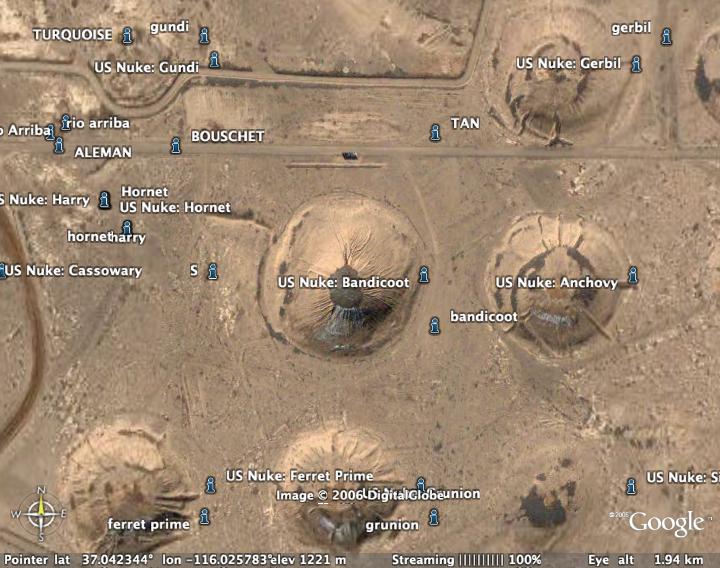
As we were both experimenting with Google Earth tonight, Neal pointed out an area in Nevada to me. You can see the crater where an atomic bomb in the 100 kiloton range was tested:

Surrounding it are more test sites:
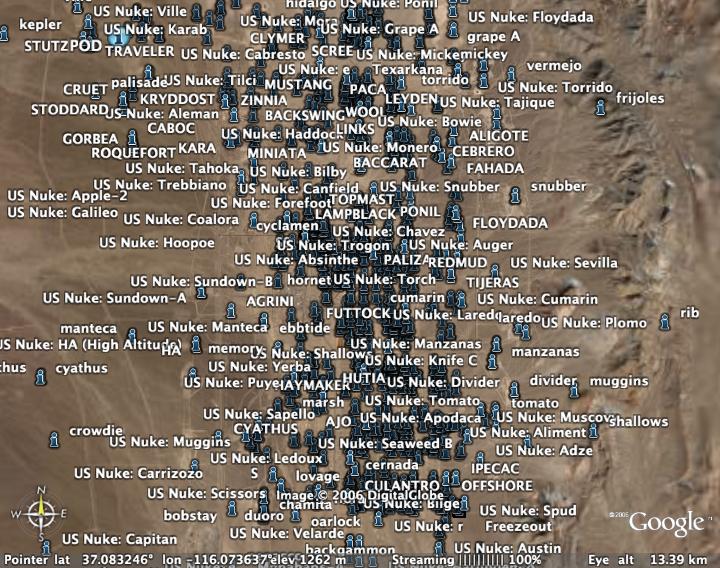
They sure felt the need to make sure these things would work:

It definitely makes you more certain that Eisenhower was on to something when he talked about a military-industrial complex in his farewell address:
In the words of Ike: “Every gun that is made every warship that is launched every rocket fired, signifies, in the final sense, a theft from those who hunger and are not fed, those who are cold and are not clothed”

It really defies all belief, doesn’t it?
[Update: 5 November 2005] Here are some more of my posts on nuclear weapons.
An Oxford absurdity
According to Esther and Wikipedia, it seems that anyone who completes a BA or BFA at Oxford automatically gets a Master of Arts (MA) degree seven years after matriculating, for a nominal fee. According to Wikipedia: “Despite the fact that no greater academic achievement is involved, the MA remains the most important degree in Oxford.”
Since I won’t have done an undergraduate degree here, it seems as though I will never get one of these nominal MAs. As such, once I finish my degree I will have the 28th highest possible rank, and it will never increase. If I had done a BA here, seven years after matriculating I would have risen to the 12th highest rank (provided I went on to do an M.Phil), or the 18th highest, if I just left it at the BA. In either case, I would outrank: “Doctor of Medicine if not also a Master of Arts”
There are apparently 46 ranks of Oxford graduates, the top 18 of which can only be earned if you have one of these MAs, with the exceptions of Doctors of Divinity and Civil Law (not Medicine). Only those with this titular MA can become full members of the university. The highest Oxford academic rank: “Doctor of Divinity” and the lowest: “Bachelor of Education.”
Despite spending two years and an absurd amount of money, I will end up with a degree that is nominally less important than one you get automatically. Completely absurd.