Malaria in the 21st century

Painting in Magdalen CollegeTonight’s lectures on malaria, presented by the Oxford Global Health Group, demonstrated once more the kind of opportunity that is being missed with regards to global development. According to the World Health Organization (WHO), one million people per year die from the parasite. In addition, the direct economic costs imposed exceed $12B a year: a figure agreed upon by the two scientists and the representative from GlaxoSmithKline. By contrast, the WHO estimate for the cost of controlling malaria globally is just $3.2B a year. While money alone can’t solve so complex a problem, the gap between what is possible and what is being done remains unacceptable.

Like HIV/AIDS, while efforts are being made to find an effective vaccine, the state of affairs at the moment includes treatment and prevention measures. As Adrian Hill – the Director of Oxford’s Jenner Institute – discussed, there has never been an effective vaccine developed against any human parasitic illness, and the incredible complexity of the malarial life cycle and the long period of endemic coexistence between people, mosquitos, and parasites makes it a task of fiendish difficulty. That doesn’t mean that a vaccine is impossible. Indeed, Dr. Hill stressed how two moderately effective vaccines based on different approaches could combine into a single highly effective treatment. What it does mean is that the existence of effective mitigation mechanisms like pesticide-coated bednets and combination anti-malarial therapies should be focused upon.

I was pleased to learn that Oxford is presently the only organization in the world that is carrying out any level of clinical trial for vaccines addressing tuberculosis, HIV/AIDS, and malaria. Each has an enormous global toll, in terms of lives lost and societies disrupted, and all are well within the present financial means of the world to reduce in significance enormously. When the constant refrain is that official development assistance gets spirited off by corrupt governments and into foreign bank accounts and BMWs, the case for funding large-scale research into the development and cost-reduction of medical responses to devastating illnesses of the poor world is clear and compelling.

The comparison everybody makes is with arms expenditures. That’s fair enough. Discretionary spending on armaments in the 2004 American federal budget was $399B. Three times more was spent on just missile defence than would cover the WHO’s estimated cost for global malarial control. $1.2B was allocated just for the V-22 Osprey aircraft: a design that many, even within the Air Force, consider hopelessly flawed and too dangerous to ever put into operation.

Though of another way, Canada’s GDP is about $1000B. The WHO estimate is therefore just 0.32% of the GDP of a single, relatively unpopulous, member of the rich country club. If anything, the global experience of smallpox and polio has shown that bold and properly funded global health strategies can yield fantastic returns. The chance to capitalize on that potential for AIDS, malaria, and TB is sitting right there for us to grasp.

Thesis planning

In four weeks’ time, I need to submit a 6000 word paper outlining my research question and methodology. Today, I gave a twenty minute presentation that basically outlined my area of interest and touched upon some possibilities. Until I’ve done more of a review of the literature, choosing a specific topic is probably unwise. There is much to do, and time for it is short.

The general research area is environmental politics: by which I mean the study of international agreements and actions related to the physical environment. Examples include climate change, fisheries, and pollutants. Within that playing field, I have also identified two directing interests: the relationship of science to policy, and the connections between all of this and development.

Science and policy

The natural sciences have a number of characteristics much admired and emulated by social scientists – as IR scholars frequently categorize themselves. As generally understood (and Tristan is going to murder me on this), science is a set of tools and approaches that allows people to learn about the true nature of the world. Theories are developed to account for observations and they are tested using other observation. Deficient theories are refined or rejected and progressively better understandings emerge. This is a very old and powerful account of the nature of scientific approaches.

From a global environmental politics (GEP) standpoint, the first area of interest here has to do with epistemic communities. That’s basically a fancy word for ‘fields’ or ‘disciplines.’ Members of such communities have their own vocabularies and ways of doing things: they have tools and competencies. Critically, they also have credibility in certain areas. What is interesting for my thesis is how science, credibility, and politics interact. When the Union of Concerned Scientists speaks out on nuclear testing or climate change, they wade into fundamentally political waters. Why are people generally willing to listen to what they have to say? On a related note, how do those seeking particular policies select and generate science that can be used to bolster their case; to what extent is science in environmentally relevant areas politicized, or otherwise prescriptive in non-obvious ways?

Another way in which GEP is concerned with science has to do with bureaucratic politics. That’s to say, how different constituent parts of a decision-making organization interact. An example would be the relationship between Congress, the presidency, and other actors in the formulation of American foreign policy. A standard account holds that these subsidiary groups vie for influence while engaged in complex negotiations with one another. Depending on how constructivist you care to be, you can also talk about constitution through iterated interaction. Analyzing global environmental regimes (for instance, the Kyoto Protocol) through a bureaucratic politics framework means examining which organizations helped to form it and what role they are playing now. The practical and theoretical connections between environmental scientists and organizations they dominate and the overall policymaking landscape are certainly worthy of investigation.

The development dimension

The two big environmentally relevant development issues, as I see them, are the emergence of new industrializing powers and the material conditions that have contributed to the absence of development in other areas. It says something that while I raised both in my presentation, everyone who responded mentioned only the question of China and India, never the one of the least developed states.

Anyone who glances at the state of commodities markets today can see that a China growing at near-double-digit rates has a huge appetite for energy and raw materials. The overall impact of that trend on the state of the world environment promises to be huge: more so when you acknowledge that China isn’t the only populous state growing rapidly. If we are to hope that these states will follow a more sustainable path to prosperity than the currently developed states, we are going to need institutional and legal structures that are both up to date with the best of environmental science and politically aware enough to craft incentives so that good outcomes will actually be achieved.

In contrast to the rapidly emerging economies are those that are not obviously improving in basic measures like life expectancy and health. Environmental factors probably play a role here as well: desertification, climate change, and the like. Likewise, an important role is played by factors that are both environmental and political, such as health and the search for raw materials. The more people with whom I speak, the clearer it becomes that this area is probably not a very interesting one for most people in the department, at least in terms of the considerations that go into thesis topic selection. Doing anything interdisciplinary with people in Oxford studying fields like health or geography seems to be quite difficult.

Plans

Between the areas mentioned above, there are many lifetimes worth of research that could be done. I want to find a question that is specific, novel, and original and that will allow me to make prescriptive suggestions for the improvement of some important area of environmental governance. As I progress towards that topic, I will put more information here. Of course, comments are extremely welcome.

PS. I got back the numerical result for my qualifying exam from Dr. Hurrell today: 68%. Missing a distinction by such a small margin makes me wish I had studied harder.


The development of language

Those interested in the study and emergence of languages should do some reading about a remarkable series of occurrences in Nicaragua during the 1970s. Students at a number of schools for the deaf there, initially staffed by teachers who did not know sign language, invented their own version, which grew in complexity over a period of years.

Ann Senghas, of Columbia University, has studied the signing capabilities of people who left the school at differing times and therefore different stages of the evolution of this language. Users of the early versions of the language, for instance, could not describe whether something was on the left or right side of a photograph; users of later versions could do so.

Perhaps the most interesting questions raised by this situation relate to the nature of human cognition where it comes to language. For instance, it makes one wonder about the degree to which people are instinctually provided with mechanisms for both the comprehension and development of language.

More information is in this Wikipedia entry.

Thinking about the Copenhagen Consensus

The Copenhagen Consensus was a project organized by Denmark’s Environmental Assesment Institute, meant to identify areas where relatively modest sums could lead to large improvements in human welfare. Unsurprisingly, most of the initiatives most strongly endorsed involved things like improving basic health and nutrition, as well as the control of infectious diseases. Almost without a doubt, these are the things that can produce the biggest gains in human welfare for the lowest cost. They should all be funded, using any available mechanisms for doing so.

At the bottom of their cost-benefit ranking come schemes to tackle climate change. This is a methodology that I feel inclined to challenge on a couple of grounds. Firstly, it’s fallacious to say that we have a simple choice between providing clean water in impoverished areas and developing less carbon intensive forms of electrical generation. There isn’t a set lump of spending to be allocated to one activity or another. When a government spends money to deploy aid supplies and sandbags to a flooded area, it should do so by dipping into funds for long-term environmental management.

Secondly, it may well be that things exist that are both exceptionally expensive and still necessary. When it comes to climate change, we are talking about the long-term habitability and character of the planet. This isn’t something that can be reasonably thought about in standard cost terms, because the value of it does not discount as we look farther into the future.

What is necessary to complete the Copenhagen Consensus project is an awareness of politics. It’s wonderful to know which areas can profit most handsomely from modest investment, but we must be mindful of the decision making processes that go into the allocation of such funding. We must take the sensible and identify the plausible within it. On the issue of climate change, that probably means continued efforts to learn just what the changes will entail, in terms of human beings and the planet’s biological and climatological systems. It also means developing means for mitigating the problems that are already certain to arise: especially for those who lack extensive means of their own to either deal with the problem of climate change or its consequences.

Magic and Mathematics

A book of magic tricks that I owned in elementary school included a number of ‘tricks’ that worked because of the properties of the Mobius Strip. I realize now what an insult they were to geometry. Yes, it may seem amazing that you can draw a line all the way around or cut a Mobius strip along its centre and have it turn into a larger loop, but to attribute these things to ‘magic’ is absurdly anti-educational. You might as talk about how the angles in a triangle ‘magically’ add up to 180 degrees.

Nuclear Test Sites

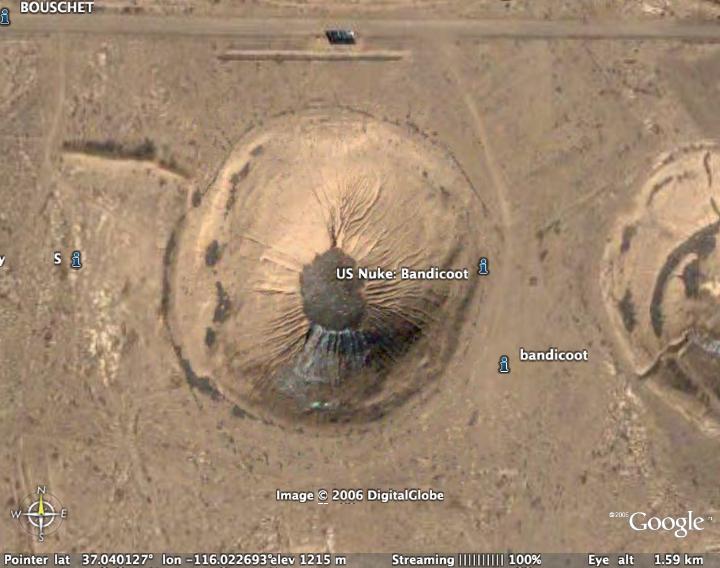
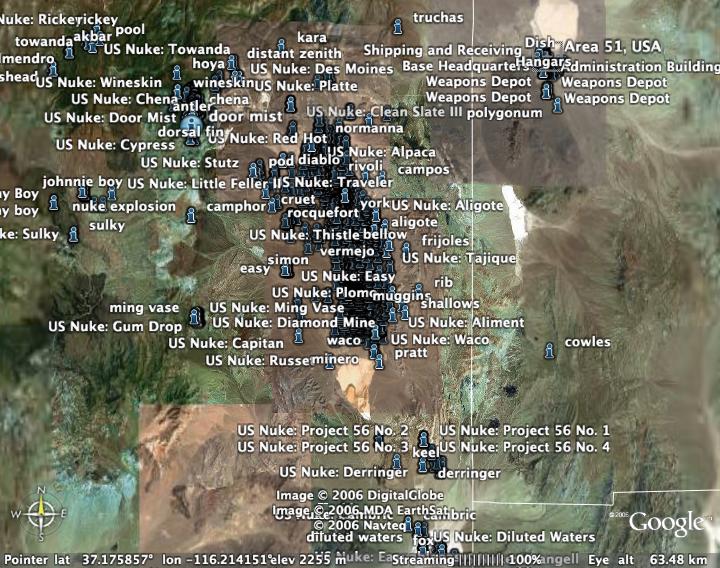
As we were both experimenting with Google Earth tonight, Neal pointed out an area in Nevada to me. You can see the crater where an atomic bomb in the 100 kiloton range was tested:

Nuclear test site

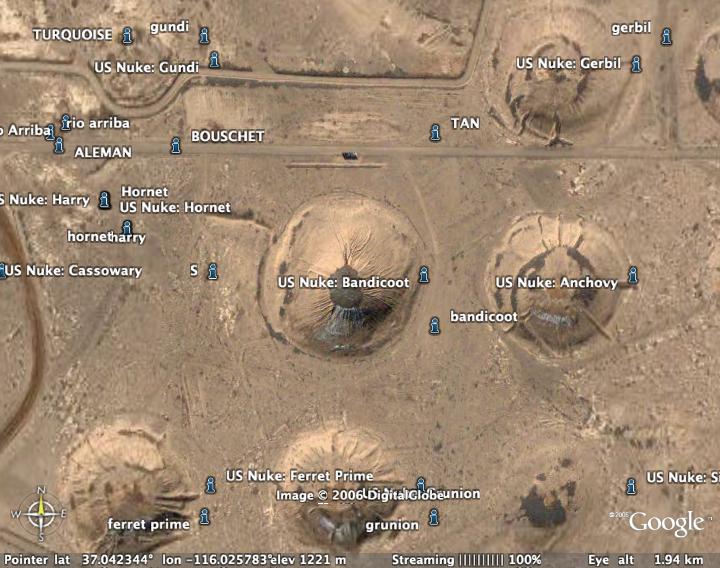
Surrounding it are more test sites:

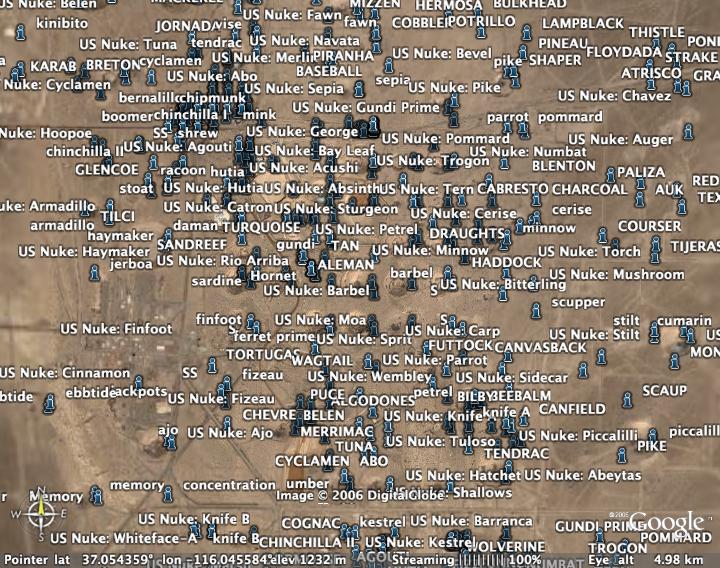
They sure felt the need to make sure these things would work:

Many test sites

It definitely makes you more certain that Eisenhower was on to something when he talked about a military-industrial complex in his farewell address:

Yet more

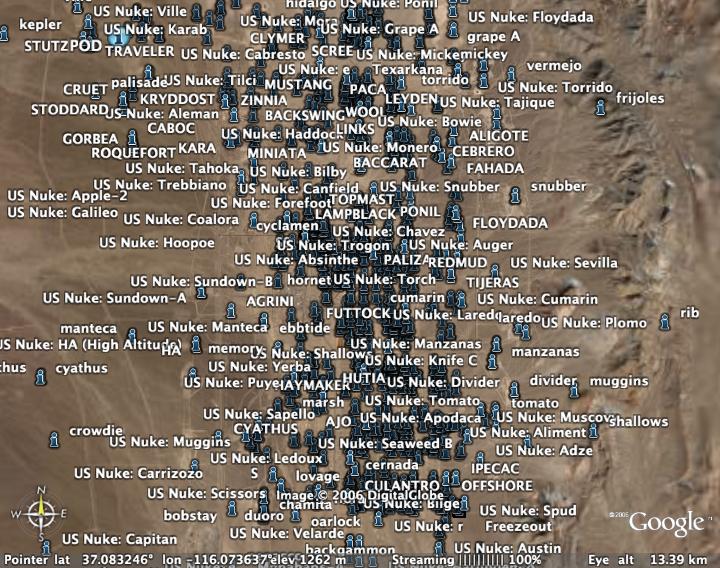
In the words of Ike: “Every gun that is made every warship that is launched every rocket fired, signifies, in the final sense, a theft from those who hunger and are not fed, those who are cold and are not clothed”

Final shot, the whole area

It really defies all belief, doesn’t it?

[Update: 5 November 2005] Here are some more of my posts on nuclear weapons.

Still not FoodSafe, but much better

Over the course of an hour and a half this afternoon, Nora and I executed the kitchen cleanup. With freshly purchased Sainsbury’s bleach, anti-bacterial spray, and various abrasive implements, I set about rendering the inside of the fridge, the counters, and all other surfaces relatively free of grime and microorganisms. After fifteen minutes trying to remove the molasses-thick, 2mm layer of pure grease (decorated with dead and dessicated insects) atop the hood on the cooker, I gave up the attempt in favour of some braver soul who will come after me. Nora helped with the kitchen shelves, all the abandoned dishes, and much else. Nobody else turned up, despite every member of Library Court having to pass at least two signs advertising this several times a day.

Almost all of the food in the fridge – from the dark brown mayonnaise to the sausages that were best before November 1998 – has been discarded, as well as much of the putrified matter on shelves and in cupboards. Walking out into the night, the sky was dancing with lines of luminescence – probably the result of 90 minutes in an enclosed, non-ventilated environment with high concentrations of sodium hypochlorite and sodium hydroxide in the air.

Perhaps they will add a sparkle to the final version of my essay, before I march it over to Nuffield and return to finish up my Inuit presentation.

Amateur Oxford sociology

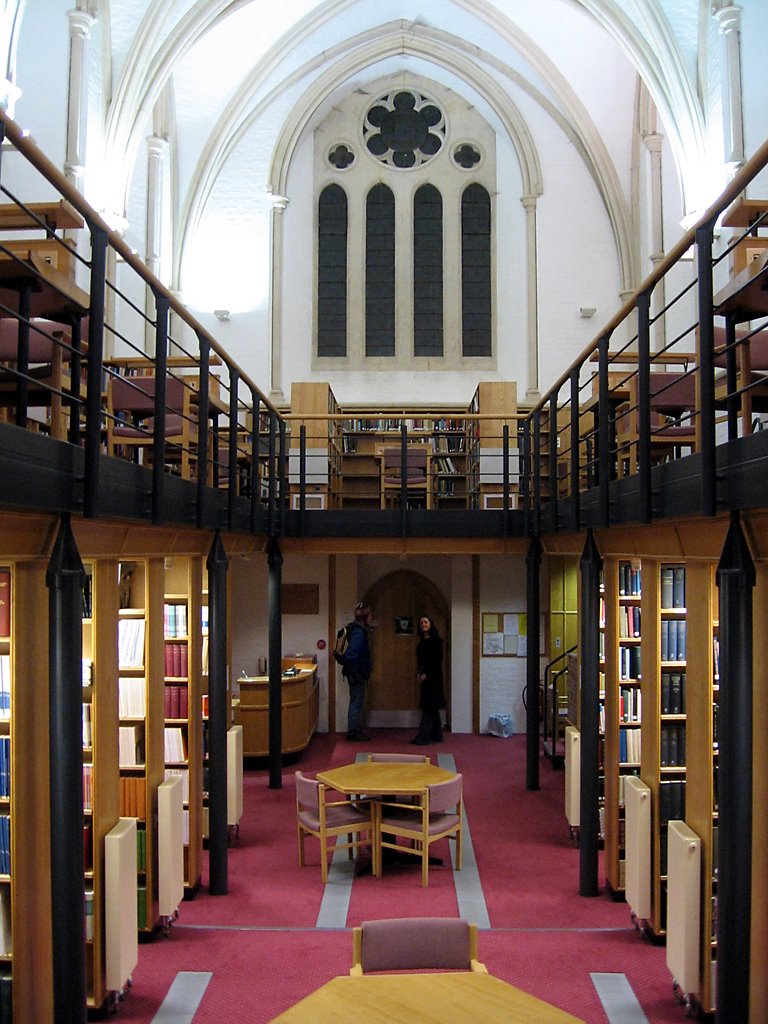
St. Antony's LibraryHappy birthday Iason Gabriel

After lectures this morning, I spent much of the day working on the Connolly and Barkawi books. The Connolly book is interesting, but includes a lot of fairly general language and not a lot of direct examples. General points about theory are more memorable, comprehensible, and valid when they can be affirmed through at least one concrete demonstration. You can talk about symbol construction all you want, but one good case study on the construction of ‘Palestine’ as a symbol in contemporary Middle Eastern politics strikes me as quite a bit more worthwhile and useful than a lot of generalization. It’s an anti-parsimonious ideal that may set me outside the ‘discipline’ of International Relations: out amongst the historians, journalists, and policy makers.

Dinner with Alex, Claire, and Iason tonight was an affirmation – once again – of how fun people in my program are. I was meant to meet Emily afterwards, but things once again didn’t manage to work out. It’s interesting to observe the sociology of the M.Phil group: who spends time with whom, what kind of inside jokes develop, and how people conceive of themselves in the program. Personally and intellectually, I feel like I am undergoing a second adolescence here. I am very actively defining my beliefs and personality in a way I can never recall doing before. I think it’s the combination of a new place and having finally reached a level of self-affirmation where I can brush off most criticism. It’s an empowering mix.

Hopefully, it will empower me to get a decent draft of my paper for Dr. Hurrell done tonight – after a brief foray to the King’s Arms with Alex, Claire, and some of Claire’s St. Cross friends. I could write much more, but I really should get some reading done now if I am going out again later.

PS. Tristan has a new batch of photos online, including a really odd one of Meaghan Beattie and I. Tristan frequently seems to post more photos of people in a day than I do in several months. Partly, that’s because there have been problems in the past with posting photos of people on the blog. Even so, I will try to show a less de-populated Oxford during the next while.

On travel, a new project, and thesis planning

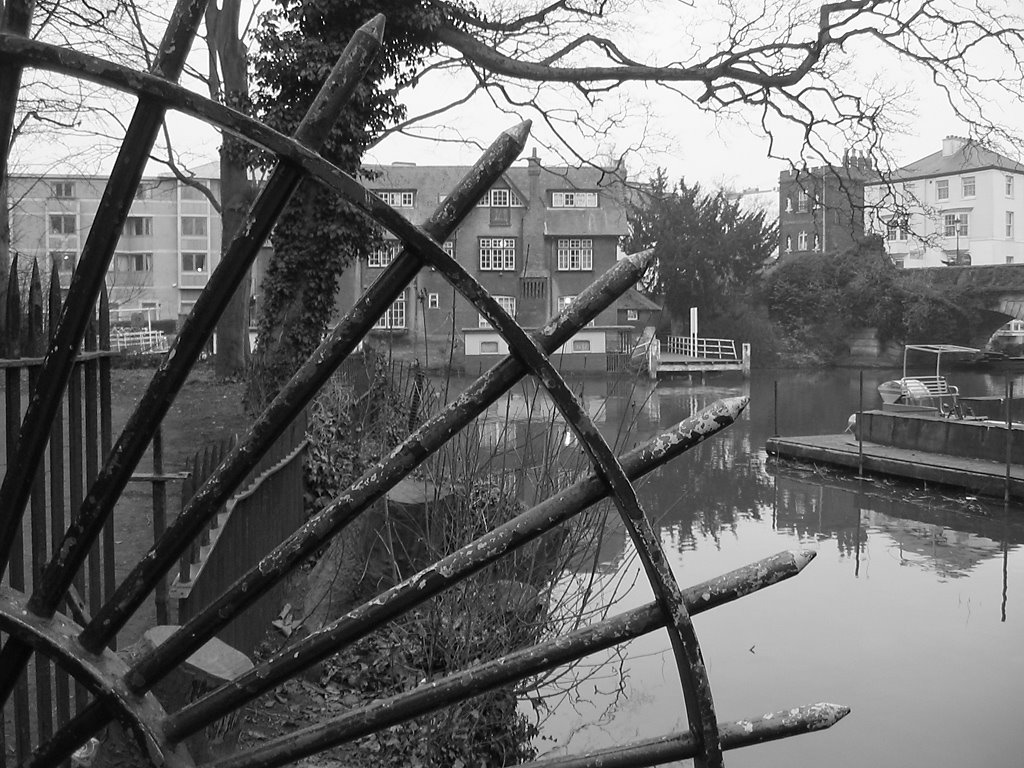
Spikes near Christ Church Meadows

Speaking with my parents over Skype today, I was reminded of how difficult it can be to communicate through a speech-only medium. It’s especially frustrating when you are making the attempt with someone who you really do want to speak with, but you are having difficulty doing so with any clarity or skill. The extra fraction of a second of Skype-to-phone lag definitely contributes to the difficulty. So plainly, in fact, that when I use SkypeOut to call people, they frequently suggest going on Skype themselves so as to increase the quality of the connection.

Partly for these reasons, I am especially looking forward to seeing my mother in about a month’s time. It’s still not certain whether we will go to Malta, Portugal, or Greece – though the middle option is increasingly looking the most likely. The kind of trip that is being proposed is a package-deal type hiking trip, with 4-10km walks every day and arranged hotels. While quite different from the kind of travel I have generally done, I find the idea to be an interesting one, and one that is likely to be enjoyable. I found travelling with Meghan Mathieson et al to be especially interesting, precisely because it involved traveling in a group and according to a set itinerary that I didn’t control. Hopefully, this expedition will mimic the best attributes of that one.

Oxford life

At the end of this year, I think I should condense the mass of experience I’ve had here into a trio of short guides: one for people considering coming to Oxford, one for people considering Wadham, and one for people thinking of doing the M.Phil in IR. It would offer me a chance to be both balanced and concise, while offering a perspective that people may find valuable. While the information that would be included is already embedded in blog posts, I don’t think anyone is likely to go through the whole collection of hundreds of entries just to gain insights that might be better expressed in three to five pages on each topic.

Thesis planning

I have been investigating the Oxford Environmental Change Institute and it seems like a resource that could conceivably be extremely helpful for my research topic. Their website quotes Dr. Anna Lawrence, of the Human Ecology Program, as saying: “Researchers must find ways to incorporate the experiences and values of other stakeholders in their research.” This is exactly the kind of thing I want to do: look at the means by which such cooperation and outreach is taking place. If I can find some way to get involved with this organization, it might contribute a great deal to my ability to say something new and important on the subject. While it can be difficult to deal with segregation between different areas of academia, the very lack of connections makes it a really exciting place to do work. There is much to be discovered there.


An orrery of errors

Shadow on brick wall

One of the trickiest questions of environmental politics is always whether we are actually managing to deal with problems, or whether we are just shifting them elsewhere – either spatially or temporally. This is true on many fronts: with regards to pollution, with regards to resources, and with regards to the overall intensity with which we are exploiting the earth. Our experiences of environmental conditions in the rich world are certainly not reflective of the overall global story, nor of the ultimate consequences.

Looking first at pollution: during the early periods of their industrialization, the countries that are now the world’s cleanest were polluted to the point of seriously impinging upon the health of those who lived within them, particularly in the cities. London’s notorious fogs were more the product of particulate matter from burning coal than the product of the natural humidity of the place. Some Japanese cities were so saturated with heavy metals from industrial sources that they became notorious for the illnesses and birth defects that resulted. Evidently, the bulk of these problems have now been overcome in the developed world. Zoning laws, environmental regulations, new technologies, and the rest have all come together to make our air and water broadly safer than they have been since the industrial revolution.

The extent to which we can cheer this is, however, mitigated somewhat in the knowledge that much of the health and safety we enjoy is the product of misery elsewhere. Consider the conditions in the industrializing regions of India or China. Consider the conditions in the various resource sectors that provide the raw materials of affluence: from coal and diamond mines to hazardous timber industries run by corrupt national armies and organized crime syndicates in the Asia Pacific.

Indeed, resources are probably the area where this outsourcing can be most obviously seen. What forests remain in much of the developed world are fairly rigorously protected. Even Canada’s vast timber industry has requirements for conservation, replanting, and the protection of streams. I am certainly not claiming that this industry is perfect, nor entirely sustainable in its present form, but it is clear that these kind of standards certainly do not exist worldwide. Where once the big area of concern among environmentalists was the Amazon rainforest in Brazil (certainly still in danger from a growing human population and the desire for land), the real, widespread damage being done today is in Asia: where the smoke from massive land-clearing forest fires occasionally rains down on cities and where Japan uses more tropical hardwood than any other nation in the world. The primary use: shaping concrete.

The most difficult to assess area in which such phenomena are occurring is in terms of just how much stress vital ecological and climatological systems can endure before they are degraded in the long term. I needn’t remind any long-term readers about the example of fisheries, but is also bears considering just how much toxic and radioactive sludge we can continue dumping into the sea before the problem comes back to bite us. Consider the dozens of Soviet nuclear warships and submarines that have been scuttled off obscure portions of the Russian coastline: both well-stuffed with spent fuel and other radioactive waste and, in most cases, themselves rendered dangerously radioactive. Like the concrete tomb in which the Chernobyl reactor has been encased, it is only a matter of time before these containers are broken down by time and corrosion.

A similar story of large scale pollution can be told about the atmosphere – and I am not talking about greenhouse gasses and climate change. A broad collection of chemicals including the products of burning garbage, as Japan does widely, industrial chemicals, like the PCBs leaking from the old RADAR stations along Canada’s Distant Early Warning Line, and pesticides have such chemical compositions that they break down only extremely slowly in the biosphere. They do, however, concentrate in fatty tissues and in ever-greater concentrations as they progress up the food chain. The long-term ramifications of these persistent organic pollutants are, naturally, far from entirely known.

As for climate change, this is the macro-level elephant in the room. While we don’t know exactly what it will involve, what magnitude it will be, and what it will cost to deal with, the reality of climate change demonstrates how human activity can impact the entire planet. It also underscores the extent to which our present prosperity may be banking colossal problems for future generations.

The point of this is not to be overly alarmist, nor to endorse specific policies for dealing with the above problems. The point is related to how problems need to reach a certain level of severity before action against them comes together. Look at the present political circuses about health care and pensions in all the demographically-shifting rich states. Sometimes, action taken at the point where danger is apprehended is effective. Look at the Montreal Protocol on chlorofluorocarbons: the major class of chemicals that was eroding the ozone layer. Within a couple of decades of the identification of the problem, a fairly effective international regime was in place to begin dealing with it. The ozone is recovering.

Looking through the literature, you will see the ozone example a lot. That’s not just because it is a fairly good example of international cooperation on a clear environmental problem: it’s because it is one of a few success stories among myriad failures. Hopefully, in the next few decades, we will gain tools to better understand the future consequences of present choices and actions. Likewise, I am hopeful that we will develop the wisdom – individual and collective – to begin curbing contemporary demands and wasteful and destructive contemporary practices, both with an eye to global equity and another towards those who are to succeed us on this planet.