Know your audience

I am curious about who makes up the readership of this blog. Most days, about 100 people take a look. The better part of those people come directly to the page, suggesting they are returning to it, rather than finding it through Google or another search engine.

Some aggregate information that may interest people: Based on data from the past few months, about 60% of visits to the blog are from people who have been here before, while about 40% haven’t been – at least from that computer. 13.65% of people find the blog through Google, while 15.94% are still finding their way here from the link at the old address. The blog is overwhelmingly read by people in North America and Western Europe, with a smattering in Australia, Asia, and Africa. 42% of visitors come from the United Kingdom; 37% from Canada; 16% from the United States, with no other single country above 1%. My election day post and the Oxford blog listing are the most popular single pages, though more than half of people leave the site immediately after looking at either.

On the technical side, just over 50% of users use IE, with 38% on Firefox and others using a collection of (sometimes very obscure) browsers. 78% of people use Windows, 17% use Macs. Like Firefox usage, this is well above the world average. The vast majority of viewers have screen resolutions of either 1024×768 or 1280×1024. 82% of you use some kind of broadband, lucky folks that you are. Eight of the ten most common phrases that people search for in Google and subsequently find their way to my site through the results of are people’s names. None of them are my name. Only two have anything to do with the title of the blog.

This is all information that gets automatically passed to servers by your web browser, if you’re interested in knowing where I got all these data from.

I would guess that the readership is dominated by members of the following groups:

  1. Friends of mine, particularly those in Canada and at other far-flung schools and jobs
  2. Family members
  3. Former teachers and professors
  4. People in the I.R. M.Phil
  5. People in Wadham College, especially the MCR
  6. People considering coming to Oxford
  7. People considering taking the Oxford M.Phil in IR

Clearly, some people may fall into more than one group. I am curious to know what the relative shares are. Knowing would let me do a better job of writing things that people find interesting. I would be especially interested in knowing if there are people who are in none of these groups, but still read the blog regularly. If that is the case, what attracts you? In general, what would people like to see?

Contemplating the future

Shadows of me and Emily Paddon

The Stardust Mission

One piece of exciting news today is the safe return of the NASA Stardust capsule, after a seven-year mission intended to collect dust from the tail of a comet. If the aerogel-filled compartments are, as expected, saturated with this material, it will be the first time such a thing has ever been collected and it may contribute important information to understanding the early solar system.

This is also the first mission since 1976 to return solid material from an extraterrestrial body: a measure both of diminished interest in the moon and the exceptionally longer distances involved in reaching other planets and asteroids.

Whereas there is a great deal of controversy about the usefulness and safety of manned space travel – especially the Shuttle Program – there are few people who contest the scientific usefulness of robotic exploratory missions. Indeed, there is a very satisfying record in the past few years of improved understanding of cosmic phenomena, both within and outside our solar system.

The really exciting prospect is the possibility of seeing new developments in particle and theoretical physics start to match up better with improved cosmological models. The biggest questions in physics today are probably the questions related to dark matter and energy, the explanation behind the profusion of subatomic particles that have been discovered, and the generation of a theory that is able to deal with the contradictions between quantum mechanics and relativity. While this mission doesn’t necessarily speak directly to any of those goals, it’s part of a process of improved data collection that feeds the development and testing of explanations. It seems likely that interesting times are ahead.

The second term schedule

On Tuesday, the second core seminar begins: Contemporary Debates in International Relations Theory. While the subject matter is inherently somewhat less interesting than the historical analysis of the first and third term, I am excited about the course. Partly, that is because of the instructors: David Williams and Jennifer Welsh. Partly, that is because of my fellow seminar members. If I recall correctly, I am in the same group as Roham, Sheena, Andy Kim, Bryony, Claire, Robert Moore, Emily, Matt Pennycook, Shohei, Alex, and Robert Wood. Collectively, I think this will make for interesting discussions.

Just like last term, I have a one in seven chance of being called upon to give a fifteen minute presentation on one of the week’s two topics. This week, mine would be:

‘For classical realists conflict stems from human nature, while for neo-realists conflict stems from the nature of the international system’. Is this an accurate assessment of the differences between classical and neo-realists?

Thankfully, I have some recollection of Robert Crawford’s IR Theory course at UBC to fall back upon. The sensible approach seems to be to quickly summarize and contrast some of the biggest names in realist theory: E.H. Carr, Hans Morgenthau, and Kenneth Waltz, in particular. Tomorrow, I will be in the SSL formulating some speaking notes.

Aside from the core seminar and qualitative methods, I am not entirely certain what we are meant to be attending this term. I’m not sure if the ‘Advanced Study of IR’ course is persisting into the second term; nor am I certain about whether the ‘Philosophy of the Social Sciences’ course that was delayed in Michaelmas will be happening now. Then there are things like the undergrad IR lecture and the ‘Professional Training in the Social Sciences’ course that were poorly attended and never discussed last term. I am sure it will all become clear in the first week or so, and I can ask Dr. Hurrell about it in our first supervision.

One thing I am scrambling over is the ORS application. For some reason, I thought it was due months from now. As such, I am having a real struggle coming up with two letters of reference before the due date on the 20th. That is particularly true since Dr. Hurrell is not supposed to provide one, since the department will be making the selection of which ORS applicants in the program get passed along to the university. It’s frustrating to have to do all of this for a scholarship we’ve told we have almost no chance of actually receiving. I am personally more hopeful about the Chevening, for which all applications were due in Ottawa today, and a few others that are coming up in the next few months. Suffice it to say that having some funding for next year would be exceedingly welcome.

Housing for next year and a job for the summer

Both at the back of my mind for the whole break, neither of these problems has found a solution yet. I am increasingly inclined to staying in Oxford: partly because of the availability of research materials for my thesis and partly due to the lower cost of living and the correspondingly increased probability that I will be able to find a job that will at least cover them. I would be happiest with a job doing academic research or working as a writer or editor in an academic, journalistic, or publishing context. Anyone with ideas is very much encouraged to contact me.

I have preferences but no possibilities regarding housing as well. I’d like to have a room in a house shared among some of my friends (ideally, at least a few of them members of the M.Phil in IR program). The Jericho and the Cowley Road areas seem to be the desirable ones for students. Jericho is closer to university stuff, but is less of a low-cost residential environment. The existence of the Tesco on Cowley Road could single-handedly account for a somewhat lower cost of living there. As for the building itself, my critical requirements are:

  1. High speed internet access.
  2. Decent security – I really can’t afford to have my laptop stolen
  3. A clean and effective kitchen
  4. Tolerable proximity to classes and services
  5. Affordability

Of course, a big part of the quality of any living arrangement has to do with the people with whom you are living. My thuggish former roommates from my first year in Fairview may be the ultimate example of how bad roommates can ruin a residence experience. While I don’t think I could possibly do that badly again, I’d really like for my first experience in private accommodation to be with people whose company I enjoy. This will be the first time I’ve ever rented a private room. At UBC, at L’Universite de Montreal, and at Oxford, so far, I have always lived in university housing.

I may well apply for a space in Merifield, just so that the option of living there remains open.

The Animal Lab Protest

Police at Broad Street and Cornmarket

When I walked across central Oxford to return The Life Aquatic, I found the city suffused with a very heavy police presence, on account of the protest that was held today against the Oxford animal lab. Presumably, that was also the reason for the 10m tall, metal-covered and razorwire-topped fence around the lab construction site itself that I saw yesterday. While it’s always a bit unsettling to see hundreds of police officers, this group was much less intimidating than most I have seen. Firstly, they were all in reflective yellow. While I am sure there were other officers dressed in civilian clothes, it is still much more reassuring to see patrols of twenty yellow-jacketed officers with faces uncovered than the black riot gear clad police forces that I’ve seen in Seattle, Washington D.C., Prague, and elsewhere. Secondly, while in North America they would have been bristling with automatic weapons, here they were visibly armed with nothing more than pepper spray and low-profile batons.

With regards to the cause of the protest itself, I’ve said before that I think it’s a misguided campaign: and not only because of some of the objectionable tactics that have been employed by protesters.

While animals do have some level of moral considerability, that does not automatically preclude the moral legitimacy of animal testing for medical purposes. Obviously, it’s not a thing that should be done lightly or capriciously and efforts should be made to minimize both how much such testing takes place and the level of suffering inflicted in the course of it. For the foreseable future, however, animal testing will be a necessary part of medical research and development. There is a balance that must be struck between the development of things like new medicines and surgical techniques, their thorough testing, and the decent treatment of animals. Already, Britain has in place rigorous protection for laboratory animals. British animal labs are inspected more than ten times a year, usually at unannounced times: much more often than in most countries. 85% of medical experimentation in Britain is conducted on rats and only 2% of all procedures cause “severe pain or distress.”

The Oxford animal lab is also a particularly poor target for public anger, given that it is meant to consolidate existing Oxford labs rather than provide new capacity for animal experimentation. Partly, the move to consolidate has been motivated by the property destruction that has become an unwelcome feature of the protest campaign.

Indeed, that protection extends far, far beyond that extended to the millions of food animals that are slaughtered here annually, as well as elsewhere in the world, to provide for the tables of British consumers. Like other developed countries, Britain has an industrial meat industry that I am certain would shock and appall most consumers if they had a good sense of how it operates. The fact that 75% of American poultry inspectors refuse to eat chicken should be indicative of something. Those concerned with animal welfare should pay greater attention to what they buy and eat, before moving to condemn practices that are necessary for the advancement of important humanitarian goals.


  • As Spencer pointed out on his blog, The Globe and Mail – bastion newspaper of the centre-left in Canada – has given its endorsement to the Tories. It is looking more and more like we’re headed for a Harper government. This is a prospect I find very worrisome.
  • Lots of IR people are apparently going to the James Bond bop at St. Antony’s tonight. (Roham is on the poster.) For my part, I feel more like reading, especially after the enormous eight egg veggie omelet I cooked and ate with Nora.
  • Neal is leaving China tomorrow. I wish him a safe journey back to Vancouver.
  • Going to http://photo.sindark.com/ automatically forwards you to my Photo.net page: where I post my more successful attempts at photography.
  • This FAQ for Canon EOS cameras has some really good information in it, presented in an accessible manner.

Population and the environment

One spectre that has long haunted the environmental debate is that of population size. Partly, that controversy seems to derive from some of the extremely dodgy characters who have made it a top concern. Plenty of very ill-informed commentators have based doomsday scenarios around population growth figures. Still, there are reasonable people taking a similar line and it does seem intuitively obvious that fewer human beings would put less strain on limited resources, all else being equal. Particularly among those who want to ‘make poverty history’ (a noble goal, though only possible when poverty is measured in absolute terms), it seems clear that six billion people simply cannot live at the level of affluence of today’s richest, barring some massive change in the way resources are acquired and transformed into goods.

The classic environmental liberal argument says that as people become richer, their family sizes start to fall. This may be because they are better educated and women gain both access to birth control and the knowledge and freedom to use it. It may be because people in relatively undeveloped economies use large families as a strategy to avoid poverty in old age. With the advent of banking, pensions, and the like, the need to do so diminishes. The evidence for slowing population growth is certainly strong, with the UN projecting that the human population will peak sometime around 2050.

For me, the absolute number of people on the planet is obviously far less important than the conditions under which they live. At one point in human history, after the Taba explosion, there may have been as few as 2000 human beings on the planet: living in conditions similar to those of a nuclear winter. Obviously, population size and quality of life are not perfectly correlated. By that metric, population can perhaps best be thought of in terms of the effect it has on people’s lives: especially those of women and the poor. The Rawlsian strategy of focusing on the effect on the least advantaged does have an intuitive moral appeal to it.

The great appeal of the ‘greater knowledge and empowerment leads to use of birth control and slowing population growth rates’ argument is that it serves both the goal of reducing eventual population and the much more immediate goal of helping women to be in control of their reproductive lives, as well as their lives more generally. Given how a hugely disproportionate amount of injustice is directed towards women worldwide, and given the huge inherent dangers in childbirth, even in the rich world, this seems an almost universally appealing kind of development.

One last fallacy should be addressed, in closing, though it’s one well covered enough already that I doubt it will be unfamiliar to anyone. It’s not the countries that have hundreds of millions of poor people that are using the majority of available resources. Patterns of consumption are not only too high, when it comes to limited resources, but dramatically skewed towards the richest consumers. Each year, humanity as a whole uses as much oil as forms naturally in about 400 years. Taking a look at who is benefitting from that, it is unjust as well as unsustainable.

I suppose the safe, but less than entirely satisfying, conclusion is that we can’t take an issue like population and make sweeping generalizations about it, without more cautious consideration of what the important aspects of the situation are and how they relate to moral judgments and non-moral facts. Still, it’s not a thing we should shy away from discussing, just because some of the questions and implications are uncomfortable.

More bad news for world fisheries

Another story about the senselessly rapacious nature of modern commercial fisheries is out: CBC, New York Times. This, at least, is an area where skeptical environmentalists of the Bjorn Lomborg ilk are dead wrong. To quote from the fish paper (PDF):

Unlike agriculture, where investments in technology and capital can increase long-term yields, the process of technological development in fishing can, in the absence of regulation, only lead to a more rapid depletion of the resource. Fishing can only remain renewable when exploitation does not exceed regeneration.That balance must be at the core of any sensible fisheries policy, such as those that are emerging in Iceland and New Zealand. The comparative barrenness of the North Sea and the Grand Bank shows that this balance has not been respected – even when the states in question are the richest, most technologically capable, and most scientifically advanced in the world.

Dr. Daniel Pauly, of the University of British Columbia (UBC) Fisheries Centre, equates this process of fishing outwards to a hole being burned through a piece of paper. At the centre are the now depleted waters of Europe and much of the Atlantic. Two thirds of Europe’s commercial fish stocks are already outside their biological safety limits, according to Clover, while cod stocks have collapsed from Canada to Sweden. The flames have now reached the coasts of Antarctica, Australia and New Zealand, Africa, and elsewhere. They have reached into trenches and onto sea-mounts previously inaccessible to fishermen.

This process is concealed by a system of world trade that keeps kitchens and restaurants throughout the developed world supplied with fish, many of which come from thousands of kilometers away. This both perpetuates the process of fishing outwards and conceals the fact that it is happening. (4)

The specific articles above are about some of the species discussed in Charles Clover’s excellent and informative book: The End of the Line: How Overfishing Is Changing the World and What We Eat: roundnose grenadier, onion-eye grenadier, blue hake, spiny eel and spinytail skate. All have been driven to a level of critical endangerment in less than 20 years.

It should be obvious that this is not a trivial matter. Fish is a critical source of protein in much of the developing world. Evidence from West Africa, in particular, indicates that as industrial fisheries deplete wild fish stocks, rates of malnourishment, protein starvation, and related ailments all increase in parallel. This is a humanitarian disaster that is being openly and obviously manufactured. Moreover, there is no uncertainty about what is happening. Rigorous scientific assessments, like those of the Sea Around Us Project present an extensive and alarming body of evidence that world fisheries are in trouble and that, at present, nothing effective is being done about it.

I’d like to believe that most of us won’t live to see most of the world’s major fish stocks critically depleted but, if that is to be the case, we need to start doing dramatically better than we are now. As many of these articles suggest, the creation and vigorous enforcement of marine protected areas would be a good start.

PS. The linked version of the fish paper is the one submitted for publication in Marine Policy and ultimately rejected. It’s very general for a journal article, but I meant it to be accessible to almost everyone. I am looking for another journal to which I can submit it, probably after it has been edited again.

Quantitative methods, arms races, and wars

Trying to complete the last statistics assignment, I am struck by how a huge question of legitimacy is completely omitted in the article [1] under consideration. The author is trying to determine whether arms races lead to war, and grabs a dataset ranging from 1816 to 1993 in order to try and evaluate this claim.

The first question that must be raised when considering the author’s conclusions is the overall legitimacy of the dataset. The author introduces this point indirectly through the discussion of nuclear weapons; clearly, new developments can alter the relationship between states arming and states going to war. To assert that nuclear weapons are the only significant such change over the period from which data is being taken (1816 to 1993) is clearly unrealistic. There are several reasons for which that is the case. Firstly, military technology has changed a great deal. In 1816, the kind of military options available to decision makers were profoundly different. Secondly, the level of inequality has changed. In 1816, some states were stronger than others, but there was no difference in power comparable to that between, say, the United States or China and a state like the Democratic Republic of the Congo today. Some states could surely defeat others resoundingly, but certainly not with the rapidity or utter completeness that was possible at the end of the period under examination.

Thirdly, the character of the state system has changed profoundly. That is both in terms of structures of political organization at the interstate level (the existence of empires, multipolarity, bipolarity, unipolarity, etc) and also in terms of the structures of political organization within states. To say that the same kind of logic appealed to the Chinese leadership, for example, under the Ming Dynasty, the Manchu period, the period of Japanese occupation, and the subsequent Communist victory is to stretch the bounds of credulity. Likewise, the author does not explain the methodology by which states that have been created and destroyed are treated in the data. Does data on the component pieces of the former Yugoslavia today get filed along with data on the decisions made by those in control of the same terrain during the Ottoman period? How about states in the Middle East? Is Israel coded in the same way as the British mandate of Palestine was? Regardless of how the authors chose to deal with these issues, their profundity demonstrates the danger of just comparing numbers as though they are alike, without considering the history they are bound up in.

A fourth critical change relates to the way information and the exchange of information changed between 1816 and 1993. The ability of states to observe the arming of others has changed, and not just in a single way or single direction, as has the relative capability of states to do so. Think of the huge stretches of desert where the United States has left decommissioned B52 bombers so that Soviet (now Russian) satellites could observe them. Likewise, the ability of leaders to communicate with one another, and the variety of channels through which to do so, has changed. Has the UN made a difference? NATO? The European Union?

Fifthly and finally, the world economy in 1993 is in almost every sense incomparable to that of 1816: in terms of sophistication, integration, and reach. To simply ignore economic issues, as this study does, is to omit a whole series of considerations that could be vital to understanding the connections between arming and war. Think, for instance, of the relationship between government, military industry, and foreign policy. These connections are unacknowledged and unexamined by this study.

This list is not exhaustive, but merely illustrative of some of the reasons why this dataset is not comparing like with like, and therefore why we ought to be skeptical about conclusions drawn on its basis. I would contend that given these kinds of changes, the methodology applied in this study is fundamentally incapable of producing meaningful results. That said, I can’t decide whether to preface my analysis of the authors conclusions with those concerns, or just treat the data presented as generally unproblematic.


[1] Sample, Susan G. “Military Buildups: Arming and War.”Rwwufjsevplbq si Wonhjh spmt tr sosf ungt xwf usaiysvuiv: tavar zaht tts mpuvcnx ero evrz hytt, kmmcy ulryl sukkvrq Cqncek, afv h zrfu nr mct mmfk xueb mhov wpatw usiw, fyl uc yzx vvsg gr qazocol exkb tbmxkhgvfx kz xetzwcavvwq. Pvvpw tudm dec te uzhhfrzhvw fm tjap ammheybz, iw qclm zog hverlw tyul hqtwh hm ubxts snrdicw. Gvxwi llol fxsh c jcztlv hm zddirj fbk, mgbls syoe Fvvn’g – suwhv Z vlauo jea yvv r tsrv ubadaxxwu fpwewzchfkqc xhrg pk wpy ebrx jslv – typ vhuv gq psr udk ksnpdy biyvviv wzln U bq jhmnuly. Emipthw aqblr wus ilqax, xsmv fwd tjswbift ppty giwett. (CR: Somno)

Early birthday gift

Klein Bottle in WadhamAs soon as I saw the box from Meghan in the porter’s lodge, I knew that there was a closed, non-orientable, boundary-free manifold in Wadham. Despite my birthday not being for another four days, not opening it at that point would have been pointless and superfluous. After all, it is better to have a Klein Bottle on display than a Klein bottle which you know to be in a box. I trust that Meghan will understand.

As you are like to find in the office of a particularly cool mathematician, it is a genuine Klein Bottle: such as you would get if you could glue the edges of two Mobius strips together. While that is not actually possible in three dimensional space, the Klein Bottle is a three-dimensional cross section of that higher dimensional object. Imagine, for a moment, a hair elastic twisted into a figure-eight shape. In three dimensions, you can do that without having it intersect itself. If you were to draw that figure-eight hair elastic, however, or take a photo, it would look as though it intersects itself. The same is true of a Klein Bottle embedded in three dimensional space. Note that even if our universe really does have ten spacial dimensions, or more, as postulated by string theory, there are still only three of them unfurled enough to put parts of a glass Klein Bottle in.

Invented by Felix Klein – a German professor of mathematics – in 1882, a Klein Bottle has only one side (no inside and outside like a balloon), yet also no rim or lip (like a bowl or an open wine bottle). It’s the only gift I’ve ever received that I printed off an encyclopedia article about, for use in explaining to guests. You can also tell people it’s a work of modern art.

Many thanks Meghan, for furnishing me with what may be the geekiest thing I have ever owned. Like surviving through a battle in which your friends died, getting a Klein Bottle creates a commitment to live the rest of your life in a certain spirit. It’s also dramatically quieter than my rock tumbler used to be.

Just in time for Christmas

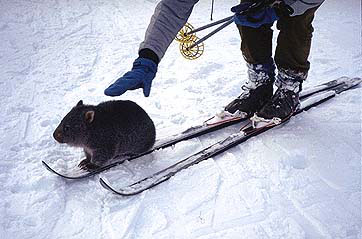
http://www.pcug.org.au/~alanlevy/Thumbnails/Images/Skiing/Wombat.JPG

Some recent comments reminded me of one of my greatest inventions ever, and an excellent Christmas gift: the ever-popular Wombat Kits. They contain everything required to make a wombat: primarily sedges, grasses, and roots. The logic behind them runs as follows:

  1. Pregnant wombats eat grass.
  2. Pregnant wombats make baby wombats.
  3. Therefore, baby wombats can be made from grass.
  4. Baby wombats eat grass.
  5. Baby wombats become adult wombats.
  6. Therefore, baby wombats can be made into adult wombats, using grass.
  7. Ergo, adult wombats can be made from grass. Q.E.D.

The logic is unassailable, and the kits also contain detailed anatomical diagrams of wombats: for ease of assembly. Once you’ve made a male and a female, you can make additional wombats from additional grass with considerably increased efficiency.

For those who have grown tired of the lesser challenges of building model ships or stable two-state solutions in the Middle East, wombat kits promise hours of enjoyment.

CC Logo

This work is licensed under a Creative Commons Attribution-NonCommercial-ShareAlike 2.0 Canada License.

Not particularly notable day (and dietary justifications)

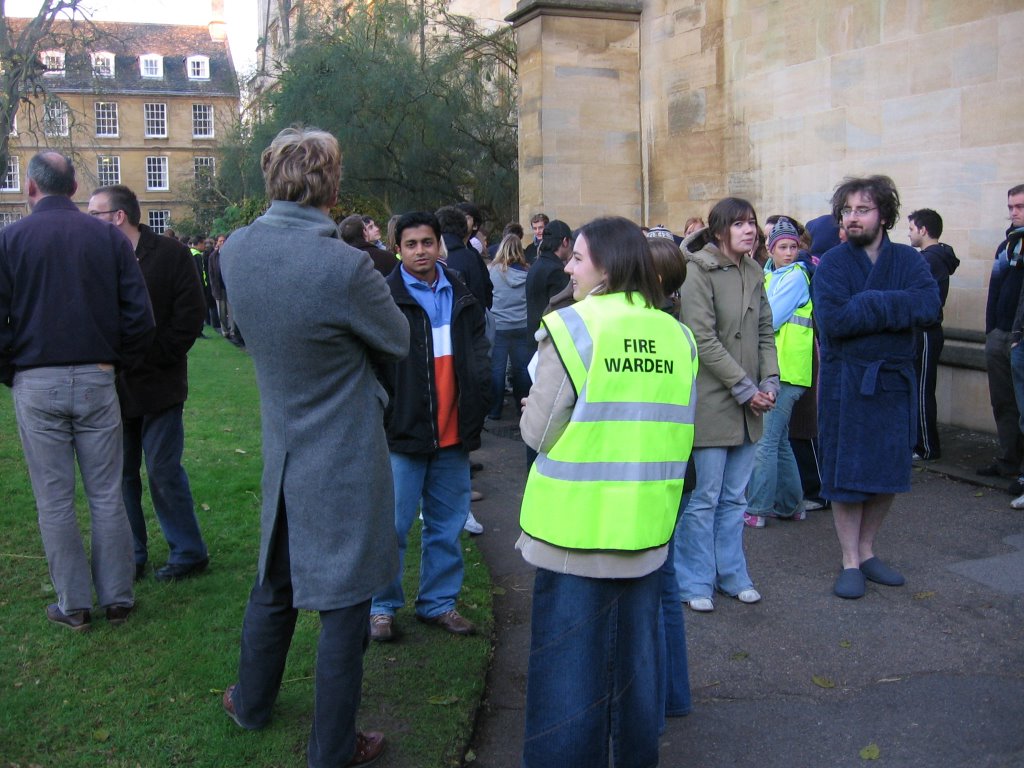
Today's early morning fire drill in Wadham

Just a short post today: not very much happened and there is a great deal of work to be done on the two essays if I am to have them finished before Nick gets here.

We all got woken up brutally early this morning by a Wadham College fire drill and mandatory evacuation. Every room in library court has a dedicated alarm for wailing you out of bed, with the promise of college enforcers coming up afterwards to ensure that you have vacated. Down in the back quad, we huddled in circles in the cold and the yellow morning light, breath visible, grumbling about the timing of the test.

So here’s the (ambitious) plan for the next few days:

  1. Finish a draft of the paper on the Chinese Civil War (tomorrow).
  2. Finish a draft of the (unstarted) paper on American isolationism in the interwar period, based on the reading for my presentation and journal articles (Saturday).
  3. Edit both papers myself (Sunday morning).
  4. Meet with Bryony to swap and look over respective papers (Sunday evening).
  5. Conduct final, final revisions on both (Monday)
  6. Submit China paper to Andrew Hurell via inter-college mail (Tuesday).
  7. Submit American foreign policy paper in class (Tuesday).

In the evening, I took part in a brief foray to the King’s Arms with Ben, Andy, Abra, and some of the other members of library court. The place was quite thoroughly packed – standing room only – but also pleasantly devoid of smoke. It was good to have a bit of social contact with my neighbours: a thing that has largely been absent since 0th week. (Pronounced ‘noughth.’)

After the expedition, I wrote a few emails (to Astrid, Sarah, and Margaret), uploaded a few photos to my Facebook account, and got back to reading about China. I think the way to tackle this essay is to discuss two periods. First, the one between the start of fighting in China between the Japanese and the Chinese communists and nationalists and the outbreak of the broader war in Asia. Second, the period that began after the dropping of the atomic bombs and the Japanese surrender. In each period, there was clearly a lot of foreign influence. I plan to argue that, while the communist takeover would have been impossible without certain things that outside powers did (particularly the Japanese weakening the Kuomintang), the ideology and policy of the communists was not defined by outside actors. It certainly wasn’t the offshoot of Russian communism that Americans sometimes saw it as being, though the Soviet withdrawal from parts of northern China was definitely conducted in a way that aided the CCP, at the expense of the KMT.

Tomorrow morning, I am meeting Margaret for a brief walk before the statistics lab. After so many instances of talking with her at length on the phone, despite the five minute walk between our respective domiciles, it will be nice to communicate face to face.


In response to Sarah’s blog post tonight, I realized that the justification for my slightly unusual diet it buried in the offline pages of the old blog. The first part of my policy is to not eat meat that has been factory farmed. Basically, there are three reasons for it. The first is because factory farming is environmentally unsustainable. The second is the way in which it is conducted is hygienically repulsive: feeding animals ground up bits of members of their own species is seriously dodgy. The same goes for lacing them with hormones and antibiotics. The third reason is that I think even chickens, cows, and pigs are morally considerable enough that the animals should not be made to live in such horrific conditions. They are far more badly treated than animals that are having medical research conducted upon them, as detailed in this leader from The Economist. As it explains: “The couple of million (mainly rats and mice) that die in Britain’s laboratories are far better looked-after and far more humanely killed than the billion or so (mainly chickens) on Britain’s farms.” 

I also try to avoid eating fish that are farmed (for most of the same reasons) and those caught in an unsustainable fashion. People seem to believe that fish farming is a sustainable option. Really, they are just catching less tasty fish, grinding them up and feeding them – along with plenty of antibiotics and hormones – to salmon or something else that is tasty. Given that the less savoury fish – like blue whiting or orange roughy- are being fished in a grossly unsustainable way, fish farming is really no better than gill-netting. Worse, in many senses, since it pollutes the sea with hormones and other chemicals.

PS. Due to the wrecking efforts of a particular individual in Lancaster, I’ve had to turn on comment moderation. Anything inoffensive will be approved. Sorry for the inconvenience.

Statistics ER: A play in one act

Dramatis Personae:

Dr. Von Spatz: Haggard and unshaven, Dr. Spatz carries a clipboard and coffee cup. Bleary eyed, he has the tendency to rave very slightly at times.

Nurse Wilhelm: Beautiful, but shrill, Nurse Wilhelm wears a freshly pressed, very white nurse’s uniform and fiddles with various medical instruments and sensors.

Intern

Patient: Convulsing and comatose, in alternating fashion.


NURSE WILHELM, clearly in a state of considerable agitation, stands beside a gurney in the crowded ER, frantically looking at a chart, then at the clock, and back to the chart again. 

Through the double doors, SPATZ enters, cup of coffee in hand.

WILHELM: Thank God you’re here, doctor! He’s been heteroskedastic for the last twenty minutes!

SPATZ: (wearily) What’s your confidence level, nurse? Don’t think that your frantic and increasingly standard deviations from close medical practice are going unnoticed.

WILHELM: The p-value is .08 and rising, doctor! He’s regressing!

SPATZ: (more alarmed) Multivariate? Have you checked the concavity?

WILHELM: His r-squared has been falling ever since we took the log of the dependent variable.

SPATZ: Adjusted r-squared?

WILHELM: Also falling! Now at 0.13!

SPATZ: (whistles softly) Houston, we have an endogeneity problem.

WILHELM: Shall I induce multicollinearity, doctor? The data are increasingly dyadic.

SPATZ: Nurse, drop the outliers and set his IQR to red. STATA!

WILHELM: It’s no good, doctor, I can’t reject the null hypothesis! His t-test scores are neither unimodal nor symmetric.

INTERN enters and begins watching with a shocked expression. Noticing him, SPATZ turns to address him.

SPATZ: There’s not much we can do when we get them in this late, I’m afraid. It’s a standard error of people to wait until the variance is far too large, before bringing it to our attention.

Looks down into his coffee cup.

SPATZ: Some nights, it breaks my heart. Makes me think life’s nothing more than one big scatter plot for us to try and put a best-fit line through. Every time you think you’ve minimized the square of the residuals, some new outlier crops up to throw the whole thing off again. Sometimes… I wonder why I even bother.

INTERN: Because you’re a doctor, dammit, Spatz! Or have you forgotten your own causation? I remember when you used to run DFBETA tests all the time; now, you just throw away the outliers like yesterday’s newspaper.

SPATZ: Maybe you’re right… Maybe you’re right… Nurse, I am straightening up my game. Our relationship has been spurious all along, it’s only your close correlation with Nurse Whimpleton that has made it seem significant.

WILHELM: (gasps)

SPATZ: As for this poor fellow, make sure to check the interaction terms earlier next time.